
Azodicarbonamide Market Expands with Industrial Demand in Plastics, Rubber, and Packaging
Growing applications in foamed plastics, construction materials, and rubber manufacturing are expected to drive the azodicarbonamide market from US$ 1.72 billion in 2025 to US$ 2.67 billion by 2034, at a CAGR of 5.02% from 2026 to 2034.

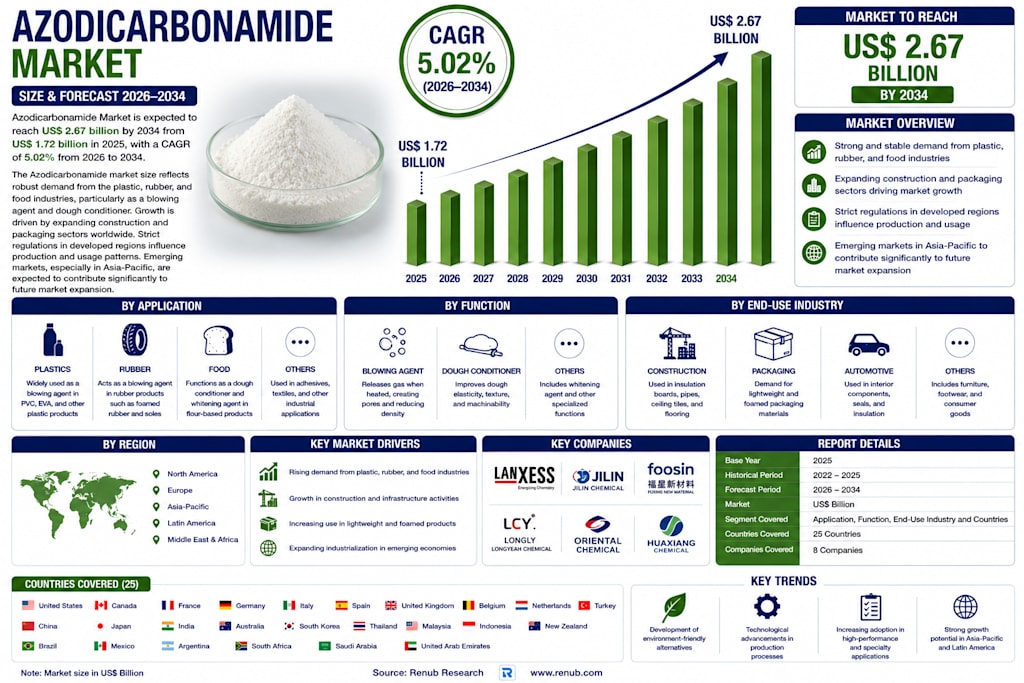
The global azodicarbonamide (ADA) market is witnessing steady growth as industries increasingly demand lightweight, durable, and cost-effective materials. Widely used as a blowing agent in plastics and rubber, and as a dough conditioner in the food industry, azodicarbonamide plays a critical role across multiple industrial applications.
According to Renub Research, the market is projected to grow from US$ 1.72 billion in 2025 to US$ 2.67 billion by 2034, reflecting a compound annual growth rate (CAGR) of 5.02% during the forecast period. This growth is primarily driven by expanding construction, packaging, and manufacturing sectors, particularly in emerging economies.
Azodicarbonamide is a yellow-orange crystalline compound that releases gas when heated, making it ideal for producing foamed materials. Its unique properties enable the creation of lightweight yet strong products, which are widely used in insulation, automotive components, footwear, and packaging materials.
Strong Demand from Plastics and Foaming Industry
One of the primary growth drivers of the azodicarbonamide market is its extensive use in the plastics and foaming industry. ADA is widely used to produce foamed plastics such as PVC, polyethylene, and polyurethane, which are essential in construction, packaging, and automotive applications.
The increasing demand for lightweight and energy-efficient materials is boosting the adoption of foamed plastics. In construction, these materials are used for insulation and structural components, improving energy efficiency and reducing building weight.
In packaging, foamed plastics offer durability, shock absorption, and cost efficiency, making them ideal for protecting goods during transportation. The growing e-commerce sector is further driving demand for advanced packaging materials.
As industries continue to prioritize efficiency and sustainability, the demand for high-performance foaming agents like ADA is expected to remain strong.
Growth in Rubber and Footwear Manufacturing
The rubber industry is another key contributor to the growth of the azodicarbonamide market. ADA is used as a vulcanization accelerator, enhancing the elasticity, flexibility, and durability of rubber products.
This makes it an essential component in the production of footwear, tires, conveyor belts, and industrial rubber goods. The global expansion of the automotive and footwear industries is significantly increasing demand for high-quality rubber materials.
Rising disposable incomes and urbanization in emerging markets are also driving footwear consumption, further supporting ADA demand. Additionally, the trend toward lightweight and durable automotive components is increasing the use of foamed rubber materials.
These factors collectively reinforce the importance of azodicarbonamide in industrial manufacturing processes.
Applications in the Food Industry
Azodicarbonamide is also used in the food industry as a dough conditioner, particularly in bread and bakery products. It helps strengthen gluten, improve dough elasticity, and enhance the texture and volume of baked goods.
The growing global demand for processed and packaged foods is supporting ADA usage in industrial baking. Large-scale bakeries benefit from its ability to ensure consistency and efficiency in production.
However, the use of ADA in food has become increasingly controversial due to potential health concerns. During baking, ADA can break down into compounds such as semicarbazide, which has raised safety concerns in some regions.
As a result, regulatory restrictions and consumer preferences for clean-label products are limiting its growth in the food segment. Despite this, ADA continues to be used in certain markets where it remains permitted under controlled conditions.
Challenges: Regulatory Pressure and Environmental Concerns
The azodicarbonamide market faces significant challenges related to regulatory scrutiny and environmental concerns. In the food industry, several regions, including the European Union, have banned or restricted ADA due to health risks associated with its breakdown products.
Even in regions where ADA is permitted, strict regulations on usage levels and labeling requirements increase compliance costs for manufacturers. Consumer awareness and preference for natural ingredients are further reducing demand in food applications.
Environmental concerns also pose challenges. The production and use of ADA involve chemicals that can contribute to emissions and waste, requiring proper handling and disposal. Manufacturers must invest in emission control systems and sustainable practices to meet regulatory standards.
Additionally, fluctuations in raw material prices, influenced by global chemical markets, can impact production costs and profitability. These challenges require companies to balance compliance, cost efficiency, and innovation.
Regional Insights Highlight Market Trends
Asia-Pacific dominates the azodicarbonamide market, driven by rapid industrialization, expanding construction activities, and strong demand for plastics and rubber products. Countries such as China and India are key contributors to growth.
The United States represents a stable market, supported by advanced manufacturing infrastructure and consistent demand for high-performance materials. However, regulatory scrutiny influences its use in food applications.
The United Kingdom market is characterized by strong industrial demand and strict regulatory oversight, particularly in the food sector. Manufacturers are focusing on compliance and alternative solutions.
India is a high-growth market, supported by expanding manufacturing sectors, rising consumer demand, and cost-effective production capabilities. The country’s growing construction and automotive industries further boost ADA consumption.
The United Arab Emirates serves as a regional hub, with demand driven by construction, packaging, and industrial activities. Growth in infrastructure projects supports the use of foamed materials.
These regional dynamics highlight the global diversity of the azodicarbonamide market and its dependence on industrial development and regulatory environments.
Competitive Landscape and Key Players
The azodicarbonamide market is moderately competitive, with key players focusing on production efficiency, product quality, and compliance with environmental and safety standards. Major companies include Lanxess AG, Otsuka Chemical Co., Jiangxi Selon Industrial, Abtonsmart Chemicals, and Nikunj Chemical Limited.
Recent developments indicate a shift toward stricter regulations and reduced use in food applications. For example, China removed ADA from its list of approved food additives, reflecting global trends toward regulatory alignment.
Companies are also investing in research and development to explore alternative chemicals and sustainable solutions, particularly for food and environmentally sensitive applications.
These developments highlight the evolving nature of the market and the need for innovation to address regulatory and environmental challenges.
Market Segmentation Reflects Broad Applications
The azodicarbonamide market is segmented by type and application, reflecting its diverse industrial uses.
Industrial Grade
The dominant segment, used in plastics, rubber, and construction materials. It benefits from strong demand for lightweight and durable products.
Food Grade
Used as a dough conditioner in bakery products, although its share is declining due to regulatory restrictions and consumer preferences.
Applications
Key applications include plastics and rubber manufacturing, food and beverage processing, leather and textiles, and other industrial uses.
This segmentation underscores the versatility of azodicarbonamide and its importance across multiple industries.
Final Thoughts
The azodicarbonamide market is set for steady growth, driven primarily by industrial demand in plastics, rubber, and construction sectors.
Renub Research’s forecast of US$ 2.67 billion by 2034 highlights the market’s resilience and long-term potential.
While challenges such as regulatory pressure and environmental concerns remain, ongoing innovation and the search for sustainable alternatives are expected to shape the market’s future.
Ultimately, azodicarbonamide continues to play a vital role in modern manufacturing, enabling the production of lightweight, efficient, and high-performance materials that support global industrial development.
About the Creator
Enjoyed the story? Support the Creator.
Subscribe for free to receive all their stories in your feed.
Comments
There are no comments for this story
Be the first to respond and start the conversation.