
Augmented Reality in Healthcare Market Is Moving from Novelty to Necessity
From surgical precision and medical training to patient education and remote guidance, augmented reality is becoming one of the most practical digital tools in modern healthcare.

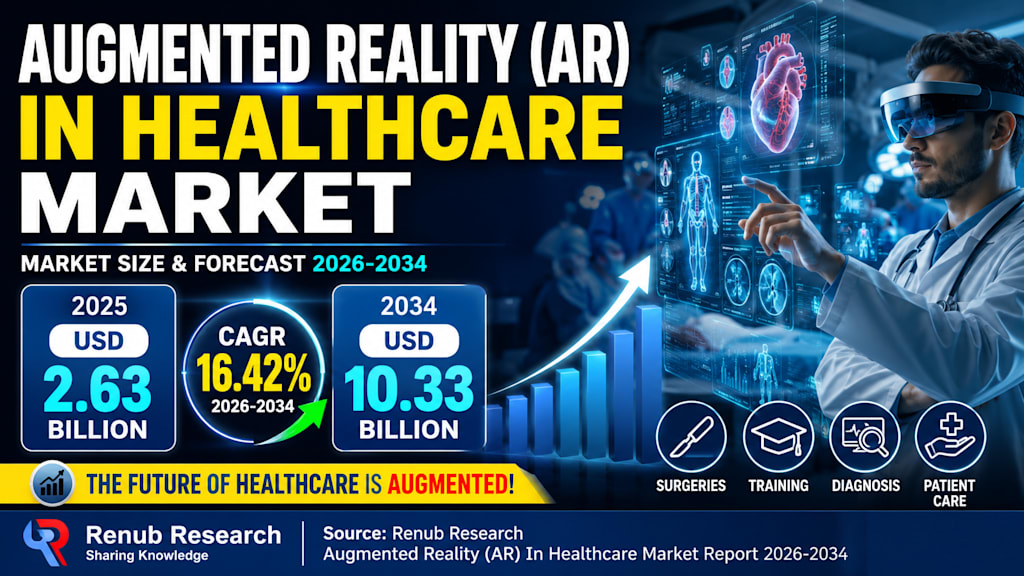
Augmented reality is no longer just a futuristic concept in healthcare. It is becoming a working tool that supports surgeons, trains medical professionals, improves diagnosis, and helps patients understand their care more clearly. According to Renub Research, the Augmented Reality in Healthcare Market is expected to grow from USD 2.63 billion in 2025 to USD 10.33 billion by 2034, reflecting a CAGR of 16.42% from 2026 to 2034. That kind of growth signals something bigger than a passing trend: it points to a shift in how healthcare itself is delivered and experienced.
At its core, augmented reality in healthcare overlays computer-generated images, data, or instructions onto the real medical environment. In practice, that means a surgeon can see anatomical information in real time, a trainee can practice procedures in a simulated environment, and a patient can better understand a diagnosis or treatment plan. The technology is being used across surgery, medical education, diagnosis, rehabilitation, and patient education, while also enabling remote guidance in certain settings. The appeal is simple: better visualization, better decision-making, and greater precision.
Why the market is gaining momentum
The strongest reason for AR’s rise in healthcare is that it solves real operational problems. Hospitals and clinics are under pressure to improve outcomes while reducing errors and increasing efficiency. Augmented reality helps meet those goals by giving clinicians access to critical information without forcing them to step away from the task at hand. It also supports minimally invasive care, which is now a major preference across many procedures. That is one reason why AR is being adopted more widely in environments where precision matters most.
Surgical and clinical applications are especially important. AR can help doctors visualize critical structures, imaging results, and anatomy directly in the field of view, which improves accuracy and reduces the chance of mistakes. This is particularly valuable in orthopedic, neurosurgical, cardiovascular, and reconstructive procedures. As healthcare institutions continue to emphasize patient safety and better clinical outcomes, AR-assisted procedures are becoming more attractive inside the operating room. The market is therefore being shaped not only by technology, but by the practical demands of modern care.
Surgery is turning into a major growth engine
One of the clearest signs of AR’s potential is the growing use of the technology in surgical settings. The source notes that in 2024, an estimated 38 million procedures were carried out worldwide, which represented a 40% increase from 2020. The broader rise in surgical and non-surgical alternatives, including cosmetic and minimally invasive procedures, reinforces the need for tools that can improve accuracy and support better planning. AR fits neatly into that environment because it adds visual guidance without replacing the clinician’s judgment.
This trend is not limited to a single specialty. AR-assisted surgery is useful wherever anatomy is complex and precision is essential. The technology can support preoperative rehearsal, intraoperative visualization, and procedural confidence. That combination makes it especially relevant in high-stakes operations where even a small improvement in visibility can make a meaningful difference. In other words, AR is not trying to replace surgery; it is trying to make surgery smarter.
Training and education are unlocking another layer of demand
Healthcare training is another powerful driver. Medical education is difficult, expensive, and often limited by access to real cases. AR helps solve that problem by creating lifelike, interactive learning environments where students, surgeons, and healthcare workers can practice without risk to patients. It turns theory into experience and makes it possible to repeat complex procedures until skills improve. For medical institutions trying to build a stronger workforce, that is a major advantage.
The market is also being helped by the fact that traditional training methods are not always scalable. AR-based simulations in anatomy, surgery, and procedural learning can be distributed more efficiently and used more consistently across teams. That consistency matters in healthcare, where quality and readiness must remain high. The file even points to a March 2025 example in which Endo launched a spatial-computing injection simulator powered by Apple Vision Pro, showing that the training use case is already moving beyond theory and into deployment.
Digital health is accelerating adoption
A broader digital transformation is also helping AR grow. Healthcare systems are increasingly combining AR with artificial intelligence, imaging, wearables, and other smart technologies to improve diagnosis and treatment. That convergence is important because AR becomes more useful when it is connected to data-rich clinical workflows. As healthcare organizations invest in digital tools, AR is increasingly seen as part of the same modernization wave rather than as a standalone gadget.
The investment side is equally revealing. Renub Research notes that Augmedics raised USD 82.5 million in Series D funding in 2024, bringing total funding to USD 149 million, with plans to expand its xvision spine system into 250 hospitals. The same section also mentions that larger industry players are increasingly interested in data-driven capabilities rather than optics alone. That suggests the market is entering a more mature phase, where competition will likely center on integration, utility, and clinical value.
The challenges are real, and they matter
Despite the optimism, AR in healthcare still faces serious obstacles. The biggest is cost. Many AR solutions depend on specialized hardware, smart glasses, head-mounted displays, advanced imaging devices, and software platforms that are not cheap to deploy. Smaller hospitals and facilities in developing regions may struggle to justify the investment, especially if they also need to retrain staff and upgrade infrastructure. That makes affordability one of the most important barriers to wider adoption.
Data privacy and regulation create another layer of difficulty. Healthcare AR systems often process sensitive patient information, including imaging and other clinical data, so security and compliance are essential. Since regulatory requirements differ by region, vendors and providers must make sure their systems are reliable, safe, and aligned with local rules. In a field as sensitive as healthcare, even a promising technology can slow down quickly if trust, privacy, or compliance is in doubt.
Software, devices, and displays each have a role
The market is also expanding across different product and technology categories. On the software side, AR tools are being used for visualization, surgical planning, training simulation, and patient education. These applications are valuable because they bring 3D anatomical visualization and real-time data overlap into clinical workflows. As digital healthcare systems mature, software is becoming one of the foundations of AR adoption.
Handheld devices are another important segment. Smartphones and tablets make AR more accessible because they do not require the same level of hardware installation as more advanced systems. In outpatient care, emergency settings, telemedicine, and bedside communication, portable AR tools can be especially practical. Their familiarity also helps adoption, since many clinicians and patients already know how to use them.
AR displays, including head-mounted devices, smart glasses, and transparent displays, are likely to remain highly visible in the market because they offer hands-free precision. These displays are valuable in situations where doctors need uninterrupted access to visual information while staying focused on the patient or procedure. Cost remains a constraint, but improvements in resolution, wearability, and battery life are making these devices more practical over time.
Hospitals remain the center of adoption
Among end users, hospitals and clinics are the most prominent category. That is not surprising, because hospitals have the infrastructure, expertise, and budgets needed to adopt innovative technologies at scale. AR can support surgery, training, diagnostics, rehabilitation, and patient education in a hospital environment, where multiple departments can benefit from the same platform. The long-term payoff is improved accuracy, lower error rates, and better efficiency.
Hospitals are also where digital transformation is most visible. Value-based care, operational efficiency, and clinical precision are all pushing healthcare providers to adopt tools that make real-time decision-making easier. AR fits that need well because it adds visual intelligence without disrupting the existing workflow. That is why hospitals are not just one end-user segment; they are one of the main engines of adoption.
Regional trends show a global market in motion
In the United States, the market is especially advanced due to strong digital health adoption, sophisticated healthcare infrastructure, and high R&D spending. AR is increasingly being used in surgery, education, diagnosis, and patient engagement, while major technology and healthcare companies continue to push innovation. The file highlights a collaboration between SimX and the U.S. Air Force, supported by USD 750,000 in funding for an augmented reality and virtual reality healthcare training solution, which underscores the U.S. focus on high-value clinical simulation.
The United Kingdom is also showing steady growth, especially in medical training and patient engagement. The source notes the use of virtual and mixed reality training at the University of Birmingham’s RESILIENCE Centre, helping students experience near real-life manufacturing scenarios. India, meanwhile, stands out as a high-potential market due to improving healthcare infrastructure, rising chronic disease burden, and stronger demand for advanced training tools. Saudi Arabia is moving as well, with the launch of the Seha Virtual Hospital, described in the file as the world’s largest virtual hospital and supported by AI and AR technologies.
What the market mix tells us
The segmentation in the report shows how broad the opportunity is. Products include AR displays, sensors, input devices, semiconductor components, and others. Technology categories include head-mounted devices and handheld devices. End users include hospitals and clinics, research laboratories, and others. Geography is also wide, covering North America, Europe, Asia Pacific, Latin America, and the Middle East & Africa. That breadth suggests AR in healthcare is not a niche category anymore; it is becoming a multi-layered market with room for hardware, software, and service innovation.
That wide market structure also explains why competition is building quickly. Companies such as AccuVein, Atheer, Augmedics, CAE, Google, Philips, Magic Leap, Medical Realities, Microsoft, and Siemens are all part of the ecosystem. Each brings a different strength, whether in visualization, simulation, software, or hardware. In a market like this, winners are likely to be the firms that can combine technical credibility with clinical usefulness.
Final thoughts
The Augmented Reality in Healthcare Market is growing because it solves problems that healthcare providers face every day: how to visualize better, train faster, reduce mistakes, and improve patient care. Renub Research’s forecast of growth from USD 2.63 billion in 2025 to USD 10.33 billion by 2034, at a 16.42% CAGR, reflects a market that is moving from early adoption to practical scale. The next phase will likely be shaped by affordability, integration, regulation, and clinical proof. But the direction is clear. AR is not just adding a digital layer to healthcare; it is helping reshape how modern medicine sees, teaches, and treats.
About the Creator
Enjoyed the story? Support the Creator.
Subscribe for free to receive all their stories in your feed.
Comments
There are no comments for this story
Be the first to respond and start the conversation.