
Artemis II Successfully Completes Its Lunar Flyby Mission
Space

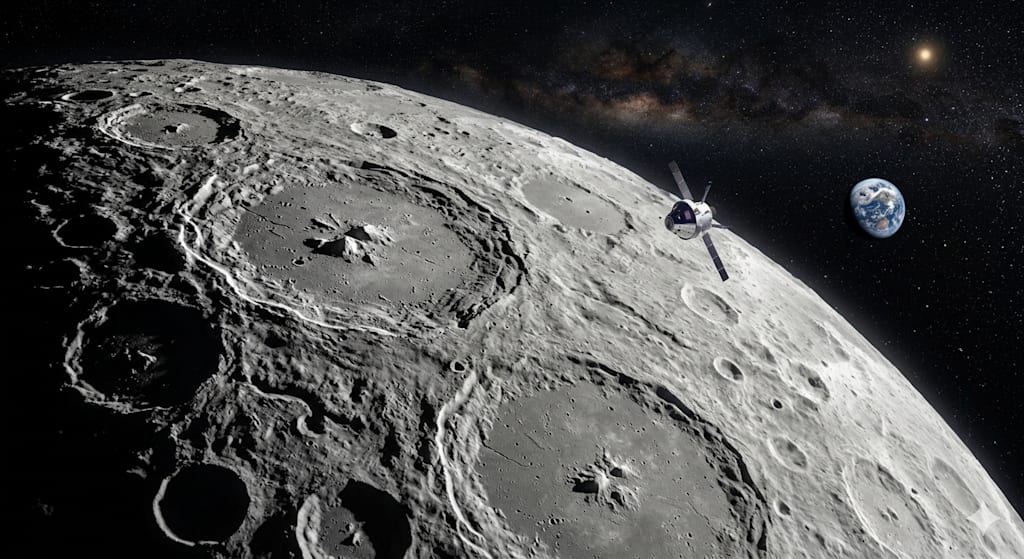
The successful completion of Artemis II marks a decisive turning point in modern space exploration. For the first time in more than fifty years, humans have traveled around the Moon and returned safely to Earth—an achievement that signals not just a revival of past ambitions, but the beginning of a sustained human presence beyond low Earth orbit.
A Historic Return Beyond Earth Orbit
Since the final missions of the Apollo program, human spaceflight has largely remained confined to low Earth orbit. While robotic probes have ventured far beyond, carrying instruments to Mars, Jupiter, and even interstellar space, astronauts themselves have not traveled farther than the Moon since 1972. Artemis II changes that.
Unlike Artemis I, which tested the system without a crew, Artemis II placed four astronauts aboard the Orion spacecraft and sent them on a journey that required every major system to function flawlessly in deep space conditions. The mission was not about landing—it was about proving that humans can safely travel to the Moon and back in preparation for future surface missions.
The Journey: Precision and Risk
Launched atop the powerful Space Launch System, the Orion spacecraft first entered Earth orbit before executing a critical translunar injection burn. This maneuver accelerated the spacecraft to speeds exceeding 39,000 km/h, placing it on a trajectory toward the Moon.
As Orion approached its destination, it performed a free-return trajectory—an orbital path that naturally loops around the Moon and brings the spacecraft back to Earth without requiring major propulsion corrections. This approach, also used during Apollo missions, serves as an important safety mechanism. If propulsion systems were to fail, gravity alone would guide the crew home.
During the lunar flyby, the spacecraft passed within a few thousand kilometers of the surface. From this vantage point, astronauts observed geological features such as impact basins, crater chains, and the stark boundary between the Moon’s near side and its far side. These observations were not merely symbolic—they contributed to updated mapping efforts and provided visual confirmation of instrument readings.
Testing Human Limits in Deep Space
One of the mission’s most critical objectives was to evaluate how the human body responds to deep space conditions. Unlike astronauts aboard the International Space Station, the Artemis II crew operated outside the protective shield of Earth’s magnetosphere. This exposed them to higher levels of cosmic radiation, offering valuable data for planning longer missions, particularly those targeting Mars.
For example, wearable sensors continuously monitored radiation exposure, heart rate variability, and sleep patterns. These datasets will inform spacecraft design improvements, such as enhanced shielding and optimized crew schedules.
The crew also conducted a series of manual control exercises. At one stage, automated navigation systems were deliberately disengaged, requiring astronauts to orient and maneuver the spacecraft manually. This test confirmed that human operators can effectively intervene during system anomalies—an essential capability for long-duration missions where communication delays make real-time support from Earth impractical.
Engineering for the Future
Artemis II served as a comprehensive validation of next-generation space technologies. The Orion spacecraft demonstrated its advanced life support systems, capable of sustaining a crew for extended periods. These systems include carbon dioxide removal units, water recovery systems, and temperature regulation mechanisms designed for deep space environments.
Equally significant was the performance of Orion’s heat shield during re-entry. Traveling at speeds exceeding 40,000 km/h, the spacecraft encountered temperatures approaching 3,000°C. The shield’s ablative material performed as expected, gradually eroding to dissipate heat while protecting the crew inside.
Communication systems also proved robust. Using a combination of NASA’s Deep Space Network and onboard relay technologies, the crew maintained near-continuous contact with mission control, even at distances exceeding 380,000 kilometers. This level of connectivity is essential for both operational coordination and psychological well-being during extended missions.
A Glimpse of What Comes Next
Although Artemis II did not include a lunar landing, its success directly enables the next phase: Artemis III. This upcoming mission aims to return astronauts to the Moon’s surface, with a particular focus on the lunar south pole—a region believed to contain water ice deposits.
These resources could fundamentally change how missions are conducted. Water ice can be converted into drinking water, breathable oxygen, and even rocket fuel, reducing the need to transport supplies from Earth. In this sense, Artemis II is not just a standalone mission; it is a critical step toward building a sustainable lunar infrastructure.
The broader Artemis program envisions a long-term human presence on and around the Moon, including orbital stations like the Lunar Gateway and surface habitats designed for extended stays. These developments will serve as testing grounds for technologies and operational strategies needed for eventual missions to Mars.
Why Artemis II Matters
The importance of Artemis II extends beyond engineering milestones. It represents a strategic shift in how humanity approaches space exploration—from short-term achievements to long-term presence. It also reflects growing international collaboration, with multiple space agencies contributing technology, personnel, and expertise.
Moreover, the mission has reignited public interest in space. High-definition images of the Moon, live broadcasts from deep space, and firsthand accounts from astronauts have brought a new generation closer to the realities of exploration.
Conclusion
Artemis II demonstrates that human deep space travel is no longer a relic of the past—it is an active and evolving frontier. By successfully sending astronauts around the Moon and back, NASA has validated the systems, technologies, and procedures required for more ambitious missions ahead.
If the Apollo era proved that reaching the Moon was possible, Artemis II shows that returning—and staying—is within reach. The trajectory is clear: from orbiting the Moon to walking on its surface again, and eventually, to stepping onto entirely new worlds.
About the Creator
Holianyk Ihor
Exploring the cosmos and seeking answers to universal questions. Astrophotographer capturing planets and deep sky wonders. Let’s look at the stars together.
Enjoyed the story? Support the Creator.
Subscribe for free to receive all their stories in your feed.
Comments
There are no comments for this story
Be the first to respond and start the conversation.