
Art and Writing
about AI, art, self publishing & my first chapbook—poetry


Everyone knows Bob Ross, but was he a good artist? It’s a sincere question. I have nothing against him or what he has achieved, I loved him as a child, but I can imagine the locker room talk. In my area growing up I watched him on TV and in the area I grew up in, there was a Bob Ross in every indoor mall flogging their art. [a very similar style] Keep in mind this was the seventies and even into the eighties when indoor malls were far and few between in Ontario, Canada.
I heard a writer/editor/teacher—Shane McCrea guest on the SLEERICKETS podcast with Mathew Buckley-Smith. Mathews most recent book The Soft Black Stars. Shane McCrae’s most recent book is titled “New and Collected Hell”. I’m looking forward to my copy. I have Mathews book and love how quiet it reads. I thoroughly enjoyed this conversation on the SLEERICKETS episode titled Mr. Bones and here’s what Shane said that really motivated me:
“An art is a thing that in one way or another presents us with challenges in the making, or at least in the preparation. We’ve got to study for it. Poetry is the one art that I can think of, that everyone is just assumed to be able to do it.
So, we ignore the idea that there are challenges in the making of poetry. We sort of write it as if writing poetry is equivalent to writing a diary entry, or writing a letter to a friend. But we want it to be treated as an art equivalent to composing like a violin concerto or something.
It’s very much a have a cake and eat it too sort of situation. And I want to try to convince my students that no, it is an art that requires technique, skills, study, preparation. But in order to treat it this way, in order to work in it in that way, one must impose upon oneself restrictions of some kind or another.
Even if, you know, I’m willing to define restriction very loosely, even if restriction just means I have spent a good deal of time studying poetry so that I understand[…]” (taken with permission from Mathew and Shane.)
I agree with some of this and again I don’t. Maybe I don’t, is wrong—I mean it all makes perfect sense, especially, near the beginning—Preparation, and I see where Shane is coming from and going, I’m not a career writer; I’ve dabbled on and off and have recently—in the last five or six years pursued it more vigorously writing poetry. Am I there yet—I don’t feel I am, or am where I would like to be, or even know what that looks like? I feel and I’m trying to understand the industry and how it works and I think this thought I have that can go in any given number of directions causing confusion, misunderstanding and a lot of questioning about—am I doing things right and will all this amount to something in the end? And I’m too old for school. One thing I noticed is this same feeling in many writers. I think learning in a good school is the best approach. I use the term good school loosely. I think it is good writers that make the school a good school. Shane cares about craft and teaching and giving his students the best start. There will always be writers or artist that don’t take these steps or can’t. Much of my youth was centred around visual art and graphic design at a time before computers, so a person kind of had to have some practice or training to succeed. But still there are people who make visual/writing/art without training for the sheer pleasure or for other motives. Nobody taught me to draw, but the class at a college level was full of people who came to learn at a late age and for the most part couldn’t draw well or at all. I think it is hard for someone to grasp starting at late age but not impossible. If a person applies themselves in some form as stated above by Shane…. Art, I believe is something natural and some grasp it, hone it like an athlete wanting to win gold. I think what many writers maybe concern themselves with is saturation and they let this market saturation get to them. Coming into the scene late I can add to this, saturation is not just a writing thing, it is in almost every industry and the invention of AI will only exasperate it. Many restaurants fail because someone who makes a mean omelet thinks they should open a restaurant. Most of us can cook but top chefs are far and few between when looking at the numbers and then there’s saturation, far too many restaurants. But if you like to cook should not becoming a top chef sway your decision to open a restaurant? I think not. For art saturation is just one draw back I see. I don’t have a lot of credibility, but I feel I’m on the outside looking in and wonder about letting it get me down or moving forward.
With my limited knowledge of neurology was Bob Ross using the left hemisphere of his brain or the right? I think this plays a big part in art today including writing…
There’s a link between neurology and art and the art of poetry that is important. Dr. Iain McGilchrist, a well-known neurologist has written extensively about the brain and its two hemispheres and the function between them. He has guested on numerous podcasts as well as producing his own.
At a young age I could draw and paint in many mediums. Nobody teaches that in most cases it’s a natural interest [in my opinion] a form of communication. When I entered high school, I began to study Graphic Art. I remember clearly the first things we were taught—
everything in graphic design revolves around circles, squares, and triangles—and everything has already been done…
I didn’t know this at the time, but this is clearly left hemisphere speaking, according to Dr. McGilchrist. After all it was the seventies when I was in high school and oddly enough when MFA teaching began. As a person on the outside looking in, I can relate this to poetry and the elusive MFA. Is it a bad thing? Not really—at first, I didn’t like the constraints of being a graphic artist. Constraints such as only black ink, or one colour, or to use only certain shapes, page layout etc. Constraint taught me to use my left hemisphere, fitting ideas into a box. The trick was to break out of the constraints and add your own intuition, something I think that can’t be taught and in this I find many MFA written poems sound the same. The poems have the structure, the sound, but lack intuition or the creativity that hides the circles, squares, and triangles. I could read ten different poems and think they have been written by the same author. I see this a lot in short stories as well. I see this within lit mags and websites that adhere to the constraint of having only one editor. This is the circles, squares, and triangles and a failure or lack of right hemisphere injection. Often we hear opinions that state what makes a good poem, is often limited to the effective use of its constraints and its constraints alone. It isn’t always the case but I see it or hear it often.
In art—the circles, squares, triangles, is not just a graphic approach it is seen as far back as the greats such as Antonio Canova —
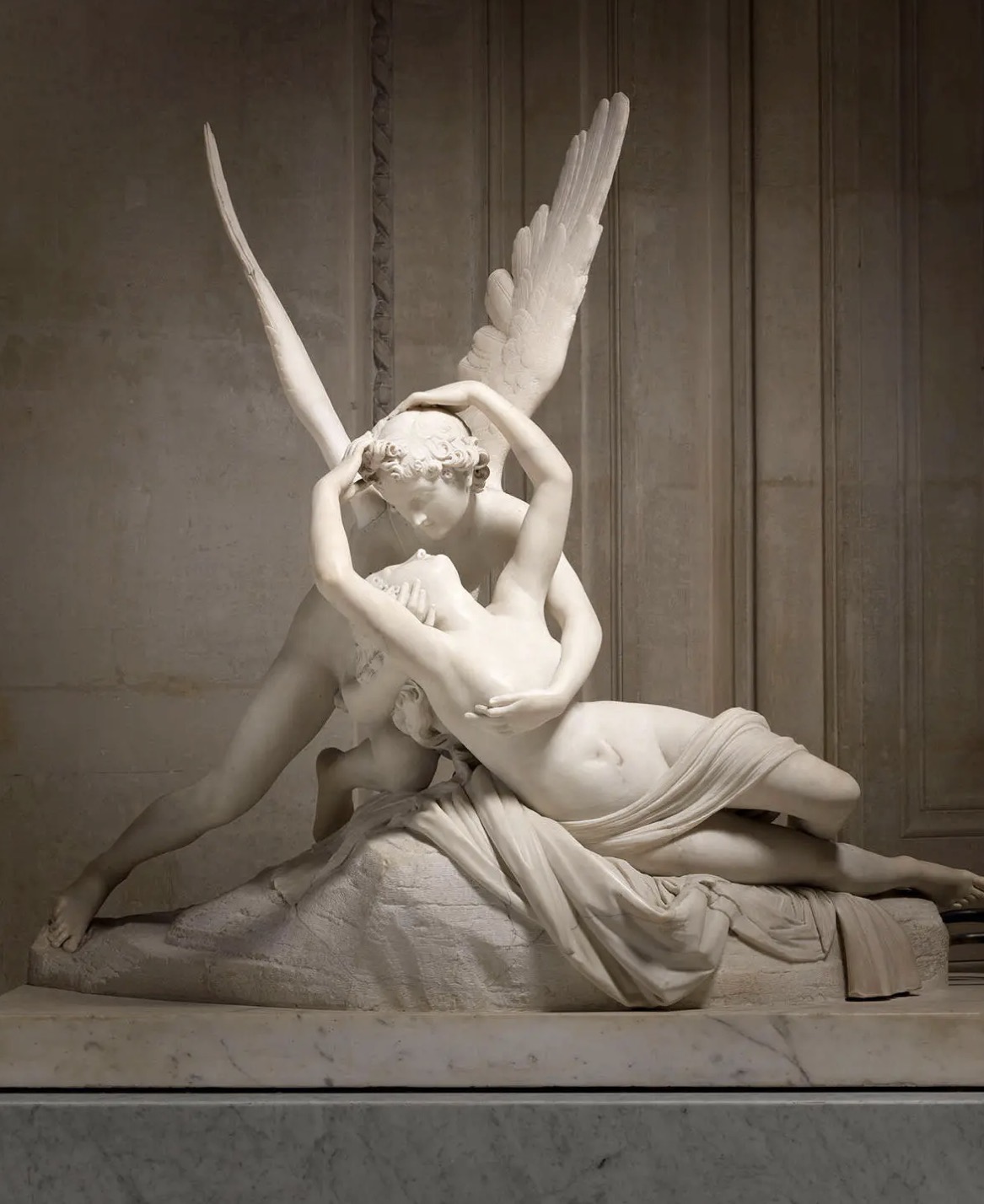
The triangle is there, but you don’t notice the constraint, in fact there is more than one triangle, and often can be seen if you walk around the work the triangle moves. The triangle is subtle but it carries your eyes through the whole piece. The movement and extreme attention to detail and passion bring it out of its shape. Nothing is missed and every emotion is felt. Many great works of art have this approach. (circles, squares, triangles) Many great poems exude the same feelings.
Compare Bob Ross with Picasso. Its clear Picasso was totally right hemisphere, or was he? Many don’t know he began by painting in a style similar to many artists in his era, then drastically broke away with his own unique style and intuition using more of his right hemisphere. Because western society has moved to thinking more with the left, Picasso was not widely accepted for his style of art, but when you think about it—most people couldn’t name another artist from that era but everyone knows Picasso. Bob Ross on the other hand, his style of painting can be purchased from any craft sale or print framing gallery and may be more desirable to most not just because of price but also fits in closer to the left hemisphere utilizing circles, squares, triangles and a technique most can associate with and understand with ease. Bob Ross’s work is more about constraint. Picasso exudes an emotion (the right) Bob Ross is just there (the left). I see this same phenomenon in MFA written poetry. Some will argue, yes! and please do…
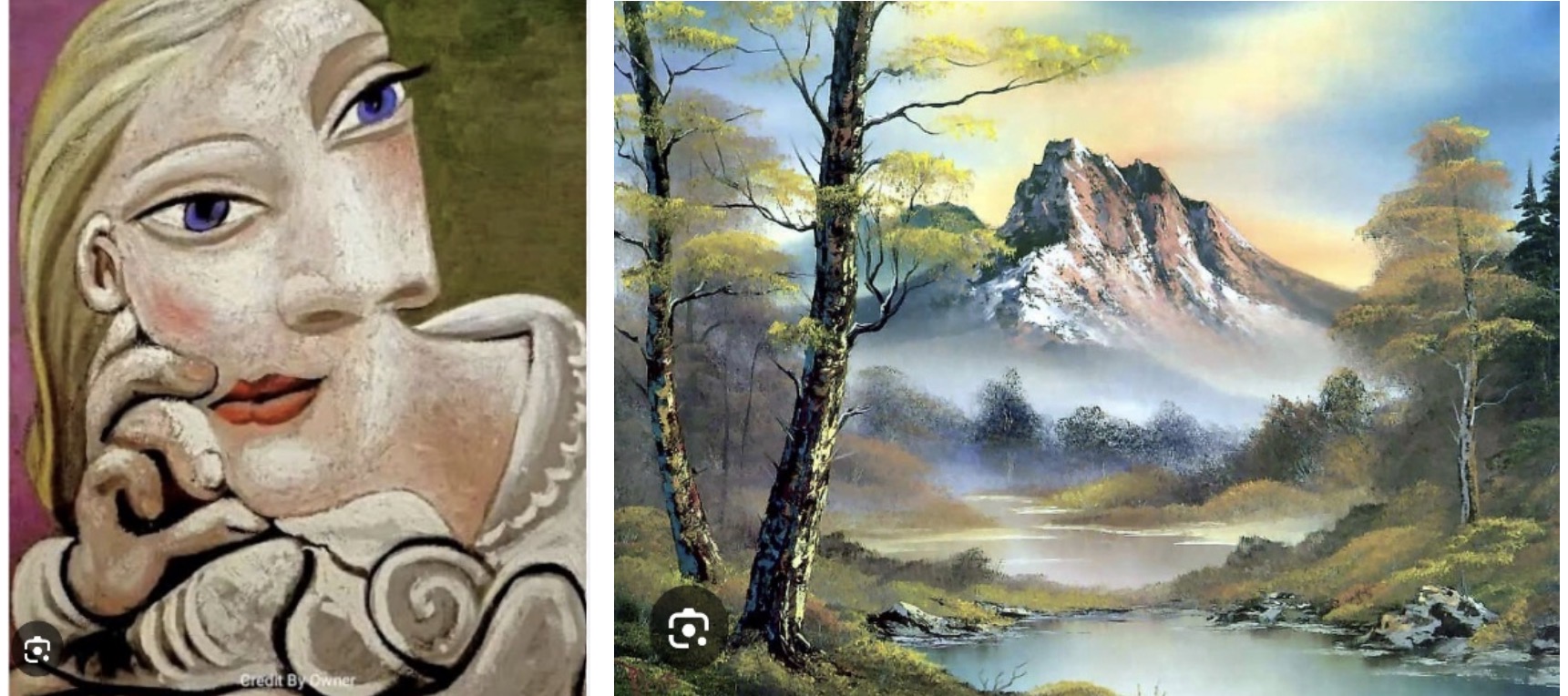
Picasso/Bob Ross
How many times have you seen that mountain or the flicks of a particular brush to create leaves on a tree, in the Bob Ross painting?—MFAish in its constraint. Maybe a knife used to create the hard edge of a mountain and tree bark. A particular brush technique to create the soft areas, and like an MFA a list of trees, grass, and flowering. The mountain creates a triangle effect but doesn’t give the painting much movement. But Picasso on the other hand opens a whole conversation. Is this woman side eyeing, or is she bored, or not amused with her lover, or is she cleverly scheming a plot, is it even a woman? The distortion in the face gives it such movement., almost as if he had captured it in the middle of its movement. Here in this painting, you can almost say he has created contrapposto of the face. Picasso opens emotion and conversation. The commonality in these two works is the warmth of colour.
Here in this painting you can almost say he has created contrapposto of the face.
So here we are now, my favorite controversy:
How Pants – Anne Carson vs Chat GTP
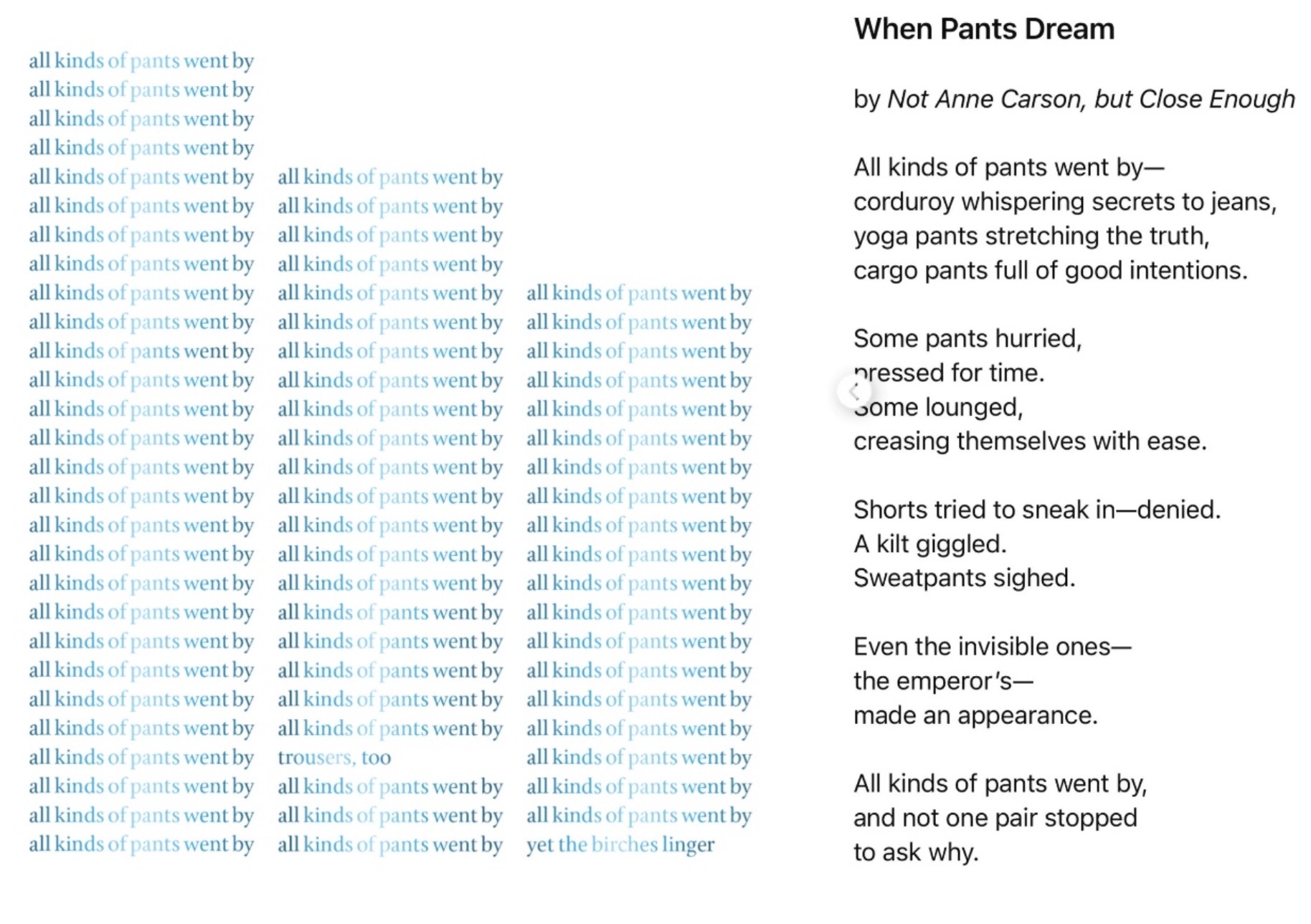
The argument here is or was, who could write the better poem about pants—Anne Carson or ChatGTP? Or maybe it was a question of who in their right mind would publish How Pants when ChatGTP could write a better poem—Drama Drama Drama!
Sounds like something Elon would say!
I personally love the Anne Carson poem!
The real danger here according to Iian McGilchrist is that letting machine learning such as ChatGTP do our tasks and thinking for us, it is a danger and a prime example of only using left hemisphere thinking. The western world has been increasingly more dependent on left hemisphere use and he feels it can become a big danger for our future. He states, if someone is telling others how a good poem should be written that is the left hemisphere thinking or speaking. Poetry has evolved to what it is today, that was achieved through right hemisphere creativity combined with left hemisphere constraint. If someone says an MFA is the be all and end all to writing poetry, that is the left hemisphere dictating. Iian McGilchrist states that the problem with the left hemisphere is that it thinks it is always right, it has all the answers, it knows everything. Take away the right and this will create a big problem—stagnation and lose of control. I’ve paraphrased, but just that statement alone commands attention. I will stop there on this matter and not get too political, but ChatGPT’s poem When Pants Dream kind of has the MFA flavour but seems incomplete to me—however I do like the line: yoga pants stretching the truth. This could be, on its own a haiku or a metaphor for the poem, and who knows it could also all be plagiarized. How Pants is subjective, stirs emotion and controversy and will always be remembered (a Piccaso) When Pants Dream is already long forgotten after it’s been read. How Pants is truly not MFA or something we are used to seeing or reading, but isn’t much of Anne’s work this way? Butt is it really about pants?
—however, I do like the line: yoga pants stretching the truth. This, could be, on its own a haiku/senryu
My first Chapbook—
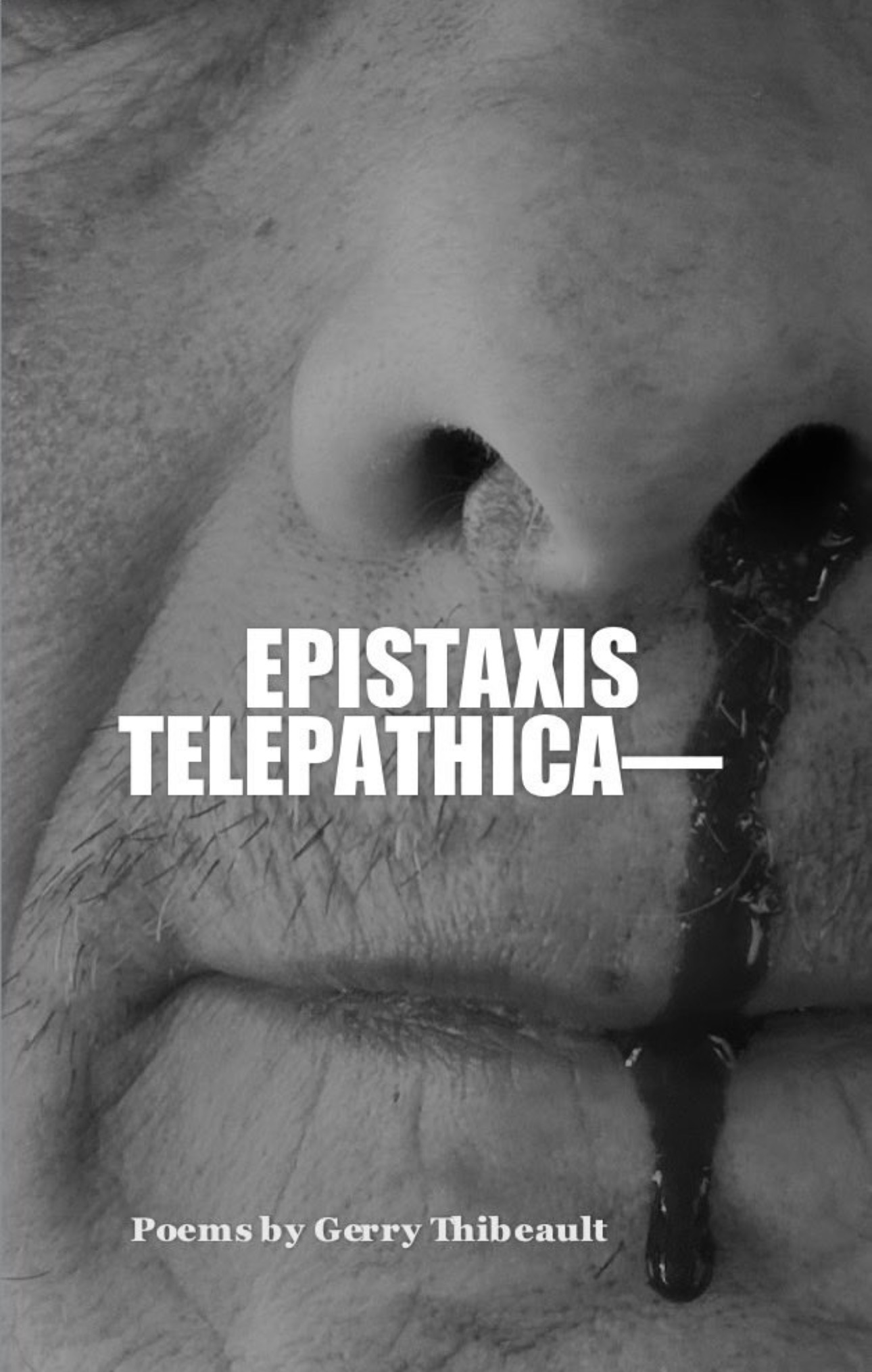
The beauty to self-publishing—I can give you a bio without it being written in third person. Another luxury is I won’t be using Blurb’s—I despise blurbs. The title of the book is Epistaxis Telepathica. Released August 13/2026. Epistaxis Telepathica is a science fiction trope. It’s a term for causing nose bleeds using telepathic control. It’s usually a control that would be inflicted onto others but in this case it’s the artist inflicting on oneself. This book of poetry is not science fiction, but rather about the struggles of an artist trying to understand art, its process, aging love and acceptance. The struggles are real life struggles many of us encounter daily, whether it be writing, trying to fit into the writing community, trying to understand poetry as art and its politics withing the publishing industry. The speaker also grapples with how to fit into a society that they have been born into. A society that quickly changes before there is even time to react or comprehend what the changes are or mean. This book is a bit raw and gritty. It’s gentle and reflective in its calm approach as it enters conversations with other works in a subtle manner. It’s truthful in its ways as it tries to understand love in the process of aging and of course it is Canadian so there is a brief mention to hockey in the poem title Imagine Al Purdie on Twitter. It engages in conversation with other books and authors throughout with poems titled; In Love with Currency, and The Story Nobody Wants to Hear —to name a few titles. The release date for this first chapbook is August 13, 2026, and it can be found — here
You may be wondering what is the Futurism here in this story and maybe some have just become accustom to AI but for many of us artist we fear AI and are living in it. I for one fear it and have no inclination to use it, this story is also about my Futurism and yours in the art of writing, something I've been working on for many years and finally living in the future of self-publishing and releasing my first book. The futurism that we are all now able to self-publish. It doesn't end here for me I have several manuscripts on the go and will continue to hone my craft here on Vocal-Media. Will I always self-publish, well that remains to be seen. I do submit to the odd call but I'm choosy and pessimistic so we will see what the future holds, but for writing I think it's evolving.
Gerry Thibeault
About the Creator
Gerry Thibeault
1st chapbook set to release in August 2026...
Enjoyed the story? Support the Creator.
Subscribe for free to receive all their stories in your feed. You could also become a paid subscriber, letting them know you appreciate their work.
Comments
There are no comments for this story
Be the first to respond and start the conversation.