
Aroma Chemicals Market Expands as Fragrance, Food, and Sustainable Ingredients Drive Demand
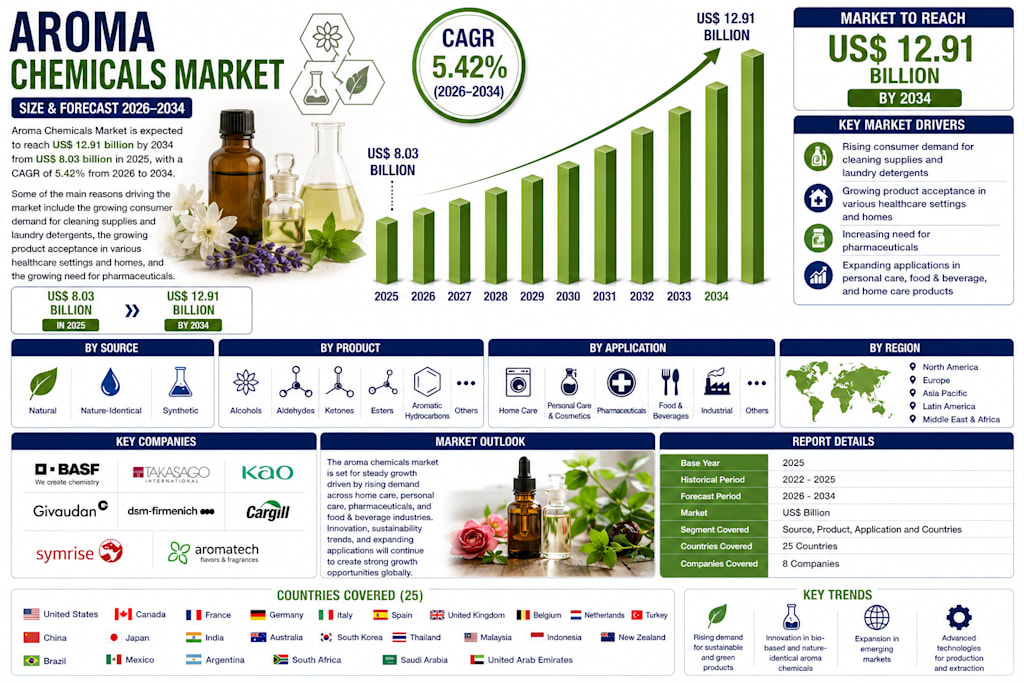
Rising demand from personal care, food & beverage, and household products is set to push the aroma chemicals market from US$ 8.03 billion in 2025 to US$ 12.91 billion by 2034, growing at a CAGR of 5.42% from 2026 to 2034.

The global aroma chemicals market is steadily evolving as a critical backbone of the flavors and fragrances industry. From perfumes and cosmetics to packaged foods and cleaning products, aroma chemicals play an essential role in shaping sensory experiences that influence consumer preferences and brand identity.
According to Renub Research, the market is projected to grow from US$ 8.03 billion in 2025 to US$ 12.91 billion by 2034, reflecting a compound annual growth rate (CAGR) of 5.42% during the forecast period. This growth is driven by increasing demand for scented and flavored products across multiple industries.
Aroma chemicals are organic compounds used to create or enhance fragrances and flavors. They can be derived from natural sources, synthesized chemically, or produced as nature-identical compounds. These ingredients provide consistency, scalability, and cost efficiency compared to natural extracts, making them indispensable for large-scale manufacturing.
Rising Demand from Personal Care and Fragrance Products
One of the strongest drivers of the aroma chemicals market is the growing demand for personal care and cosmetic products. Consumers increasingly associate fragrances with identity, emotional well-being, and lifestyle, leading to higher consumption of perfumes, deodorants, skincare, and haircare products.
Aroma chemicals enable manufacturers to create complex, long-lasting scent profiles that differentiate brands in a competitive market. The trend toward premium and customized fragrances is particularly strong in urban and emerging markets, where consumers are willing to spend more on high-quality products.
Additionally, rising awareness of hygiene and self-care is boosting demand for everyday products such as soaps, shampoos, and sanitizers, all of which rely heavily on aroma ingredients. As brands continue to innovate with new formulations and seasonal launches, the need for diverse aroma chemicals is expected to grow steadily.
Expansion of the Food and Beverage Industry
The food and beverage sector is another major contributor to the growth of the aroma chemicals market. These compounds are widely used to enhance flavor, maintain taste consistency, and compensate for flavor loss during processing and storage.
With changing lifestyles and increasing consumption of packaged and convenience foods, manufacturers are relying more on aroma chemicals to meet consumer expectations for appealing taste and aroma. These ingredients are used in beverages, confectionery, baked goods, and dairy products.
The rise of plant-based and health-focused food products is also creating new opportunities for specialized aroma compounds. These compounds help improve taste without relying on excessive sugar, salt, or fat, making them essential for modern food formulation strategies.
As consumer demand for innovative and enjoyable food experiences continues to grow, the role of aroma chemicals in the food industry is becoming increasingly important.
Shift Toward Sustainable and Bio-Based Ingredients
Sustainability is emerging as a key trend in the aroma chemicals market. Consumers are increasingly seeking products with clean labels, natural ingredients, and environmentally friendly sourcing.
This shift is encouraging manufacturers to invest in green chemistry, fermentation technologies, and renewable raw materials. Bio-based aroma chemicals are gaining popularity as they align with sustainability goals while maintaining performance and quality.
Regulatory pressures and corporate commitments to environmental responsibility are further accelerating this transition. Companies are focusing on reducing their carbon footprint and adopting sustainable production practices.
The move toward sustainable and bio-based ingredients is not only reshaping product portfolios but also creating new opportunities for innovation and premium positioning in the market.
Challenges: Regulation and Raw Material Volatility
Despite its growth potential, the aroma chemicals market faces several challenges. One of the most significant is the complex regulatory environment governing the use of fragrance and flavor ingredients.
Manufacturers must comply with strict safety and environmental regulations, which vary across regions and applications. This requires substantial investment in testing, documentation, and reformulation, increasing operational costs.
Another challenge is the volatility of raw material supply. Many aroma chemicals are derived from petrochemicals or agricultural sources, making them susceptible to fluctuations in availability and pricing.
Climate conditions, geopolitical factors, and supply chain disruptions can impact production and lead times. Managing these risks while maintaining consistent quality and cost efficiency remains a key challenge for industry players.
Regional Insights Highlight Market Diversity
The United States represents a mature market with strong demand from personal care, food, and household product sectors. Consumers are increasingly favoring premium and natural ingredients, driving innovation in sustainable formulations.
The United Kingdom market is characterized by a strong preference for ethical and sustainable products, encouraging manufacturers to adopt green chemistry and transparent labeling practices.
India is experiencing rapid growth, driven by urbanization, rising disposable incomes, and increasing demand for personal care and food products. The country’s combination of domestic consumption and export opportunities supports market expansion.
The United Arab Emirates benefits from a strong fragrance culture and luxury retail sector, driving demand for high-quality aroma chemicals. Its position as a regional trade hub further supports market growth.
These regional dynamics highlight the global nature of the aroma chemicals market and its adaptability to diverse consumer preferences.
Competitive Landscape and Industry Developments
The aroma chemicals market is highly competitive, with major players focusing on innovation, sustainability, and strategic partnerships. Key companies include BASF SE, Givaudan, Symrise AG, Takasago International, and DSM-Firmenich.
Recent developments reflect the industry’s focus on sustainability and technological advancement. For example, BASF introduced L-Menthol FCC with a reduced carbon footprint, while DSM-Firmenich is investing in new production facilities to expand capacity.
Collaborations between companies are also driving innovation. Partnerships aimed at developing bio-based and sustainable aroma chemicals are becoming increasingly common, highlighting the industry’s shift toward environmentally responsible practices.
These developments demonstrate the dynamic nature of the market and its commitment to innovation and sustainability.
Market Segmentation Reflects Broad Applications
The aroma chemicals market is segmented by source, product type, and application. Sources include synthetic and natural compounds, each offering unique advantages in terms of cost, performance, and sustainability.
Product categories include terpenoids, benzenoids, and musk chemicals, which are used across various applications. Key application areas include food and beverages, fine fragrances, cosmetics and toiletries, and household products.
This segmentation highlights the versatility of aroma chemicals and their importance across multiple industries, from consumer goods to food production.
Final Thoughts
The aroma chemicals market is evolving into a vital component of the global consumer goods and food industries. With rising demand for fragrances, flavors, and sustainable ingredients, the market is set for steady growth in the coming years.
Renub Research’s forecast of US$ 12.91 billion by 2034 underscores the market’s long-term potential.
While challenges such as regulatory complexity and raw material volatility remain, ongoing innovation and sustainability initiatives are expected to drive future growth.
About the Creator
Enjoyed the story? Support the Creator.
Subscribe for free to receive all their stories in your feed.
Comments
There are no comments for this story
Be the first to respond and start the conversation.