
After decades of attempting, scientists are finally able to capture an amazing meteorological phenomena on camera.
In the almost complete darkness of a Penn State meteorology and atmospheric sciences lab, the positive, left, and negative corona discharges from a storm are displayed on a spruce tree branch.

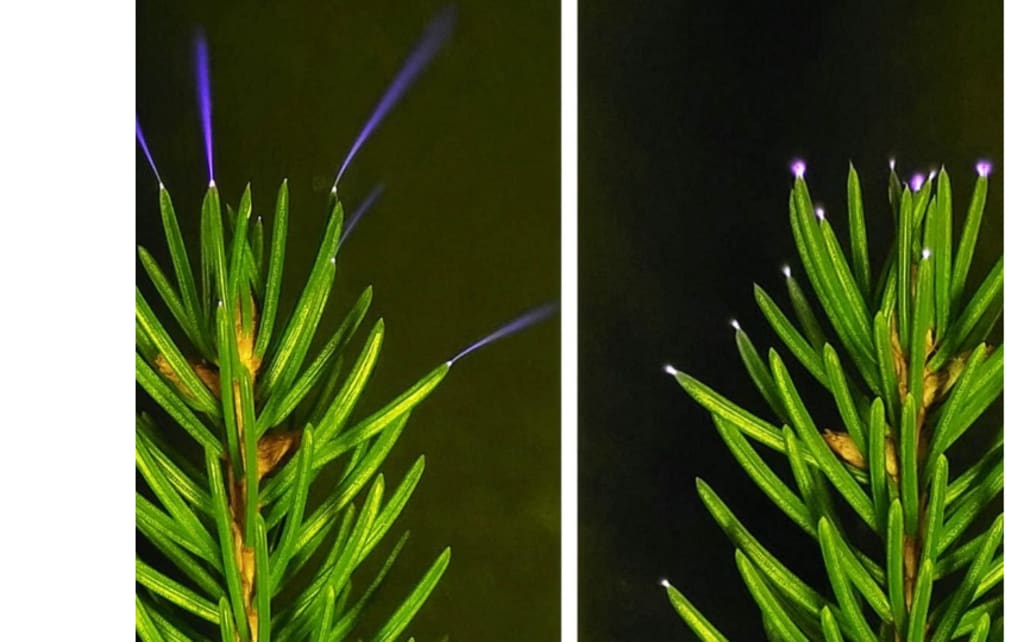
Most people picture rain, thunder, and the occasional lightning strike when they picture a thunderstorm passing over a forest. What we fail to envision is a subtle, scarcely perceptible illumination that shimmers across the tops of the trees. However, the air we breathe is altered by these electrical discharges.
Glowing treetops during thunderstorms
For almost a century, scientists have speculated the existence of this luminescence. When the electric field of a thunderstorm builds up overhead, a mild electrical spark known as a corona discharge forms on the ends of leaves. This kind of discharge on a tree in the wild had never been observed before. That was recently altered by a Penn State team.
This only demonstrates the ongoing nature of discovery science. Scientists have been speculating about the existence of the corona for more than 50 years, but this establishes it, according to P. J. McFarland, the study's lead author.
A corona: what is it?
Consider a corona to be the far more reserved relative of lightning. Lightning strikes quickly, violently, and with blinding heat. The opposite is a corona. It's a chilly, mild electrical leak. It is little warmer than the surrounding air.
When the surrounding electric field becomes sufficiently strong, coronas silently ooze out of sharp points, such as the tips of pine needles or the edges of jagged leaves. Coronas are almost invisible to us because they emit primarily ultraviolet light (UV). However, they are strong enough to alter the surrounding air's chemistry. They create enormous quantities of a chemical known as the hydroxyl radical. This molecule aids in the removal of air contaminants.
Glowing treetops are seen using a new instrument
A unique instrument installed on a research vehicle was created by the Penn State team. It is able to detect UV rays that would otherwise be drowned out by sunshine. A telescope and a UV camera make up the setup's core. Only a tiny sliver of light between 255 and 273 nanometres is "seen" by the camera.
Because of the ozone layer, sunlight in that range never reaches the ground. This implies that if UV is detected by this camera, it almost certainly originates from an electrical discharge. After that, the group pursued thunderstorms. As storms approached, they parked their car close to trees and aimed the telescope at the tops of the trees.
During a thunderstorm, a sweetgum tree
It all came together recently in Pembroke, North Carolina. The gadget was first focused at a sweetgum tree and subsequently a loblolly pine by the researchers. Directly overhead, a thunderstorm passed. The camera recorded hundreds of small UV lights dancing along the branches over the course of the following several hours.
The coronas were not stationary. From leaf to leaf, they hopped. Occasionally, the wind would push a single branch around, and they would follow it. The duration of each flicker ranged from a few seconds to a fraction of a second.
Each branch of the trees was radiant.
The glow's uniform distribution was one of the major surprises. The scientists discovered coronas wherever they aimed their telescope. They were found in every branch they looked at. They were present in both trees, and at fairly comparable frequencies.
Additionally, the researchers saw the same type of activity under four other storms on entirely different kinds of trees, ranging from Florida to Pennsylvania. This implies something remarkable. Almost every treetop beneath a forest is silently shimmering with these tiny sparks whenever a thunderstorm passes over it.
"Our instruments give rise to a vision of swaths of scintillating corona glowing as thunderstorms pass overhead, but it's nearly invisible to the naked eye," McFarland explained.
Assessing the Unseen
The crew was able to determine the real amount of energy passing through the trees by counting the UV photons that struck their camera. Approximately one microamp of current was being pushed by each corona. The trickle was very small. However, it was occurring on tree after tree, leaf after leaf.
The connection was verified by independent laboratory tests using potted spruce and maple trees. The UV glow's brightness and the electrical current flowing through the plant are perfectly matched. Researchers now have a dependable method for translating "how bright is the glow" into "how much current is flowing."
Why this is important
Some leaves may appear to be curious at first glance because to a little shine. In actuality, it is significant for three reasons. First, coronas generate massive quantities of hydroxyl radicals. They remove contaminants and hydrocarbons from the air in forests. In ways we never considered, forests may be cleaning themselves after storms.
Second, the delicate leaf tips may be gradually burnt by the coronas. Damage from that accumulates over several storms. This is particularly true in areas that frequently experience thunderstorms. Third, the thunderstorm itself may receive energy from the charged particles that coronas produce. That might have a subtle effect on the storm's behaviour.
According to McFarland, "such widespread coronae have implications for the removal of hydrocarbons emitted by trees, subtle tree leaf damage, and could have broader implications for the health of trees, forests, and the atmosphere."
Additional studies on glowing treetops
People have witnessed nothing but rain, lightning, and ominous clouds when standing beneath thunderstorms for generations. We now understand that there is more going on just above our heads. Quietly, the forest canopy is performing its own light show. The trees, the air, and perhaps even the storms themselves are being shaped by it. And that sheen will only intensify as more thunderstorms are caused by climate change.
About the Creator
Enjoyed the story? Support the Creator.
Subscribe for free to receive all their stories in your feed.
Comments
There are no comments for this story
Be the first to respond and start the conversation.