
Adhesion Barriers Market Grows as Surgical Volumes Rise and Focus Shifts to Post-Operative Care
Increasing surgical procedures, improved biomaterials, and awareness of post-operative complications are driving the adhesion barriers market toward US$ 2.15 billion by 2034 at a CAGR of 6.03%.

Adhesion Barriers Market Overview
The adhesion barriers market is gaining steady traction as healthcare systems increasingly focus on preventing post-surgical complications and improving patient outcomes. Adhesion barriers are medical devices used during surgery to prevent the formation of adhesions—bands of scar tissue that can develop between organs and tissues after surgical procedures.
These barriers are available in multiple forms, including films, gels, liquids, and sprays, and are designed to create temporary separation between tissues during the healing process. Once healing is complete, they are naturally absorbed by the body.
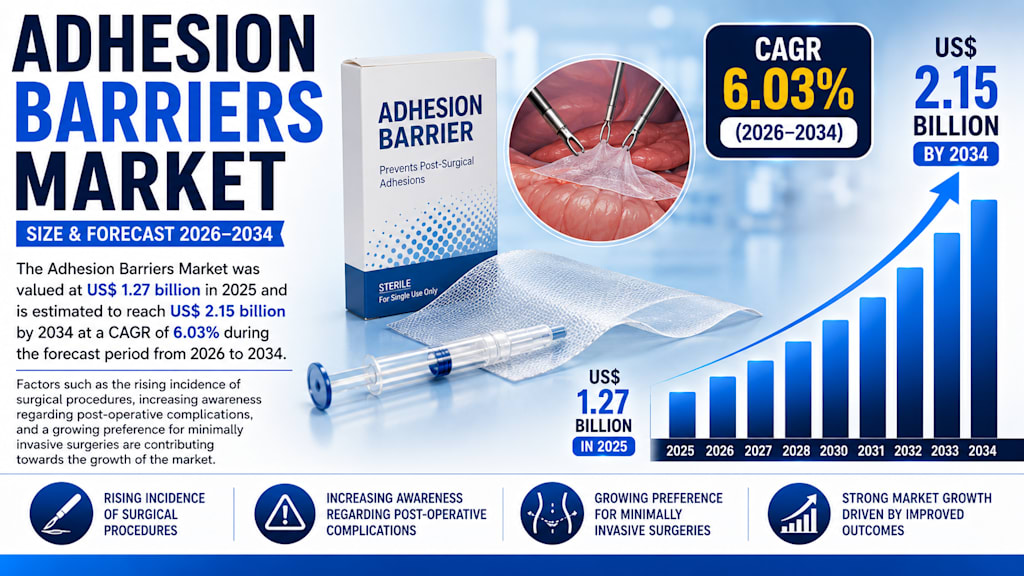
According to Renub Research, the adhesion barriers market was valued at US$ 1.27 billion in 2025 and is expected to reach US$ 2.15 billion by 2034, growing at a CAGR of 6.03% from 2026 to 2034.
The growing number of surgical procedures worldwide, combined with increasing awareness of adhesion-related complications, is positioning adhesion barriers as an essential component of modern surgical practice.
Key Growth Drivers in the Adhesion Barriers Market
Rising Volume of Surgical Procedures
One of the most significant drivers of market growth is the increasing number of surgical interventions globally. Surgeries account for a substantial portion of global healthcare activity, with millions of procedures performed annually across various specialties.
Procedures such as abdominal, gynecological, cardiovascular, and orthopedic surgeries are particularly associated with a high risk of adhesion formation. As a result, healthcare providers are increasingly adopting preventive solutions like adhesion barriers to improve patient outcomes and reduce the need for repeat surgeries.
Growing Awareness of Adhesion-Related Complications
Awareness of the clinical and economic impact of adhesions is rising among surgeons and healthcare institutions. Adhesions can lead to serious complications such as chronic pain, infertility, bowel obstruction, and additional surgeries.
Medical research, education, and guidelines are emphasizing the importance of prevention rather than treatment. Initiatives like the BeNeFIT project, involving multiple European research institutions, are further advancing understanding and adoption of adhesion prevention strategies.
Advancements in Biomaterials and Product Innovation
Technological advancements in biomaterials are significantly enhancing the effectiveness of adhesion barriers. Modern products offer improved biocompatibility, ease of application, and better performance in complex surgical environments.
Innovations include bioresorbable gels, films, and sprays that conform to irregular anatomical surfaces and are compatible with minimally invasive procedures. These advancements are increasing surgeon confidence and expanding the use of adhesion barriers across different surgical disciplines.
Challenges in the Adhesion Barriers Market
High Costs and Limited Reimbursement
The relatively high cost of adhesion barrier products is a major challenge for market growth. In many healthcare systems, these products are considered supplementary rather than essential, which limits reimbursement and adoption.
Budget constraints in hospitals and healthcare systems may prioritize essential surgical equipment over preventive solutions, even when adhesion barriers offer long-term cost savings.
Variability in Clinical Effectiveness
Another challenge is the variability in clinical outcomes associated with adhesion barriers. Effectiveness can depend on factors such as surgical technique, product application, and patient-specific conditions.
Lack of standardized protocols across different surgical disciplines can also lead to inconsistent adoption. Some surgeons continue to rely on traditional methods, which may slow the widespread use of these products.
Segment Insights in Adhesion Barriers Market
Synthetic Adhesion Barriers
Synthetic adhesion barriers are gaining popularity due to their predictable performance and lower risk of infection. These products are made from engineered polymers that provide consistent degradation rates and ease of handling.
Liquid Adhesion Barriers
Liquid adhesion barriers are increasingly used in minimally invasive surgeries due to their ease of application and ability to conform to complex anatomical structures. These products are particularly effective in laparoscopic procedures.
Gel Adhesion Barriers
Gel-based adhesion barriers offer strong clinical performance and flexibility. They adhere well to irregular surfaces and remain localized at the application site, making them suitable for high-risk surgical areas.
Gynecological Surgery Applications
The gynecological segment is a major contributor to market growth, driven by the high incidence of adhesion-related complications in procedures such as hysterectomy and endometriosis surgery. Preventing adhesions is critical for preserving fertility and improving patient outcomes.
Orthopedic Surgery Applications
In orthopedic surgeries, adhesion barriers help reduce complications such as stiffness and reduced mobility. The growing number of joint and spine surgeries is driving demand in this segment.
United States Adhesion Barriers Market
The United States is one of the most developed markets for adhesion barriers, supported by high surgical volumes and strong awareness of post-operative complications. Advanced healthcare infrastructure and early adoption of innovative technologies contribute to market growth.
In September 2025, Womed received FDA premarketing approval for its adhesion barrier product, highlighting ongoing innovation in the market.
United Kingdom Adhesion Barriers Market
The UK market is growing steadily, driven by increasing surgical procedures and awareness of adhesion prevention. The National Health Service plays a key role in promoting high-quality surgical care and adopting advanced medical technologies.
Despite cost constraints, the focus on reducing long-term healthcare expenses through prevention supports the adoption of adhesion barriers.
India Adhesion Barriers Market
India’s adhesion barriers market is expanding rapidly due to rising surgical volumes, improved healthcare infrastructure, and growing awareness among surgeons.
Private hospitals and specialty centers are leading adoption, while medical tourism and investments in advanced technologies are further supporting growth. However, cost sensitivity remains a challenge in broader adoption.
Saudi Arabia Adhesion Barriers Market
Saudi Arabia’s market is growing steadily, supported by increasing healthcare investments and rising awareness of post-operative care.
The expansion of private healthcare facilities and adoption of advanced surgical technologies are driving demand for adhesion barriers in the region.
Market Segmentation
The adhesion barriers market is segmented by product type, formulation, application, and geography. Products include synthetic and natural barriers, while formulations include films, liquids, and gels.
Applications span gynecological, abdominal, cardiovascular, orthopedic, neurological, and urological surgeries. Geographically, the market covers North America, Europe, Asia-Pacific, Latin America, and the Middle East & Africa.
Key Companies in the Adhesion Barriers Market
Leading companies in the market include Anika Therapeutics, Baxter International, Integra LifeSciences, Johnson & Johnson, Medtronic Plc, Medical Devices Business Services, and Groupe Sanofi. These companies are driving innovation through advanced biomaterials and product development strategies.
Final Thoughts
The adhesion barriers market is becoming increasingly important as healthcare systems shift toward preventive care and improved surgical outcomes. By reducing complications and enhancing patient recovery, adhesion barriers are playing a vital role in modern surgical practices.
With ongoing advancements in biomaterials, rising surgical volumes, and growing awareness among healthcare professionals, the market is set for steady growth in the coming years.
About the Creator
Enjoyed the story? Support the Creator.
Subscribe for free to receive all their stories in your feed.
Comments
There are no comments for this story
Be the first to respond and start the conversation.