
A Tiny Implant Is Changing What We Know About Blindness
Restoring Vision Through Bioelectronics: Inside UCL’s Retinal Implant Breakthrough
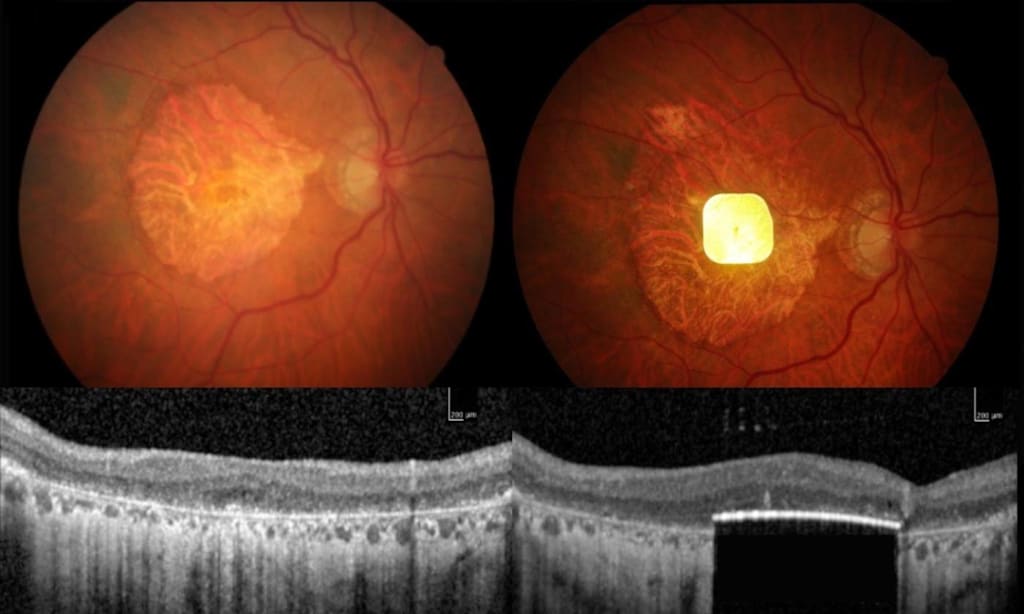
The future of medicine is increasingly shifting from chemical intervention to engineered biological integration. Nowhere is this transition more evident than in the field of retinal implants, where researchers are redefining blindness not simply as a loss of function, but as a disruption in signal transmission—one that can potentially be reconstructed. A recent clinical breakthrough led by University College London (UCL), in collaboration with Moorfields Eye Hospital, offers compelling evidence that vision, even after significant degeneration, can be partially restored through bioelectronic systems.
The study, published in The New England Journal of Medicine, evaluated a novel retinal implant system known as PRIMA, developed by Science Corporation. This system was tested in patients suffering from geographic atrophy, an advanced form of dry age-related macular degeneration (AMD) that leads to irreversible loss of central vision. For decades, there has been no effective treatment for this condition, particularly in its late stages where photoreceptor cells in the macula have completely degenerated. What makes this study remarkable is not only the restoration of visual perception, but the recovery of functional vision—specifically, the ability to read.
In a multi-center European clinical trial involving 38 patients, 84% of participants were able to recognize letters, numbers, and words using the implanted system. Prior to treatment, these individuals had lost all central vision in the affected eye, rendering them unable to perform even basic visual tasks such as reading a chart. Following implantation and rehabilitation, patients were able to read an average of five lines on a standard vision chart. This level of recovery represents a significant improvement in quality of life, restoring not only functional independence but also psychological confidence.
At the core of this innovation lies a subretinal photovoltaic implant—an ultra-thin microchip measuring just 2 mm by 2 mm and approximately 30 micrometres thick, about half the thickness of a human hair. Surgically inserted beneath the retina, the implant replaces the function of lost photoreceptors. Unlike traditional electronic implants that require wired connections, the PRIMA system operates wirelessly. It is paired with augmented-reality glasses equipped with a camera and a portable processing unit. The camera captures the visual environment, and advanced algorithms convert this information into simplified signals that can be interpreted by the brain.
These processed signals are then transmitted as near-infrared light projected directly onto the implant. Acting much like a miniature solar panel, the implant converts this الضوء into electrical stimulation, activating the remaining retinal neurons. These neurons, still intact despite photoreceptor loss, transmit the signals through the optic nerve to the brain. The brain, in turn, reconstructs these signals into visual patterns. Rather than restoring natural vision in its original form, the system enables what is often described as “prosthetic vision”—a learned interpretation of structured electrical input.
An essential dimension of this technology is neuroadaptation. Patients do not immediately regain intuitive sight after the implant is activated. Instead, they undergo months of structured rehabilitation, during which the brain gradually learns to interpret the new signals. This process underscores a fundamental truth in neuroengineering: vision is not solely a function of the eye, but of the brain’s ability to decode information. In this sense, the PRIMA system represents not just a medical device, but a dynamic interface between artificial systems and neural plasticity.
Equally important is the practicality of the surgical procedure. The implantation is performed using a standard vitrectomy technique and can be completed in under two hours by a trained vitreoretinal surgeon. This level of procedural accessibility is critical for future scalability, suggesting that the technology could be adopted more widely if regulatory approval is achieved. Notably, the study reported no significant deterioration in patients’ remaining peripheral vision, reinforcing the safety profile of the intervention.
This breakthrough signals a broader shift in biomedical engineering—from attempting to repair damaged biological structures to bypassing them entirely through engineered systems. By directly interfacing with neural pathways, retinal implants like PRIMA demonstrate that lost sensory functions can be reconstructed through alternative signal routes. As advances in artificial intelligence, materials science, and neurotechnology continue to converge, the implications extend far beyond ophthalmology.
Ultimately, this work positions bioelectronic implants at the forefront of a new medical paradigm—one where the boundaries between biology and technology become increasingly fluid. The restoration of reading vision in patients who were once completely blind in their central field is not merely a clinical milestone; it is a proof of concept that the human sensory system can be augmented, reprogrammed, and, in certain respects, rebuilt.
For a deeper scientific exploration, readers are encouraged to consult the original study published in The New England Journal of Medicine, which provides comprehensive clinical and technical insights into this transformative technology.
As we look ahead, one question becomes unavoidable: if vision can be restored through engineered signals today, how far are we from enhancing it beyond its natural limits tomorrow?
About the Creator
The Biotech Lens
Delivering in-depth biotechnology advancements, cutting-edge research breakthroughs, and pivotal industry narratives.
Enjoyed the story? Support the Creator.
Subscribe for free to receive all their stories in your feed.
Comments
There are no comments for this story
Be the first to respond and start the conversation.