
A piece of the Milky Way fossil shows how our galaxy began.
An extended memory system

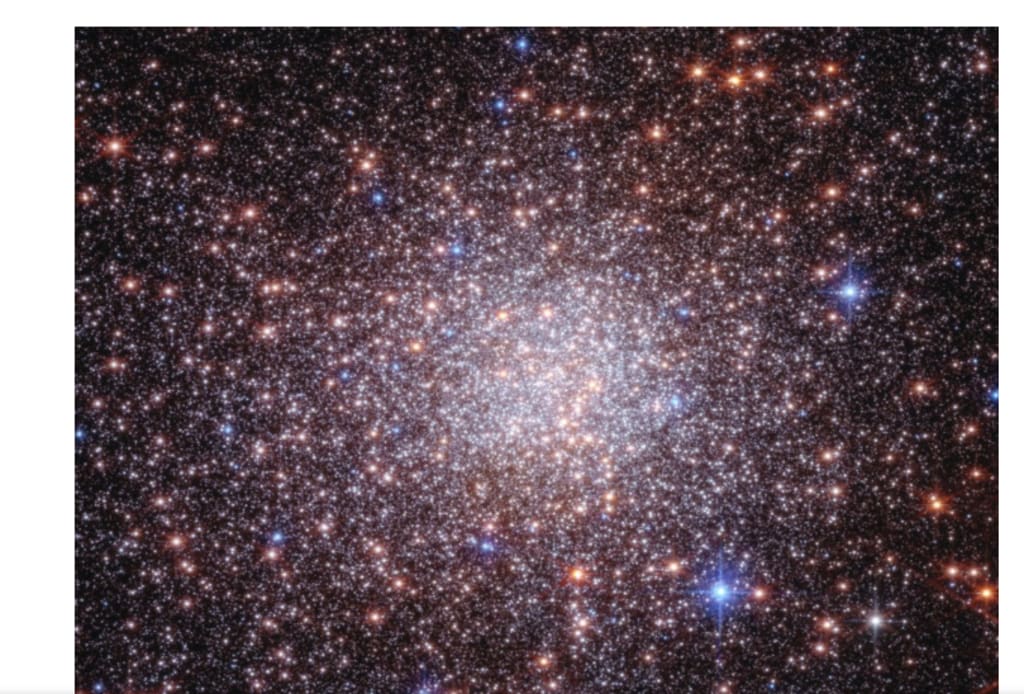
The Milky Way's center is everything from peaceful. The area is covered in stars, studies are hampered by dust clouds, and the galaxy's early past is still visible throughout its densely populated core.
For a long time, astronomers have thought that during the early stages of the galaxy's development, the majority of the stars there merged together. However, one peculiar item seems to have taken a completely different route.
Terzan 5, a star system, is not what astronomers previously believed it to be, according to new discoveries from NASA's Hubble Space Telescope and James Webb Space Telescope.
It was categorised for many years as a globular star cluster, which is a kind of object that usually has a single old star population. The new results show a far more complex picture.
An extended memory system
Astronomer Azop Terzan made the discovery of Terzan 5 in 1968. It initially appeared to resemble many of the Milky Way's globular clusters. Stars that formed during a single period billions of years ago are typically found in those clusters.
When astronomers discovered that Terzan 5 had two different groups of stars in 2009, the image began to shift. According to Hubble observations from 2016, one population developed approximately 12 billion years ago, while the other formed approximately 5 billion years ago. Terzan 5 seemed out of the ordinary even then.
Giorgia Zullo, a PhD candidate at the University of Bologna in Italy, oversaw the study. "We now have a much clearer picture of Terzan 5's history thanks to Webb's new near-infrared observations cross-referenced with Hubble's archival observations," stated Zullo.
Four star generations
Because Terzan 5 is located inside the Milky Way's bulge, a crowded center region full of stars and obscuring dust, studying it is challenging. Astronomers were able to see through a lot of that dust and find many dim stars that were overlooked by previous investigations because of Webb's infrared detectors.
To ascertain the stars' ages and chemical composition, scientists examined their colours and brightness. Hubble was also quite important. Researchers studied minute stellar motions and distinguished Terzan 5 stars from unrelated stars in the surrounding bulge by comparing observations made 12 years apart.
Recurring star formation episodes
The combined data showed evidence for four stellar populations instead of simply two. The oldest stars were found to have formed 12.5 billion years ago. 4.7 billion years ago, a new generation emerged. 3.8 billion and 2.5 billion years ago, two more populations emerged.
The findings imply that, contrary to what is known about globular clusters, Terzan 5 had numerous periods of star formation over billions of years. The reasons behind Terzan 5's continued success
Dust and gas clouds give rise to stars. Heavy elements are produced and material is blasted into the surrounding space when huge stars explode as supernovae. Because the explosions force that material away, smaller systems frequently lose it.
Terzan 5 seems to have been large enough to retain such components. The heavier components created by previous stars were integrated into subsequent generations of stars.
Chemically different stars
These chemically different populations are confirmed by measurements from the W. M. Keck Observatory and the Very Large Telescope of the European Southern Observatory. R. Michael Rich, a research astronomer at the University of California, Los Angeles (UCLA), is a co-author of the study.
According to Rich, "the cluster preserves a fossil record of progressive enrichment of heavy elements by supernovae along with the ages of these populations."
Simpler theories are no longer valid because astronomers discovered four distinct generations of stars. Terzan 5 may have crashed with another cluster or absorbed new gas from somewhere else, according to earlier theories. These theories seem improbable in light of the new facts.
A survival from the early Milky Way
A more dramatic conclusion is suggested by the study. When the Milky Way first formed 12.5 billion years ago, Terzan 5 was most likely a part of a much larger star system. The majority of comparable structures would have long since blended into the expanding galactic bulge. Somehow, Terzan 5 managed to survive.
According to Francesco R. Ferraro, the chief investigator of the Webb observations, "for some reason, this peculiar clump of stars formed separately from the bulge and was not destroyed as the bulge itself formed."
"Because Terzan 5 resembles the primordial clumps that contributed to the formation of the bulge, we now refer to it as a bulge fossil fragment." The same classification has only been applied to one other known object. It is also home to several generations of stars and is known as Killer 1.
In order to determine whether there are any more undiscovered fossil bits within the Milky Way's bulge, researchers now intend to investigate 40 to 50 other clusters. Indications of how galaxies expand
The ramifications go much beyond our galaxy.
Professor Barbara Lanzoni, a co-author of the paper, stated, "We believe that galaxies in the early universe had huge discs of gas that fragmented into clumps and formed stars based on observations and in-depth simulations."
"Many of these clumps merged to form their bulges after migrating to the center of the galaxies." Several distant galaxies with this clumpy look, such as the Firefly Sparkle galaxy, which existed when the universe was only a few hundred million years old, have been discovered by recent Webb studies.
According to Lanzoni, "Terzan 5 may offer direct evidence that can help explain how bulges formed in galaxies throughout the universe." Terzan 5 may be more than just a peculiar group of stars for astronomers attempting to comprehend the formation of galaxies. Preserved for billions of years in plain sight, it might be one of the rare remnants of the Milky Way's early construction history.
About the Creator
Enjoyed the story? Support the Creator.
Subscribe for free to receive all their stories in your feed.
Comments
There are no comments for this story
Be the first to respond and start the conversation.