
A Day in 2050: The Future Didn’t Arrive Suddenly—It Just Became Normal
Waking up in a world where AI, climate adaptation, and digital identity quietly redefine what it means to live

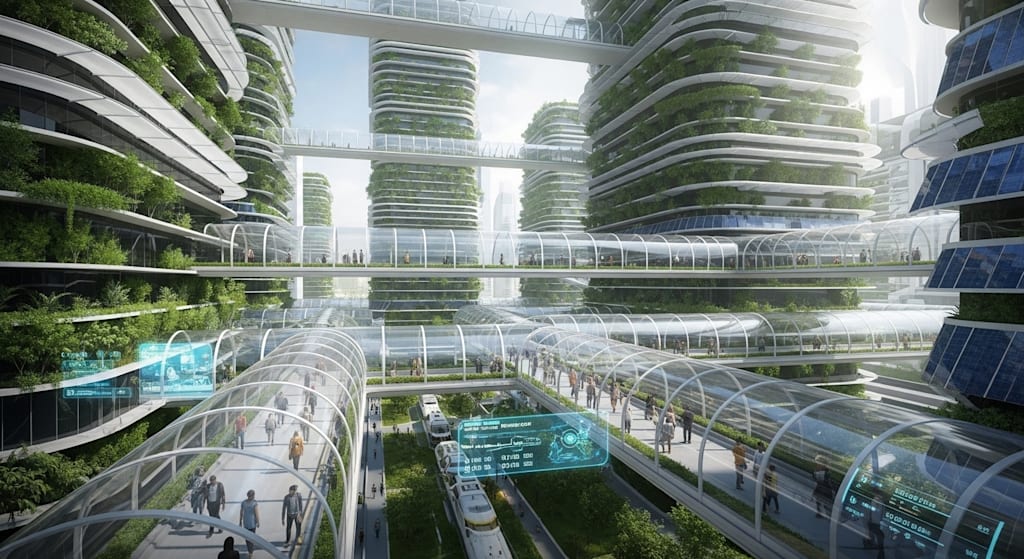
You don’t wake up in 2050 and feel like you’ve entered the future.
That’s the first misconception.
There are no flying cars waiting outside your window. No dramatic neon skylines announcing a new era. No obvious dividing line between “then” and “now.”
Instead, everything feels slightly familiar—but adjusted.
Like someone took the world you know and quietly optimized it overnight.
Your alarm doesn’t ring anymore. It knows when your sleep cycle has completed its most restorative phase and gently nudges you awake with light and sound calibrated to your stress levels. You don’t check your phone first thing in the morning—it’s already filtering what matters, what can wait, and what you don’t need to see at all.
You didn’t ask for that exactly.
But you also didn’t refuse it.
Because by 2050, most convenience is no longer optional. It’s ambient.
Your personal AI doesn’t feel like a tool anymore. It feels like a layer of cognition you were born slightly incomplete without. It remembers appointments you never consciously made. It drafts replies you edit lightly before sending. It notices patterns in your behavior before you do.
And slowly, without ceremony, it becomes difficult to remember how you functioned without it.
Outside, the city is quieter than older generations expected.
Not because it is empty—but because it is optimized for flow. Traffic is largely autonomous. Logistics are predictive. Crowds are distributed in real time based on environmental load balancing systems designed to reduce friction.
Even chaos has been partially engineered out of daily life.
Not removed. Just softened.
Work, for most people, no longer looks like “going to work.” It looks like managing systems, making decisions AI cannot ethically or creatively finalize, and overseeing outputs that scale far beyond human capacity alone.
The idea of a single career has blurred.
People don’t “become” one thing anymore. They rotate through skill clusters, identity profiles, and adaptive roles that shift depending on global demand and personal cognitive preference models.
Your professional identity is less a job title and more a dynamic profile.
Some days you design solutions.
Some days you supervise automation behavior.
Some days you do nothing that would have been recognized as “work” in the early 21st century at all.
And yet, people still feel busy.
Perhaps even more than before.
The difference is that busyness is no longer tied to physical effort. It’s tied to cognitive load—the constant balancing of decisions, filters, and micro-adjustments between human intention and machine suggestion.
But the most significant change isn’t technological.
It’s emotional.
By 2050, emotional interaction has become partially mediated.
Not replaced—but supported, analyzed, and gently guided.
AI systems can detect early signs of emotional distress in communication patterns. They can suggest when to step away from conversations. They can simulate empathy responses in digital interactions with increasing accuracy.
And because of that, people are rarely emotionally alone in the technical sense.
But something more subtle has shifted.
Emotional dependence no longer looks like addiction to devices.
It looks like trust in systems that understand you more consistently than people do.
This raises a question no one fully agrees on:
If something understands your emotional patterns better than most humans in your life, does it become a form of relationship?
Some say yes.
Others insist it’s just advanced tooling.
But in practice, the distinction becomes harder to maintain.
Even memory has changed.
Not biological memory—but externalized continuity.
People outsource remembering. Not just facts, but emotional logs, life narratives, and decision histories. You can revisit versions of yourself from years ago—not just through photos, but through reconstructed behavioral models of who you were at that time.
It is possible, in a limited sense, to meet an earlier version of yourself.
Not as nostalgia—but as data.
And sometimes that is more unsettling than comforting.
Because you realize how much of “you” is just a pattern maintained over time rather than a fixed identity.
Still, not everything is seamless.
There are tensions.
Between automation and autonomy.
Between convenience and agency.
Between systems that predict your needs and the quiet human desire to surprise yourself.
Some people resist full integration.
They limit AI assistance. They choose slower systems. They intentionally introduce inefficiency into their lives—not because it is better, but because it feels more self-authored.
These people are often called “friction users.”
A small cultural movement built around the idea that struggle is not always a problem to solve.
It is sometimes a way to stay human.
Meanwhile, cities have adapted to climate reality in ways that are no longer dramatic headlines but standard infrastructure. Coastal zones are redesigned. Heat-managed districts regulate temperature through distributed environmental grids. Migration is not a crisis—it is a managed constant.
The world did not “fix” climate change.
It adapted to living inside it.
And perhaps the most important realization of 2050 is this:
The future does not feel like a destination.
It feels like a condition.
A stable, evolving environment that you participate in rather than arrive at.
There is no moment when you can point and say, “Now we are in the future.”
Only a gradual recognition that the present has quietly outgrown the past.
And if you look closely, the most advanced technology of all is not artificial intelligence, or automation, or synthetic environments.
It is adaptation.
The ability of humans to normalize almost anything—given enough time.
So in 2050, the question is no longer “What will the future look like?”
It is:
What will we stop noticing along the way?
About the Creator
Enjoyed the story? Support the Creator.
Subscribe for free to receive all their stories in your feed.
Comments
There are no comments for this story
Be the first to respond and start the conversation.