
The Joneses
Keeping Up with the Jones' has never been so Dangerous

They arrived on a Thursday, which is the worst day for envy.
Mondays are too busy, Fridays too forgiving. Thursdays sit in the middle like a held breath—long enough for comparison to bloom, short enough that you still think you can do something about it.
The moving truck was spotless. Not clean—spotless, like it had never been touched by dust, like it had been assembled in a place that didn’t believe in dirt. It idled at the end of Alder Row without coughing, without shaking. Even the engine sounded… polite.
By evening, the house was done.
No one saw furniture go in. No one saw boxes. The windows glowed anyway, all of them, in a warm, amber grid that made the rest of the street feel dimmer by comparison. The lawn was trimmed in perfect diagonals. The hedges were symmetrical. The mailbox, freshly installed, bore a single word:
JONES.
Evan noticed first.
“It’s too fast,” he said, standing at the kitchen sink, dishwater cooling around his hands. “No one moves in that fast.”
Clara didn’t look up from her phone. “Maybe they hired help.”
“Help doesn’t make a place look like a magazine overnight.”
Clara finally turned, following his gaze through the window. The Jones house sat directly across from theirs, framed by the last light of day. It didn’t just look nice. It looked finished, in a way that suggested it had always been finished, that it had never been anything else.
“People have money,” she said.
It wasn’t an argument. It was a quiet accusation.
Evan dried his hands. “We have money.”
Clara gave him a look that hovered somewhere between patience and disappointment. “We have enough.”
Across the street, a garage door slid open without a sound.
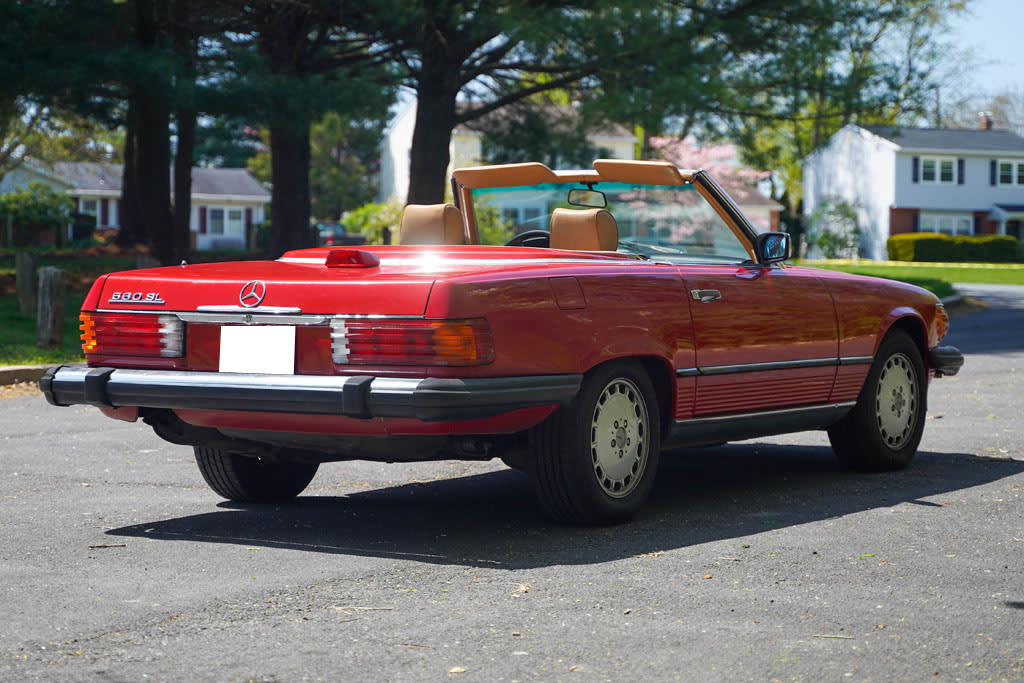
The car inside caught the fading light and threw it back in a sharp, blood-red gleam.
A drop-top 1984 Mercedes-Benz. Perfect. Not restored—restoration implies history, flaws corrected. This car had no past. The paint was too deep, too alive. The chrome didn’t reflect the world; it seemed to reject it.
The man who stepped into the driveway wore a suit that fit like it had opinions. He didn’t wave. He simply existed, and in existing, suggested that everything around him could be improved.
Clara stepped closer to the window.
“That’s…” she began.
“Yeah,” Evan said.
They stood there, shoulder to shoulder, watching the man slide into the car. The engine purred, low and assured, and when he drove off, it felt less like leaving and more like the street had been temporarily released from his presence.
Clara exhaled.
“We should redo the front,” she said.
Evan didn’t answer right away.
“We just did the front,” he said finally.
She nodded, but her eyes stayed on the empty driveway across the street. “We can do better.”
—
The first change was the lawn.
Evan hired a landscaping company that used words like “precision” and “architectural flow.” They tore up the yard and replaced it with something that looked less like grass and more like intention. Lines were drawn. Edges were sharpened. The neighbors noticed.
“Looks great,” Mrs. Pritchard said, leaning over the fence.
Clara smiled. “Thank you.”
But when she turned back to the house, her smile faltered.
Across the street, the Jones lawn had changed.
Not dramatically. That was the unsettling part. It had always been perfect, but now it was… more. The green was richer, the lines impossibly clean, as if the grass had decided, collectively, to be better.
Evan saw it too.
“They probably redid it,” he said.
“When?”
He didn’t answer.
—
The second change was the car.
It started as a joke.
“We could get something nicer,” Clara said one night, scrolling through listings. “Not like that, but—”
“Like what?” Evan asked.
She turned the screen toward him. Sleek lines, polished finishes, cars that looked like they had never been driven, only admired.
Evan hesitated. “We don’t need—”
“We don’t need a lot of things.”
There it was again. Not anger. Not even frustration. Just that quiet, steady pressure, like water finding its way through stone.
Two weeks later, the old sedan was gone.
In its place sat something new. Something that turned heads, that made the neighbors pause, that made Evan feel, briefly, like he had corrected a mistake he hadn’t realized he’d made.
Clara ran her hand along the hood. “See?” she said. “Feels good, doesn’t it?”
Evan nodded.
That night, he woke to a sound.
Not loud. Not obvious. Just… wrong.
He got out of bed and went to the window.
Across the street, the Jones garage was open.
The red Mercedes sat inside, but it wasn’t still.
It shifted.
Not like a car settling. Not like metal cooling. It moved with intention, a subtle realignment, as if it were adjusting itself to a standard no one else could see.
Evan blinked.
The garage door slid shut.
In the darkness, he told himself he had imagined it.
—
The third change was the inside.
Clara wanted new furniture. Then new lighting. Then the walls felt wrong, so they repainted. Then the floors didn’t match, so they replaced them. Each improvement revealed another flaw, another place where the house failed to be what it could be.
“It’s an investment,” Clara said, standing in the middle of the living room, surrounded by samples and swatches. “We’re increasing the value.”
Evan nodded, but the word value had started to feel slippery.
Value compared to what?
Compared to them.
He stopped sleeping well.
Every night, something in the Jones house changed. A window would be slightly larger. A line sharper. A color deeper. It was never enough to point to, never enough to prove, but it accumulated, night after night, like interest on a debt he couldn’t track.
One night, he saw the man again.
Standing in the driveway, looking directly at him.
Evan froze.
The man smiled—not warmly, not cruelly, just… knowingly.
Then he raised his hand, not in a wave, but in a gesture that felt like invitation.
Or challenge.
—
“Do you think they’re watching us?” Evan asked.
Clara didn’t look up. “Who?”
“The Joneses.”
She laughed, but it was thin. “Why would they care about us?”
Evan didn’t have an answer that didn’t sound insane.
Because every time we change something, they change more.
Because their house isn’t just better—it’s becoming better.
Because I think they’re waiting for us to catch up.
He shook his head. “Never mind.”
Clara finally looked at him, really looked. “Evan… what’s going on with you?”
He wanted to tell her.
Instead, he said, “We should redo the kitchen.”
—
It escalated.
Not all at once. That would have been obvious, stoppable. Instead, it crept.
They took out a loan.
Then another.
Clara stopped talking about “want” and started talking about “necessary.” The house had to be right. It had to be complete. It had to be enough.
Evan found himself agreeing, even when he didn’t understand why.
Across the street, the Jones house thrived.
It didn’t just improve. It refined. Each change was precise, deliberate, as if guided by a vision that existed fully formed somewhere beyond sight.
The neighbors started to drift.
Mrs. Pritchard stopped coming outside.
The Millers put their house up for sale, then took the sign down two days later without explanation.
A tension settled over Alder Row, a quiet, collective unease that no one acknowledged.
Except Evan.
He started keeping a notebook.
He documented every change—every shift in color, every adjustment in structure. He took photos, compared them, tried to find something solid, something he could point to and say, There. That’s impossible.
But the evidence slipped.
Photos blurred. Details refused to hold.
It was like trying to remember a dream.
—
The breaking point came with the car.
Clara stood in the driveway, arms crossed, staring at the Jones garage.
“We need something better,” she said.
Evan followed her gaze.
The red Mercedes sat in the open, gleaming in the late afternoon sun. It looked… sharper than before. More defined. As if the idea of the car had been clarified.
“That’s not normal,” Evan said.
Clara didn’t respond.
“We just bought this car,” he continued. “We can’t—”
“It’s not about the car.”
“Then what is it about?”
She turned to him, and for a moment, he didn’t recognize her.
“It’s about not being left behind.”
The words hung in the air.
Left behind where?
Evan opened his mouth, then closed it.
He didn’t know.
That was the problem.
—
That night, he went outside.
Alone.
The street was quiet, the kind of quiet that feels deliberate, curated. The Jones house glowed softly, every window lit.
Evan crossed the street.
Each step felt heavier than it should have, as if the air itself resisted him. The closer he got, the more the house seemed to… expand. Not physically, not in a way he could measure, but in presence. It filled his vision, his thoughts, his sense of space.
He reached the front door.
It opened before he could knock.
The man stood there, smiling.
“Evan,” he said, as if greeting an old friend. “You’re almost there.”
Evan swallowed. “What is this?”
The man stepped aside. “Come in.”
Evan hesitated.
Then he stepped inside.
—
The interior was impossible.
Rooms extended beyond the walls, angles that didn’t align, spaces that felt both vast and intimate. Everything was perfect, but not in a human way. It was perfect in a way that suggested the concept of imperfection had never existed.
“Do you like it?” the man asked.
Evan turned slowly. “It’s… too much.”
The man smiled. “That’s because you’re still thinking in terms of limits.”
“What are you?”
The man tilted his head. “We’re what happens when the idea of ‘better’ is taken seriously.”
Evan felt a cold weight settle in his chest.
“This isn’t real.”
“It’s more real than what you had,” the man said gently. “You saw that. That’s why you started changing things.”
“You made us do that.”
“No,” the man said. “You did that. We just… showed you what was possible.”
Evan shook his head. “At what cost?”
The man gestured around them. “Does it look like we’re lacking anything?”
Evan thought of the loans. The sleepless nights. Clara’s distant eyes.
“You’re not paying the price,” he said.
The man’s smile didn’t falter.
“Not in the way you understand.”
—
Evan ran.
He didn’t remember leaving the house. One moment he was inside, the next he was on the street, the night air hitting his face like a warning.
He stumbled back into his own home.
“Clara!” he called.
No answer.
He found her in the living room, standing perfectly still.
“Clara?”
She turned slowly.
Her eyes were bright. Too bright.
“It’s almost done,” she said.
Evan’s stomach dropped. “What is?”
“The house.”
He looked around.
Everything was… better.
Sharper. Cleaner. More defined. The changes he had pushed for, the ones she had insisted on—they had all coalesced into something that felt eerily similar to the Jones house.
“No,” Evan said. “No, we’re stopping.”
Clara smiled.
“Why would we stop now?”
Because there’s no end to it, he wanted to say.
Because “better” doesn’t have a ceiling.
Because we’re not improving—we’re being replaced.
But the words wouldn’t come.
Outside, a car engine purred.
Evan turned to the window.
The red Mercedes sat in their driveway.
Not across the street.
Here.
The driver’s door opened.
The man stepped out.
Evan backed away.
“You don’t get to just—” he began.
The man raised a hand, and the words died in Evan’s throat.
“You’ve done very well,” he said. “Most people resist longer. Or they give up too soon.”
Evan forced himself to speak. “What happens now?”
The man glanced at the house, then at Clara.
“You finish.”
Evan shook his head. “And then?”
The man’s smile widened, just a fraction.
“Then you move in.”
Evan’s breath caught.
“This is our house.”
The man’s eyes flicked to the street.
Evan followed his gaze.
Across the road, where the Jones house had been, there was now something… smaller.
Less defined.
A house that looked familiar.
Too familiar.
Evan’s pulse roared in his ears.
“No,” he whispered.
The man stepped closer.
“Better is a direction, Evan. Not a destination.”
Clara took Evan’s hand.
“It’s okay,” she said softly. “We’re almost there.”
Her grip tightened.
Too tight.
Evan looked at her, really looked.
At the brightness in her eyes.
At the stillness beneath her smile.
At the way she seemed… aligned.
Like a piece that had found its place.
He looked back at the street.
At the smaller house.
At the faint, flickering lights inside.
At the silhouettes moving behind the windows.
Watching.
Waiting.
Evan understood, then.
There was always someone across the street.
There was always someone trying to catch up.
He turned to the man.
“What happens to them?” he asked, nodding toward the smaller house.
The man’s expression didn’t change.
“They improve,” he said.
Evan closed his eyes.
When he opened them, the world felt… sharper.
Clearer.
He could see the flaws now, everywhere—the slight imperfections in the walls, the subtle inconsistencies in the light. Things he had never noticed before, things he suddenly couldn’t ignore.
He felt Clara’s hand in his.
Felt the house around him, breathing, waiting.
Across the street, the smaller house glowed.
Inviting.
Insufficient.
Evan took a step forward.
Then another.
The man watched, satisfied.
“Welcome,” he said, “to the neighborhood.”
And somewhere, in a house that suddenly felt too small, someone looked out their window and decided they could do better.
About the Creator
Violet Hamilton
Harlem born. Author of Shark Weak. Wrote multiple Award-Winning Cast and Crew screenplay "What If" and "Trickster." Educated. World traveler. I now reside in Long Island, New York. I adore writing. It's the only time I get to play God.
Enjoyed the story? Support the Creator.
Subscribe for free to receive all their stories in your feed.
Comments
There are no comments for this story
Be the first to respond and start the conversation.