
The Building Made a Decision
Nothing collapses all at once—until it does.

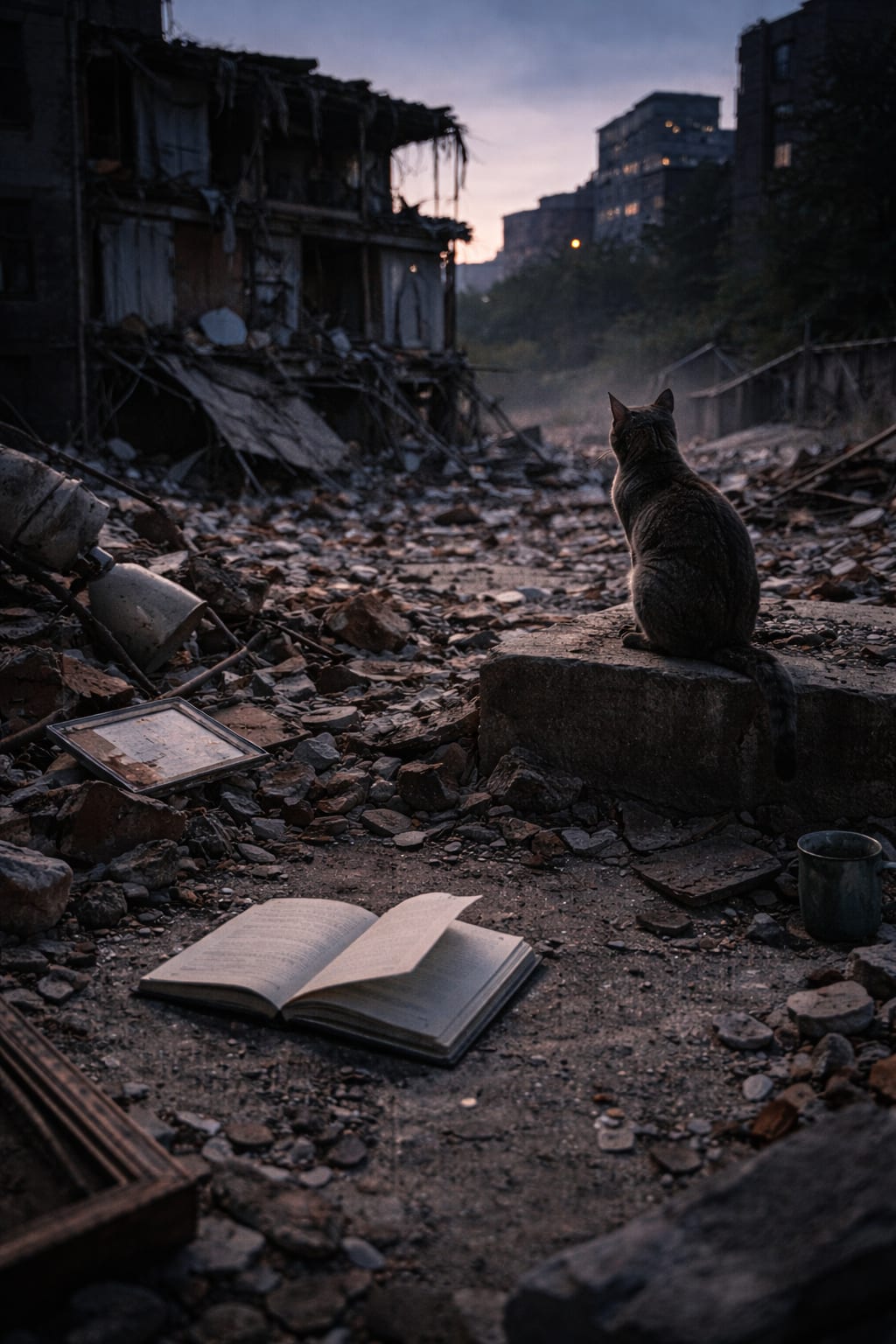
They named the cat Consequences because nobody wanted him, and because it was easier to give a thing a name than to admit what it meant.
He arrived without ceremony—no thunder, no dramatic rain—just a thin gray body slipping through the half-broken front door as if he had always known the building would leave itself open. His fur looked like it had been brushed by too many wrong days. His tail bent at a place that suggested something had already gone badly and stayed that way.
“Bad omen,” Mrs. Ross said, clutching her grocery bag like it might argue with her. “Mark my words.”
“Good cat,” Lila said, because she needed something in this city to choose her first.
The cat looked at neither of them. He walked past, slow and certain, climbed the stairs that complained under his weight, and stopped at Lila’s door. When she opened it, he walked in.
That was that.
“You can stay,” she told him, her voice softer than she intended. “But I’m not calling you Consequences.”
He blinked.
She sighed. “Fine. I’m calling you Consequences.”
—
The building was the kind that held on too long.
It had once been proud—there were traces of it in the molding, in the tall windows that still tried to catch light like it mattered. But now it sagged in small, tired ways. The hallway leaned. The pipes coughed. The floor carried a quiet, steady complaint no one could quite locate.
Lila rented 2B because it was cheap and because she had run out of places that said yes.
She unpacked slowly, like someone who wasn’t sure if staying was a promise or a mistake. A notebook on the table. A coat on the chair. A single mug in the cabinet.
Consequences made himself at home with the confidence of something that had never believed in permission. He chose her coat as his bed. He chose the windowsill as his lookout. He chose, occasionally, her lap—only when she wasn’t asking for it.
At night, she wrote.
Stories, mostly. The kind that started with a feeling and ended with a quiet absence where something used to be. She didn’t mean for them to turn that way. They just did.
Consequences would sit beside her, his body a small, steady warmth, and watch her hand move across the page like he was waiting for something to go wrong.
Sometimes, he would press his paw down on a line.
“Don’t,” she’d say, gently moving him. “It’s not done yet.”
He never argued. He just watched.
—
Across the hall lived Kevin.
He had the kind of tired that didn’t complain about itself. He worked nights, slept in pieces, and spent his spare hours fixing things no one had asked him to fix.
The railing. The flickering light. Mrs. Ross’s sink.
“Everything breaks,” he said once, tightening a screw that didn’t want to hold. “You just decide how long you can pretend it’s not happening.”
“That’s… not comforting,” Lila said.
He smiled a little, like he knew that already. “It’s not supposed to be.”
Consequences liked Kevin. Not in any obvious way—he didn’t curl up beside him or purr—but he allowed him near, which was the closest thing the cat had to approval.
Kevin never tried to pet him. He just existed in the same space, steady and quiet.
“You should give him a different name,” Kevin said one afternoon, watching the cat stare out the window.
“Like what?”
Kevin thought for a moment. “Second Chance.”
Lila laughed, but it caught halfway. “That’s worse.”
“Yeah,” he said. “It is.”
—
The first notice came folded, like it was trying to be polite.
STRUCTURAL CONCERNS.
“Concerns,” Mrs. Ross repeated, outraged. “Everything has concerns. My cholesterol has concerns.”
Lila read it twice. The words felt official but distant, like they were happening to someone else.
Kevin didn’t laugh. He stood in the hallway, reading it slower than the others, like the spaces between the words mattered more.
“They’re not wrong,” he said quietly.
“What does that mean?” Lila asked.
He hesitated. That was worse than anything he could have said.
“It means…” He exhaled. “It means this place isn’t safe.”
Lila looked around—at the walls that had held her things, at the window that let in the same light every morning, at the cat now asleep on her coat like none of this applied.
“It feels safe,” she said.
Kevin met her eyes. “That doesn’t mean it is.”
—
They didn’t leave.
Of course they didn’t.
They talked about leaving. They made plans in the vague, comfortable way people do when they think time is still on their side.
“I’ll start looking next week,” Lila said.
“My cousin might have space,” Kevin said. “Just temporary.”
“Yeah,” she nodded. “Temporary.”
Consequences stretched in a patch of sunlight that had found its way through the grime. He yawned, showing small, perfect teeth, as if the world had never once surprised him.
—
The second notice was louder.
UNSAFE STRUCTURE. VACATE IMMEDIATELY.
“Immediately?” Mrs. Ross snapped. “I have a life here.”
Lila felt something tighten in her chest, something that didn’t have a name yet.
“Maybe we should go,” she said to Kevin, her voice smaller than she wanted it to be.
He nodded. Too quickly. “Yeah. We should.”
Neither of them moved.
—
The crack appeared like a thought no one wanted to finish.
It ran along the ceiling, thin at first, almost delicate. Lila noticed it one morning while brushing her teeth. Toothpaste on her lip, eyes half-open, and there it was—something new, something wrong.
“Kevin,” she called.
He came, looked, and went very still.
“That wasn’t there before,” she said.
“No,” he agreed.
Silence stretched between them.
“It’s probably fine,” she added, because the alternative was too large to hold.
Kevin didn’t answer right away. When he did, it was soft. “Yeah. Probably.”
Consequences sat beneath the crack, looking up at it like it was something he recognized.
—
That night, Lila couldn’t sleep.
The building made noises she had never noticed before—or maybe they had always been there, and she had finally learned how to hear them. A low shift. A sigh. The quiet, unbearable weight of something holding itself together out of habit.
She got up and sat on the floor, her back against the wall, her notebook open in her lap.
She tried to write.
The words wouldn’t come.
Consequences climbed into her lap without asking. He pressed his small, solid weight against her, grounding her in a way nothing else could.
“I’m scared,” she whispered, the words feeling strange and true in her mouth.
He didn’t move.
She pressed her face into his fur. “I should have left.”
He didn’t forgive her. He didn’t need to.
He just stayed.
—
It happened in the afternoon.
There was no warning anyone could agree on later.
Lila was standing by the window, watching a man across the street struggle with an umbrella that refused to open. It was almost funny—this small, stubborn battle against something so simple.
Then the floor shifted.
Not much. Just enough.
Enough to make her pause.
“Kevin?” she called.
No answer.
The building moved again, a slow, deliberate motion that felt like something deciding.
A sound came from somewhere deep inside it—low, breaking, final.
“Out!” someone shouted.
Lila turned toward the door.
“Consequences!” she called.
He was on the windowsill, exactly where he always was.
“Come on,” she said, her voice breaking. “Now.”
He didn’t move.
The wall cracked—loud this time, undeniable. Dust fell like something giving up.
“Please,” she said, and she didn’t know if she was talking to the cat, the building, or time itself.
He jumped down.
For a moment, they were together in the center of the room.
For a moment, it felt like enough.
Then the floor gave.
Not all at once. Just enough.
Her foot slipped. The world tilted. The door moved farther away instead of closer.
“Lila!” Kevin’s voice, somewhere beyond the breaking.
She reached—for the doorframe, for the wall, for anything that had ever promised to hold.
Her fingers closed on nothing.
“Kevin—”
The rest of his name disappeared.
Consequences leapt.
Clean. Precise. Certain.
He landed on the edge of something that hadn’t fallen yet.
He turned back.
Their eyes met.
In that second, there was no comfort. No reassurance. Just truth.
This is what happens.
Then he was gone.
And Lila wasn’t.
—
After, there were sirens.
Kevin stood in the street, his hands empty, his chest tight with something that had nowhere to go.
“They were just there,” he told anyone who would listen. “She was just—”
No one answered in a way that mattered.
They pulled people out.
Not all of them.
Kevin watched every face, every movement, every stretcher.
He waited for hers.
He never saw it.
Which meant nothing.
Which meant everything.
—
Time passed.
The building didn’t come back.
The lot became empty, then fenced, then promised.
COMING SOON.
Kevin stood there sometimes, staring through the chain-link like it might explain something if he looked hard enough.
It never did.
He still fixed things.
A door. A window. A loose hinge.
Things that could be fixed.
Things that stayed fixed.
At night, he woke up sometimes, reaching for a voice that wasn’t there.
He never got used to that part.
—
Somewhere else, a gray cat walked along a narrow ledge, balanced perfectly between staying and falling.
He did not look back.
—
Beneath the dirt, beneath the broken wood and the pieces that used to be a room, a notebook lay open to a page that ended in the middle of a sentence.
It did not finish.
Nothing did.
And no one came to make it right.
About the Creator
Violet Hamilton
Harlem born. Author of Shark Weak. Wrote multiple Award-Winning Cast and Crew screenplay "What If" and "Trickster." Educated. World traveler. I now reside in Long Island, New York. I adore writing. It's the only time I get to play God.
Enjoyed the story? Support the Creator.
Subscribe for free to receive all their stories in your feed.
Comments
There are no comments for this story
Be the first to respond and start the conversation.