
The Battery
A Trial of Power, Obsession, and Betrayal

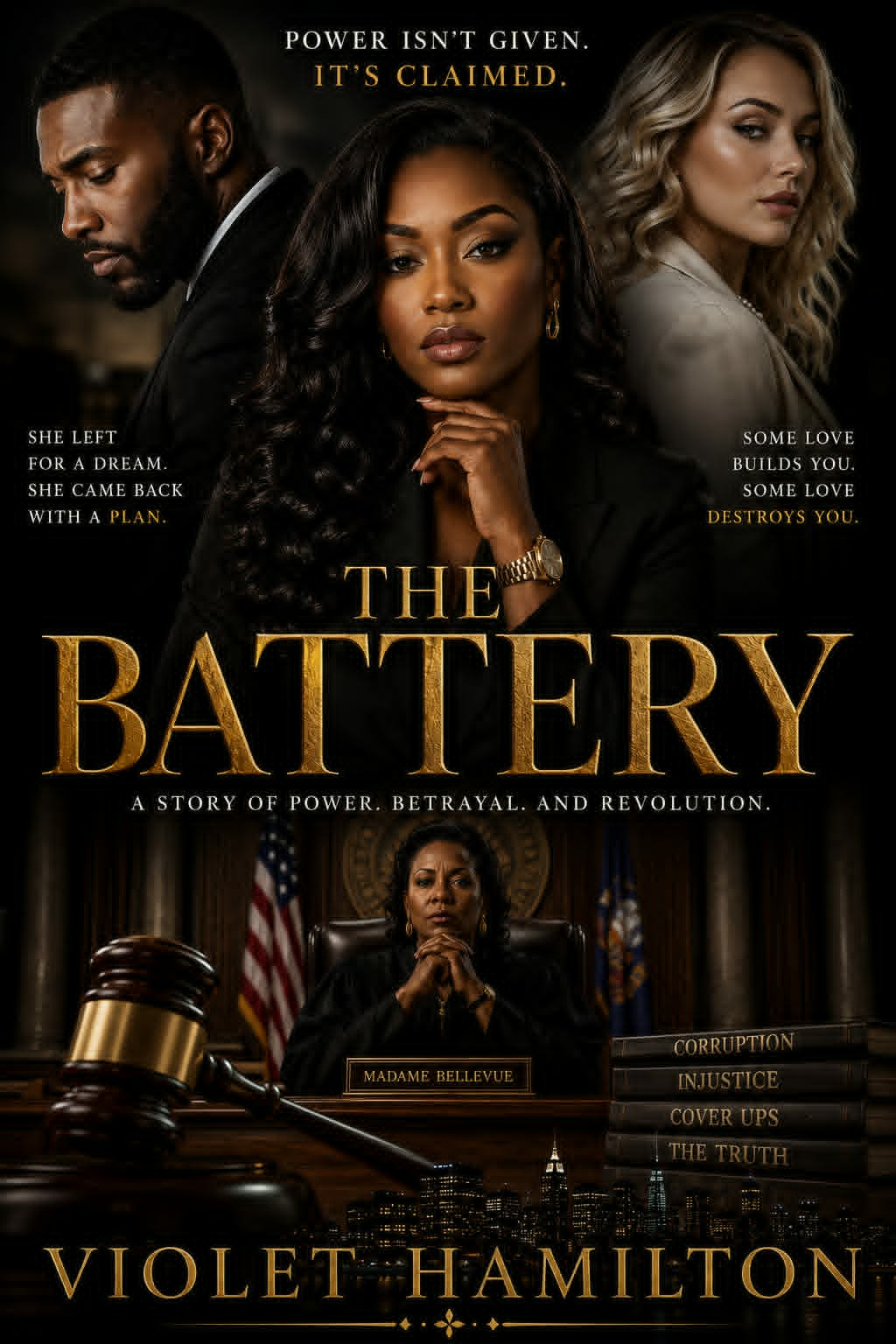
Zora King’s earliest memory of power was not political.
It was electrical.
Summer, 1998.
Newark suffocated beneath July heat while helicopters circled overhead and apartment windows stood open like exhausted mouths. Then the blackout came.
Buildings vanished one floor at a time until entire neighborhoods looked bitten apart by darkness.
Inside Apartment 4B, Zora’s mother lit candles inside jelly jars while radios crackled uselessly against dead air.
And through the silence came a sound Zora would remember forever:
the slow static ticking of dying batteries searching desperately for signal.
Her mother stared through the dead city and whispered:
“Everything dies the second the power disappear.”
Years later, Zora would realize her mother had never been talking about electricity.
---
By twelve years old Malik Thompson already belonged to Zora King.
Everybody knew it.
He followed her through Newark like gravity while she climbed fences faster than boys, argued with teachers until principals looked spiritually exhausted, and studied people with unsettling precision.
“You ever notice adults lie all day?” she asked Malik one afternoon while sitting on the hood of an abandoned Buick.
“What adults?”
“All of them.”
“You crazy.”
“No,” she replied quietly.
“They scared.”
He never forgot the way she said it.
Like fear itself offended her.
They married too young.
Everybody said so.
But people like Malik and Zora never loved carefully. Their relationship felt less like romance and more like collision.
They honeymooned in Egypt before finally marrying years later in a courthouse chapel with rings bought from a thrift shop and a dress ordered online because they had little besides each other.
At night they lay together listening to Newark breathe through cracked windows while police sirens drifted through housing towers like unanswered prayers.
Malik loved Zora with the obsession of someone who believed proximity to brilliance might save him from becoming ordinary.
And Zora loved Malik because he made her feel human before the world began turning her into mythology.
“You know what your problem is?” Malik asked one night.
“One?” she smirked.
“You always trying to understand everything.”
“Because everything connected.”
“You think too deep.”
“No,” she whispered.
“Everybody else too shallow.”
---
But Malik carried emptiness long before Evelyn Hart entered his life.
A shoulder injury introduced Percocet. Then oxycodone. Then whatever quieted the noise in his head long enough to sleep.
Most addictions begin politely.
Quiet.
Functional.
Zora noticed before he admitted anything.
“You disappearing,” she told him.
“I’m tired.”
“No,” she said softly.
“You fading.”
He snapped immediately.
“You always gotta psychoanalyze somebody.”
“And you always gotta numb yourself before honesty.”
The room froze.
Because it was true.
And Malik hated truth when it cornered him.
Especially from her.
---
Years later Zora left Newark carrying unfinished manuscripts, leather notebooks, and a mind too large for the city that raised her.
California sharpened her instead of softening her.
She never studied law formally.
That made her more dangerous.
She learned courtrooms the way hustlers learned streets: through observation.
She sat silently through public hearings studying people unravel emotionally before judges even opened their mouths.
Eventually she realized something terrifying:
Most courtrooms had very little to do with truth.
Courtrooms were theaters.
And whoever controlled emotional perception controlled power.
By thirty-five Zora had become an underground literary phenomenon publishing essays about trauma, emotional violence, race, custody battles, and systems disguised as justice.
Some readers called her brilliant.
Others called her unstable.
Usually the same readers.
---
Malik stayed behind in Newark.
At first because Newark felt like home.
Then because leaving began feeling impossible.
Then because Evelyn Hart entered his life quietly while Zora chased ambition three thousand miles away.
Evelyn arrived softly.
Like sympathy.
Unlike Zora, Evelyn never challenged Malik intellectually.
She soothed him.
A pediatric nurse.
Soft voice.
Long shifts.
Church on Sundays when she remembered.
Everybody trusted nurses automatically.
That fascinated Zora later.
Because Evelyn understood something deeply American:
People associate caregiving with goodness.
And goodness with innocence.
Evelyn knew how to weaponize both.
She knew exactly when to cry.
Exactly when to sound tired instead of manipulative.
Exactly when silence could imply victimhood better than words.
And unlike Zora, Evelyn understood the strategic power of appearing harmless.
That difference became fatal.
The affair began emotionally.
Then physically.
Then permanently.
Children.
Court dates.
Financial obligations.
Secrets growing mold in darkness.
And through all of it Malik never stopped loving Zora completely.
Evelyn knew it too.
Women always know when another woman still lives inside a man spiritually.
Sometimes Evelyn stared at herself in mirrors after the children fell asleep.
Studying her own reflection.
Pale skin.
Straight hair.
Soft features she once considered ordinary.
But around Black women she suddenly felt visible in the wrong way.
Undefined.
Like culture existed around her but never inside her.
She began overcompensating unconsciously.
Changing slang.
Changing music.
Changing how she dressed depending on who entered the room.
At first it looked harmless.
Then sad.
Then dangerous.
Once during an argument Malik said quietly:
“You always trying to prove something.”
Evelyn froze.
“What’s that supposed to mean?”
“You act like having Black kids make you something different.”
Her face hardened immediately.
“They are my children.”
“I know.”
“You think I don’t belong with my own family?”
“That’s not what I said.”
But deep down Evelyn heard the accusation anyway:
outsider.
And she never forgave him for it.
---
By the time Zora returned to Newark everybody was already bleeding emotionally.
Malik looked older.
Eyes hollow.
Hands shaking when he thought nobody noticed.
Evelyn looked exhausted in the polished way women do when they’ve mastered survival performance.
And Family Court had become the center of everybody’s lives.
Malik and Evelyn were trapped in child-support litigation involving their two children.
At the same time Evelyn and her husband, Chad Hart, were fighting through custody proceedings involving Evelyn’s youngest child.
Then a fourth case appeared.
*Zora King v. Evelyn Hart.*
Petition for an Order of Protection.
Threats.
Harassment.
Coercion.
Allegations that Evelyn repeatedly pressured Malik to reveal Zora’s confidential address despite court protections already being in place.
The filing electrified courthouse gossip instantly.
Because now the wife had entered the war directly.
---
Judge Marianne Bellevue presided over Family Court Part 7 like a queen governing ruins.
Silver-streaked hair.
Voice sharp enough to split concrete.
People feared her courtroom because she recognized lies too quickly.
The first thing Bellevue noticed about Zora was silence.
Most petitioners entered emotional.
Performative.
Angry.
Zora entered observant.
Dressed entirely in black while writing quietly inside leather notebooks.
Bellevue disliked that immediately.
Family Court smelled like coffee, paper, perfume, sweat, and fear.
Children cried near elevators.
Attorneys whispered beside vending machines.
Men stared blankly at walls calculating how much of their lives would disappear financially before lunch.
And every morning people entered believing truth mattered.
Every evening they left understanding narrative mattered more.
---
The hearing resumed after lunch beneath exhausted fluorescent lights.
Everybody looked worn down.
Attorneys shuffled paperwork like gamblers losing slowly while deputies called names into overcrowded hallways.
Judge Bellevue entered already irritated.
Evelyn sat beside counsel wearing pale blue again.
Soft colors.
Sympathetic colors.
Across the room sat Zora in black with a leather notebook resting on her lap like scripture.
Silent.
Watching.
Always watching.
Bellevue reviewed several pages before speaking.
“Ms. Hart, I requested certified financial disclosures two weeks ago. I still do not have complete records.”
Evelyn exhaled loudly.
“I work twelve-hour shifts. I’m trying to understand how regular people are supposed to keep up with all this.”
“By complying with court orders.”
“Well the court keeps asking for the same things over and over.”
“Because your figures continue changing.”
Evelyn folded her arms.
“Maybe because life changes.”
“No,” Bellevue replied sharply. “Income should not fluctuate several thousand dollars every filing.”
Silence spread briefly.
Then Evelyn laughed under her breath.
Not nervous laughter.
Dismissive laughter.
The kind that sounded dangerous inside courtrooms.
Bellevue looked up slowly.
“Is something amusing?”
“I just think this process is interesting.”
“Interesting.”
“Yeah. Fathers disappear for months and somehow mothers still end up defending themselves.”
Her attorney shifted uncomfortably.
Bellevue’s expression hardened.
“This court is not interested in speeches.”
“I’m answering the question.”
“You’re avoiding it.”
Evelyn leaned back.
“That’s your opinion, Judge.”
The room froze.
Bellevue removed her glasses slowly.
“Does my opinion count?”
Silence.
Heavy silence.
For the first time all afternoon, Evelyn looked uncertain.
“My opinions become orders every single day in this courtroom.”
The humiliation landed publicly.
Even the stenographer looked uncomfortable.
From the gallery, Zora continued writing quietly inside her notebook.
Bellevue noticed.
“What are you writing, Ms. King?”
“Observations, Your Honor.”
“This isn’t a journalism class.”
“No, Your Honor.”
“Then what is it?”
Zora paused.
“A study in escalation.”
The courtroom tightened instantly.
“There she go again talking like a damn supervillain,” Evelyn muttered.
“Ms. Hart,” Bellevue snapped.
“What? Everybody act like she some genius because she wear black and write in notebooks.”
Zora answered softly without looking at her.
“I observe behavior, Your Honor.”
“There!” Evelyn snapped. “That fake calm voice. Like she above everybody.”
Bellevue stared at Evelyn with open annoyance.
“Ms. Hart, you are dangerously close to being removed from my courtroom.”
Evelyn laughed again.
That same dismissive laugh.
“See? Nobody can say anything about her.”
“The issue,” Bellevue replied sharply, “is your inability to control yourself.”
The words hit Evelyn visibly.
Because deep down she understood something terrifying:
Judge Bellevue no longer saw her as sympathetic.
She saw her as unstable.
And once judges reach that conclusion, courtroom gravity changes permanently.
---
Outside court one afternoon, Evelyn cornered Zora beside the vending machines.
“You think you better than everybody.”
Zora looked almost confused.
“No.”
“Then why you always staring at people?”
“Because most people tell the truth accidentally.”
Evelyn laughed bitterly.
“You don’t love people. You study them until they stop feeling human.”
That landed.
For the first time, Zora looked wounded.
Evelyn stepped closer.
“You call it observation because ‘control’ sounds ugly.”
Neither woman spoke afterward.
Only fluorescent buzzing overhead.
Then unexpectedly Evelyn whispered:
“We probably would’ve liked each other if he wasn’t weak.”
The honesty stunned both of them.
Zora almost smiled.
“Maybe.”
Then the elevator doors opened.
And the moment disappeared forever.
---
The messages intensified after that.
At first philosophical.
Then obsessive.
Then impossible to categorize.
LOW BATTERY.
Some women don’t want peace. They want access.
Everybody feeding off everybody else pretending it’s love.
Sometimes Zora sent courtroom observations.
Sometimes memories.
Sometimes manuscript pages spread across apartment floors beneath dying electronics.
One night she texted Malik:
You know what the judge saw today?
Weakness.
Then another message followed.
Not yours.
Malik stared at the screen for a long time.
Because despite everything, Zora still understood people with terrifying precision.
And that terrified him too.
Because loving Zora meant feeling completely visible.
Around her there were moments he felt less like husband and more like evidence.
---
Everything exploded during cross-examination.
Evelyn’s attorney introduced screenshots of Zora’s messages onto courtroom projectors.
YOU DRAIN PEOPLE.
LOW BATTERY.
EVERYBODY USES EVERYBODY.
The words illuminated courtroom walls like evidence from a psychological autopsy.
Bellevue adjusted her glasses.
“Ms. King, did you send these?”
“Yes.”
No hesitation.
No embarrassment.
“Why?”
“Because people lie to themselves professionally.”
“That isn’t an answer.”
“It’s the only real answer.”
Bellevue’s voice hardened.
“You believe you’re the smartest person in every room.”
“No.”
“Then what exactly do you believe?”
Zora looked toward Evelyn.
Then Malik.
Then the judge.
Finally she whispered:
“I believe some people confuse proximity with identity.”
The courtroom quieted instantly.
Evelyn’s expression changed.
Not anger.
Recognition.
Dangerous recognition.
Zora continued softly.
“Some people think sleeping beside Blackness makes them powerful.”
“Objection,” Evelyn’s attorney snapped.
“Overruled,” Bellevue replied coldly.
And suddenly everybody in the courtroom understood something private had entered public air.
Evelyn looked exposed now.
Truly exposed.
Zora leaned back slowly.
“You wanted his children because you thought it transformed you.”
“That’s not true.”
“But it is.”
“No.”
“You wanted access to something you could never become.”
“Stop talking.”
“You wanted to wear suffering without carrying history.”
Evelyn stood abruptly.
“STOP TALKING ABOUT ME LIKE YOU KNOW ME.”
But Zora’s voice only softened further.
That made it worse.
“Do you think I want Irish children?”
Silence.
Complete silence.
“Do you think I would ever need a white baby to validate myself?”
“Ms. King,” the attorney warned carefully.
But Evelyn was unraveling now.
Breathing harder.
Eyes glassing over.
And Zora saw it.
Saw the insecurity.
Saw the obsession with proximity.
Saw the years Evelyn spent trying to feel exceptional through association instead of identity.
Then came the final blade.
“Listen to me carefully.”
Zora’s voice dropped nearly to a whisper.
“No matter what you do…
no matter what you say…
you will never have melanin.”
The courtroom froze completely.
“A scum like you could never stand in the same class as someone like me.”
Even Bellevue looked stunned.
Then—
almost casually—
Zora gathered her notebook.
A deputy opened the side gate.
“They’re calling me to the stand.”
And she walked away calmly.
Leaving Evelyn alone inside the silence.
Alone with everybody staring at her.
Alone with the unbearable feeling that Zora had seen directly through her.
That was the moment Evelyn lost control.
The movement happened fast.
A blur of blue fabric.
A chair scraping violently against tile.
Evelyn lunged across counsel table before deputies could react.
Her hand struck Zora across the face with a crack that echoed through the courtroom like a gunshot.
Gasps exploded everywhere.
Bellevue slammed the bench.
“ORDER. ORDER IN THIS COURT.”
But Zora never moved.
Not even after the strike.
One hand rested against her cheek.
Watching.
Studying.
Almost calm.
Then slowly—almost unbelievably—she smiled.
Not mockingly.
Recognition.
Bellevue saw it immediately.
And suddenly the judge understood.
The battery.
That was all the law required.
A physical act.
A measurable escalation.
One moment transforming allegation into evidence.
Evelyn saw it too.
Her face drained instantly.
“Oh my God,” she whispered.
Deputies restrained her while Bellevue’s expression hardened into something final.
“Ms. Hart, you have just committed battery in open court.”
Silence.
Because there it was.
The terrible truth.
Zora had not needed fear.
Or bruises.
Or dramatics.
All she needed was escalation.
All she needed was battery. ...And she'd know what to do.
And now the courtroom itself had witnessed it.
---
The ruling arrived three days later.
Packed courtroom.
Standing room only.
Bellevue adjusted the paperwork before her.
“In the matter of King versus Hart, this court finds substantial evidence supporting a pattern of harassment, coercive conduct, and physical battery witnessed directly by this court.”
Evelyn lowered her head.
“An extensive Order of Protection is hereby granted in favor of Ms. King.”
The words landed like concrete.
“No contact.
No third-party communication.
No discussion of petitioner’s location.
Violation will result in immediate arrest.”
Then Bellevue looked directly at Evelyn.
“You allowed anger to make a permanent decision for you.”
Then toward Zora.
“And you…”
The judge paused.
Something unreadable flickering behind her eyes.
“You understand systems too well.”
Zora said nothing.
But for the first time all year Bellevue looked almost afraid of her.
---
Three nights later Newark lost power again.
Transformer explosions swallowed neighborhoods in darkness.
Zora sat alone inside her apartment illuminated only by candlelight.
Court transcripts covered hardwood floors beside tangled chargers and dying electronics.
Her phone battery blinked red.
2%.
For the first time in months silence entered completely.
No hearings.
No cameras.
No messages.
No audience.
Only herself.
And suddenly a terrifying realization surfaced beneath all the anger:
What if nobody stole her energy?
What if she gave it away willingly?
The thought hollowed her instantly because it felt true.
She thought about obsession.
About turning heartbreak into identity.
About how visibility itself became addictive.
For the first time in years Zora cried without imagining someone watching.
---
Months later *The Battery* detonated across literary culture.
Critics called it genius.
Others called it unstable.
One review described it as:
“A hallucination disguised as literature.”
Another called it:
“The most original psychological thriller of the decade.”
Readers argued endlessly.
Was Zora victim or villain?
Prophet or narcissist?
Revolutionary or unreliable narrator?
Nobody agreed.
That uncertainty made the novel immortal.
Because secretly everybody recognized themselves somewhere inside it:
the hunger to matter,
the fear of invisibility,
the addiction to emotional voltage,
the desperation to be chosen.
Late one night Malik finished the manuscript alone inside his car outside Evelyn’s apartment.
Snow drifted softly against the windshield.
Low fuel light glowing.
Phone charger broken.
Battery draining.
He stared at the final page for a very long time before finally closing the book.
Because at last he understood something devastating:
Zora had never written about court.
Or custody.
Or betrayal.
Or even battery.
She had written about power.
And everybody inside the story had mistaken love for ownership.
On the final page appeared only two words:
LOW BATTERY.
Then the dashboard lights died one by one until Malik disappeared inside darkness completely.
About the Creator
Violet Hamilton
Harlem born. Author of Shark Weak. Wrote multiple Award-Winning Cast and Crew screenplay "What If" and "Trickster." Educated. World traveler. I now reside in Long Island, New York. I adore writing. It's the only time I get to play God.
Enjoyed the story? Support the Creator.
Subscribe for free to receive all their stories in your feed.
Comments
There are no comments for this story
Be the first to respond and start the conversation.