Young Adult
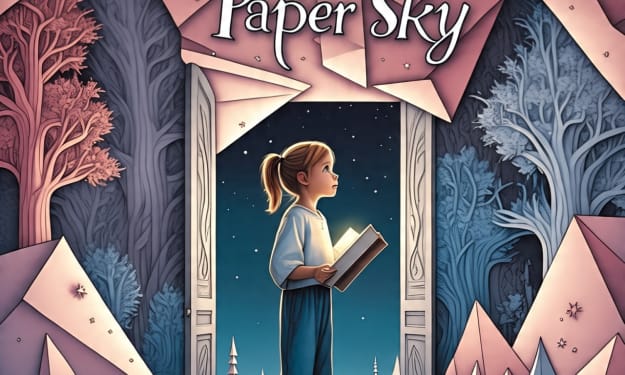
Beneath the Paper Sky
When the world ended, it didn’t crumble into fire or freeze into silence—it folded. It began on a Tuesday, with the sky. One moment it was bright with morning sun, clouds drifting lazily across the blue. The next, a sharp crease appeared overhead, as if some invisible hand had bent the heavens along a straight edge. Birds scattered. Planes veered. And within hours, more folds appeared—crisp, geometric lines slicing through the sky like origami instructions. By sunset, the sky was no longer a dome, but a canvas—creased, bent, and finally folded into sharp planes. The stars never came out. The moon blinked off like a forgotten lamp. People panicked. Scientists fumbled for explanations. Some said it was an atmospheric illusion. Others blamed satellites or solar flares. But sixteen-year-old Lena Holloway knew better. She had seen it before. In her sketchbook. Weeks before the sky changed, Lena had started drawing a series of dreamscapes. One showed a forest where trees bent like accordion paper. Another, a city where buildings folded flat and stood back up again. And one, drawn in the margins of her math homework, showed a sky with a perfect crease running across the sun. She hadn’t known why she drew them. They just came. Now, she stared up at the fractured sky, flipping through her sketchbook in disbelief. Every image was coming true. Her parents were too busy hoarding supplies and boarding windows to listen. Her teachers stopped holding online classes. The news looped the same footage: people staring up, screaming, praying, or simply sitting on rooftops waiting for answers. Lena wasn’t interested in answers. She wanted to know why. So she packed her sketchbook, a flashlight, and three granola bars, and followed the lines in the sky. Literally. The folds above cast long shadows on the ground, as if the heavens were reflecting themselves. The creases led her out of the city, into the overgrown fields behind the old train tracks—places she used to explore with her older brother before he disappeared a year ago. Before he’d left behind only a note with a single sentence: “Beneath the paper sky, you’ll find the door.” She hadn’t understood it then. But now, as she stood beneath a part of the sky that shimmered unnaturally, almost pulsing like a heartbeat, she pulled out the sketchbook and flipped to the last page. There, in charcoal and smudged ink, was the drawing of a doorway—tall, narrow, floating just above the ground. And as the wind picked up and the folds in the sky shifted again, there it was. The door, hovering before her, exactly as she’d drawn it. Lena stepped forward. The door opened inward, revealing paper. Not darkness. Not light. Just paper. Miles and miles of blank, moving parchment that rippled like ocean waves. She stepped through. Inside, the world was… constructed. Trees made of paper tubes and curled leaves. Rivers drawn in ink that flowed across textured parchment. Birds flew overhead, their wings flapping with the sound of flipping pages. And in the center, on a hill of stacked books and folded maps, stood her brother—Jamie. He turned as if he’d been expecting her. “I knew you’d follow the folds,” he said, smiling. “They started coming to me first. The drawings. The visions. I thought I was losing my mind. Then I realized…” “What?” Lena asked. Jamie looked around. “This place—it’s not just a world. It’s ours. Built by the ones who see beyond the folds. The artists. The dreamers. People like us.” Lena glanced at her sketchbook. The pages now glowed faintly, pulsing with warmth. “But why is the real sky folding?” she asked. Jamie knelt beside a pool of shimmering ink. “Because that world is collapsing. Too much noise. Too little imagination. The folds are the undoing—and the beginning. This world… this is where we rebuild. From stories. From memory. From imagination.” Lena looked up. The paper sky above this world was soft, glowing with handwritten constellations and drifting ink clouds. “It’s beautiful,” she whispered. Jamie nodded. “But it needs more creators. More dreamers. The others are coming. We need to be ready to guide them.” Lena took a deep breath, then tore a blank page from her sketchbook. She placed it on the ground, pulled out her pencil, and began to draw. A lighthouse. A real sun. A mountain with singing trees. The paper absorbed it instantly, and the drawings came alive. --- Back in the real world, the sky folded one last time. People stood still, breath held, as the last patch of blue disappeared into the crease. And then, above them, a new sky unfurled—of paper, yes, but glowing with stars and swirls of color that had never existed before. The old world was gone. But beneath the Paper Sky, a new one was being written. One story at a time.
By Azmat Roman ✨about a year ago in Fiction
The Day the Moon Didn't Rise
e I was the kind of evening where the sky melted into soft pastels, and the stars waited behind a veil of dusk, ready to twinkle awake. But that night, something was wrong. The moon did not rise. It wasn’t just late. It wasn’t hidden by clouds. It was… gone. At first, no one noticed. The streetlights flickered on as usual. Parents called children in for dinner. Dogs barked at nothing in particular. But when people looked up, expecting that familiar silver coin in the sky, they found only emptiness. Astronomers scrambled. Satellites were checked. Telescopes turned skyward. The moon had vanished—not behind Earth’s shadow, not out of orbit. It was simply not there. In the small town of Thistle Hollow, twelve-year-old Ella Caldwell noticed first. She was a stargazer, a dreamer, the kind of girl who kept a telescope on her windowsill and a notebook full of sky charts under her pillow. That night, she had been waiting to see the Harvest Moon, the biggest and brightest of the year. She had even made cocoa and pulled her beanbag chair right up to the window. When she saw nothing, not even a sliver, her stomach twisted. “Dad,” she called downstairs. “The moon’s gone.” Her father laughed. “Probably behind some clouds, kiddo.” But Ella knew better. The next morning, the world was buzzing. Newscasters used phrases like “unprecedented astronomical anomaly” and “possible spatial displacement.” Scientists gave long explanations that didn’t explain anything. But Ella had a different theory. She remembered something her grandmother once told her, late one night as they stargazed together. “The moon is more than a rock in the sky,” Grandma had said. “It’s a guardian. A watcher. If ever it disappears, it means something has gone very wrong.” Ella had thought it was just a story. But now, as she stared at the empty sky night after night, she wasn’t so sure. Animals were acting strange. Tides grew erratic. People became restless. Dreams turned darker. Without the moon’s gentle pull, something in the world—perhaps even in people—was unraveling. One night, a week after the moon vanished, Ella awoke with a start. A soft, humming sound filled her room. She sat up, heart pounding. Her telescope began to glow faintly blue. The hum came from the sky. She looked through the telescope. And gasped. There, hidden behind a shimmer like heatwaves, floated a silver shape—blurred, out of reach. The moon wasn’t gone. It was trapped. Ella scribbled furiously in her notebook. She plotted the shimmer’s location and realized something startling: the moon wasn’t missing—it was hiding behind a tear in the sky, like a curtain pulled between dimensions. But why? That night, under the ghostly stars, Ella crept into the woods behind her house. There, in the clearing where she used to play, a strange circle of mushrooms had grown—massive, glowing faintly. A faerie circle, Grandma would’ve called it. She stepped into it. The world twisted. Colors bled into one another, and the sky above shimmered like oil on water. And then—there it was. The moon, suspended, pulsing softly, like it was breathing. Beside it stood a figure cloaked in shadow, tall and ancient. “You’re not supposed to be here,” it said, voice like falling leaves. “Why did you take the moon?” Ella asked, clutching her notebook to her chest. “The world no longer listens,” the figure replied. “They poison the seas, burn the forests, drown the stars in city light. The moon grew tired. So I let her rest.” “She doesn’t want to rest,” Ella said, heart rising. “She wants to shine. She has to.” The figure was silent. The moon throbbed faintly, like it heard her. “I still look,” Ella whispered. “Every night. And I’m not the only one.” The figure studied her, eyes like old stone. Then it reached into the sky and peeled something back. The shimmer split, and light burst through like sunrise. “She will rise again,” it said. “But remember—she watches. And she tires.” In a blink, Ella stood in her backyard, her telescope humming once more. That night, for the first time in eight days, the moon rose—full, bright, and heavier somehow, like a queen returning from battle. The world exhaled. But Ella remembered. She watched the sky every night, not just for beauty, but for balance. She wrote to newspapers, joined science clubs, started skywatching meetups. She reminded people of what they'd almost lost. Because she knew the truth: The moon doesn’t just rise. She chooses to.
By Azmat Roman ✨about a year ago in Fiction
When He Opened His Eyes. Content Warning.
>>>***Inspired by something I saw in the eyes of a stranger once.*** We were laughing. That’s what I remember first. Not the screech of tires or the shatter of glass—just the sound of Jackson’s laugh echoing through the cab of his beat-up blue Tacoma, windows down, late summer air breezing in.
By Muhammad Abdullahabout a year ago in Fiction
My Grandmother’s Mirror Only Reflects the Dead
The Mirror’s First Secret I almost sold the mirror the day after Grandma Lillian’s funeral. It was an ugly thing—a heavy oak frame carved with twisting vines, the glass smoky with age. But Mom insisted: "She wanted you to have it. Said it was special."
By MUHAMMAD Abbasabout a year ago in Fiction
Yesterday's Future
The last time I stood on the rooftop of our old apartment building, the city looked different. Back then, we were seventeen. The skyline shimmered with possibility, every blinking light a promise waiting to be kept. We called it “the edge of tomorrow”—that crumbling rooftop with graffiti on the walls, where dreams felt like they might leap straight into the sky. “I’m going to build something that matters,” you told me once, your breath visible in the winter air. “Not just make money or survive. I want to build something people remember.” I nodded. “And I’ll write. About us. About this.” You laughed. “Who’s going to read a book about two kids staring at airplanes?” I smiled back. “You. When we’re old.” That was twelve years ago. Now I stood there alone, the wind colder than I remembered, the rooftop smaller. The building next to ours had grown taller—steel and glass climbing higher than any dream we ever sketched on notebook margins. Progress. Time’s monument. I took the old Polaroid out of my pocket. Us, blurry and half-smiling. You had written in the white space below: "This is what yesterday’s future looks like." Back then, it felt poetic. Now it felt like a question I didn’t know how to answer. --- We had it all planned. You’d go to college for engineering. I’d major in literature. We’d move to the city, share an apartment, chase our dreams until they caught us or killed us. But the thing no one tells you about futures is how fragile they are. Your scholarship fell through. Mine didn’t. You stayed behind to help your mother after her accident. I left. I told myself it was temporary. We called. We wrote. For a while. Then time got in the way. I published my first book at twenty-six. It was about us, thinly veiled behind fiction. It sold decently. You messaged me congratulations. I said thank you. You said you liked chapter seven. I never asked which part. You stopped replying after that. I stopped writing about you. --- Until last week, when your sister called. She found my number buried in an old phone, still saved under "Skyline." She said the accident was sudden. A drunk driver. A rainy road. You didn’t make it. I hadn’t seen you in ten years. I didn’t even know you still lived here. I asked if I could come to the funeral. She said yes. And now I was back on the roof, holding the photograph you never threw away. I imagined you standing beside me again, eyes squinting against the sun, hair tousled by wind. Would you recognize me now? Would I recognize you? In the distance, I saw a plane cut through the clouds—just like we used to watch. You once said they looked like punctuation marks in the sky. I never understood what you meant. Maybe I do now. Maybe you were telling me that life is a sentence we write one word at a time, and sometimes we don’t realize we’ve reached the end of a chapter until it’s already behind us. --- As I turned to leave, I heard laughter. Two teenagers had climbed onto the rooftop. A boy and girl, backpacks slung low, their conversation light and fast, filled with the same dreams we once whispered into the wind. They didn't notice me. Why would they? I was yesterday now. But as I passed them, the girl asked, “Do you ever wonder what the future looks like?” The boy shrugged. “Probably like this. Just... older.” I smiled. Maybe they were right. Maybe yesterday’s future isn't some grand revelation or perfect destination. Maybe it's just this—returning to where we once began, older, quieter, but still reaching for the sky. Before I stepped through the rooftop door, I left the Polaroid wedged in the metal railing, fluttering slightly in the wind. A memory. A reminder. A punctuation mark in someone else’s story.
By Azmat Roman ✨about a year ago in Fiction
One Night. Top Story - June 2025. Content Warning.
**Inspired by a dream that I had last night** We were coming home late from a dinner with a group of friends on a Thursday night. It was just a regular day for us. We both had worked and decided that we wanted to go out afterwards. He was driving our old brown Explorer when we were hit by a drunk driver.
By Chloe Unfilteredabout a year ago in Fiction
The Last Delivery
BY SHAFI ULHAQ The rain started the moment he turned onto Maple Street, thick drops blurring the windshield and rhythmically drumming against the roof of the van. Eli leaned forward, squinting past the wipers as he pulled up to house number 34—the last delivery on his route.
By Shafi ulhaqabout a year ago in Fiction