thriller
The Last Prayer of Rahim
There’s a small village at the edge of nowhere — the kind of place where time moves slowly, and people remember everything. That’s where Rahim lived. He wasn’t always sick. Once, he was the strongest man in the village — the kind who carried bricks all day and still helped his neighbors fix their roofs before sunset. People used to call him “Bhai Rahim — the man with a heart bigger than his hands.” But life has a strange way of testing the kindest souls. A few years ago, an illness crept into Rahim’s body. At first, it was just pain — something he could hide behind his smile. Then came the swelling, the weakness, the nights of burning fever. Doctors called it incurable. Rahim just called it “Allah’s test.” His house was small — two rooms and a wooden door that always creaked. Every morning, before the sun climbed over the rooftops, he would spread his prayer mat and whisper the same words: >Ya Allah… give me patience, not comfort. Give me strength, not ease.” The neighbors would hear his voice through the thin walls. Some pitied him. Others just shook their heads and said, “He won’t live long.” But Rahim always smiled when he heard that. “I’ve already lived longer than despair,” he’d say softly. -- One cloudy afternoon, a traveler named Saeed arrived in the village. He wasn’t looking for Rahim — he was just passing through, tired and lonely, searching for something he couldn’t name. Someone at the tea stall told him about “the sick man who prays for others.” Curious, Saeed went to find him. When he reached Rahim’s home, the sight stopped him cold. Rahim was sitting on a thin mattress by the door. His body looked fragile, but his eyes — those eyes had light. He wasn’t praying for healing; he was praying for gratitude. Saeed sat quietly beside him. Neither spoke for a while. The sound of their breathing filled the silence between prayers. Finally, Rahim opened his eyes and smiled. “Brother, you look troubled,” he said softly. Saeed’s eyes were wet. “I came to see you, but now I don’t know what to say. I feel helpless.” Rahim chuckled faintly — a dry, gentle sound. “Don’t be. Pain is not always a punishment. Sometimes it’s a reminder… that we still belong to Him.” -Saeed took out a bundle of money, hands trembling. “Please, take this,” he said. “Use it for medicine, for care… for anything.” Rahim looked at it for a moment, then closed Saeed’s hand around it again. “Brother, money can fix a body, but not a heart. And my heart is fine.” Saeed couldn’t hold back his tears anymore. “What can I do then?” he asked. “Pray with me,” Rahim whispered. “That’s all I ever need.” So they sat together — two strangers who suddenly felt like brothers. Their hands lifted, voices low but full of meaning. “Ya Allah, forgive us when we forget to be grateful. Forgive us when we fear pain more than we fear losing faith. And when we suffer, let us remember — You never test without purpose.” The air grew still. Even the birds seemed to listen. Saeed could feel the weight of those words settle deep inside his chest. Rahim’s hands slowly dropped to his lap. His eyes stayed open, but something changed — a softness came over him. He whispered one last time, barely audible: “Tell the world… I wasn’t waiting for death. I was waiting to meet the One who gave me life.” And then, silence. Complete, peaceful silence. The azaan began to echo from the nearby mosque. Saeed sat there, motionless, tears falling one by one. He wasn’t crying out of pity anymore — he was crying because he’d just seen what faith truly looked like. Before leaving, he looked around the little courtyard. There was no wealth, no comfort, no sign of healing. Yet somehow, Rahim had everything Saeed had been searching for — peace. When Saeed walked back to the main road, the evening light touched the village roofs. He whispered to himself: "He healed me, even as he was dying.” And from that day on, wherever Saeed went, he carried Rahim’s prayer in his heart — a prayer that wasn’t just about pain or faith, but about finding light in the darkest corners of life. Moral / Reflection: Some people leave this world without fame or fortune, but they leave behind something far greater — a lesson that faith can turn suffering into strength, and sorrow into peace.
By Vocal Member about a year ago in Fiction
Lost and Alone
Lost and Alone Knock, knock, knock. The sound of a simple rhythmic beating on the door was the beginning of a startling, unsettling and terrifying experience. Gradually growing louder, the knocks seem to be getting more angry if that is even possible to assign emotion to a sound. Bang! Bang! Bang! My first instinct is to hide, stay as quiet and still as possible almost frozen in fear or maybe anticipation. It's a very base and guttural response to such a small thing, a knock at the door. It's comical how much fear that instills in me.
By Sindy Leah Fitzabout a year ago in Fiction
Boop. Content Warning.
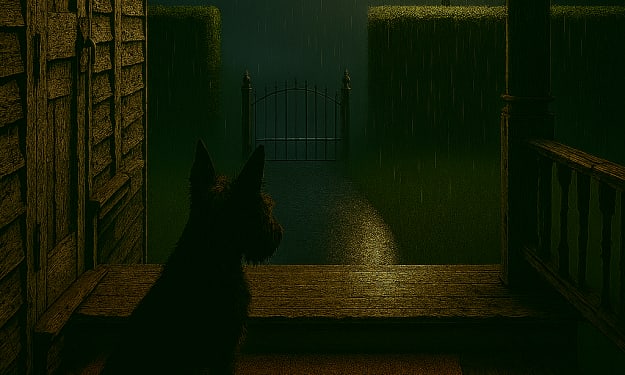
Part I The knock at the door wasn't unusual - just four knocks - knock-knock-knock-knock. Usual. The thunderous barking of Ryan Seacrest, my Scottish Terrier wasn't unusual. Pound-for-pound, Scottish Terriers have the loudest bark in the canine kingdom.
By John R. Godwinabout a year ago in Fiction
The Holy American Empire
The air in Panama City hung heavy with humidity and unease. The skyline glittered just beyond the tinted windows of the presidential palace, but inside, beneath the sterile glow of the conference hall lights, the atmosphere was taut with fear.
By Logan M. Snyderabout a year ago in Fiction
Trapped by the Spider. Content Warning.
**Warning: Contains depiction of kidnapping and torture.** I knocked on the door three times. Knock. Knock. Knock. My presence was greeted by a dog barking, and within a minute, the sound of locks fumbling. The door swung open and I was greeted by the acrid smell of Marlboro red’s–what Grandpa used to smoke. A man stood in the doorway with a mess of curly grey and smoke-dyed hair. A slop of a beard decorated his face with his high cheekbones that pushed on narrow, beady brown eyes. He stood taller than me, but was short for a man. His red and black flannel fit poorly over his round belly.
By Callum Summersabout a year ago in Fiction
Parallel Collision. Honorable Mention in Parallel Lives Challenge.
The morning was unremarkable. The morning welcomed me with the kiss of a thin fog coiling over the payment and just the whisper of slick frost and ice waiting for the sun to thaw it back into water. The streetlight on the corner flickered like it was getting ready to die out. I tightened my jacket around me and checked my watch while I rushed to the bus stop a block away. Seemingly reading my mind, the bus rounds the corner, headlights splitting the mist.
By Autumn Stewabout a year ago in Fiction
When Mercy Knocked
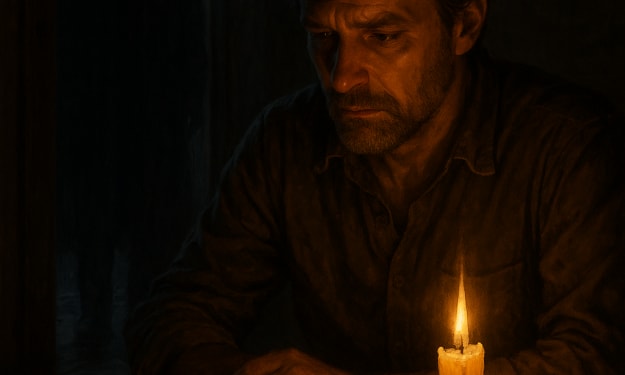
The rain had been falling for hours—steady, heavy, and unending. It wasn’t the kind of rain that washed the world clean, but the kind that soaked into it, making everything heavier. Outside, the city lights were muted behind the downpour. Inside, Samuel’s apartment felt isolated, sealed off from the rest of the world. A candle flickered on the table beside a folded note written in a shaky hand. He stared at it for a long time, listening to the hum of the refrigerator and the slow drip from the ceiling. He hadn’t prayed in weeks, yet the impulse to speak to God still surfaced in his mind like muscle memory. If You’re there, don’t answer, he thought. Not tonight. He lifted his glass, the amber liquid trembling with his reflection. Then three soft knocks broke through the silence. Samuel froze. It wasn’t thunder or pipes or the wind. The sound was too deliberate—three steady, rhythmic knocks, like the beat of a pulse. He waited, holding his breath. When it came again, it was gentler, as though whoever stood outside already knew he was listening. He rose from the table, the chair scraping quietly against the floor, and glanced toward the window. Rain streamed down the glass, muting the glow of the streetlights. Another knock came, softer, patient. “Who’s there?” he called out, but no one answered. He hesitated, his hand hovering near the doorknob. Against his better judgment, he opened the door. Wind swept in, carrying the smell of rain and earth. A man stood in the doorway, soaked through, head bowed beneath a hooded coat that didn’t seem to belong to him. “Evening,” the stranger said in a calm, even voice. “Forgive me. My car broke down near the bridge. I saw your light.” Samuel studied him. The man’s eyes were dark and steady—too steady. There was something ageless in his gaze, as if he weren’t seeing a stranger at all. “You’re out of luck,” Samuel said. “Power keeps cutting in and out. Heat’s fading.” “Still warmer than out there,” the man replied. Samuel hesitated again before stepping aside. The stranger entered. The storm clung to his coat, yet the floor beneath him stayed dry, as though the rain itself refused to follow him in. They sat in silence for a while. The man introduced himself only as Elias. His clothes were damp but spotless, his hands clean despite the storm. “You live alone?” Elias asked. “Yeah,” Samuel said. “You passing through?” “Something like that.” Elias’s gaze moved toward the table, where the folded note sat beside the candle. “You were writing.” “It’s nothing,” Samuel said quickly. Elias didn’t press. He studied the candle for a moment. “Some fear the fire because it consumes,” he said. “Others light it because they still believe something might see the smoke and find them. You lit the flame.” Samuel frowned, uneasy with the weight of the words. “You think lighting a candle means something?” Elias smiled faintly. “I think it already did.” Outside, thunder rumbled, but the candle held steady. Samuel poured himself another drink and offered one to Elias, who shook his head. “Already had my fill,” Elias said. “What are you, a preacher?” “I’ve been called worse.” Samuel gave a humorless laugh. “You talk like my father. He used to say things that didn’t make sense but somehow sounded wise.” “And what happened to him?” “Same thing that happens to everyone,” Samuel muttered. “He died believing God would save him.” He drained the glass. “Guess he was half right.” Elias watched him quietly. “You stopped believing.” “I stopped being stupid,” Samuel said, his voice sharp. “My son died three years ago. My wife left after that. Tell me where God was then.” The storm outside intensified, wind rattling the windows. Elias spoke softly, almost gently. “Do you believe mercy has an expiration date?” Samuel looked up. “What?” “If a man builds a wall between himself and heaven,” Elias continued, “who really locked the gate—him or God?” “You don’t know me,” Samuel said. Elias held his gaze. “I know you prayed after your son passed. Every night for thirty-one days. When you didn’t hear an answer, you mistook silence for absence.” Samuel’s breath caught. “How could you possibly know that?” Elias turned toward the window, watching a flash of lightning illuminate the room. “Because I was there.” The room went still. Samuel’s voice trembled. “You were where?” “When you held your son’s hand,” Elias said. “When you asked for one more minute. You said, Please, God, I’ll do anything.” Samuel stumbled back, his throat tightening. “Who are you?” Elias turned to face him fully. His eyes reflected the candlelight. “You wouldn’t believe me if I told you.” The power flickered once, then went out completely. Darkness swallowed the room. Somewhere in that blackness, Elias began to hum—a slow, haunting tune Samuel hadn’t heard since childhood. His mother used to sing it while washing dishes: Come home, come home, ye who are weary, come home… “How do you know that song?” Samuel whispered. “Everyone hears it eventually,” Elias said. The air shifted. The apartment seemed to breathe with them. Samuel felt the grief he had buried for years start to move again, loosening like old dust in his lungs. When the lights came back, Elias stood near the door. “You’ve been waiting for the wrong kind of answer,” he said. “You thought faith was a rescue. Sometimes it’s a reminder.” Samuel shook his head. “You think I haven’t tried? I wanted to believe. Every night I closed my eyes and begged to hear something—anything.” Elias stepped closer. “You were heard. You were never forgotten.” He gestured toward the Bible on the floor, its cover dulled by dust. “Read it.” Samuel hesitated, then picked it up. The spine cracked as he opened it. The page had already fallen to a passage in Revelation: Behold, I stand at the door and knock. If anyone hears my voice and opens the door, I will come in and eat with him, and he with me. Elias’s voice softened. “You answered tonight. You opened the door.” Tears welled in Samuel’s eyes. “You’re saying you’re—” Elias raised a hand. “Names are small things. What matters is that mercy doesn’t wait for permission. It knocks anyway.” A gust of wind swept through the room, though every window was closed. The candle flared, its flame bending toward Elias. Samuel fell to his knees. “I can’t do this alone.” Elias knelt beside him. “You never were.” He placed a hand on Samuel’s shoulder—warm, real—and then the light dimmed. The air calmed. Silence returned.
By Carolina Borgesabout a year ago in Fiction
The Knock at Room 9
The first knock came just after midnight — three slow, deliberate taps against the door, patient and almost polite. Agnes Miller opened her eyes. A thin strip of light spilled beneath the door, but the sound hadn’t come from the hallway. It was closer, as if the room itself had exhaled. She turned toward the nightstand, where her worn Bible and silver rosary rested. The beads trembled faintly, catching the moonlight that slipped through the blinds. The nursing home was meant to be a place of rest, yet Room Nine was never quiet. They said the room was cursed — that people assigned to it never lasted long. Patients who arrived healthy would weaken within days. Machines faltered, crosses fell from their hooks, and radios whispered static during the night. The nurses stopped discussing it aloud, but their silence said more than rumors ever could. Even the most practical ones would cross themselves before entering. When Agnes was wheeled into Room Nine earlier that week, someone murmured, “Poor thing.” She heard it but only smiled. She wasn’t afraid, or at least she told herself she wasn’t. Her Bible and rosary had seen her through war, childbirth, and widowhood. They were her anchor — symbols of faith that kept her tethered when the world tried to unmoor her. Still, she noticed how heavy the air felt her first night there, as though the walls themselves were holding their breath. And when she prayed, she sensed something listening that wasn’t God. The second knock came the following night, softer this time but undeniably closer. The sound seemed to come from within the room rather than beyond the door. The rosary hanging from the bedpost began to sway, the small cross glinting in the dim light. Agnes reached for it, clutching it tightly as she whispered, “The Lord is my light and my salvation; whom shall I fear?” Her hands trembled. The Bible on her nightstand fluttered open on its own, the thin pages settling on Psalm 23. She began to read, her voice wavering as she reached the familiar line: “Yea, though I walk through the valley of the shadow of death…” The words comforted her, yet something in them felt less like reassurance and more like preparation. The air grew colder. She could feel a pull — gentle but insistent — as though the rosary were being drawn toward the door. She gripped it tighter, whispering through clenched teeth, “Not tonight.” On the third night, the knocking came from within the walls. It was steady, patient, almost rhythmic, like a heartbeat. The rosary slipped from her fingers and clattered softly onto the tile. Agnes’s breath caught. “Who are you?” she asked. No voice answered aloud, but she felt the response rise in her chest, a voice both foreign and familiar: It is time. Her pulse stumbled. She wanted to scream, but she couldn’t. The voice didn’t carry malice; it carried finality. Still, fear tried to take hold. “If you are not of God,” she said shakily, “you have no power here.” The light flickered. Her Bible fell open again, this time to Luke 12:5. Her gaze fixed on the verse: “Fear Him who, after your body has been killed, has authority to throw you into hell.” The words struck her like a revelation. This was not a warning but a reminder — that she had feared the wrong thing. At three in the morning, the final knock came. The room had fallen utterly silent, the kind of silence that presses against your ears. The sound no longer came from the walls or the door. It came from somewhere deeper, inside her chest — a slow, fading rhythm that matched her heartbeat. And in that moment, Agnes understood. Death hadn’t come to claim her. God had come to call her home. Tears welled in her eyes as she smiled faintly. “I’m ready,” she whispered. Her trembling hands rested on her Bible and rosary — her faith, her armor, her peace. “Your will be done.” When the nurse entered at dawn, the room felt different. Still, but not cold. Peaceful. Agnes lay motionless, the Bible open across her chest, her rosary coiled perfectly beside her hand. On the open page, something had been written in shaky handwriting, the ink smudged by tears: Do not fear what He created. Fear the One who commands all creation. The nurse stared at the words, her heart pounding as she thought she heard a faint knock — not from the door, but from somewhere far beyond the room. From that day forward, no one feared Room Nine again. The knocks stopped, and those who entered found rest rather than dread. Because sometimes, the knock you fear the most is the one that saves you.
By Carolina Borgesabout a year ago in Fiction