thriller
Shadows of midnight
Party with Shadows Lucas parked his car at the top of the hill. As he walked toward the mansion’s metal gates, nostalgic thoughts crept into his mind. He recognized the dense grove and the faint outline of a hidden path he used to sneak down as a child. Back then, this place was nothing more than a spooky, abandoned house surrounded by overgrown gardens. So many years had passed since then, and now, it was bursting with life, transformed into a luxurious party venue, the type he rarely attended.
By Kaloyan Kolarovabout a year ago in Fiction
"The Healer’s Burden: Faith, Legacy, and the Weight of Divine Gifts"
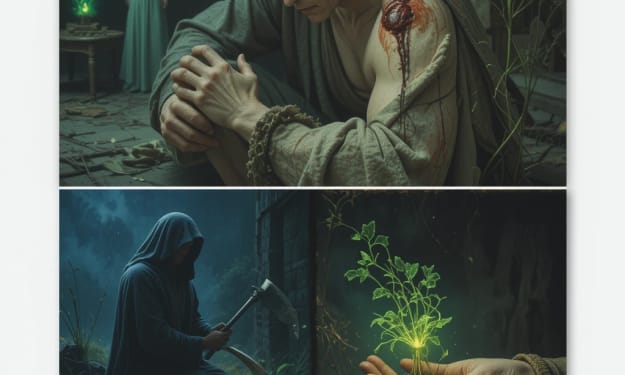
The Healer understood her gift far better than the Apprentice ever could. To be *Blessed* was not about skill or effort—it was simply *being*, carrying a selfless faith so profound that it shaped the world without intent. Though she healed with her hands, sometimes the Divine intervened, mending what mortal ability could not. "It’s not a choice," the Healer murmured. "What happens through me defies understanding. If I tried to dissect it, I might destroy it." The Apprentice bit back her frustration. "Then what *can* you teach me?" "Everything I know," the Healer replied. "The wisdom from my first master, the lessons of High Valley. You could even go there—I’d give you a letter. But don’t chase a Blessing. That path will poison your joy and corrupt your craft. Some things *are*. Some *aren’t*. And some *never will be*." With a tired sigh, the Healer shifted, rubbing her lower back. The Apprentice immediately kneaded the stiff muscles, wondering what toll the Blessing truly took. She’d never know—but while her master remained, she would learn. To be Blessed seemed miraculous. Yet, watching the Healer’s weariness as she guided the Apprentice’s hands, it was clearly a burden too. The magic came unpredictably. Rarely did the Healer *know* it would work—except with the boy, when green light had flared beneath her fingers. Even then, she couldn’t claim it as her own, couldn’t replicate it, couldn’t pass it on. As she worked the knots from her master’s shoulders, the Apprentice wondered how much time they had left. The Blessed were wanderers at heart; this village might not hold her forever. Then she caught herself—*scheming again*. Trying to manipulate, to *force* understanding. The Healer was right. If the rules were as she said, the Apprentice could never be Blessed. But there’d been a hint in her words: *faith alone moves magic*. Perhaps, if she planted the seeds now, generations later, a new Blessed might rise in this village. Another farm boy might cheat death because of her unseen hand. That future healer would eclipse her own legacy. Her name would fade, remembered only as a woman who’d once mended wounds. She was content with that. Healing was enough. Unseen, a wisp of green light seeped through the Healer’s dress, settling into the Apprentice’s fingers. "Never to be Blessed" didn’t mean the gods would refuse her all grace. As her master said, even mortals could heal—*with their own hands*. --- **The Weight of Blessings** The Healer knew her gift in ways the Apprentice could scarcely fathom. To be *Blessed* was not a matter of study or will—it was a state of being, a surrender to a faith so profound it moved through the world like wind through grass, unseen but undeniable. She healed with her hands, yes, but sometimes—only sometimes—something greater stirred within her, mending what should have been beyond repair. "It isn’t something I *do*," the Healer said, her voice quiet but firm. "It passes through me. If I tried to hold it, to dissect it, I fear I would lose it entirely." The Apprentice clenched her fists, frustration simmering beneath her skin. She had so many questions, so many *whys* and *hows*, but the answers slipped like water through her fingers. Swallowing her impatience, she asked instead, "Then what *can* you teach me?" The Healer’s expression softened. "I can teach you all I know—the remedies passed down from my first master, the secrets whispered in High Valley. If you wish, I will send you there with my blessing. But listen well: Do not seek the Blessing itself. That path leads only to disappointment. Some things cannot be claimed. They can only be *received*—or not." With a weary sigh, the Healer set aside her cloth and shifted, wincing as she pressed a hand to the small of her back. The Apprentice moved without thinking, her fingers finding the familiar tension in her master’s muscles. She had seen this weariness before, the way the Healer’s body bore the cost of her gift. *What does it feel like?* the Apprentice wondered. To be a vessel for something so vast, so beyond comprehension? To never know when—or if—the magic would answer? The Healer had spoken of faith, but faith was a slippery thing. The Apprentice had seen miracles—like the boy and the scythe, the way emerald light had knit his flesh back together as if the wound had never been. Yet the Healer refused to take credit, refused to call it her own. *That* was the hardest part to understand. How could she not want to *own* such power? To wield it with certainty? As she worked the stiffness from her master’s shoulders, the Apprentice’s thoughts wandered. The Blessed were said to be wanderers, never staying long in one place. Would her master leave someday? Would she wake to find her gone, with only memories and half-learned lessons left behind? The thought sent a pang through her chest. There was still so much to learn. Then she caught herself—*scheming again*. Always trying to shape the future, to control what could not be controlled. The Healer was right: If the Blessing demanded surrender, then the Apprentice’s very nature worked against her. She was a creature of plans and puzzles, of *making* things happen. But perhaps… perhaps there was another way. The Healer had spoken of faith moving through generations, of seeds planted long before they bloomed. If the Apprentice could not be Blessed herself, maybe she could prepare the ground for someone who *could*. A descendant, a student yet unborn—someone who might one day stand in this very house and mend wounds with hands that glowed like spring leaves. The thought should have saddened her. To be forgotten, her name lost to time while another’s shone bright… and yet, it didn’t. The work would remain. That was enough. Unnoticed by either of them, a single spark of green light drifted through the fabric of the Healer’s sleeve, settling into the Apprentice’s palm. "Never to be Blessed," the Healer had said. But the gods, it seemed, had their own ideas.
By Nasir Khanabout a year ago in Fiction
The Girl Who Remembered Tomorrow
The Girl Who Remembered Tomorrow Aarya had never feared the future—until it started happening exactly as she dreamed it. It began subtly. A spilled cup of coffee her mom didn’t remember making. A conversation at school she swore she’d already heard. She dismissed them as déjà vu, ordinary flickers of a restless mind. But then came the dreams. Vivid, visceral, and painfully accurate.
By FAIZAN AFRIDIabout a year ago in Fiction
"The Soul of the Species". AI-Generated.
The year was 2417, and Earth had long since shed its skin of nations, borders, and war. What remained was a single shimmering society, strung together not by conquest or control, but by choice. Yet, as with all things born of struggle, the peace humanity now enjoyed came at the end of a long, bruising journey. High above the planet, in a station orbiting the edge of the moon’s shadow, Archivist Elen Myles prepared for her final entry into the Living Memory—a sentient library of Earth’s history, dreams, and despair. The Memory was not just text or video, but emotion itself. Those who accessed it didn’t just read history. They felt it. Elen had been chosen for the final curation: a single tale that would define humanity when read by any species, anywhere in the universe. A capsule of essence. The soul of the species. She took a breath and began. --- Chapter One: The Fall In the early 21st century, humanity stood divided—by color, creed, class, and country. Wars were fought not only with weapons, but with information, starvation, and silence. Climate collapses carved deserts where forests once stood. Oceans devoured coasts. Machines became smarter than their makers, but not wiser. And yet, amid the unraveling, something stubborn burned in the human spirit. When cities fell to floodwaters, strangers linked arms to form rescue chains. When disease swept continents, scientists worked across borders, language barriers, and sleepless nights. They failed, then learned, then succeeded. It was during the darkest years—known as the Global Fracture—that the turning point came. A ten-year-old girl named Mina from Lagos went viral for a simple drawing: a stick figure handing another a glass of water, beneath a shaky title—“We All Thirst the Same.” The world didn’t change overnight. But it paused. And from that pause, came thought. --- Chapter Two: The Stitching By 2094, the first global council was formed—not of politicians, but of teachers, farmers, nurses, and engineers. People who built, grew, healed, and guided. It was messy. Democracy is always an act of faith, and Earth’s wounds were deep. But they listened. To stories. To pain. To dreams that refused to die. There was an old man from the Philippines who stood and wept, recounting how rising seas swallowed his village. A woman from Greenland spoke of growing tomatoes in once-frozen soil. They did not argue facts. They exchanged truths. The soul of the species was not logic alone—it was empathy tethered to action. Technology became a servant, not a master. Artificial intelligence wasn’t banned, but bonded to a new ethic: never replace, only raise. Machines translated languages in real time, turning arguments into dialogues. Education became Earth’s currency. Not to rise above others—but to lift with them. --- Chapter Three: The Reclamation By the 2200s, Earth began to heal. Cities floated, deserts bloomed. The oceans, once choking with plastic and poison, sang again with the songs of whales. But what defined this era was not the recovery of nature—it was the rediscovery of one another. No longer bound by profit or power, people pursued mastery, meaning, and memory. Artists painted not for fame, but to archive feeling. Dancers learned to mimic the movement of trees. Poets turned quantum theory into lullabies. The most-watched program of the century wasn’t a show, but a live stream of an old man teaching children how to bake bread. Even beyond Earth, the legacy spread. Mars, the moons of Jupiter, floating colonies around Venus—all followed the Earth Ethic: To inhabit is to honor. --- Chapter Four: The Reckoning Yet not all was peace. In 2311, a rogue colony on Ganymede declared humanity should shed emotion entirely—that logic alone could lead the species forward. They erased history, severed art, and taught their young that the past was a burden. A small delegation from Earth went to speak—not to fight. They brought nothing but stories. One woman shared how her grandmother had sewn blankets from worn-out uniforms during the Collapse. A boy recited a poem written by a man who had died nameless, but whose words ended a war. A former soldier wept while telling how his enemy had spared him to care for a wounded dog. They did not argue. They remembered. It took two generations, but the Ganymede colony rejoined the fold—not conquered, but convinced. --- Epilogue: The Mirror Back in the present, Archivist Elen Myles closed her eyes and pressed the final glyph. The Living Memory accepted her story. A new being would one day read it—a creature of scale or shadow, silicon or song—and know this: Humanity was not perfect. It was born screaming, grew angry, lost its way a thousand times. But it always came back to a single truth. To be human is to reach—across distance, doubt, and difference—and offer your soul not as a weapon, but a mirror. Not to conquer the stars. But to deserve them.
By "TaleAlchemy"about a year ago in Fiction
The Thirsty Crow
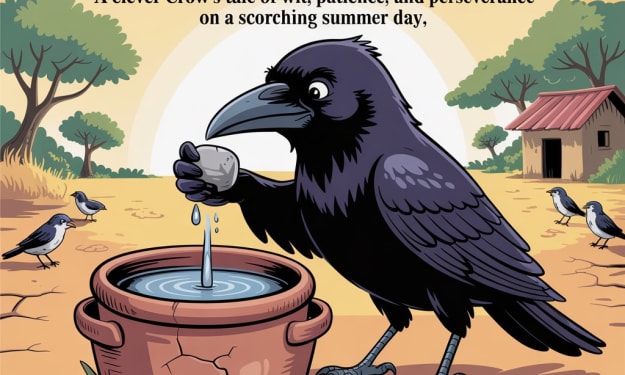
Once upon a time, in a small village surrounded by green fields and dense forests, there lived a clever little crow. His feathers were glossy black, and his eyes shone like tiny beads. He was known throughout the village for his wit and intelligence. While other birds would often act foolishly or get into trouble, this crow always managed to find a way out of tricky situations. One particularly hot summer afternoon, the sun blazed mercilessly in the sky. The air shimmered with heat, and not a single cloud floated above to offer shade. All the ponds, rivers, and wells in the village had either dried up or were reduced to muddy puddles. It was a difficult time for every living creature in the area. Birds sat panting on the branches of leafless trees, and animals hid in their burrows and caves to escape the unbearable heat. The little crow had been flying around for hours in search of water. His throat was parched, his wings felt heavy, and his beak was dry. He desperately needed a drink, but wherever he went, he could find no water. He flew over the fields, hovered near the village wells, and searched around the edges of the forest, but all in vain. Tired and exhausted, the crow finally landed on the branch of a tall, old tree at the edge of the village. He sat there for a while, catching his breath and wiping his beak against the rough bark. Just then, his sharp eyes caught sight of something glinting in the sunlight below. Curious, he flew down to investigate. To his great joy, he discovered an old earthen pot lying near a small hut. The pot looked weathered and cracked, but when the crow peered inside, he saw a small amount of water collected at the bottom. It wasn’t much, but it was enough to quench his thirst. The crow eagerly tried to reach the water with his beak, but the neck of the pot was too narrow, and the water was too low. He tried tilting the pot, but it was too heavy for him to move. He even tried dipping a stick inside, hoping it would bring some water up, but the stick was too thick to fit. For a moment, the crow felt frustrated and hopeless. He was so close to water, yet he could not reach it. But being clever and quick-thinking, he didn’t give up. Instead, he looked around carefully to see if there was something nearby he could use. Suddenly, an idea struck him. He noticed that the ground around the hut was covered with small pebbles and stones. The crow recalled something he had seen before: when stones are dropped into water, the water level rises. Maybe, just maybe, he could use this trick to bring the water within his reach. Without wasting any time, the crow picked up a small stone in his beak and dropped it into the pot. Plop! The stone sank to the bottom, and the water rose slightly. Encouraged by this, the crow quickly picked up another pebble and dropped it in. Plop! Again, the water rose a little higher. The crow worked tirelessly, flying back and forth, picking up pebble after pebble, and dropping them into the pot. With each stone he added, the water level rose a little more. Though it was hard work, and the sun beat down on him relentlessly, the thought of finally quenching his thirst kept him going. After many trips and much effort, the water level finally reached the brim of the pot. The crow could now easily reach it with his beak. With great relief, he dipped his beak into the cool water and drank deeply. The water tasted sweeter than anything he had ever known. His dry throat felt soothed, and the coolness revived his tired body. Feeling satisfied and proud of his cleverness, the crow looked up at the bright blue sky and let out a loud, happy caw. He had not only quenched his thirst but had also proved once again that intelligence and determination can overcome even the toughest obstacles. The crow then flapped his wings and took to the sky, feeling refreshed and joyful. As he soared above the village, he noticed other birds still struggling in the heat. Remembering his own struggle, he decided to share his newfound trick with them. He flew to the tallest tree and called out to the other birds, telling them about the pot and how he had raised the water with pebbles. The birds, grateful for the crow’s wisdom and generosity, followed his advice and soon found relief too. From that day on, the crow became a symbol of cleverness and resourcefulness in the village. The villagers would often tell their children the story of the thirsty crow, teaching them that with a little bit of thought and perseverance, any problem can be solved.
By Muhammad Naeemabout a year ago in Fiction
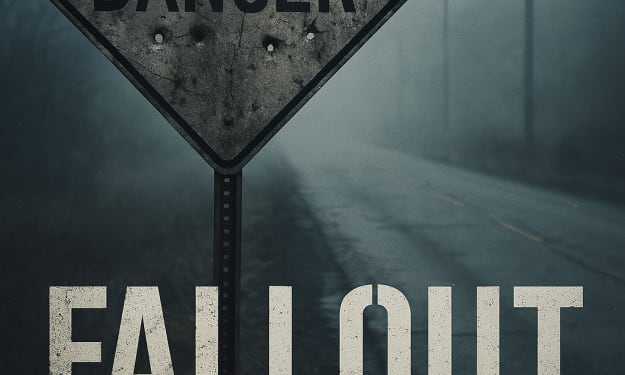
Fallout - Chapter 5
The mess hall was half empty by the time I sat down with my tray – eggs, dry toast, black coffee. Fuel, not food. Conersations buzzed at other tables, but I wasn’t listening. My eyes kept flicking to the far end of the room without meaning to.
By Delaney Allenabout a year ago in Fiction
"The Future of Economy and Investment in a Rapidly Changing World"
🌐 The future of economics and investment in a rapidly changing world In this era of rapid technological advancements, shifting political alliances, and growing awareness of sustainable development, the global economy is undergoing an unprecedented transformation. Understanding this economic trajectory — and investing strategically — is more important than ever for individuals, businesses, and governments.
By Amdadul Haq Sardarabout a year ago in Fiction