Stream of Consciousness
The Lower Shelf
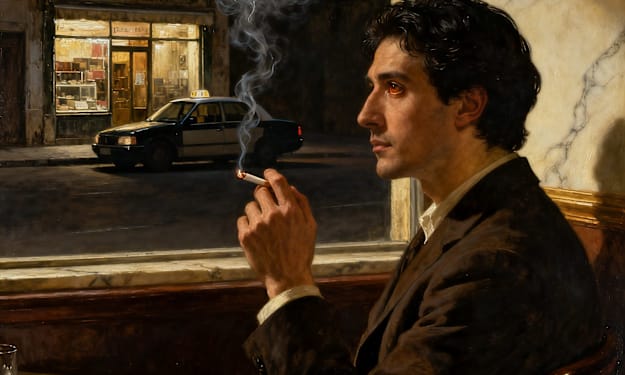
The Lower Shelf by luccian.layth An old bookstore on a street he won't remember the name of. Ghaith pulls a book from the bottom shelf, wipes the dust with his finger without meaning to. A woman stands nearby reading upright, as though standing is part of the act.
By LUCCIAN LAYTH6 months ago in Fiction
The Dreamholders of Tessarna
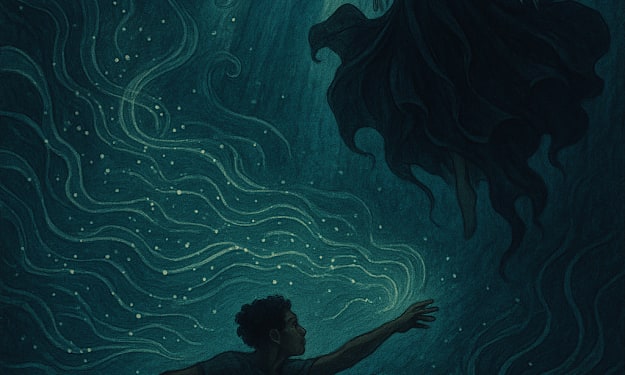
Beyond the snowy slopes of the twin Plardo-Tylno Peaks with their ruby caps, across the Sea of Fiery Tamarinds where the trees grow out of the purple reefs to spray burning spores into the wind. Between the River Endurib’s wide delta that meanders aimlessly around the Plain of Milisino licking the plain’s fields of golden grass, and the sharp obsidian blades of the Wicklaure Mountains where the Dwerrow mine for diamonds and cut obsidian blades. At the centre of the vast and ancient Empire of Tessarna that is ruled by the mighty Lord of the City, Divine Emperor of the Manifold Blades, the Emperor-God Thah-Rast who has ruled there for ten thousand generations. There sits the many-spired citadel of Chega-Toleh, where the streets are limned in purple banners of silk and the paving stones are green marble laced with threads of gold brought up from the sea by the sixteen mighty hands of titanic Thah-Rast. Here the Guild of Dweomercraefters makes its magical vessels to store up dreams in captured form to be experienced again and again by whosoever seeks them. Dreams small and large, pleasant and horrible, all manner of dreams they ensnare in the delicate glass vessels and sell to the highest bidder.
By Samuel Wright6 months ago in Fiction
Magic - Chapter Two
Author's note: Today, my stream of consciousness flows easily without having to think through the story. Therefore, I am letting my subconscious do the work. I am writing this after writing the following, which you will soon read, and I want to mention that everything I have written so far is purely from my subconscious mind. I have not planned the plot, especially what will happen in today's chapter; you will wonder if I have planned this particular incident. The answer is 'No, I have not'. To be honest, it just came into my mind rather abruptly as I was writing, and that's how the subconscious usually works. I hope you understand what I am saying. If you don't, I recommend you read the book The Power of Your Subconscious Mind by Joseph Murphy.
By Denise Larkin6 months ago in Fiction
I Had Already Given Up… But Then Something Unexpected Happened
From the outside, nothing looked too bad. I had a roof over my head, a few people around me, and dreams that once gave me purpose. But inside… it was a completely different story. I was tired. Not physically, but mentally and emotionally exhausted. I had tried so many times to improve my life. I made plans, set goals, and promised myself that “this time will be different.” But every time I tried, something went wrong. Either I failed, or things didn’t go as expected. Slowly, those failures started building a wall inside me—a wall made of doubt, fear, and disappointment. At first, I kept fighting. I told myself that failure is part of success. I watched motivational videos, read quotes, and forced myself to stay positive. But the truth is… there is a limit to how much a person can pretend to be strong. And one day, I reached that limit. I stopped trying. I stopped setting goals. I stopped dreaming. I stopped believing that anything good could happen to me. Days became empty. I would wake up without purpose and go to sleep without hope. Life felt like a routine I was forced to follow, not something I wanted to live. One night, I remember sitting alone in my room. The lights were off, and the silence felt heavy. I kept staring at the ceiling, lost in my thoughts. A question kept repeating in my mind: “What’s the point of trying if I’m just going to fail again?” For the first time, I didn’t have an answer. That night, I silently gave up—not just on my goals, but on myself. The next morning, I woke up late. I had no plans, no motivation, and no reason to get out of bed. I picked up my phone just to pass time, scrolling mindlessly. And then, I saw something unexpected. A message. It was from an old friend I hadn’t talked to in months. The message was simple: “Hey… I don’t know why, but I just felt like telling you this. I believe in you. Don’t give up.” That was it. No long speech. No deep advice. Just a few words. At first, I didn’t think much of it. I even smiled a little, thinking it was random. But as I kept staring at those words, something inside me shifted. “I believe in you.” It had been a long time since I heard that. And even longer since I said that to myself. For months, I had been my own biggest critic. I kept reminding myself of my failures, my mistakes, and everything that went wrong. But I never once reminded myself of my efforts… or my potential. That small message didn’t magically fix my life. My problems were still there. My situation hadn’t changed overnight. But something else changed. My perspective. For the first time in a long time, I thought… “What if I try again? Just one more time?” Not perfectly. Not confidently. Just… honestly. So I started small. The next day, I woke up a little earlier. Not 5 AM like those perfect routines—but earlier than usual. I did one small productive task. It wasn’t much, but it was something. The day after that, I did a little more. Some days were still hard. Some days I felt the same heaviness, the same doubt creeping back in. There were moments when I wanted to quit again. But this time, I didn’t. Because now, I had a different mindset. I wasn’t trying to be perfect. I was just trying to not give up. Weeks passed, and slowly, things began to change. Not dramatically—but noticeably. I became more focused. My thoughts became clearer. I started feeling a little more in control of my life. Opportunities didn’t suddenly fall into my lap, but I started noticing them again. And one day, while reflecting on my journey, I realized something powerful: I wasn’t stuck because I failed. I was stuck because I stopped trying. Failure didn’t destroy me. Giving up did. That one message from my friend didn’t change my life directly. But it reminded me of something I had forgotten—that even in the darkest moments, there is always a small chance to start again. And sometimes, that’s all you need. A small reminder. A small step. A small decision to try again.
By Tawseef Aziz6 months ago in Fiction
The Moment Empires Stop Following the Rules
The empire had lasted for more than three hundred years. People in the capital liked to say it was eternal. Children learned its history in school. Old men in tea houses repeated the same line again and again: empires survive because they follow rules. There were rules for kings. Rules for soldiers. Rules for judges. Rules for trade. Rules for war. That was what separated the empire from the tribes beyond the mountains and the kingdoms across the sea. At least, that was what everyone believed. Elias had spent most of his life inside the royal archive, copying old letters and recording taxes from distant provinces. He was not an important man. Nobody noticed him. Nobody remembered his face. That was why he saw things others did not. Every morning, sealed documents arrived from the palace. Elias and the other scribes sorted them into shelves. One winter morning, a letter arrived with the royal seal. It was a report from the northern province. A governor had refused to pay taxes because a drought had destroyed the farms. According to imperial law, the governor should have been questioned by a court. Instead, the emperor ordered the governor’s entire family executed. Elias read the order twice. Then a third time. He thought perhaps it had been written by mistake. But the next week, another letter came. A city in the east had protested against rising prices. Imperial law said soldiers could only enter a city if local leaders requested help. The emperor ignored the law. Five thousand soldiers entered the city. Hundreds of people disappeared. The official report called it a peaceful operation. By spring, the old rules had become meaningless. Merchants could be arrested without trial. Land could be taken without compensation. Judges who disagreed with palace orders simply vanished. At first, people stayed silent. They told themselves the empire was only going through a difficult season. “Things will return to normal,” they whispered. But nothing returned to normal. One evening, Elias visited his friend Adrian, who had once served as a military officer. Adrian lived in a small house near the river. He poured tea into two cups and listened quietly as Elias described the letters. When Elias finished, Adrian stared out the window. “Do you know what holds an empire together?” Adrian asked. “The army?” Elias said. Adrian shook his head. “Belief.” He pointed toward the city outside. “People obey because they think the system is fair. Soldiers fight because they think the law matters. Judges judge because they think someone above them still respects the rules.” He looked back at Elias. “The moment rulers stop following their own laws, the empire starts dying. Maybe slowly. Maybe quietly. But it starts dying.” Elias wanted to disagree. He wanted to believe that great walls, strong armies, and gold-filled treasuries were enough. But deep down, he knew Adrian was right. The summer brought food shortages. The emperor blamed traders and had several of them publicly executed. Then he blamed local officials. Then foreign spies. Each week, new enemies appeared. Fear spread across the empire. People stopped trusting neighbors. Shopkeepers hid their money. Families spoke in whispers behind closed doors. Even soldiers no longer trusted their commanders. In the south, an army captain refused an order to burn a village. He and his men were killed. After that, more soldiers deserted. Some joined rebel groups in the hills. Others simply went home. The empire still looked strong from the outside. Its flags still waved above government buildings. Its coins were still used in markets. Its armies still marched through the streets. But inside, everything was rotting. Elias saw it clearly in the archive. The shelves were full of reports about missing grain, unpaid soldiers, angry villages, and broken roads. Every province was sending warnings. Nobody in the palace listened. Then, one autumn morning, the bells of the capital began ringing. Crowds gathered in the streets. Smoke rose near the palace walls. A group of soldiers had turned against the emperor. Other soldiers joined them. By sunset, the palace gates had fallen. The emperor disappeared. Some said he escaped through a secret tunnel. Others said his own guards killed him. No one ever learned the truth. That night, Elias stood outside the archive and watched flames rise into the dark sky. The empire that had seemed eternal was collapsing in front of him. Not because of foreign invasion. Not because of famine. Not because of weak armies. It collapsed because the people at the top stopped obeying the rules they expected everyone else to follow. And once that happened, the empire was already broken. It simply took time for the rest of the world to notice.
By JAMES NECK 6 months ago in Fiction
The Lesson
I had just deplaned in Austin after a torturous flight from Sacramento. The weather had been bad when we lifted off and didn’t seem to get much better throughout the flight, with an unexpected delay in Vegas that lasted more than three hours. I was already wound up tight for this trip, a work gig that was going to involve either me or someone else losing their job, so the tension of the delays didn’t help me much. Turbulence makes me nervous, and I could definitely feel my shoulders and my gut paying the price. Needless to say, when the plane finally landed, I was more than ready to disembark.
By David Muñoz6 months ago in Fiction
The Window
The glow was the first thing everyone checked in the morning—not the sun, which was unreliable and messy, but the steady, cool blue of the glass. Every home was a gallery of these illuminated rectangles, windows that offered a view far more curated and pleasing, than normal human optics could receive from the unfiltered world that hid behind everyone's' walls.
By Meko James 6 months ago in Fiction
The Unspoken Rule. Content Warning.
She’s six years old in a hotel room giving way to darkness on the way down to Florida. They’re fighting again, but this is common enough now. She kneels in front of the small screen and presses the button on the TV itself. The remote doesn’t work.
By Leigh Victoria Phan, MS, MFA6 months ago in Fiction