Short Story
The Vanishing Neighbor: A Secret Behind Closed Doors
It all started on a rainy Tuesday morning. I was sipping my coffee, staring out the window, when I noticed something unusual. Mrs. Kapoor’s house, right across the street, was eerily quiet. Her curtains, always drawn open by 7 AM, remained tightly shut. Her car, usually parked in the driveway, was gone. It was as if she had vanished overnight.
By Word Weaver2 years ago in Fiction
Uncle Sal Bought a Cat
Sal Maggio was an uncle of mine whom I consider one of the most unlucky men ever. I never knew him when he was young because I wasn’t born at the time. I got to hear about him and his imperious accomplishments after he caught a case and went to prison. Even with him away, plenty of folklore circulated in the neighbourhood about him. My dad and his buddies chattered incessantly about him whenever alcohol flowed like he had slain a medieval dragon or something. It wasn’t until I was in my teens before he came out of prison that I learned the truth.
By Philip OYOK2 years ago in Fiction
So the Story Goes on and on and on and Skewed Right
Part One by JBaz Part TwoPart ThreePart FourPart Five⬇⬇⬇ They’d returned to the interstate after driving through a few red lights on the side streets, and Special Agent Cochran sped to Bentonville, where they quickly switched SUVs. The Ford Expedition they had been forced to choose had much less space than the Suburban, and with its bright red paint, the Ford stood out.
By Mother Combs2 years ago in Fiction
Vaccine Hesitancy and Uptake: A Shift in Public Health Research Priorities: NIH to Terminate or Limit Grants
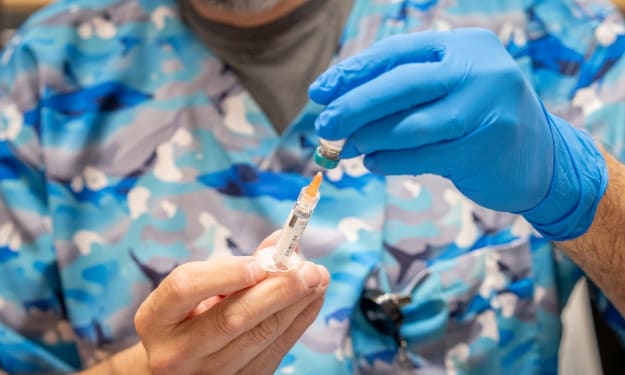
Vaccine Hesitancy and Uptake: A Shift in Public Health Research Priorities: NIH to Terminate or Limit Grants The National Institutes of Health (NIH) recently made a significant decision that has sparked debate among experts in public health, researchers, and policymakers. It decided to end or limit grants related to vaccine hesitancy and uptake. As the federal agency seeks to reallocate resources toward other pressing public health issues, this decision reflects a broader shift in priorities. Vaccine reluctance continues to be a significant problem that necessitates ongoing research and intervention, despite the fact that some support the move as a necessary step to concentrate on emerging threats. The NIH's decision, its context, and its potential effects on public health are the subject of this article.
By Khondokar Bakhtear Hossain2 years ago in Fiction
Alas, Poor Yorick. Content Warning.
As an English teacher, she’d use the prop when she taught Hamlet at the end of October. Shakespeare is difficult to make exciting to younger generations raised on movies and social media. The most famous scene is when Hamlet realizes the skull he is holding and talking to is probably the king’s former jester, the one that used to make him laugh. Alas, poor Yorick. In class, the students were either mesmerized or repulsed by the skull she brought forth. Either way, she figured, they wouldn’t forget the storyline.
By Barb Dukeman2 years ago in Fiction
From Dust to Dawn
Dawn Summers is out and about surveying the cemetery of Sunnydale by herself. Her older sister Buffy is letting her patrol for her slayer duties for a night as a way of proving herself ready for the upcoming battle against evil itself, The First. “Seriously, Buffy couldn’t have given me a creepier night to patrol” Dawn thought to herself.
By Joe Patterson2 years ago in Fiction
I Hate You, I Hate Myself. Content Warning.
All of you are here today because you care for someone who has abused you at some point in your life. Before we begin, I want to explain why everyone is seated in a circle facing outward. This setup ensures that no one can see each other. Each chair is spaced far enough apart so that even if you turn your head, you won’t be able to get a clear look at the person next to you. The purpose of this arrangement is to keep our focus solely on the situations we’ve experienced, rather than on each other’s identities. In this group, we will not introduce ourselves or share personal details such as our names or where we live. Each of you has been assigned a number from one to five, which is how you will be identified. Additionally, when speaking about the person you care for—the one who has also harmed you—please refer to them only as “they”, rather than using ”he” or “she”. This will help remove identifying factors from our discussions. Before we move on, does anyone have any questions? No? Then let’s continue. We will go around the circle three times. - In the first round, each of you will state one thing your abuser did to you. While they may have harmed you in multiple ways, for this exercise, you should describe just one action in no more than two sentences. This may be the action that impacted you the most. - In the second round, you will explain, again in two sentences, why you have become this person’s caregiver. - In the third round, you will share how caring for them has affected your emotions or how it has helped you grow—also in two sentences. I will begin with an example of how your responses should be structured. After I make my statement, I will say, "Number one", signaling the first person to speak. When person number one finishes, they will say "Number two", and so on until we reach person number five.
By Rick Henry Christopher 2 years ago in Fiction
Watching Over You
Most of the houses were already dark as it was almost midnight. There was something so relaxing, almost meditative, about the stroll through suburban streets. The night was warm and quiet, crickets chirping the only thing to hear. The sound of summer. Anthony took his time walking home.
By Cristal S.2 years ago in Fiction