Short Story
Shake It Off and Step Up
Since obstacles are something to shake off, step on. Once upon a time, there was a farmer who had a donkey. It was very old. Once the farmer took out the old donkey. So idiotic, it recently fell into a pond. It groaned for a long time. The farmer attempted to find a way to help it. At last, the farmer saw that the donkey was too old. Plus, the pond needed to be hidden. It was stupid to help the donkey. So the farmer told the villagers to help cover the pond. They all gathered with shovels to dump dirt into the pond. When the mud first landed on the donkey's back, it was surprised, but it soon came to understand its situation. It howled immediately. At one point, everyone looked and was amazed to see that the donkey was silent. When the farmer had thrown a few shovels of soil into the pond, he looked inside the pond and was astounded to discover that when everyone threw soil on the donkey's back, the donkey would shake the soil off its back and step on that soil. The more everybody tried to throw dirt, the better it rose to the challenge.
By Rohitha Lankaabout a year ago in Fiction
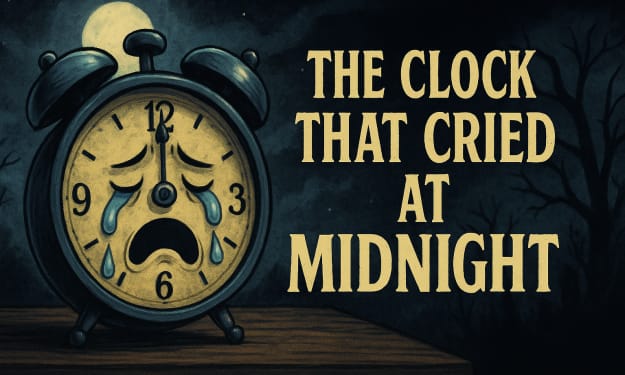
The Clock That Cried at Midnight
The Clock That Cried at Midnight In a quiet corner of an old city street, there stood a dusty little antique shop. Inside were worn-out books, faded picture frames, and creaky old toys. But the most curious object in the shop was a very old clock hanging on the back wall. Its paint had faded, its hands were rusted, and every night at exactly midnight, it let out a soft, sorrowful sob.
By USAMA KHANabout a year ago in Fiction
Begging for a Bite
I wanted her to sink her fangs into my fragile skin. To drink me up. Lick the drops of my blood from her ruby red lips. I wanted to feel the weightlessness of the aftereffects, euphoria, the tingling of my existence wavering on the edge.
By Oneg In The Arcticabout a year ago in Fiction
"Atoms of Power". AI-Generated.
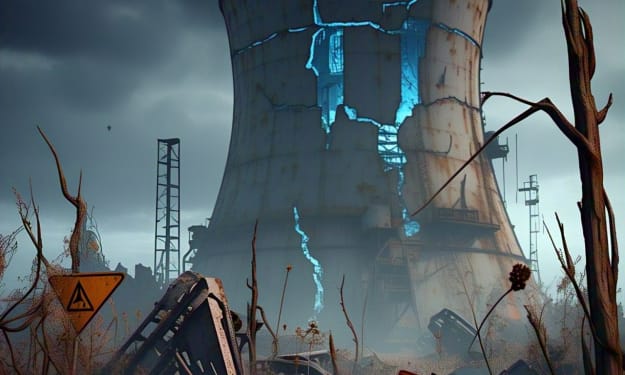
In the heart of what was once the Republic of Virelia, a lone reactor still pulsed beneath layers of concrete and steel. The world above had changed — forests crept through crumbling cities, vines tangled with satellite dishes, and dust-laden roads led to nowhere. But underground, deep in the Earth’s forgotten chambers, power still hummed. Silent. Eternal. They called it Astra Core — once the pinnacle of nuclear innovation. It had promised clean energy, unshackled progress, and freedom from fossil dependence. And for a time, it delivered. Cities lit up like constellations. Machines hummed in perfect synchronicity. Every home was warmed by invisible atoms breaking apart in carefully calibrated reactions. Then came the Divide. It wasn’t a war in the traditional sense. No bomb dropped. No siren screamed. But economies collapsed, governments fractured, and scientific truth fractured with them. What began as political unrest spiraled into civil schism. Some claimed Astra Core was a godsend. Others, a deathtrap. In the end, no one won. Fear spread faster than radiation. And so, the last great reactor was sealed. Not destroyed — no one dared. Instead, it was buried beneath titanium vaults and cryptographic seals, its existence scrubbed from official records, its guardians dispersed. Nature resumed its quiet dominion, and Astra Core became myth. But myths have a way of calling out. A drone — spider-like, silent, and solar-powered — scuttled over moss and rubble. Its directive came not from a human hand but from code written decades ago, instructions buried in the algorithm of an old university server that had recently come back online during a rare solar flare. The drone had received a signal: a pulse, faint but clear, from beneath the earth. A call from Astra Core. It descended through the remnants of a fractured elevator shaft, past murals of scientists, atoms, and children holding hands beneath a glowing sun. Deeper still, until it reached the control nexus. Panels lit up as if they had been waiting. Power surged into sensors. The drone transmitted a single packet of data. Far away, in an abandoned observatory reclaimed by wind and ivy, a terminal flickered on. It belonged to a woman named Keira Lang. Keira was a legacy — the granddaughter of one of Astra Core’s chief engineers. She had grown up listening to bedtime stories about the reactor, told like fairy tales: how it could power a continent, how it ran cleaner than any energy before it, how it had nearly bridged the gap between science and magic. But her parents had taught her the other stories too — about the Divide, about fear, about the day everything fell quiet. The data stream was brief. Coordinates. Access codes. A temperature reading far too stable for something supposedly dormant. Keira stared at the screen, the pulse of the reactor echoing in her chest like a heartbeat. Why now? she wondered. What woke it up? Driven by curiosity and an unspoken duty, she set out with only her tools, a solar battery, and her grandfather’s old tablet — its cracked screen still etched with the symbol of a glowing atom. It took her three days to reach the site. The entrance had collapsed decades ago, but erosion and time had opened a new path, as if the Earth itself had grown tired of secrecy. She descended alone. Inside, the air was dry and still. Lights flickered on as she passed, recognizing her biometric signature through embedded DNA authentication — another gift from her grandfather, whose code lived in her very cells. She reached the core chamber. The reactor stood tall — an angular monolith surrounded by containment rings, humming with restrained energy. Screens blinked to life, showing environmental metrics, core stability, reserve output. It hadn’t degraded. It hadn’t slept. It had waited. A message displayed across the main screen: "PROTOCOL: GUARDIAN INITIATED." "STATUS: NOMINAL." "REQUEST: HUMAN OVERRIDE REQUIRED TO RESUME PRIMARY FUNCTION." Keira felt the weight of the decision before her. The world above had moved on. Tribes, communes, nomadic science guilds — people had adapted to a post-energy world. They feared what came before, revered it as both salvation and curse. Restarting Astra Core would change everything. Cities could rise again. Technology could thrive. But so could division. Control of such power had sparked collapse once. Could it be different this time? She touched the terminal. The override code appeared, encrypted but familiar — her grandfather’s favorite equation. She decrypted it with shaking fingers. Another message appeared: "CONFIRM ACTIVATION: Y/N" Keira paused. The silence was complete. No voices, no guidance, no one to say if this was right or wrong. She thought of the stories. Of promises. Of warnings. Then she closed her eyes and pressed Y. The reactor responded instantly. Rings of energy shimmered to life. Heat diffused through superconductive panels. Power surged outward — not in destruction, but in renewal. Above ground, long-dormant sensors pinged online. A weather satellite adjusted its trajectory. A beacon lit up on the old international relay network — a signal not of conquest, but of return. And far across the planet, others saw it. Scientists in hiding. Children born in the quiet world. Dreamers. Skeptics. Survivors. They all saw the light. --- Atoms of Power had awakened. Not as a weapon. But as a second chance.
By "TaleAlchemy"about a year ago in Fiction
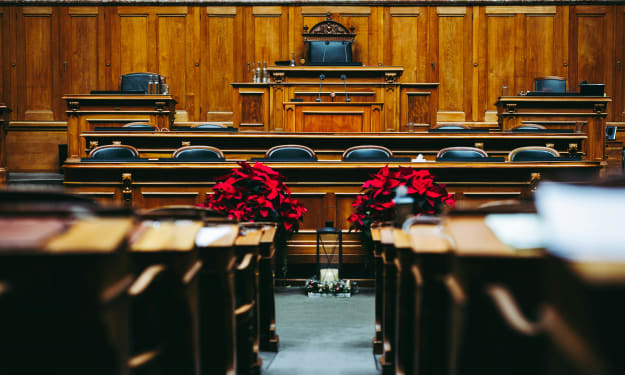
The Courtroom
The judge continues "and after completing your sentence if still alive you will come back to this town and show them how much you have changed, and you must compensate the community somehow when you return. You are now 18 so you unless you really get on someone's nerves you will survive this.
By Mark Grahamabout a year ago in Fiction
The Courtroom
The audience and all present were on pins and needles. The judge is about to state the result. "I find the defendant Guilty on all charges of assault and weckless endangerment of a whole community. You, Morty Sidewinder, will be remanded to the state penitentiary for the next 15 to 20 years plus.....
By Mark Grahamabout a year ago in Fiction
The Courtroom
The judge has arrived. All may be seated. Will the defendants please rise. They rose from their chairs. This was a very long case during this long hot and humid summer. We were all tired, but we wanted to make sure that justice was brought for the victims of one heinous crime presented.
By Mark Grahamabout a year ago in Fiction
The Courtroom
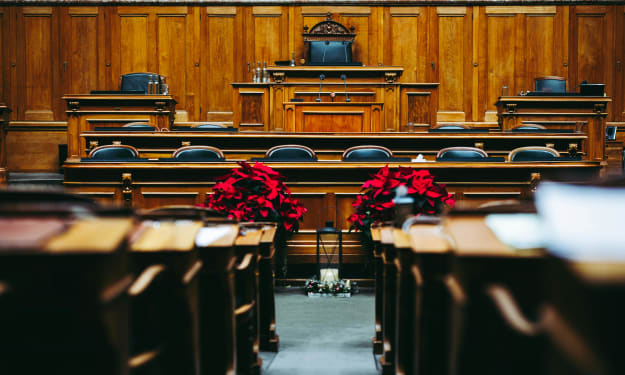
The courtroom was filled to capacity for this particular case. The audience is excited to see how this case turns out. The prosecutors and defense attorneys along with the defendants are present. Now we are waiting for the judge. It is a day that is hot and steamy and no air. Waiting now....
By Mark Grahamabout a year ago in Fiction
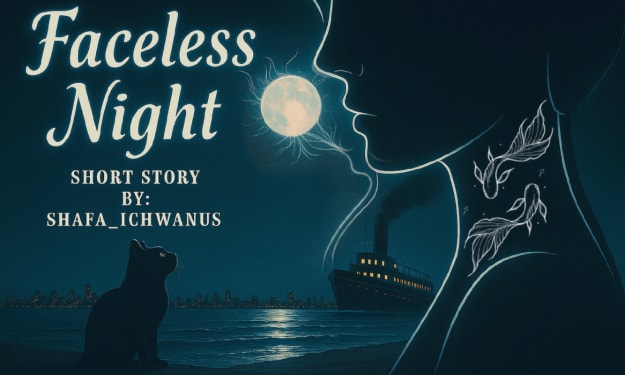
Faceless Night [Part 3].. Content Warning.
*** The man remembers, fifteen years ago. Before he truly understood the curse. He walked among the lips of the pier, scavenging through the pile of trash left by the passengers. He found nothing except for the foaming ocean water. Then, his two pearl eyes fixated on a mother carrying her child on her left arm, and a bag of fresh fish on her right hand. His drool dripped, his eyes sharpened, and his long tail waved as a signal that he found his target. His paws stuck closer to the edge of the pier, and he leaped into the big ship that had just docked. The ship's anchor protruded from the surface of the sea that started to turn reddish in the reflected light of sunset. The big ship departed, leaving its city behind. The city filled with narrow alleys, where he always ran to avoid being hit by broomsticks. Narrow alleys that had trash cans at each end, where he scavenged for food. The cat meowed and sniffed on the third floor deck of the ship, sharpening his sense of smell to trace the fresh fish aroma brought by the mother. It was complete, just five meters in front of him. The mother was sitting on the passenger seat, nursing her child. Now, he just had to wait for the pitch-black night. It had been an hour and thirty minutes since the ship sailed calmly on the moonlit sea. Some passengers grouped themselves according to their age order. They suddenly greeted each other, getting to know each other, telling their origins and ethnicities. The elderly were busy discussing their youthful days, while the young people joked around while humming night songs. It was not as dark as expected. Now the cat took a higher spot, on the roof of the third floor deck. He still caught the scent of fresh fish, guarding it not to be lost. His trick turned out not to be as easy as wagging his tail, which now just lay flat, stroking his hungry belly. He sat, gazing into the distance, occasionally looking up to let the moonlight's bias dip into his pearl- like eyes. He meowed loudly, asking the clouds to cover the moonlight. "Meeeooong...!" Suddenly, the passengers fell silent, momentarily stopping their activities. They were quiet not because a cat was meowing on the roof, but because the ship's speed slowed down when the captain turned the steering wheel to make a turn. Then, from a distance, there was a faint sound like a trumpet. There were other ships across the port. The lights of the ships sparkled like fireflies, lining up and shining along the beach's lips. Confirming that the destination was close, a destination to another city. The cat squinted, its ears perked up, sharpening its hearing. Restless, the fish might not be eaten. It leaped and ran towards the deck, keeping an eye on the passengers' area. The fish bag was still there, among the rows of long benches. It was time for dinner. Nobody cared, not even the owner who had already fallen asleep with their child. The cat crept among the slouching passengers' legs, finally getting a big chunk of fresh fish. It sharpened its claws, clawing at the bag until it tore open. The cat was angry because the ship was slowing down to dock, and the bag was still intact. It bit into the bag, its fangs piercing the surface. It tasted the fish's fat mixed with its own saliva, and continued to scratch at it. But then the mother woke up, finding her child urinating, peeing on the black fish bag. The cat, now wet with urine, was trying to steal the fish.
By Shafa Ichwanusabout a year ago in Fiction