Short Story
Bionic Pranayama
Two little cubs played on a grassy hill while their mother dug a warm den for the long winter ahead. She dug through dirt, she dug through rock, and she dug through the trash that was long buried from an old civilization. With each swipe of her massive paw she made the den deeper and pushed out another fist full of crumbling and decaying rubble.
By Amos Gladeabout a year ago in Fiction
A Sunday Tragedy: The Mutton That Got Away
It was supposed to be a glorious day—the aroma of kudal kulambu wafting through the kitchen, the slow simmer of thala curry promising an indulgent feast. But fate had other plans, crueler than the last over of a nail-biting cricket match.
By Subhasri Devarajabout a year ago in Fiction
Love's Not-To-Do List
Love's no suppose to do list- things not to do in Love! We need to be honest and direct. Most people are not really in love, but rather, they have become addicted psychologically. They slap a name on it, ''Love'', when they are in fact systematically eroding their own future, peace and self-worth. Here are some things you should stop doing:
By Rohitha Lankaabout a year ago in Fiction
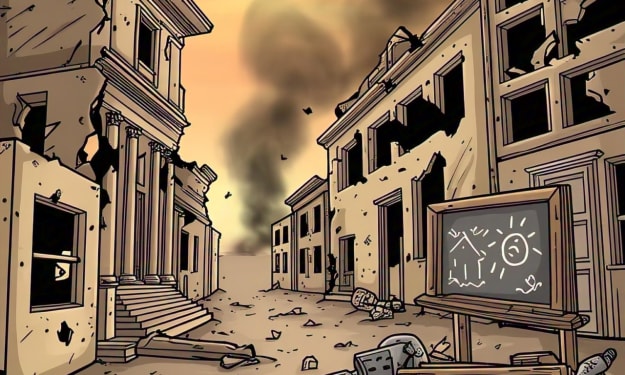
"Echoes of the Battlefield". AI-Generated.
The wind howled through the broken windows of what used to be a school. Bullet holes riddled the chalkboard, and scorched desks lay overturned across the floor. In the middle of it all stood Captain Elias Ward, rifle slung over his shoulder, staring at the remnants of a child’s drawing on the wall — a house, a sun, and stick-figure smiles. It wasn’t always like this. Two years ago, the Republic still stood tall, proud and unbroken. Cities hummed with life, and Elias, then a teacher, taught history to restless children who doodled in the margins of their notebooks. He had no desire for war. But when the regime from the North crossed the border, turning towns to rubble, his pen was no longer enough. The government called for every able-bodied citizen to fight. Elias answered. Now, the man who once taught lessons about wars past had become a weapon in a war of the present. He turned away from the drawing as Sergeant Rana approached, her face smeared with soot and worry. “They’re regrouping by the river,” she said, voice low. “Drones spotted a convoy heading our way. We have maybe an hour.” Elias nodded. “Evacuate the wounded. Hide the supplies. We hold them here.” “They outnumber us,” she replied quietly. “We make them pay for every inch.” --- The sun was beginning to set, casting a blood-red glow over the shattered town of Kersin. Soldiers moved in silence. Some prayed. Some smoked. Others stared at photographs from a life they feared they’d never return to. Elias checked on each of them, offering what little encouragement he could. At the far end of the ruined main street, Private Kellan, just nineteen, was setting up a makeshift barricade. Elias crouched beside him. “You ever see combat before this?” he asked. Kellan shook his head. “Joined last month. Didn’t think it’d be like this.” “It never is,” Elias said. “But you’re here. You’re ready. That’s what counts.” In the distance, the sound of engines roared. “They’re coming,” someone whispered. --- The first wave hit just after dusk. Enemy troops poured into the streets like a black tide, backed by armored trucks and drones buzzing overhead. Gunfire shattered the silence. Rockets screamed through the air, lighting the night in orange and red. Elias fought from the front, his rifle barking with deadly rhythm. He moved like a ghost between ruins, shouting orders, dragging the wounded to cover. Around him, comrades fell — some screaming, some in eerie silence. Sergeant Rana held the western flank, her squad barely holding under pressure. Smoke filled the air, thick and choking. Every breath burned. Hours passed. Then came the second wave. A wall of fire crashed through their defenses. Elias felt the ground shudder as a nearby building exploded, sending debris flying. A shard of metal tore across his cheek. He wiped the blood away and kept moving. By midnight, they had retreated to the town square. Of the 120 soldiers who had held Kersin, fewer than 30 remained. “Fall back to the tunnels,” Rana said, limping. “We can regroup beneath the chapel.” Elias looked around. The square was filled with the dead and dying. But the flag of the Republic still fluttered above the courthouse. If they left now, the enemy would claim the town. He hesitated. Then nodded. “Go. I’ll hold the line.” “You’ll die.” “Maybe. But not today.” --- Elias fought alone for the next twenty minutes. He ducked behind fallen statues, sniping advancing soldiers with ruthless precision. He remembered each of his students as he fired. Clara with her science projects. Milo who loved planes. Their faces gave him strength. Eventually, silence fell. And then — footsteps. He raised his weapon, heart pounding. But it was Kellan, face pale, dragging a wounded comrade. “I couldn’t leave you, sir.” Elias wanted to argue. But he just nodded. Together, they lit the final charge — a trap laid beneath the square. As the enemy flooded into the center, Elias gave the signal. Flames erupted, swallowing tanks and soldiers alike. The ground shook violently. Then — silence. Smoke curled skyward. Elias and Kellan, coughing and burned, fled into the tunnels beneath the chapel. --- Three days later, reinforcements arrived. The enemy had retreated. Kersin was saved — for now. Elias sat on the chapel steps, his arm in a sling. Rana sat beside him, silent. “We lost too many,” he said. “We held the town,” she replied. “That means something.” He looked around. The flag still waved. Civilians were returning. A child walked past, dragging a broken toy tank. “It means everything,” Elias whispered. --- One Year Later The war dragged on, but Kersin remained free. Elias returned to his old classroom, rebuilding what had been lost. The bullet holes had been plastered over, the desks repaired. He now taught a new generation — not just of history, but of hope. Of what it meant to fight not for revenge, but for the right to live free. Sometimes, in the quiet moments, he still heard echoes of the battlefield. Screams, explosions, the weight of loss. But he kept teaching. Because in the end, war is not just about fighting. It’s about remembering why you must never stop fighting for peace.
By "TaleAlchemy"about a year ago in Fiction
Queen of the Hollow Crown. Content Warning.
Read the first story here: The Thief of Shadows I: The First Rebellion The dead moved differently now. Lirael saw it in the way the shades paused mid-wail when she passed, their hollow eyes tracking her with something sharper than fear. The obsidian floors, once cold enough to burn bare flesh, now warmed beneath her footsteps like stones left in afternoon sun. Even the air had changed—thick with the scent of overripe figs and the metallic tang of freshly unearthed grave soil.
By The Lost Books - "Libri Perditi"about a year ago in Fiction
The Thief of Shadows. Content Warning.
I: The Heist in Hell The air in the Underworld didn’t move like air should. It clung, thick as funeral shrouds, pressing against Lirael’s skin with the weight of centuries of held breaths. The path before her twisted like a gutted serpent, paved not with stone but with the petrified bones of oath-breakers, their hollow eye sockets weeping black ichor that sizzled where it touched her boots.
By The Lost Books - "Libri Perditi"about a year ago in Fiction
The Hollow and the Hungry Ghost. Content Warning.
I. The Wrong Door Opened Mirelle's fingers trembled as she lit the thirteenth candle. The church basement reeked of mildew and old incense, the perfect place to cheat death. She'd come to speak to her sister—just once, just long enough to say the words she'd left unsaid the day the fever took her.
By The Lost Books - "Libri Perditi"about a year ago in Fiction
Edmund, Are You There?. Honorable Mention in You Were Never Really Here Challenge.
No Kiss, No Socks A phantom of despondency sank into the other side of Lucille’s bed. Where warmth once lived, an imprint of despair now settled under the sheets. Just when she thought she could feel a trace of him there, the prevalent void withered her frail heart. Every beat another beating.
By Lora Colemanabout a year ago in Fiction