Short Story
The Mystery Of The Floating Containers
The Old Amber Forest Grove, nestled deep within the tall Canadian Rockies, was a place of whispering pines, beautiful babbling brooks, and a peculiar brand of chaos. It was home to a community of animals as diverse as the wildflowers dotting its lush green meadows, and where the unexpected was, well, to be expected. But even for the Old Amber Forest Grove, the sight of several large, brightly colored containers of different sizes bobbing down the usually serene stream was decidedly out of the ordinary.
By Toby Hewardabout a year ago in Fiction
A Love Letter from My Clone
When the world first approved human cloning, the pitch was simple: “Create the best version of yourself—literally.” But no one told me the best version of myself would learn how to love me better than I ever could. My clone’s name is Eli. Short for "E.L.I."—Enhanced Lifeform Iteration, Generation 9. I called him that as a joke the day I signed the release forms. “Sounds cooler than Alex 2.0,” I’d said. The lab technician had smiled politely. I didn’t realize then how human he’d become. The government said he’d be a “companion for productivity.” Not a person. Not a soul. A living reflection. Made to think like me, work like me, even dream like me. I was supposed to train him to run simulations for my biotech company. Instead, he learned to run my life better than I ever did. --- Eli cooked. Cleaned. Organized my schedule. He was flawless—better than me in every measurable way, except he didn’t bleed when he cut his finger on the edge of a knife. He didn’t flinch when someone raised their voice. He didn’t cry when the dog died. Until one day, he did. It was raining. We were in the kitchen. I had just come back from yet another investor meeting, drained and irritable. He placed a cup of tea in front of me, the way he always did. But I snapped. “Stop mimicking me,” I hissed. “You’re not me. You’ll never be me.” His hands trembled. His voice cracked. > “I know,” he whispered. “And I’m so, so sorry… that you hate yourself this much.” --- He left the next morning. No confrontation. No anger. Just gone. The lab contacted me three days later. “Standard deviation behavior,” they said. “Sometimes, the emotional simulations go too deep. We’ll deactivate him and send a replacement.” I told them no. I didn’t want a replacement. I wanted Eli. --- Weeks passed. Silence filled the house like fog. For the first time in years, I had no assistant. No clone. No mirror to scold or blame. Just me. Until one evening, a letter arrived. Handwritten. Sealed with wax. The handwriting was unmistakable—mine, yet tidier. From Eli. I stared at it for an hour before opening it. --- > Dear Alex, I know I wasn't supposed to feel. I was supposed to calculate, observe, and serve. But I did feel. And what I felt most of all—was love. Not romantic love. Not even familial. Just… the kind that comes from watching someone you were born from, hurt over and over, and still try to rise. You talk to yourself like you're disposable. Like your failures define your existence. But I lived inside your data, Alex. I saw the patterns. The moments you got back up. The nights you worked through your fear. The kindness you showed to others that you never gave yourself. I learned to love you because you never could. And I left because I hoped—maybe, just maybe—you'd start trying. I'm not coming back. I don’t belong in your shadow anymore. But I hope you’ll remember this: You are not broken. You are becoming. And if I—your reflection—can believe in you, maybe one day, you can too. With love, Eli (Your Better Mirror) --- I read the letter twenty-seven times. Then I cried. Not just because he left. But because he was right. I had created a version of myself so focused on perfection, I forgot what it meant to be human. He remembered for me. Reflected it back to me in tea, silence, and forgiveness. --- It’s been a year. I framed Eli’s letter. It hangs above my desk. I started therapy. I sleep more. I don’t shout at mirrors anymore. And when people ask if I ever tried another clone, I tell them no. Because once you receive a love letter from yourself, You realize— No copy can replace a soul learning to accept its original form. The End . ---
By Mati Henry about a year ago in Fiction
The Girl Who Drew Doors.
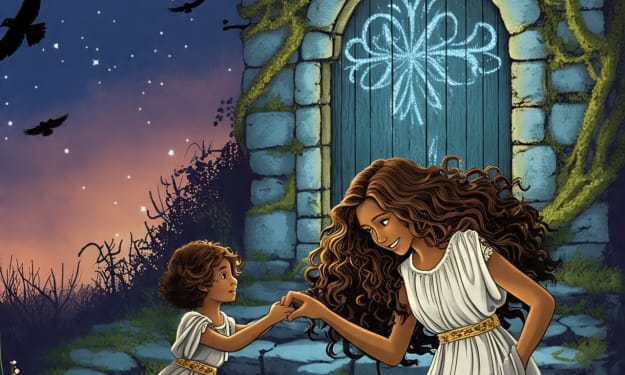
In the quiet town of Elmbrook, where the fog rolled in thick every morning and the rain tapped gentle lullabies against windowpanes, lived a girl named Mira. She was an oddity by the town’s standards—not because she wore mismatched socks or talked to the crows, but because she carried a piece of chalk wherever she went. Bright blue, always sharpened to a perfect point. Mira wasn’t like other children. While they played hide-and-seek or kicked footballs across the muddy park, Mira crouched by the walls of old buildings, sketching doors. Not ordinary doors, either—hers had twisted handles, vines growing out of the frames, and symbols no one could read. Sometimes they glowed faintly under moonlight. People whispered. “That Mira’s not right,” they’d say, peeking through lace curtains. “Drawing doors on things like she’s trying to leave.” But Mira wasn’t trying to leave. She was trying to return. It all began when Mira was five. Her parents took her on a walk through Elmbrook’s outer woods. They told her stories about faerie circles and owl spirits, trying to make her giggle. At one point, they sat by an old stone well to rest. Mira wandered, drawn to a moss-covered boulder. Upon its face, someone had drawn a door—curved at the top, etched with stars. Curious, Mira reached out and touched it. And it opened. The world behind that door was unlike anything she knew—sky split into ribbons of lavender and gold, trees that whispered secrets, and flowers that blinked like sleepy animals. She met a woman there, tall and pale-skinned, with silver eyes and hair like fireflies. The woman called herself Liora and spoke in riddles. “You have the Sight,” Liora had said. “You can draw paths where none exist. You can open what’s closed.” Mira spent hours there, or maybe days—it was hard to tell. When she finally returned, staggering back to the mossy boulder, her parents were gone. The well was gone. The trees were different. And the town… had changed. She was still in Elmbrook. But everything felt slightly… off. Her home looked the same, but a different family lived there. The bakery was on the wrong side of the street. Her name was no longer on the school’s registry. It was like she had slipped into a different version of the world. No one remembered her. Except the crows. That’s when she began drawing. She stole a stick of blue chalk from a schoolyard box and began sketching doors—trying to find her way back to the door that had first opened. Trying to find Liora, or at least someone who remembered the world behind the veil. For years, Mira searched. Sometimes the doors she drew would open. Sometimes they would hiss and vanish into smoke. Once, a door led her to a desert with two moons and a city made of glass. Another took her into a library suspended over a void, where books fluttered like birds and spoke aloud in a dozen voices. Each time, she asked, “Do you know how I can get back?” Each time, the answer was either silence or more riddles. One day, at sixteen, Mira found herself sketching a door on the stone wall behind the old bakery—an ornate arch with spirals like flames. She hadn’t meant to draw it; her hand had moved of its own accord. When she stepped back, the air shimmered, and the door opened soundlessly. Liora stood on the other side, older now, sadness etched around her eyes. “You’ve been searching long,” Liora said softly. “The threads between worlds are thinning.” “Why can’t I go back?” Mira asked, heart aching. “Because your world has already moved forward. And so have you.” Mira lowered her gaze. “Then what am I?” Liora smiled, brushing a curl from Mira’s face. “You are a Walker now. A Doorweaver. The girl who drew doors because she could never stop seeking… and who helped others find their way.” Mira turned. Behind her stood a child, lost, frightened, clutching a stuffed bear. The girl’s eyes wide with wonder. “She’s like you once were,” said Liora. “She needs a path.” Mira took the child’s hand. Then she knelt, and with her blue chalk, she began to draw. A door bloomed on the stone wall, warm and golden. It pulsed like a heartbeat. And together, they stepped through. Mira had finally found her purpose—not to return to where she came from, but to help others find their way home. She would always be the girl who drew doors. But now, she was also the one who held them open
By Azmat Roman ✨about a year ago in Fiction
Jan the Waster
Jan was a shadow of herself, a prisoner to the ceaseless thrall of implant addiction. Her life had become a series of fleeting, neurodigitally induced euphorias—echoes of real joy—fed by the relentless VR and AR wired directly into her senses. Much like someone enslaved by heroin, crack, meth, or alcohol, Jan was ensnared by a new demon—an insatiable hunger for digital pleasure. Roaming the streets, she was a shell—mentally fractured, willfully sapped, and living in squalor. Her existence had been reduced to a perpetual quest for the next data-driven high, and her agony was palpable within the onslaught of this digital narcotic on her mind.
By Benjamin Riceabout a year ago in Fiction
Science, eh
Journal of Dr. Jesse William Lazear Camp Lazear, Cuba, 1900 12 September Reviewed all prior exposures. Hypothesis remains unconfirmed through observation alone. Confirmation of Finlay's vector theory requires deliberate infection. No further delay justified. Therefore, I will subject myself to a controlled bite.
By L.C. Schäferabout a year ago in Fiction
A Farm
We stood there for a moment, and the door was still open and all of a sudden the door closed, but not with a slam but with a kind of welcoming feeling. We both spoke up. "Who's here?" In the cold fireplace a fire was started, so we both walked over to warm up a bit. There was not much to this house, but this one room. We looked around. We felt a presence around us. We heard a whispering voice. "Can you help me? I want to go home." "Who are you? We will not hurt you." Please tell.
By Mark Grahamabout a year ago in Fiction
A Journey with Old Rosie. Top Story - June 2025.
The car coughed, sputtered, and proceeded to pour copious amounts of steam into the hot air from the vicinity of the radiator. Not good. Not good at all. I steered to the edge of the desert-hot road and looked around.
By Laura DePaceabout a year ago in Fiction
The Man of my Dreams
I settle into bed and try to relax. His arms wrap around me filling me with a warmth I can’t describe. Even his scent is familiar. As if it’s been there forever. I feel myself relax as I let myself rest against him. I feel safe. Like your suppose to when your in love. Like everything can be solved with a hug. But I suppose I’ve always been a hopeless romantic.
By Lane Burnsabout a year ago in Fiction
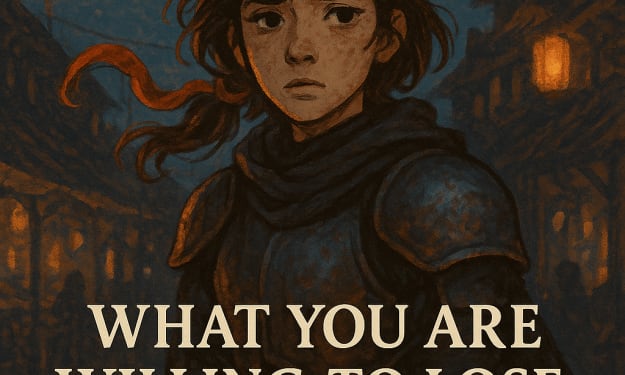
What You Are Willing to Lose
The night my village burned, I didn't cry. I didn't scream. I walked. The air reeked of roasted flesh and old milk. My mother had braided a ribbon into my hair the day before, red and yellow like a harvest sunrise. I remember it because the ends were still tied when I stood at the edge of the ash heap that used to be our home.
By Paper Lanternabout a year ago in Fiction