Short Story
The Silent Howl of Lyra
The wind whipped through the jagged peaks of the Greyfang Mountains, carrying the scent of pine and the promise of a harsh winter. Lyra, a lone wolf with fur the color of twilight and eyes like molten gold, stood silhouetted against the bruised sky. Her pack, once vibrant and strong, had been scattered by a sudden, violent blizzard months ago. She was the sole survivor, her paws aching with every step, her belly hollow with hunger.
By Waqif Khanabout a year ago in Fiction
The Letters She Never Read
The Letters She Never Read by (Mukhlis) He wrote her letters. One every week, without fail. From rain-soaked cities and quiet corners of the world, Ayaan wrote to Elina with the kind of love people read about in novels but rarely find in real life.
By NASRULLAH MUKHLISabout a year ago in Fiction
The Mirror Lied. Content Warning.
The mirror had always been in the hallway. Tall, framed in tarnished gold leaf, its glass was slightly warped — the kind that made your reflection look just a bit... off. It belonged to my grandmother, who used to mutter in her last years, “Don’t trust what it shows you.”
By Kamran Zebabout a year ago in Fiction
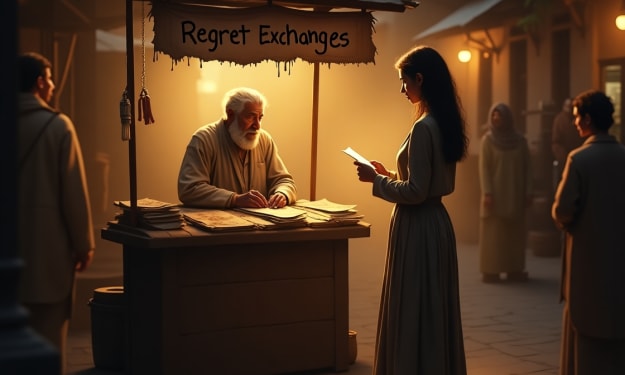
The Man Who Sold Regrets
The Man Who Sold Regrets by (Mukhlis safi) In a cramped corner of the old bazaar, nestled between a spice seller and a cobbler who never smiled, was a stall so plain most walked past without noticing it. Its banner, dusty and frayed, read only:
By NASRULLAH MUKHLISabout a year ago in Fiction
"The Day the Moon Forgot to Rise"
The Day the Moon Forgot to Rise When darkness came early… and never left. --- It began with whispers — not in the air, but in the silences. You know the kind: between one heartbeat and the next, when the world pauses for no reason at all. On the last normal night, the town of Merrow Hill lay quiet. People cooked dinner, turned on their porch lights, let the dogs out. The sky was clear. The air smelled like rain that hadn't come yet. Everyone expected the moon to rise, same as always. No one expected the sky to stay black after the sun dipped beneath the horizon — not clouded, not stormy — just black. Like the stars had packed up and gone. Like the moon had called in sick and no one filled its shift. At first, we waited. Checked the time. Checked the weather. Some said it was an eclipse. Others joked about aliens. One neighbor said it was a “government blackout test,” whatever that meant. By 9:00 PM, all the power had gone out. Streetlights blinked and died. Phones lost signal. Even battery-powered clocks stopped ticking, their hands frozen in useless quiet. That’s when people began to worry. Not panic — not yet. But worry crept in like a draft beneath a door. Something wasn’t right. By midnight, children were crying. Dogs refused to go outside. And that’s when people noticed the quiet — the kind that screams at your ears. No crickets. No cars. Not even the wind. Just silence so deep it felt like drowning. We couldn’t see the stars either. Just the blackness, pressing harder against the windows than any storm ever had. Like it wanted in. I opened the back door to let in some air, and that’s when I realized it wasn’t just the sky that had gone dark. It was everything. I couldn’t see my own hand in front of my face. I waved it wildly, right in front of my eyes — nothing. I stepped out barefoot onto the porch, but I didn’t feel the boards beneath me. I didn’t feel anything. It was like stepping into a dream someone else was having — no up, no down, no weight, no wind. I screamed for my brother, who had been sitting on the couch only minutes ago. No reply. When I turned to go back inside, the door was gone. The porch, the house, the yard — all gone. Or maybe I was. Panic hit then, cold and sharp. I fell forward and landed flat on something too smooth to be wood, too warm to be stone. I reached out blindly, trying to find a wall or railing — anything familiar — but I touched only space. Space and whispers. They weren’t loud. They weren’t even words, at first. Just... murmurs. Like wind through reeds, or breath through cracked lips. I thought I heard my name. That was when I realized I wasn’t alone. I wasn’t hearing whispers — I was being whispered to. Hundreds of voices, overlapping, like insects inside my head. Some spoke in languages I didn’t recognize. Others repeated things I had thought and forgotten. Some told stories — stories about the moon, about why it never came that night. They said it saw something. They said it ran. They said it would never come back. --- When I woke up, it was still dark. It’s been dark for… I don’t know how long now. Days? Weeks? The clocks never started again. The sun never rose. We light fires, we burn anything that will hold a flame, but the light never lasts. It flickers out faster every time, like the dark is learning how to eat it. We’ve gone down to the lake. We thought maybe the moon would find us there — catch its reflection and remember where it belonged. But the water just sits like oil, still and thick, swallowing every torch and lantern we offer it. People are disappearing. Sometimes we hear their voices for a while afterward, echoing from the dark. Calling for help. Or calling us into it. If you find this… and there's still light where you are… don't wait for the moon. It’s not coming back.
By Muhammad Waqas about a year ago in Fiction
How to Open Up to a Big Sister
1. Understanding the Distance: Acknowledge the Pain Without Judgement Growing up without the presence or support of a big sister can leave emotional gaps that are difficult to articulate. Older siblings often carry symbolic weight—they are protectors, guides, and sometimes even role models. When that expectation is unmet, it leads to confusion, resentment, or a silent longing for connection. Before you can open up to her, it's important to first explore your own feelings about the past. Were you hurt because she didn’t come to your school events? Did you feel alone during family crises because she seemed emotionally or physically absent? Understanding the specifics of your experience, rather than burying the emotion, is a vital step toward meaningful communication. It’s also crucial to recognize that her absence may not have been intentional. Perhaps she was going through personal struggles of her own—dealing with mental health issues, academic pressures, or family expectations that took her away from her younger siblings emotionally. Or maybe she simply wasn’t mature enough at the time to handle the role she was meant to play. This does not erase your pain, but it does open the door to a more balanced perspective. By removing the weight of harsh judgment, you allow yourself the chance to approach her not with blame, but with the desire to heal. This shift in mindset sets the stage for a more productive and empathetic conversation. 2. Preparing Emotionally: Define Your Intentions and Set Boundaries Before initiating the conversation with your sister, it helps to reflect deeply on what you hope to achieve by opening up. Do you want closure about the past? Are you hoping to rebuild a stronger bond moving forward? Or do you simply need to express feelings that have been bottled up for too long? Being clear with yourself will give your conversation focus and help avoid veering into territory that could reopen old wounds without resolution. It's also essential to prepare for the possibility that your sister may not respond the way you want her to. She may feel guilty, become defensive, or even deny your experience. Preparing yourself for these reactions allows you to stay grounded and avoid being blindsided. Equally important is setting emotional boundaries. Make a conscious decision about what you're willing to share and what you’d rather keep private. You don’t have to bare your soul all at once. Vulnerability is not about dumping years of pain in one go—it’s about opening the door just enough to let the light in. Perhaps start by discussing a single incident or a general feeling you’ve carried with you, and observe how she responds. If she shows openness, kindness, or even regret, you can gradually reveal more. If not, you’ve still taken an important step in honoring your truth. Either way, by clarifying your intentions and limits, you’ll approach the conversation with more confidence and emotional safety. 3. Choosing the Right Setting and Language: Start Soft, Stay Honest The timing and environment in which you open up to your sister can make a significant difference. Avoid doing it during a rushed moment, family gathering, or high-stress event. Choose a neutral, quiet setting where both of you can be physically comfortable and emotionally present. A walk in a park, a calm café, or a private chat over video call—whatever feels safest for you both. Begin the conversation gently. Start by expressing appreciation for the chance to talk, or even acknowledge that it’s not an easy topic for either of you. Using soft, non-accusatory language helps lower her defenses and encourages her to listen more attentively. Use “I” statements rather than “you” statements to express your emotions. Instead of saying, “You were never there for me,” try saying, “I often felt alone growing up, and I struggled with not having you around.” This shift in language places the emphasis on your experience rather than casting blame. The goal here is not to guilt her into an apology, but to invite her into your world—a world she may not have realized she was absent from. Also, be patient with pauses, silence, or emotional responses. Opening up is not a monologue—it’s an emotional dance. Allow her to process what you’re saying, and give her the chance to respond in her own way and time. 4. Dealing with Responses: Embracing Disappointment, Hope, or Reconnection Your sister’s response can range from heartfelt understanding to complete denial. She may apologize with sincerity, offering insights into her own struggles and perhaps expressing regret for her absence. This outcome, while ideal, is not guaranteed. She might respond with defensiveness, saying things like, “You’re overreacting,” or, “I didn’t even know you felt that way.” If that happens, it can feel like your emotional vulnerability was wasted, but it’s important to remember that people can only meet you as deeply as they’ve met themselves. Her inability to accept your feelings doesn’t invalidate them. If her response is dismissive or cold, you are still in control of how you choose to heal. You may need to grieve the relationship you hoped to have with her. This is a valid and necessary part of the process. Closure doesn’t always come through resolution—it often comes from recognition. If, however, your sister is open to further conversation, or expresses a desire to reconnect, then you’ve both been gifted a chance to rebuild a relationship that was once fractured. This will take time, effort, and continuous honesty. Perhaps you can begin with small, consistent steps—shared activities, text messages, or just learning more about each other’s present lives. Reconnection after emotional distance is never immediate, but it is possible with mutual care and patience. 5. Moving Forward: Healing as a Personal and Shared Journey Whether or not your sister responds the way you hoped, opening up is a powerful step toward healing. It reflects courage, emotional maturity, and a willingness to confront pain rather than suppress it. Healing is never linear—it comes in waves. Some days you may feel lighter, having voiced your truth; other days, old wounds may sting anew. Be gentle with yourself during this process. Seek additional emotional support if needed—therapy, journaling, or conversations with trusted friends can help you navigate the aftershocks of vulnerability. If a new relationship with your sister begins to bloom, celebrate the small wins. Every moment of shared laughter, every message exchanged, is a step toward a bond that didn’t exist before. And if that relationship remains distant, know that you’ve done your part in extending an olive branch. Opening up isn’t about changing the past—it’s about making peace with it. You’re not just reaching out to her—you’re reaching inward, reclaiming your narrative, and choosing to live authentically. Regardless of how she responds, your journey toward healing and self-expression is already a powerful act of transformation.
By Dipayan Biswasabout a year ago in Fiction
The Power of Truth: A Wise King’s Justice
In a kingdom ruled by power and pride, it was not a warrior or a noble who won the king’s heart — but a simple water carrier. His joy was in serving others. His reward? A betrayal that nearly cost him his life. But fate had other plans. This is the tale of Shankar — a humble soul whose honesty outshined even the most cunning schemes.
By Soul Pagesabout a year ago in Fiction
Wear the Mask, Play the Game. Top Story - June 2025.
I stared at the setup with familiar apprehension. I wondered if I could do it this time. Eyes stared at me in the gloom; I caught a glint over light off of horn-rimmed glasses. “Think you’re ready for this?”
By Meredith Harmonabout a year ago in Fiction
What Are The Odds?
Flat to Let – South London, Zone 2 Bright and spacious two-bedroom flat in Peckham Rye. Top-floor unit in quiet residential street. Double-glazed windows, good natural light throughout. Large living area with separate kitchen. Modern bathroom. Ideal for young professionals or postgrads. Excellent transport links - 10 mins to Overground, buses nearby. Unfurnished. Available immediately. £1,950/month. Contact Gillian. Enquiries via email. +++ Three Weeks Later Text to Tim - 16.36 >Mate, I took the flat in Peckham Rye. Bit pricey but it’s a nice area. Quiet. Moving in next week. Drop by sometime. Not unannounced, ok? Reply - 22:09 >Don’t call me mate. I’m not coming to yours. You always pretended it was an accident. I haven’t forgotten.
By L.C. Schäferabout a year ago in Fiction