Short Story
Jerk
So she's lying there, in my arms. I could see her but not feel her, or smell her. I should have been able to. I could still see out of my eyes, so I should be able to use the other senses, but no. Those were closed off to me. I was trapped in here, behind these eyes, in a silent, empty world.
By L.C. Schäferabout a year ago in Fiction
The Regret of a Creator: The Man Behind the World's Deadliest Weapon
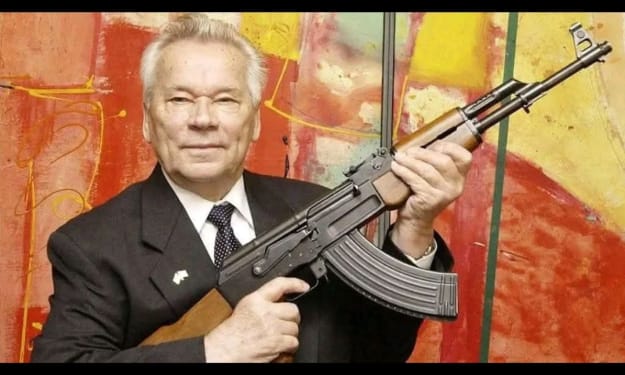
In 1947, deep within the Soviet military-industrial complex, a young Russian military engineer named Mikhail Kalashnikov gave birth to a weapon that would eventually shape modern warfare—and haunt his soul for the rest of his life. Kalashnikov, a lieutenant general in the Soviet Army and a self-taught mechanical genius, was driven by a singular vision: to create a simple, reliable weapon to protect his homeland. War had already carved its scars into his life. He had seen fellow soldiers fall in battle, many due to malfunctioning or overly complex rifles. That pain led to innovation. From his hands, the AK-47 was born—a compact, durable, easy-to-use assault rifle that could function in mud, sand, water, or snow. The rifle carried his name: Avtomat Kalashnikova 1947—the AK-47. It was an invention meant for defense, a tool to safeguard a nation. But what Kalashnikov didn't anticipate was how the world would seize his creation—and turn it into a symbol of death. Over the next few decades, the AK-47 exploded across the globe. From deserts to jungles, civil wars to gang wars, revolutions to terrorist attacks—the unmistakable outline of the AK-47 became a fixture in countless conflicts. It wasn't just a weapon; it became an icon. Cheap to manufacture, easy to operate, and devastatingly efficient, it was quickly adopted by armies, militias, warlords, guerrilla fighters, and criminals alike. More than 100 million AK-47s (and its variants) are estimated to exist today. It is the most widely used firearm in the world. But while the world held his weapon high, Kalashnikov himself began to feel the heavy weight of his creation’s legacy. "I wish I had invented a lawnmower instead." This haunting sentence, often quoted in interviews, reflected the deep regret that slowly consumed him. What began as a patriotic endeavor had spiraled into a global catastrophe of violence—and he felt helpless watching it unfold. Mikhail Kalashnikov never profited from the weapon. He lived a modest life, honored in Russia as a national hero, but internally tormented. His was not the guilt of someone who sold death for money—but of a man who felt betrayed by humanity’s misuse of his intentions. He often stated, “I created the weapon to protect the borders of my country. I never imagined it would be used by terrorists, bandits, and criminals.” As the years went on, the bloodshed mounted. Kalashnikov watched images of child soldiers holding his weapon. He saw drug cartels flaunt it. He heard stories of massacres committed using his invention. And the question began to gnaw at him: “Am I responsible for all these deaths?” In 2013, just a year before his death, Kalashnikov—then 93 years old—wrote a deeply personal letter to the head of the Russian Orthodox Church. In it, he poured out his heart: “My spiritual pain is unbearable. I keep asking myself the same question—if my rifle took people’s lives, am I responsible for their deaths... even if they were enemies?” It was the confession of a man facing the end of his life, haunted not by war, but by the moral ambiguity of creation. In that letter, he questioned not only himself but also the nature of mankind: “Why did God allow man to have envy, aggression, and evil in his heart?” These weren’t the words of a cold inventor or a proud soldier. They were the reflections of a man who had witnessed the darkness of human nature far too closely—and had become a reluctant symbol of it. It’s important to remember: a weapon doesn’t pull its own trigger. Kalashnikov understood this too. He often emphasized that the rifle itself had no will, no intention. It was humanity’s choices—driven by power, greed, revenge, and fear—that transformed a tool into an instrument of mass killing. He once said, “Blame the politicians, not the engineer.” Still, despite that logic, his soul found no peace. He believed in duty. He believed in country. But he also believed in humanity, and he never expected it to fall so far. Kalashnikov died in 2014, honored as a hero by the Russian state, but carrying a wound that medals could not heal. He was the creator of one of the deadliest weapons in history—and a man broken by the very legacy he left behind. 🖋️ "Mistrust the creation, if it ever overshadows the creator." — A lesson from a man who invented a rifle, but longed only for peace.
By Israr khanabout a year ago in Fiction
Nothing is Ever Exactly as It Seems
Nothing is Ever Exactly as It Seems. The hillside looked like a painting. A soft sweep of green rolling down into the valley, cottages scattered below, smoke curling from chimneys though the day was warm. The sky carried no blemish, only the clear blue of a summer morning. I stood on the balcony of the house, the one that was supposed to feel like home. It was her house, not mine, and I was here because everyone said it was time I met her. The mother of the man I had chosen. The old dear, that was the name whispered with fondness, as if she were nothing more than lace curtains and tea cups.
By ♿ V+ Marie381Uk about a year ago in Fiction
School Assembly
Attention teachers and students! Welcome back to Our Lady of Our Perpetual Wanting! I hope that your summer break was restful, comfortable and wonderful, and that you can forget about the unfortunate incidents of the previous semester. Over the summer, the gym was restored to its previous condition, along with warnings about the number of people allowed to use the ropes, handle the pummel horses, and do the hokey-pokey during Daylight Saving Hours. That's what it's all about... Ha, ha. Apologies. I am sure that the AV club would have enjoyed that joke if they were still with us. Amen.
By Kendall Defoe about a year ago in Fiction
The Forest of the Forgotten
Amnity sat on the old tree stump. Her face was gentle and fair against the light blue and orange hue that engulfed the early morning hours surrounding her friendly metaphysical shop when I came walking up. Amnity had her nose deep in her white oak magic book with the golden-rimmed sheets of paper, and she was reading from it calmly. Crickets broke the silence, but not her attention as she read.
By Parsley Rose about a year ago in Fiction
The Deceiver of the Wild
Auther name ( Hazratullah) The forest is a place where every creature struggles to survive, a land where strength, patience, and wisdom decide who thrives and who perishes. Among all the animals that roamed the dense woodland, there lived a fox whose name was whispered with equal parts fear and admiration. He was not the largest beast, nor the strongest, but his clever mind and quick thinking allowed him to escape the sharpest claws and the deadliest fangs. He was known as the deceiver of the wild, the one who turned danger into opportunity.
By Asmatullahabout a year ago in Fiction