Script
❤rian’s Night: When the Dark Almost Won❤
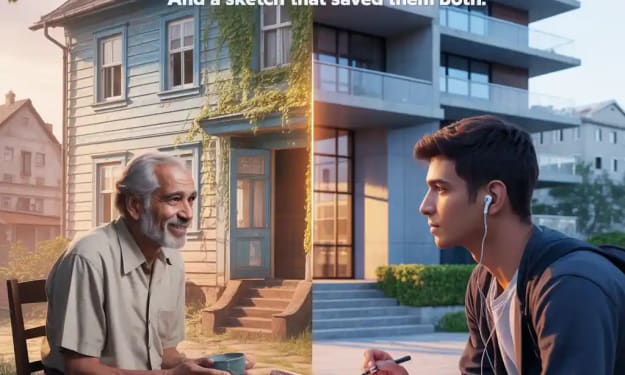
It was late at night. The wind whispered through the cracked window of a small room, lit only by a dying bulb. Arian sat on the edge of his bed, his hands gripping his face, his shoulders trembling — not from cold, but from the weight of everything he had tried to carry for too long.
By Abdulmusawerabout a year ago in Fiction
The Roar and the Whisper
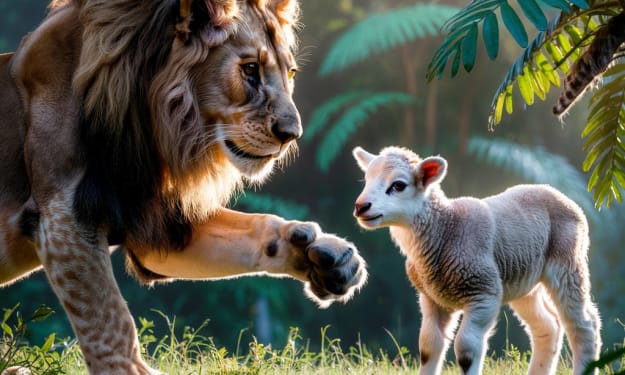
The Roar That Ruled "eep in the heart of the forest where sunlight cracked through tangled canopies and shadows held secrets, ruled the mighty lion, Ragnar. His mane was like flame, his roar like thunder, and no creature dared question his rule. He hunted when he pleased, roamed where he chose, and took what he wanted. The law of the wild was simple: “The strong survive, and the weak obey.” And no creature was considered weaker than the lambs of the northern meadow. Their soft bleats and peaceful grazing made them easy prey. They never ran far. They never fought back. And they always feared Ragnar. But the lion was growing tired. No hunt thrilled him anymore. No roar echoed long enough. A gnawing emptiness followed every victory, though he didn’t know why. The Lamb Who Didn't Run One overcast morning, Ragnar padded through the forest and came upon a stream near the meadow. There, alone and humming a strange little tune, stood a lamb—Lyra—her snow-white wool glowing against the gray sky. She was far from her flock, vulnerable, unaware. Or so Ragnar thought. He stepped forward, ready to pounce, but Lyra didn’t flinch. She looked up, locking eyes with the predator of her kind. "You’re the lion they all whisper about," she said. Her voice was calm. Almost... curious. Ragnar paused mid-step. No creature had ever spoken to him without trembling. "You should run," he growled. "I know," she replied. "But I won’t." "Why not?" Lyra smiled faintly. "Because I don’t believe you want to eat me. Not today. A Strange Curiosity Instead of devouring her, Ragnar sat down. For the next hour, they talked. Or rather—she talked, and he listened. She told him about the wind and how it carried the scent of wildflowers from the southern hills. She told him about a mother bird building her nest in a crooked tree. She even sang him a lullaby her grandmother used to hum during storms. When the sky darkened, Ragnar rose. “You’re strange for a lamb.” "And you’re quiet for a lion," Lyra said, unbothered. He left without a word, but that night, Ragnar didn’t sleep. He kept hearing her voice—soft and steady like a whisper brushing against thunde- Return to the Meadow The next day, Ragnar returned. And the next. And the next. They never talked about fear. Or death. Or what might happen if one day his hunger outweighed his curiosity. They spoke of stories instead. The myths of the forest. The colors of the moon. The dreams Lyra sometimes had where lions and lambs danced together without fear. “You’re ridiculous,” Ragnar said once, but he found himself wondering—what would that world look like The Challenge But the jungle noticed. And the pride grew restless. “You’ve gone soft,” snarled Drax, Ragnar’s younger rival. “You sit with prey while your strength withers.” “I’m still king,” Ragnar growled. “Then prove it. Hunt her. Bring her back as your prize.” Ragnar said nothing. But inside, something cracked. That night, he stood at the edge of the meadow. Lyra was waiting. She always waited. But this time, he didn’t sit. He stared at her as if seeing her for the first time—as a lamb, as prey, as the weakness he had once vowed to destroy. "Is today the day you eat me?" she asked gently. "I might have to." Lyra nodded. “Then at least let me tell you one more story.” He listened. It was a story about a lion and a lamb who were born into war but dreamed of peace. Who were told they could never be friends but still shared shade under the same tree. A story that never had an ending—because no one dared imagine one. “You can write it,” Lyra said. “You’re the lion. You decide how the story ends.” The Roar That Changed Everything The next morning, Ragnar returned to the pride. He roared—not a roar of dominance or hunger, but something new. A roar that echoed with choice, not instinct. “I will not hunt the lamb,” he declared. “Nor any creature who offers no harm.” The pride erupted. "You’ve betrayed your nature!" Drax roared. “No,” Ragnar said. “I’ve rewritten it.” A battle followed. Fierce, brutal, primal. But in the end, Ragnar stood over Drax, bloodied but unbowed. “This is our law now: strength with mercy, power with restraint.” Some lions left. Others stayed. But the jungle heard. And the whisper began to spread. A New Meadow Months passed. The forest changed. Predators and prey still lived by instinct, but not by fear. A fragile truce was born—not perfect, not without setbacks—but real. And sometimes, in the quietest part of the meadow, Ragnar would sit beside Lyra, listening to her stories as the sun dipped low. “Do you miss being feared?” she asked once. “Sometimes,” he admitted. “But I’ve found something better.” “What’s that?” He smiled. “Peace.” The Final Story Years later, when Lyra grew old and her steps slowed, she asked Ragnar for one last favor. “Tell the story,” she whispered. “Even when I’m gone. Tell it like it mattered.” Ragnar, now grayed and gentler, nodded. And he did. He told the cubs and the calves, the foxes and the fawns. He told them of a time when the jungle was ruled by fear, and how a lamb changed a lion with nothing but her voice. He ended each tale the same way: > “Strength isn’t in how loud you roar, But in how quietly you can listen.”
By Arshad khanabout a year ago in Fiction
The Man Who Sat at Table Seven
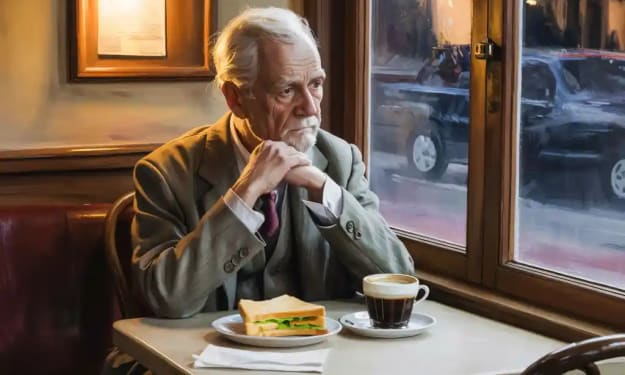
There’s a quiet little café on East 41st Street, nestled unceremoniously between a secondhand bookstore and a flower shop that always smells of jasmine and damp stems. Blink, and you might miss it. No neon signs. No whimsical chalkboard menus boasting fancy lattes or turmeric infusions. The awning just reads “Mira’s Café” in fading gold letters. Inside, it smells like toasted bread, warm milk, and stories too old to tell.
By Arshad khanabout a year ago in Fiction
The Echoes of the Yellow Scarf
When Mira stepped off the subway at 14th Street, the crowd swept around her like waves. It was the same platform, same train, same morning routine—but today, something was different. Clutched in her hand was a yellow scarf. Not hers. She had found it on the park bench she always sat on before heading to work. It was soft, handmade, and slightly frayed at the edges, with initials stitched in the corner: S.H. She hesitated before picking it up earlier that morning. Normally, she'd ignore lost items, let someone else deal with them. But something about this scarf felt… personal. Like it was meant for her to find. By the time she reached her office on the 22nd floor of a glass-paneled building, she couldn’t stop thinking about the initials. Who was S.H.? Why did it feel like more than just a lost scarf? She Googled the initials with “yellow scarf” and “New York”—of course, nothing. A thousand meaningless results. But then came the dreams. That night, Mira dreamt of a girl in a yellow scarf standing under a streetlamp, eyes full of sorrow. She said nothing. Just stood. Watching. Silent. The next night, she returned. This time, Mira spoke. “Who are you?” The girl looked up. “Help me find home.” Mira jolted awake. The scarf was on the chair beside her bed—right where she’d left it. But it looked newer. Less worn. As if time had reversed. In the days that followed, the dreams grew more vivid. The girl—always in that yellow scarf—stood by a bench, her back to Mira, facing a lake Mira had never seen before. And every time, she'd whisper, “Almost there.” Mira started drawing the scenes. She was no artist, but the urge was uncontrollable. She filled pages with images of the girl, the lake, the scarf fluttering like a whisper caught in wind. Her friends thought she was spiraling. “You need sleep,” they said. “You’re obsessing over nothing.” But she couldn't stop. One rainy Sunday, Mira walked aimlessly through Central Park, the scarf wrapped around her neck, the dreams echoing in her thoughts. And then—she saw it. The bench. Not just any bench. The bench. The one from her dreams. It faced a small, quiet lake. Willow trees bowed along the edges. A streetlamp flickered nearby. It was all real. She sat. A soft breeze passed. Leaves rustled. The scarf lifted slightly. And then, across the lake, stood the girl. Real. Flesh and bone. Same yellow scarf. Same solemn eyes. Mira stood. “Who are you?” The girl smiled faintly. “You found me.” Mira stepped forward, breath caught in her throat. But before she could speak again, the girl turned and walked toward the trees—fading like mist in morning light. Gone. Mira looked down. The scarf had vanished. In its place, on the bench, was a note. “Thank you. I’m home now. – S.H.” That was three years ago. Since then, Mira walks the park every Sunday. She never saw the girl again, but sometimes, when the breeze picks up just right, she feels a soft warmth on her neck—as if a scarf, unseen, still lingers. She doesn’t tell many people the story. Who would believe her? But if you ever find a yellow scarf where it shouldn't be… Hold on to it. Someone might be waiting.
By Arshad khanabout a year ago in Fiction
"What Happens After We Block Someone? A Digital Ghost Story Told by Algorithms"
I used to think that blocking someone was the end. A digital wall. A simple act of control in a chaotic, hyperconnected world. But what if I told you that’s not true? That when we block someone — or get blocked — it doesn’t delete the bond. It just buries it.
By Hamad Haiderabout a year ago in Fiction
The Brave Cub Who Walked Into the Storm
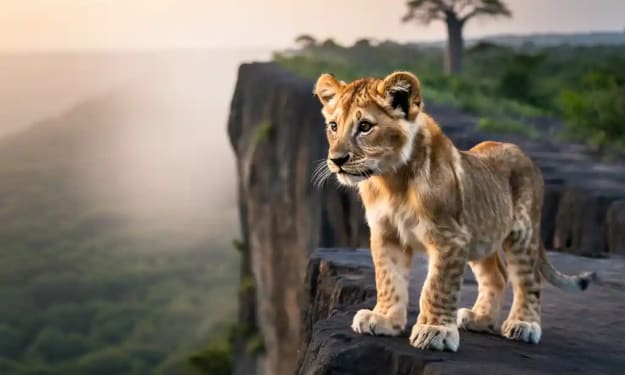
art of the African savanna, where golden grass whispers stories of survival and legacy, a lion cub named Leo was born. But unlike his siblings, who roared with instinct and leapt with promise, Leo was different. He was smaller. Quieter. Often overlooked. While the others played fiercely beneath the tall acacia trees, Leo watched from a distance—his eyes not on the games, but on the horizon. His paws were too small to race, his roar too soft to intimidate, and his legs trembled in the company of boldness. Yet there was something else inside him. A spark that didn’t show on the surface. A curiosity. A question. “Why don’t you join them?” his mother would ask gently, her golden eyes filled with worry. Leo would lift his head, ever so slightly. “Because I want to learn,” he would whisper. “I want to see the world before I try to conquer it.” Others in the jungle didn’t understand. They dismissed him. “Too small to matter,” scoffed the zebras. “Too quiet to be brave,” mocked the monkeys from their high, swinging homes. But Leo didn’t argue. He didn’t need to. Somewhere deep inside him, a voice far older than his own murmured: “Your time will come. And when it does, the world will know.” he Storm That Changed Everything It came without warning. The sky, once a blue canvas, darkened into a violent grey. Thunder cracked through the heavens, and the jungle trembled. The rain poured like arrows from the clouds, and the wind howled like forgotten spirits. Leo’s family, like many others, found refuge in a rocky cave near the cliffs. They huddled close, seeking warmth and safety as the world outside unravelled. Then came the sound that pierced the storm. A cry. Fragile and distant. Milo. The baby elephant from the neighboring herd. Lost. Alone. The lion king, Leo’s father, growled with authority. “No one moves. The storm is not kind to wanderers.” But Leo couldn’t sit still. His ears twitched at the sound. His heart raced—not with fear, but with purpose. “He’s out there,” Leo said, more to himself than anyone else. “He’s afraid.” “You’re just a cub,” his father barked. “Don’t be foolish.” But Leo had already stepped forward. His mother tried to stop him. But courage moves faster than doubt. And sometimes, a lion’s heart knows exactly when to roar—even if no one else can hear it.
By Arshad khanabout a year ago in Fiction