Sci Fi
Non-Binary Future
Everything seems normal, but I wonder why everything is so perfect? There must be something wrong. The people in this city are looking good and there is energy. But they are hiding something. For the looming threat of nuclear war that will see sweep over us all. The climate threat, the rise of neo-Nazism. There is a sinister secret about alms I must know. Why does everyone in this city spend their nights indoors.
By Karl McBeath9 months ago in Fiction
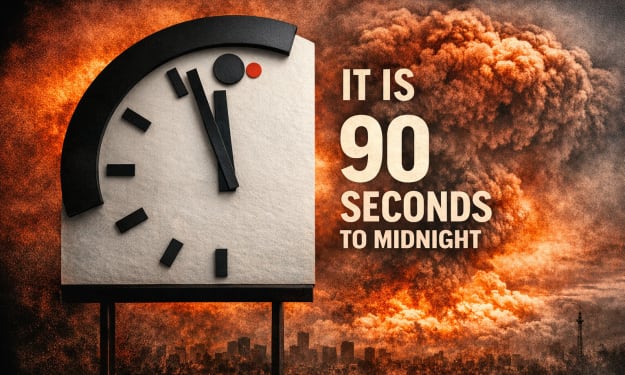
Doomsday Clock: Why the World Is Closer Than Ever to Global Catastrophe
Doomsday Clock: Why the World Is Closer Than Ever to Global Catastrophe The **Doomsday Clock** is a powerful symbolic representation of how close humanity is to a self-inflicted global disaster. Created to communicate complex scientific and geopolitical risks in a simple visual form, the clock has become a widely recognized indicator of global instability. Midnight on the clock represents total catastrophe, while the movement of its hands reflects expert assessments of existential threats facing the world. Today, the Doomsday Clock stands closer to midnight than at any point in history, raising serious concerns about the direction humanity is heading and the decisions shaping its future. --- ## What Is the Doomsday Clock? The Doomsday Clock is not a real clock and does not predict an exact moment of destruction. Instead, it is a metaphor designed to show how dangerous the current global situation is. The closer the clock is to midnight, the higher the perceived risk of a catastrophic event that could threaten human civilization. It was originally focused on nuclear weapons, but over time its scope expanded to include climate change, emerging technologies, biological threats, cyber risks, and the breakdown of international cooperation. The clock serves as a warning system intended to spark public awareness and political action. --- ## Who Decides the Time on the Doomsday Clock? The time on the Doomsday Clock is set by a group of scientists, security experts, and policy specialists. Each year, they evaluate global conditions and assess how human actions are increasing or decreasing the risk of catastrophe. Their decision is based on multiple factors rather than a single event. These include military tensions, nuclear arsenals, environmental trends, technological developments, and the strength of global institutions designed to manage risk. The clock is adjusted only when experts believe the overall danger level has significantly changed. --- ## Why Is the Doomsday Clock So Close to Midnight Now? The current setting reflects a convergence of serious global threats. Nuclear tensions between major powers have increased, with armed conflicts and aggressive rhetoric raising fears of escalation. At the same time, progress on nuclear disarmament has slowed, and some long-standing safeguards have weakened. Climate change is another major driver. Rising global temperatures, extreme weather events, and slow international responses have amplified concerns about irreversible environmental damage. Scientists warn that delayed action could trigger long-term consequences for food security, water resources, and global stability. Emerging technologies also play a growing role. Artificial intelligence, cyber weapons, and biotechnology are advancing faster than global rules and ethical frameworks. Without proper oversight, these tools could increase instability, misinformation, and unintended harm. --- ## Has the Doomsday Clock Ever Been This Close Before? The Doomsday Clock has moved back and forth over the decades, reflecting changing global conditions. During the Cold War, it came dangerously close to midnight due to nuclear weapons testing and superpower rivalry. At other times, diplomatic progress and arms reduction agreements allowed the clock to move farther away. However, the current setting is the closest the clock has ever been to midnight. Unlike earlier periods dominated by a single threat, today’s risk landscape is shaped by multiple overlapping crises happening at the same time, making the situation more complex and harder to control. --- ## What Does the Doomsday Clock Mean for Ordinary People? While the clock is aimed at world leaders and policymakers, its message is also meant for the public. It highlights how everyday political choices, energy use, technological development, and public awareness can influence global outcomes. The clock reminds people that global risks are interconnected. Nuclear conflict, climate change, and technological misuse do not exist in isolation. Addressing one threat often requires cooperation and progress across many areas. --- ## Is the Doomsday Clock Just Fear-Based Symbolism? Some critics argue that the Doomsday Clock is overly dramatic or simplistic. They claim it may create unnecessary fear rather than constructive solutions. However, supporters see it as an effective communication tool that translates complex expert analysis into a clear and urgent message. The clock is not meant to predict the end of the world. Its purpose is to encourage responsibility, cooperation, and informed decision-making before irreversible damage occurs. --- ## Can the Doomsday Clock Be Moved Back? Yes, the clock can move away from midnight if global conditions improve. History shows that international cooperation, arms control agreements, environmental action, and responsible governance can reduce global risk. Reducing nuclear stockpiles, accelerating climate solutions, regulating emerging technologies, and strengthening global institutions are all actions that could push the clock back. The future is not fixed, and human choices remain the most important factor. --- ## Why the Doomsday Clock Still Matters Today The Doomsday Clock remains relevant because it reflects the reality that human survival depends on collective action. It is a reminder that progress, technology, and power come with responsibility. As the clock edges closer to midnight, its message becomes clearer: the greatest threats to humanity are created by human decisions, and only human cooperation can prevent disaster.
By America today 9 months ago in Fiction
One Unchecked Box. Top Story - October 2024.
"Republished" because it was the only way to add the embed for the newly recorded audio version of this story due to the Top Story badge. Plus it serves as a nice, informal announcement of the podcast's revival for another season (go subscribe!):
By Stephen A. Roddewig9 months ago in Fiction
Captain Michael and the Horn of Logan
“I am King David the Magnificent. The Great and Powerful. Ruler over all that is in front of me, all that is behind me. All that is to the north, south, east, and west of me. Why have you come before my great presence? Make your request now. If it sounds pleasant to my ears, I might consider granting you your request. If not, you will be fed to the lions.”
By David E. Perry9 months ago in Fiction
The One Who Stayed in the Dream
1 It started with the dream. Every night, I saw him. It was always the same. A boy with dark hair and calm eyes, sitting across from me at a café that doesn’t exist. The walls were pale yellow, the windows fogged from the rain outside, and there was always jazz playing softly in the background.
By Yamuni Kaijumi9 months ago in Fiction
Chrome Hearts. Honorable Mention in Mismatch Challenge.
The cowboy hat draped over one eye was black leather, scuffed and worn, like it’d seen some things, but the leg peeking through the lace slit of her skirt was brand new, chrome plated titanium, fastened together with countersunk bolts. Whoever she was, she was special. Or used to be.
By Faris Lannon9 months ago in Fiction