Sci Fi
"The Healer’s Burden: Faith, Legacy, and the Weight of Divine Gifts"
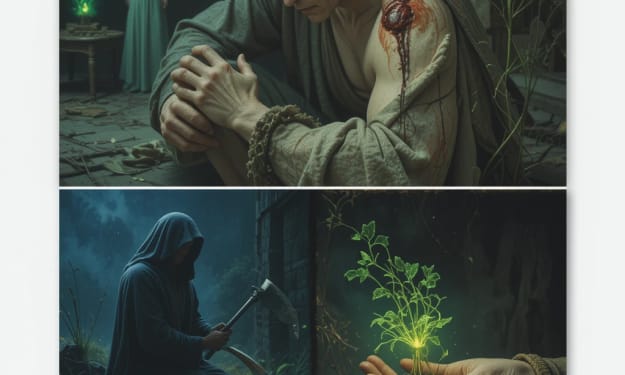
The Healer understood her gift far better than the Apprentice ever could. To be *Blessed* was not about skill or effort—it was simply *being*, carrying a selfless faith so profound that it shaped the world without intent. Though she healed with her hands, sometimes the Divine intervened, mending what mortal ability could not. "It’s not a choice," the Healer murmured. "What happens through me defies understanding. If I tried to dissect it, I might destroy it." The Apprentice bit back her frustration. "Then what *can* you teach me?" "Everything I know," the Healer replied. "The wisdom from my first master, the lessons of High Valley. You could even go there—I’d give you a letter. But don’t chase a Blessing. That path will poison your joy and corrupt your craft. Some things *are*. Some *aren’t*. And some *never will be*." With a tired sigh, the Healer shifted, rubbing her lower back. The Apprentice immediately kneaded the stiff muscles, wondering what toll the Blessing truly took. She’d never know—but while her master remained, she would learn. To be Blessed seemed miraculous. Yet, watching the Healer’s weariness as she guided the Apprentice’s hands, it was clearly a burden too. The magic came unpredictably. Rarely did the Healer *know* it would work—except with the boy, when green light had flared beneath her fingers. Even then, she couldn’t claim it as her own, couldn’t replicate it, couldn’t pass it on. As she worked the knots from her master’s shoulders, the Apprentice wondered how much time they had left. The Blessed were wanderers at heart; this village might not hold her forever. Then she caught herself—*scheming again*. Trying to manipulate, to *force* understanding. The Healer was right. If the rules were as she said, the Apprentice could never be Blessed. But there’d been a hint in her words: *faith alone moves magic*. Perhaps, if she planted the seeds now, generations later, a new Blessed might rise in this village. Another farm boy might cheat death because of her unseen hand. That future healer would eclipse her own legacy. Her name would fade, remembered only as a woman who’d once mended wounds. She was content with that. Healing was enough. Unseen, a wisp of green light seeped through the Healer’s dress, settling into the Apprentice’s fingers. "Never to be Blessed" didn’t mean the gods would refuse her all grace. As her master said, even mortals could heal—*with their own hands*. --- **The Weight of Blessings** The Healer knew her gift in ways the Apprentice could scarcely fathom. To be *Blessed* was not a matter of study or will—it was a state of being, a surrender to a faith so profound it moved through the world like wind through grass, unseen but undeniable. She healed with her hands, yes, but sometimes—only sometimes—something greater stirred within her, mending what should have been beyond repair. "It isn’t something I *do*," the Healer said, her voice quiet but firm. "It passes through me. If I tried to hold it, to dissect it, I fear I would lose it entirely." The Apprentice clenched her fists, frustration simmering beneath her skin. She had so many questions, so many *whys* and *hows*, but the answers slipped like water through her fingers. Swallowing her impatience, she asked instead, "Then what *can* you teach me?" The Healer’s expression softened. "I can teach you all I know—the remedies passed down from my first master, the secrets whispered in High Valley. If you wish, I will send you there with my blessing. But listen well: Do not seek the Blessing itself. That path leads only to disappointment. Some things cannot be claimed. They can only be *received*—or not." With a weary sigh, the Healer set aside her cloth and shifted, wincing as she pressed a hand to the small of her back. The Apprentice moved without thinking, her fingers finding the familiar tension in her master’s muscles. She had seen this weariness before, the way the Healer’s body bore the cost of her gift. *What does it feel like?* the Apprentice wondered. To be a vessel for something so vast, so beyond comprehension? To never know when—or if—the magic would answer? The Healer had spoken of faith, but faith was a slippery thing. The Apprentice had seen miracles—like the boy and the scythe, the way emerald light had knit his flesh back together as if the wound had never been. Yet the Healer refused to take credit, refused to call it her own. *That* was the hardest part to understand. How could she not want to *own* such power? To wield it with certainty? As she worked the stiffness from her master’s shoulders, the Apprentice’s thoughts wandered. The Blessed were said to be wanderers, never staying long in one place. Would her master leave someday? Would she wake to find her gone, with only memories and half-learned lessons left behind? The thought sent a pang through her chest. There was still so much to learn. Then she caught herself—*scheming again*. Always trying to shape the future, to control what could not be controlled. The Healer was right: If the Blessing demanded surrender, then the Apprentice’s very nature worked against her. She was a creature of plans and puzzles, of *making* things happen. But perhaps… perhaps there was another way. The Healer had spoken of faith moving through generations, of seeds planted long before they bloomed. If the Apprentice could not be Blessed herself, maybe she could prepare the ground for someone who *could*. A descendant, a student yet unborn—someone who might one day stand in this very house and mend wounds with hands that glowed like spring leaves. The thought should have saddened her. To be forgotten, her name lost to time while another’s shone bright… and yet, it didn’t. The work would remain. That was enough. Unnoticed by either of them, a single spark of green light drifted through the fabric of the Healer’s sleeve, settling into the Apprentice’s palm. "Never to be Blessed," the Healer had said. But the gods, it seemed, had their own ideas.
By Nasir Khanabout a year ago in Fiction
Whispers from the Dark Drift
In the year 2142, Earth was no longer the center of civilization. Humanity had spread across the solar system, building domed cities on Mars, mining colonies on Jupiter’s moons, and floating research stations in the orbit of Saturn. But in all that advancement, something deeply human was lost — the hunger for wonder.
By ABDULLAH AL LOKMANabout a year ago in Fiction
The Thirsty Crow
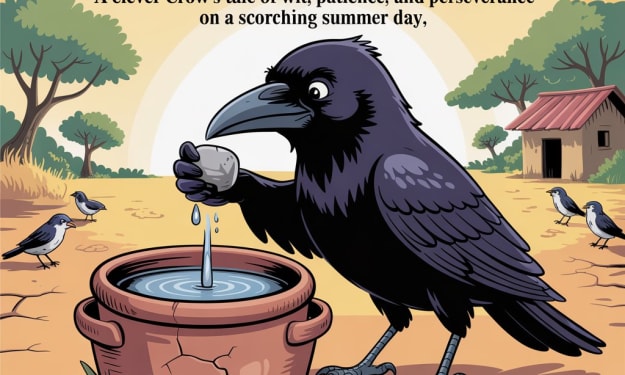
Once upon a time, in a small village surrounded by green fields and dense forests, there lived a clever little crow. His feathers were glossy black, and his eyes shone like tiny beads. He was known throughout the village for his wit and intelligence. While other birds would often act foolishly or get into trouble, this crow always managed to find a way out of tricky situations. One particularly hot summer afternoon, the sun blazed mercilessly in the sky. The air shimmered with heat, and not a single cloud floated above to offer shade. All the ponds, rivers, and wells in the village had either dried up or were reduced to muddy puddles. It was a difficult time for every living creature in the area. Birds sat panting on the branches of leafless trees, and animals hid in their burrows and caves to escape the unbearable heat. The little crow had been flying around for hours in search of water. His throat was parched, his wings felt heavy, and his beak was dry. He desperately needed a drink, but wherever he went, he could find no water. He flew over the fields, hovered near the village wells, and searched around the edges of the forest, but all in vain. Tired and exhausted, the crow finally landed on the branch of a tall, old tree at the edge of the village. He sat there for a while, catching his breath and wiping his beak against the rough bark. Just then, his sharp eyes caught sight of something glinting in the sunlight below. Curious, he flew down to investigate. To his great joy, he discovered an old earthen pot lying near a small hut. The pot looked weathered and cracked, but when the crow peered inside, he saw a small amount of water collected at the bottom. It wasn’t much, but it was enough to quench his thirst. The crow eagerly tried to reach the water with his beak, but the neck of the pot was too narrow, and the water was too low. He tried tilting the pot, but it was too heavy for him to move. He even tried dipping a stick inside, hoping it would bring some water up, but the stick was too thick to fit. For a moment, the crow felt frustrated and hopeless. He was so close to water, yet he could not reach it. But being clever and quick-thinking, he didn’t give up. Instead, he looked around carefully to see if there was something nearby he could use. Suddenly, an idea struck him. He noticed that the ground around the hut was covered with small pebbles and stones. The crow recalled something he had seen before: when stones are dropped into water, the water level rises. Maybe, just maybe, he could use this trick to bring the water within his reach. Without wasting any time, the crow picked up a small stone in his beak and dropped it into the pot. Plop! The stone sank to the bottom, and the water rose slightly. Encouraged by this, the crow quickly picked up another pebble and dropped it in. Plop! Again, the water rose a little higher. The crow worked tirelessly, flying back and forth, picking up pebble after pebble, and dropping them into the pot. With each stone he added, the water level rose a little more. Though it was hard work, and the sun beat down on him relentlessly, the thought of finally quenching his thirst kept him going. After many trips and much effort, the water level finally reached the brim of the pot. The crow could now easily reach it with his beak. With great relief, he dipped his beak into the cool water and drank deeply. The water tasted sweeter than anything he had ever known. His dry throat felt soothed, and the coolness revived his tired body. Feeling satisfied and proud of his cleverness, the crow looked up at the bright blue sky and let out a loud, happy caw. He had not only quenched his thirst but had also proved once again that intelligence and determination can overcome even the toughest obstacles. The crow then flapped his wings and took to the sky, feeling refreshed and joyful. As he soared above the village, he noticed other birds still struggling in the heat. Remembering his own struggle, he decided to share his newfound trick with them. He flew to the tallest tree and called out to the other birds, telling them about the pot and how he had raised the water with pebbles. The birds, grateful for the crow’s wisdom and generosity, followed his advice and soon found relief too. From that day on, the crow became a symbol of cleverness and resourcefulness in the village. The villagers would often tell their children the story of the thirsty crow, teaching them that with a little bit of thought and perseverance, any problem can be solved.
By Muhammad Naeemabout a year ago in Fiction
The Night I Accidentally Summoned a Succubus… And Fell in Love
It started as a joke—that’s the part I keep coming back to. If I had known the old leather-bound book in my uncle’s attic was an actual grimoire and not just some weird Victorian erotica, I never would have read the Latin passage out loud. Especially not after three whiskeys.
By The Lost Books - "Libri Perditi"about a year ago in Fiction
Found
Note: this is for L.C. Schäfer's One Dollar Challenge - Quote Me Baby (Goldblum Edition). Maybe I am being a little too literal with this, but it is my first entry and I am very exhausted after the end of a semester and the beginning of new contracts:
By Kendall Defoe about a year ago in Fiction
Top Mind-Blowing Facts About Space That Will Leave You in Awe
1. Space sounds nothing at all. Imagine not being able to hear a single sound while in the middle of a fireworks display. That’s space for you—an enormous vacuum with no air to carry sound waves. While explosions, collisions, and even black hole mergers happen regularly, you wouldn't hear a thing if you were floating nearby. Astronauts on spacewalks rely entirely on radio communication in their helmets to speak to each other. It’s eerily quiet up there, and that silence only adds to the haunting beauty of space.
By Shahidul islamabout a year ago in Fiction
FULGORN
PROLOGUE The Canticle of Light -As told by the Triarch High Creed Before the first spark, there was only the Void—empty and still. Yet within that stillness stirred three primordial desires: to know, to be, and to shape. From this triad of desire, the Great Flame was born. Not fire, but Fulgoria—the first light. A sentient force that shattered the Void’s silence with her hunger to create. Fulgoria wept into the dark, and where her tears fell, three suns ignited—Solan, Velas, and Koreth. They swirled in celestial unity, their dance birthing Fulgorn itself. Into this world, Fulgoria breathed her three gifts: Omnipotence—the gift of shaping. From her boundless strength, she forged all life in Fulgorn and beyond. Then coded the laws of motion and mass, and granted dominion over the fabric of reality itself. Omniscience—the gift of knowing. From her infinite mind, she mapped the ley-lines of truth and embedded celestial blueprints into the veins of all life. She unveiled the symmetries of time, the dance of particles, and wrote the song of every atom. Omnipresence—the gift of being. From her eternal essence, she suffused the spaces between. She became the breath in lungs, the pull of gravity, and the hum of quantum fields unseen but unyielding. These gifts were then bestowed upon sentient beings forged from stellar ash and fractal thought. Fulgoria then divided them into three castes: The Traktators, architects of matter, whose minds bent metals and energies alike. To them, mountains were clay and metal became a servant. The Pallators, scholars of the cosmic ledger, who parsed the codes of creation and glimpsed into the edges of infinity. The Wisps, phantoms of the interstitial realms, who could split their forms into spectral echoes and slipped through dimensions like shadows. United as the Triarchs, they vowed to steward Fulgorn as living temples to Fulgoria’s design. But even perfection fractures; A fourth caste emerged—Imparen—flawed versions of the Triarchs. Born without Gifts. They became equations unsolved, vessels devoid of Fulgoria’s sacred charge. The Triarchs condemned them to serve as hands without will. They labored in the shadow of their betters, and were forbidden from touching the tools of their makers. Fulgoria, her creation complete, dissolved into the substrate of her creation. Her final decree echoed through the new world: “Let the Triarchs reign, until the stars rewrite my name.”
By E.K.Mwauraabout a year ago in Fiction
The Alien Mirror That Pulled Me to Another World
It’s Wednesday, May 14, 2025, and just a few minutes ago, at 2:52 PM +06, I was up in the dusty attic of my family’s old farmhouse in rural Oregon. I’m Liam, a 16-year-old kid who spends most days helping Dad with the cows or messing around with my guitar. Life’s pretty quiet here, but today I found something wild while digging through Grandpa’s old boxes—a round mirror with a silver frame covered in weird, twisty carvings. When I wiped the dust off, the glass rippled like water, and a low hum filled the room. I leaned in to get a better look, and the next thing I knew, I was falling through it, landing in a place that wasn’t Oregon—or Earth. That’s how I met some of the strangest beings I’ve ever seen, aliens from a parallel universe, and it turned my world upside down.
By Ahmed Jubayerabout a year ago in Fiction