Satire
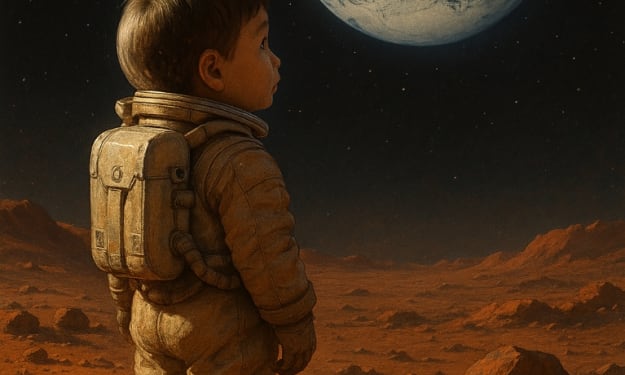
A Child’s Dream of Mars. AI-Generated.
1. The Boy Who Watched the Sky In a small, crowded city, nestled between concrete towers and tangled wires, lived a boy named Aasim. At just twelve years old, he had one peculiar habit—every evening after school, he would climb the stairs to the roof and just stare at the sky. While other kids played video games or chased after cricket balls, Aasim watched the stars appear one by one. He didn’t just see light. He saw possibilities. Routes. A calling. He didn’t come from wealth. His parents worked hard to provide food, schooling, and shoes that barely lasted a year. But Aasim had something rare: clarity of purpose. He didn’t want to be rich. He wanted to walk on Mars. 2. The Quiet Genius in the Classroom At school, Aasim was an average kid in most subjects. But in science—especially physics and astronomy—he came alive. He built paper models of rockets. He memorized every planetary orbit. He taught himself to calculate gravity on other planets, just for fun. When the school held a science fair, most students brought simple models. Aasim presented something different: “Mars Habitat for Child Survivors” — a protective space capsule designed to shelter children on Mars. The judges, visiting scientists from a global research alliance, were stunned. 3. A Future That Was Already Here The year was 2038. Humanity had already placed colonies on the Moon. Mars was the next frontier. Space travel had become faster. AI-managed spacecraft could now reach Mars in three months instead of seven. The world had changed, and space was no longer science fiction—it was a career. Aasim applied for a global space cadet program—a competitive internship designed for youth researchers to assist in Mars exploration. He didn’t expect much. He was just a kid from a crowded neighborhood. But a few months later, he received a message that changed his life. > “You’ve been selected for the Youth Mission to Mars.” 4. Leaving Home, Entering the Unknown At fourteen, Aasim left everything he knew. He boarded a sky elevator that took him into orbit. From there, he boarded a transfer shuttle bound for Mars. The three-month journey was both beautiful and brutal. Microgravity was fun—for a while. Loneliness was harder. Food was bland. Silence was constant. But Aasim carried a secret. A prayer from his mother. A handwritten note from his little sister. And a dream bigger than fear. He wasn’t just a boy. He was a seed, sent to grow on another planet. 5. First Steps on Red Dust When the lander touched the Martian surface, Aasim was among the first to step out. He didn’t jump in excitement. He simply fell to his knees and placed his forehead on the red soil. He whispered, > “Let my steps here benefit the world. Not just me.” He began working with senior scientists on a critical problem: Creating sustainable life systems—oxygen, food, and water on Mars. 6. The Discovery That Changed Everything While analyzing Martian soil, Aasim discovered microbial activity in a deep cave zone. The microbes produced trace amounts of oxygen—naturally. No one had seen this before. It was the missing piece for long-term survival on Mars. Suddenly, Aasim wasn’t just a cadet. He was a symbol. Not of genius. But of possibility. The media called him “The Quiet Star Walker.” 7. Homecoming and Humility After 18 months, Aasim returned to Earth. He had grown taller, quieter, stronger. Reporters wanted drama. He gave them depth. > “I didn’t go to Mars for fame,” he said. “I went so that kids with dreams, not resources, could believe again.” He didn’t care for interviews. He cared for education. He started a foundation to support space science in underprivileged schools. He wrote books for children, in simple language, explaining black holes, planets, and hope. Final Thoughts Aasim’s journey wasn’t just from childhood to space. It was from imagination to action. He didn’t carry flags. He carried prayers. And he proved one truth: > You don’t need to be born into greatness. You can rise to it. We may never all reach Mars. But through Aasim’s story, we’re reminded: Sometimes, all it takes is a rooftop, a restless mind, and a refusal to stop dreaming.
By Kaleem Ullahabout a year ago in Fiction
Three Little Fools and the Big Bad Shareholder. Top Story - July 2025.
Once upon a time, there were three little fools. Not mean fools. Just... a bit naive. A little too hopeful. Overflowing with good intentions and degrees that no longer paid the rent. They had ideas, subscriptions to collaborative tools, and a shared desire to be free in a world run by blurry clients and clearer algorithms.
By Alain SUPPINIabout a year ago in Fiction
The Day My Toaster Joined the Insurrection
I remember it clearly: it was 6:38 a.m. on a Thursday. I had just inserted two slices of crustless, semi-wholemeal industrial bread, with vague plans to smear them with omega-3 enriched margarine. The toaster, however, had other ideas.
By Alain SUPPINIabout a year ago in Fiction
We All Drank Tea While The Cannibals Came
So everyone was drinking tea. That’s how it started. The lights were warm, the kitchen smelled like cinnamon and mother’s milk, and the apartment (floor seventeen of a twenty-five-story building in the only neighborhood in Seattle where the rats had unionized) felt perfectly safe. There was a baby. There was a father. There was a mother. There were still walls and power and hot water. And then the TV screamed.
By Paper Lanternabout a year ago in Fiction
The Revolution Will Not Be Circumcised
The revolution... ...will not take something away from you before you have had time to enjoy it. * The revolution... ...will always leave a tip, something off the top, a little bit extra, whether it is asked for or not.
By Kendall Defoe about a year ago in Fiction
The Clockmaker's Garden
There was a village at the edge of the world where time stood still—not metaphorically, but truly. The sun always hovered in the same place. The shadows never grew longer. The leaves on the trees were forever green, and not a single wrinkle ever touched the faces of the people who lived there. Some called it a paradise. But not Mira. Mira had lived her entire life in this frozen place, where no one aged and nothing ever changed. The village was clean and calm, the people kind and quiet, but it all felt... trapped. Like living inside a snow globe where someone forgot to shake the magic. You see, the village had once been ruled by time like anywhere else. Until the day the Clockmaker came. No one remembered where he came from, or how he had arrived. But he built a tower at the village center—a tall, spiraling thing made of stone and bronze, topped with a golden clock that ticked louder than the wind. Then, one day, he stopped the clock. And when the clock stopped, so did time. People were amazed. No one got older. No one died. Food never spoiled. Days were always sunny. And for a while, it truly was a paradise. But after years, something changed—not outside, but inside the people. They stopped dreaming of new things. They stopped planting new trees. They stopped falling in love. They stopped asking, "What if?" Mira was different. Even as a child, she asked questions no one liked answering. “Why don’t we celebrate birthdays?” “What happens if the clock breaks?” “What’s beyond the hills?” The villagers would smile politely and say, “Don’t worry, dear. Everything is exactly as it should be.” But Mira wasn’t convinced. Especially not after the day she found the seed. It was buried beneath the soil behind her grandmother’s cottage, wrapped in cloth and tied with red thread. The cloth was old—older than the village’s stillness. On it, written in fading ink, were five words: "Plant me when time aches." Mira didn’t know what it meant, but she kept the seed. Years passed—or they should have—and Mira grew older in her heart, even if her body never changed. She read every book the village had. She asked questions the elders refused to answer. She even climbed the clocktower once, but found the door bolted shut with a glowing blue lock she couldn’t break. Until one night, something happened that had never happened before. She saw a petal fall. A single pink petal, drifting down from a tree in the village square. It didn’t make sense. Nothing changed here. Nothing moved unless someone moved it. But that petal had fallen on its own. As if the tree had breathed. That night, she went to her grandmother’s garden with a lantern and trembling hands. She dug a small hole in the earth and placed the old seed in it. As soon as the dirt touched the seed, the ground shivered—just a little. Not enough for anyone else to notice. But Mira did. She watered it with tears. Not because she was sad, but because she suddenly felt something for the first time in a long, long while: hope. The next morning, a small green shoot had emerged. And the day after that, a bud. And a few days later, a flower bloomed—vibrant and golden, with petals that shimmered like sunlight. People began to whisper. Nothing had grown in the village since time stopped. No new flower had bloomed in decades. But there it was, glowing softly like a candle in the fog. When the elders saw it, they panicked. They tore it from the ground. They warned Mira not to interfere again. They told her she was risking everything. That peace must be protected. That the Clockmaker would not approve. But Mira didn’t stop. She remembered what the cloth had said. “Plant me when time aches.” And time was aching. The people were stuck. Their laughter was thin. Their eyes were dull. Peace without change had become a prison with invisible walls. So Mira planted more seeds—some from old apples, some from forgotten flower pots, some even stolen from the locked archives beneath the school. And each time, something bloomed. Small things at first: daisies, dandelions, bluebells. Then vines. Then fruit. Then trees with golden bark that hummed when the wind passed through. And slowly… people changed. Some cried without knowing why. Some remembered dreams they’d buried. Some started writing poems again. Children drew things they’d never seen—skies full of color, mountains beyond the village, oceans they only imagined. And then the unthinkable happened. The clock in the tower ticked. Just once. But loud enough that everyone heard it. That night, Mira returned to the tower. The door that had once been sealed was cracked open. Inside, the gears groaned, stiff from stillness. Dust floated in the beams of moonlight. At the top of the stairs stood the Clockmaker. But he wasn’t what she expected. He looked like an old man made of wood and brass, with eyes like candle flames. His hands were tools. His spine was a coil. And on his chest was a key, long since wound down. “You have brought time back,” he said, his voice the sound of creaking floorboards. “Why did you stop it?” Mira asked. “Because the world was full of pain,” he replied. “And I thought stillness would bring peace. But peace without change… is silence.” She stepped forward. “And silence without growth... is death.” The Clockmaker nodded. “Then finish what you’ve started.” He handed her the key from his chest. She placed it in the clock. And turned it. The clock roared to life. The gears spun. The bell rang. Time surged through the village like a warm wind. The sun moved for the first time in a hundred years. Shadows danced. Trees swayed. Children grew. Laughter returned—not the polite kind, but the wild, uncontrollable kind. People wept and hugged and aged. And in the middle of the village stood Mira, now older, a little grayer, but glowing with life. She never became queen. She didn’t want to. Instead, she planted more gardens. One for every lost year. One for every forgotten dream. And people joined her. Because now… time moved. But so did hope. The End.
By Lucien Hollow about a year ago in Fiction
The Lantern of Whispering Trees
by Yahya Asim In a remote village nestled between the emerald folds of two great hills, there stood a forest known as the Whispering Trees. Locals spoke of it with reverence and caution. They said the trees could talk—not with mouths, but with murmurs carried in the wind. Only those who truly listened could understand their secrets.
By Yahya Asimabout a year ago in Fiction
May All Your Irises Be White. Content Warning.
I pissed off Amanda again. What’s new? I could never satisfy her. To be honest, I don’t even think I ever tried to. As the first child, she had to look up to me. I never had to request validation from her. But this argument was different. She wanted to partner up and move forward with the I Hate Rachel Herrmann Company. I simply could not. While the company promotes trauma recovery through the use of dark humor, I’d rather leave the more serious tasks to the professionals. Amanda believes the standard mental health treatments are corrupt and that this company will start a reform movement. She acts like Rachel Herrmann is the next Dorothea Dix. I could never have so much faith in just one person alone.
By Rachie Iris about a year ago in Fiction