Mystery
Butterflies in the Winter
Grace: "They say grief never goes away, it only changes." I can't tell you how many times I've heard that line. Even as I repeat it back to myself in times of spiraling affliction, it does nothing to calm the discourse. It only halts the inevitable chain of thought —a cycle that returns when I stub my consciousness against a distant memory. Even as the doctor desperately tries to help me navigate my loss, that proverbial saying is pointless, because nothing has changed.
By James U. Rizziabout a year ago in Fiction
The Blue and Yellow House
I never missed a day walking past the blue and yellow house on Sycamore Lane. From the day I started kindergarten, holding my lunchbox with nervous hands, to the last morning I walked to high school graduation, that house was always there. Faded blue paint, bright yellow shutters, and a porch swing that creaked in the morning breeze. But more than the house, it was Ms. Geneva who made it feel like something out of a dream.
By Shai Andersonabout a year ago in Fiction
Welcome to Forest Park. Top Story - July 2025.
Ticker tape Synesthesia The Synesthesia Tree https://www.thesynesthesiatree.com/2021/03/ticker-tape.html"Ticker taping" consists of automatically visualising written words in the form of subtitles when hearing other people speak.
By Paul Stewartabout a year ago in Fiction
The Mirror of Last Breaths
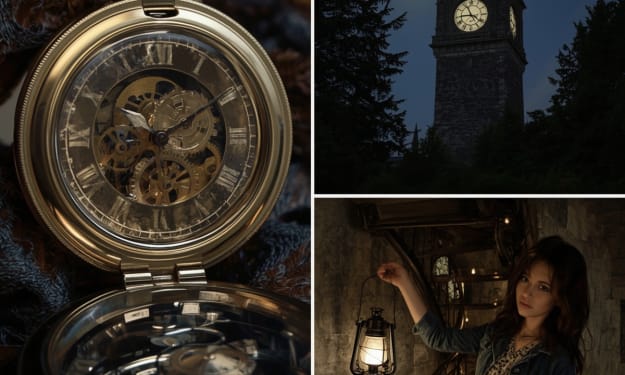
Part 2 of the "Cursed Antiques" Series By Dawood Khan The mirror arrived on a Tuesday, wrapped in black velvet and smelling of funeral lilies. Lila Carter hadn't ordered it. She knew better. After the pocket watch incident—after Harlan Shaw's ghost, after the thirteenth hour, after the way her left pinky finger had turned permanently brass—she'd sworn off strange antiques. But the delivery slip bore her name in ink that glistened like fresh blood, and when she peeled back the fabric, the mirror's frame bit her. Not a metaphor. The silver filigree *sank teeth* into her thumb. The wound didn't bleed. Instead, it oozed a sluggish mercury that pooled in her palm before slithering up her wrist like a living tattoo. The mirror's surface rippled. Lila saw herself. Not as she was—rumpled sweater, knife in hand—but *drowned*. Black silk wrapped her throat like a noose. Her mouth opened in a silent scream, bubbles rising through dark water. Behind her, a shadow pressed close, whispering a name: *"Eleanor."* She wrenched away. The mercury scars on her arm pulsed. --- **Chapter 1: The Auction House Ledger** The mirror's provenance listed seven owners, each entry more ominous than the last: 1. **Violet Duchamp (1889)** - Drowned in her bathtub, the water black with ink. 2. **Dr. Elias Finch (1923)** - Jumped from his office window, screaming about "the woman in the glass." 3. **Marguerite Shaw (1951)** - Harlan's daughter. Cause of death: *"Undetermined."* The final entry was a frantic scrawl: *"It's not showing the future—it's showing choices. Burn it."* Lila's fingers trembled as the mirror's glass clouded, swirling with storm-gray tendrils that formed a face—*her* face, aged decades in an instant, mouthing words she couldn't hear. --- **Chapter 2: Harlan's Confession** He appeared at 3:33 AM, stepping through the mirror like a man wading through smoke. More machine than ghost now, his left eye was a cracked watch face, his fingers brass talons. *"You shouldn't have kept the watch,"* he rasped, his voice the sound of gears grinding. *"Now the others will come for you."* *"Others?"* Lila pressed her mercury-scarred hand to the glass. The reflection shifted, revealing seven objects: 1. The pocket watch (⚙️ *Time*) 2. The mirror (👁️ *Choice*) 3. A music box (🎶 *Memory*) 4-7. [Blurred shapes—a doll, a locket, a pen, a key] *"I built them to save Marguerite,"* Harlan whispered. *"To rewind time, to undo her death. But the artifacts... they twist. The mirror doesn't show your fate—it shows every path you* could *take."* A crack split the glass. Lila's reflection shattered into a dozen versions of herself: - One strangled with silk. - One holding a gun. - One with hollow eyes, whispering: *"You let her out."* --- **Chapter 3: The Shattering** The mirror screamed as it exploded. Not a metaphor—the glass *shrieked*, high and human, as fractures spiderwebbed across its surface. Mercury-blood oozed from the cracks, forming words on the floor: *"CHOOSE."* Lila swung the fireplace poker. The shards didn't scatter. They *melted*, reforming into smaller mirrors—each showing a different horror: - A woman clawing at her own eyes. - A child's hands sewing a doll's mouth shut with hair. - And in the largest shard... Lila at seventy, her brass-stained hand clutching a silver key. *"Too late,"* the old Lila mouthed. *"She's already here."* --- **Epilogue: The Collector** Morning light revealed the mirror whole again on Lila's dresser. No cracks. No blood. But the reflection wasn't hers. A woman in a 1920s flapper dress pressed her palm to the glass, her smile sharp as a razor. The mercury scars on Lila's arm burned in recognition. *"Adelaide,"* she breathed. On the floor, the auction ledger flipped to a new page. Fresh ink bloomed: *"Lila Carter, 2023. Cause of death: Pending."* ---
By Dawood Khanabout a year ago in Fiction
The Clockmaker’s Secret
In a sleepy town nestled between the crooked hills of Gallowmere stood a tiny clock shop, Elliott’s Timepieces. The shop hadn’t changed since 1891. The faded green paint peeled like sunburned skin, and the shop windows, stained from time and smoke, revealed rows upon rows of clocks, none ever in sync. Nobody ever saw the owner. Clocks were fixed overnight, mysteriously. Locals called it “The Shop That Sleeps By Day.” Teenagers dared each other to knock on its door at midnight. Most didn’t. Those who did, never admitted what they heard on the other side. That is, until Nora came. Nora Vale, a curious 26-year-old with a patchy past and a new journalism degree, arrived in Gallowmere chasing ghosts—or rather, ghost stories. Her late grandfather once told her, in a whisky-slurred whisper, that some clocks don’t tell time… they trap it. He pointed to a yellowed photograph of Elliott’s shop in an old newspaper, circled in red ink. “I’m going to crack it,” Nora promised her editor. “This story could launch my career.” Her first visit was underwhelming. The shop was closed. A brass sign read: > We repair what time forgets. Please leave your broken moments by the door. That night, she left her broken wristwatch on the doorstep with a note: Can you fix time? The next morning, it was back—ticking perfectly. But something was off. The second hand ran backwards. Intrigued, she returned at dusk, hoping to catch the mysterious owner. As the last sunbeam kissed the street, the door creaked open. It wasn’t locked. Nora stepped inside. Chimes greeted her like whispers. Dozens of clocks ticked in every direction—sideways, in bursts, or not at all. She swore one was breathing. “Hello?” she called. Her voice dissolved into ticking silence. Then came the voice: “You left a broken moment.” She spun. An old man stood behind the counter, in a black waistcoat and silver-rimmed glasses. His eyes were the color of old clock dials—pale and unreadable. “Mr. Elliott?” she asked. He smiled. “Elliott was my father. I just keep the clocks.” “What is this place?” He motioned toward a grandfather clock taller than her, its hands spinning like a storm. “Not all clocks measure time. Some measure regret. Others, memories. One or two, choices never made.” She blinked. “Is that metaphor, or—” He shook his head. She swallowed. “I want to write about this place.” “Then understand it.” He pointed to a dusty mantle clock. “Touch it.” Nora hesitated. Then placed her hand on the clock. And fell. Not in body—but in time. She was ten again, standing in her old backyard, watching her parents argue in the kitchen. Her father slammed the door. Her mother wept. Nora screamed—but no sound came. She turned to the old man, now beside her in the memory. “You said this measured regret,” she whispered. “No,” he replied gently. “This is your broken moment.” Tears filled her eyes. “Can I fix it?” He didn’t answer. The world twisted, and she was back in the shop, heart racing. The clock stopped ticking. She stared at the old man. “What are you?” “I’m the custodian,” he said. “I do not change time. I only… hold it.” “Can anyone fix it?” He studied her. “Some things are meant to break, Nora. Some must remain frozen—so others may move forward.” That night, Nora didn’t sleep. The next morning, she returned. The shop was gone. Only a charred foundation remained, and a single soot-covered clock. Her repaired wristwatch—still ticking backwards—lay untouched in the ashes. A note beneath it read: You asked if I could fix time. But time was never the problem. Nora never published the article. Instead, she opened a small clock shop on the edge of town. She called it Moments in Time. It didn’t fix clocks. It healed them.
By Kausar Hayat about a year ago in Fiction