Mystery
The Last House on Juniper Lane
I hadn’t been back to Juniper Lane in seventeen years. The houses still looked like candy-colored blocks from a half-remembered dream — pastel blues, washed-out yellows, vinyl siding slowly giving way to ivy and rust. At the end of the cul-de-sac stood the house I once called home. 1324 Juniper Lane. White, or maybe gray now, with shutters that hung like tired eyes. The lawn was overgrown, a brittle “For Sale” sign leaning sideways like it had given up trying to stand straight.
By Mohammad Arifabout a year ago in Fiction
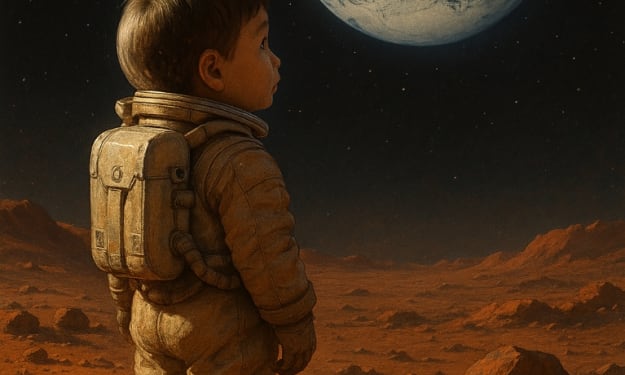
A Child’s Dream of Mars. AI-Generated.
1. The Boy Who Watched the Sky In a small, crowded city, nestled between concrete towers and tangled wires, lived a boy named Aasim. At just twelve years old, he had one peculiar habit—every evening after school, he would climb the stairs to the roof and just stare at the sky. While other kids played video games or chased after cricket balls, Aasim watched the stars appear one by one. He didn’t just see light. He saw possibilities. Routes. A calling. He didn’t come from wealth. His parents worked hard to provide food, schooling, and shoes that barely lasted a year. But Aasim had something rare: clarity of purpose. He didn’t want to be rich. He wanted to walk on Mars. 2. The Quiet Genius in the Classroom At school, Aasim was an average kid in most subjects. But in science—especially physics and astronomy—he came alive. He built paper models of rockets. He memorized every planetary orbit. He taught himself to calculate gravity on other planets, just for fun. When the school held a science fair, most students brought simple models. Aasim presented something different: “Mars Habitat for Child Survivors” — a protective space capsule designed to shelter children on Mars. The judges, visiting scientists from a global research alliance, were stunned. 3. A Future That Was Already Here The year was 2038. Humanity had already placed colonies on the Moon. Mars was the next frontier. Space travel had become faster. AI-managed spacecraft could now reach Mars in three months instead of seven. The world had changed, and space was no longer science fiction—it was a career. Aasim applied for a global space cadet program—a competitive internship designed for youth researchers to assist in Mars exploration. He didn’t expect much. He was just a kid from a crowded neighborhood. But a few months later, he received a message that changed his life. > “You’ve been selected for the Youth Mission to Mars.” 4. Leaving Home, Entering the Unknown At fourteen, Aasim left everything he knew. He boarded a sky elevator that took him into orbit. From there, he boarded a transfer shuttle bound for Mars. The three-month journey was both beautiful and brutal. Microgravity was fun—for a while. Loneliness was harder. Food was bland. Silence was constant. But Aasim carried a secret. A prayer from his mother. A handwritten note from his little sister. And a dream bigger than fear. He wasn’t just a boy. He was a seed, sent to grow on another planet. 5. First Steps on Red Dust When the lander touched the Martian surface, Aasim was among the first to step out. He didn’t jump in excitement. He simply fell to his knees and placed his forehead on the red soil. He whispered, > “Let my steps here benefit the world. Not just me.” He began working with senior scientists on a critical problem: Creating sustainable life systems—oxygen, food, and water on Mars. 6. The Discovery That Changed Everything While analyzing Martian soil, Aasim discovered microbial activity in a deep cave zone. The microbes produced trace amounts of oxygen—naturally. No one had seen this before. It was the missing piece for long-term survival on Mars. Suddenly, Aasim wasn’t just a cadet. He was a symbol. Not of genius. But of possibility. The media called him “The Quiet Star Walker.” 7. Homecoming and Humility After 18 months, Aasim returned to Earth. He had grown taller, quieter, stronger. Reporters wanted drama. He gave them depth. > “I didn’t go to Mars for fame,” he said. “I went so that kids with dreams, not resources, could believe again.” He didn’t care for interviews. He cared for education. He started a foundation to support space science in underprivileged schools. He wrote books for children, in simple language, explaining black holes, planets, and hope. Final Thoughts Aasim’s journey wasn’t just from childhood to space. It was from imagination to action. He didn’t carry flags. He carried prayers. And he proved one truth: > You don’t need to be born into greatness. You can rise to it. We may never all reach Mars. But through Aasim’s story, we’re reminded: Sometimes, all it takes is a rooftop, a restless mind, and a refusal to stop dreaming.
By Kaleem Ullahabout a year ago in Fiction
Domino Effect
The old coffee machine in the corner of the break room at Sterling & Co. always wheezed before it dripped, a familiar, comforting sound that had punctuated countless hurried mornings. Today, it was the backdrop to Sarah’s internal battle. The quarterly reports were due in an hour, and she’d spotted a discrepancy, a small, almost negligible error in the sales figures from the North division. It was a single digit, off by a mere few thousand dollars, easily missed amidst millions.
By FlammyWritesabout a year ago in Fiction
I Answered a Stranger’s Phone and It Changed My Life
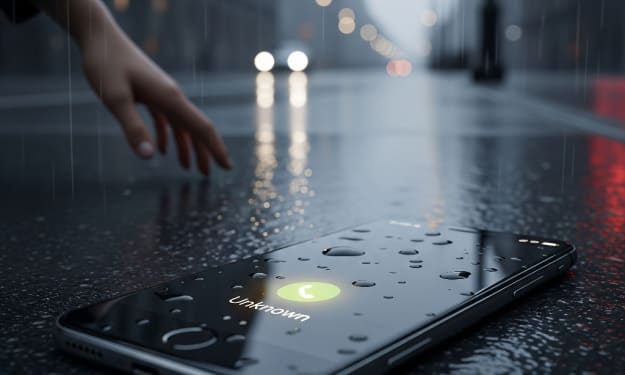
The phone rang on the wet sidewalk like it was meant for me. I wasn’t supposed to be walking that way. My usual route home was faster, drier, more predictable. But the cafe liked had closed early, and I’d decided to wander the long way through the park. That’s when I saw it — a sleek black phone, facedown, blinking with a single incoming call: “Unknown.” No one was around. Just me, the rain, and the silence between rings. I hesitated. The screen kept flashing. I answered. “Hello?” There was a pause. Then a voice I didn’t recognize, steady and calm: “Took you long enough.” My breath caught. “Who is this?” The voice didn’t answer that. Instead, it said something stranger. “I need you to listen very carefully. You have thirty minutes to get to the corner of Ash and Wren. Bring the phone. Don’t speak to anyone else.” “Wait—what?” But the line had gone dead. --- I should’ve left it right there. Put it on a bench. Taken it to lost and found. Let the rain finish it off. But I didn’t. There was something about the voice. Not threatening. Not desperate. Just... certain. Ash and Wren was ten blocks away. My shoes were soaked by the time I arrived, heart thudding louder than the thunder above. The intersection was empty. Except for a girl. Maybe seventeen. Standing perfectly still beneath a flickering streetlight, holding a red umbrella that didn’t match her black clothes. She looked up as I approached. Then — to my shock — smiled. “You brought it,” she said. Not surprised. Not relieved. Just... like she knew. “Is this yours?” “No. But it was meant for you.” “I—what is this? Some kind of prank?” “No prank,” she said gently, stepping closer. “Just a message.” She pulled out an envelope from her coat pocket and handed it to me. My name was written on it. In ink. In my handwriting. “I don’t understand.” “You will,” she said. “Just... open it when you get home. You won’t see me again after tonight.” And she walked away. --- I opened the envelope under my kitchen light, socks soggy and fingers trembling. Inside was a letter. It began: You don’t know me yet. But I know you. I’ve watched you forget the sound of your own voice when you stopped sharing your writing. I’ve seen the nights you stayed awake wondering if you matter. I know the pain you pretend you’ve outgrown. The guilt you carry from things that were never your fault. I read the whole thing, line after line, and by the end I was crying. Not because it was cruel — but because it was true. Every word. Every detail. And then, the last paragraph: Tomorrow morning, check your inbox. There’ll be a reply to the submission you sent two years ago and gave up on. Yes, that one. The one you never told anyone about. Don’t question it. Just know — it finally reached the right hands. You’re not forgotten. Not lost. Not invisible. This was just your reminder. No signature. No name. --- The next morning, I checked my email like someone emerging from a dream. And there it was. A reply from the literary journal I had submitted to years ago — long before I'd convinced myself I wasn’t good enough, long before I buried my creativity in day jobs and self-doubt. The message was simple: We loved your story. If it’s still available, we’d like to publish it. --- I still don’t know who left that phone. Who made the call. Who the girl was. Or how anyone could’ve known so much about me. But I do know this: Some stories don’t need logic. They just need to be believed. And I believe that sometimes — when you’re on the edge of giving up — the universe calls. You just have to be willing to answer.
By Firdos Jamalabout a year ago in Fiction
🐿️ The Squirrel’s Missing Acorn Heist
It all began on a crisp autumn morning when Chester the squirrel awoke to find his prized golden acorn missing. This was no ordinary acorn. It wasn’t gold in color — it was actually gold. A shiny, nut-sized trinket he’d found near a human picnic site last spring. Ever since, Chester had kept it safe in his tree hollow, hidden beneath piles of real acorns. To the forest, it was his treasure. To him, it was a symbol of pride. And now it was gone. His whiskers twitched. His tiny paws trembled. There were no signs of a break-in — no snapped twigs, no disturbed leaves. Just an empty hollow and a sinking feeling in his belly. “This is a heist,” Chester muttered. “And I’m going to crack it wide open.”
By Shoaib Afridiabout a year ago in Fiction
Where the Gravel Whispers Goodbye
It was still summer on the calendar, but in my heart, it felt like the end of something. The heavy heat of August had lifted, and I couldn’t help but feel that the sudden coolness came not from a passing storm, but from the many tears I had cried over the past days. The sky was clear, the sun was shining, but inside me, it felt cloudy. I blinked away the sting in my eyes, not wanting tears to blur my view as I drove through the winding mountain road, tree branches arching overhead like a soft green tunnel. I rolled down the window to breathe in the smell of warm grass, and for a moment, it felt like I had never left.
By ibrahim khanabout a year ago in Fiction
Whispers of the Forgotten Sky
When the stars vanished, humanity discovered the truth hidden in the darkness. No one noticed at first. A few astronomers reported missing constellations, but the news cycle moved too fast for anyone to care. It wasn’t until the stars vanished entirely—one night, all at once—that the world finally looked up.
By abidnaseemabout a year ago in Fiction
The Heartbreak - then the Repeat
It wasn't my first heartbreak, but it was the first one that shattered my heart like it was made of glass. I had wanted it to work - so badly that I stayed silent and tried my best to push through everything and be someone that I couldn't look at in the mirror. I remember being so thankful that I never bruised. I remember being so grateful that when people asked questions, that I could use that I was shy or that it was our faith and I was being a good submissive wife.
By Adora Hooperabout a year ago in Fiction
The Last Letter in Vienna
I didn’t go to Vienna looking for anything. Not love. Not meaning. And definitely not a letter that would change my life. But stories, I’ve learned, don’t wait for permission. They just show up—sometimes in dusty bookshops, sometimes in the hollow places inside you. It was a narrow alley off Kärntner Straße, the kind you’d miss unless you were actively avoiding where you were supposed to be. I was meant to meet my tour group at the Mozart House—but guilt has a funny way of tugging your feet in other directions. That’s when I saw it: Antiquariat Stein & Söhne. The name was almost invisible, its gold paint faded and peeling under a tangle of ivy. A cracked bell above the door jingled faintly as I pushed it open. Inside, it felt like I’d entered another century. The air smelled like parchment, pipe smoke, and dreams people once had. Books towered in uneven stacks. Sunlight filtered through stained glass, casting patches of blue, red, and amber across the floorboards. “Looking for anything special?” asked the old man behind the counter. His English had a crisp Viennese tilt. His eyes were sharp, curious. “No,” I replied. But that wasn’t the truth. I was looking for something I couldn’t name—something to fill the silence inside me since Nathan left. I wandered the narrow aisles until a slender book caught my eye. Liebesbriefe von 1941. Love Letters from 1941. Its spine was worn, its cover soft with time. As I flipped through its pages, something slid out. A real envelope. Yellowed. Fragile. Sealed. The name written in elegant cursive: Elena Hofstadter. And beneath it: Für immer, Dein A. (Forever, yours, A.) There was no address. Just a date: 20 April 1945. I stared at it, heart racing. The past had slipped between the pages of fiction. And it had found me. I sat in the back of the bookshop, letter trembling in my hands. Finally, I broke the seal. > Meine liebste Elena, If you're reading this, it means you found the book. It means I’m gone. But you must know: I never ran. I never betrayed you. What they said—I need you not to believe it… He had been accused of helping Jewish families escape the Nazis. He had been taken. But he left her this letter, and instructions—cryptic, hurried—about something hidden behind a painting in their favorite café in Mariahilf. It was a goodbye. It was a plea. It was a final breath sealed in paper. I felt the lump in my throat swell. Whoever he was, A. had died loving her. Desperate to be believed. And now I was the only one who’d heard his voice. I couldn’t sleep that night. I kept thinking about Elena. About A.. About the photo he said he’d hidden behind that painting. By morning, I had made my decision. I boarded the tram to Mariahilf. The café was still there—Café Rosenlicht—timeless and warm. The painting, a landscape of the Danube, hung in a quiet hallway near the restrooms. My heart beat in my throat as I touched the frame. It moved. Behind it: a loose brick. Inside the small crevice: a tin box, rusted at the corners but still intact. Inside the box: a faded black-and-white photograph of Elena and A. in front of the Danube. A pressed violet. A second letter—still sealed. I didn’t open it. It wasn’t mine to read. Back at the bookstore, I placed the tin box on the counter. The old man peered inside, then at me, his eyes glassy. “My father mentioned a couple during the war,” he said. “They used to visit this shop. He said they disappeared... but he never knew what became of them.” He looked at the photo gently, like touching history. We put the letter, photo, and violet in a glass case by the shop’s entrance. I helped write the plaque: The Last Letter of Vienna A love preserved through war, time, and silence. Tourists now stop to read it. Some take photos. Some just stare, the way I did when I first opened that letter. I came to Vienna running—from a wedding that never happened, from a man who couldn’t even give me a reason why. I wanted quiet. I wanted to disappear into a city that didn’t know me. Instead, I found love. Not for myself—but through it. In it. Because of it. A kind of love that crossed wars, walls, and time. I still write letters now. To people who’ll never read them. Not because I expect a reply, but because someone, someday, might find one—and feel less alone. Just like I did. Some stories live in us quietly, waiting. Others, like this one, crash into us unexpectedly—reminding us that even in endings, there are beginnings. Even in silence, there’s a voice. And even in forgotten bookshops, love survives.
By Muhammad Abuzar Badshah about a year ago in Fiction