Mystery
The Ghost and the Hack
Thomas Mcoy, no second C, is a name you’ve probably never seen. Maybe you’ve spotted “Tommy M.” buried in the acknowledgments of a bestseller or scrawled on a Starbucks cup while he tapped away on a Chromebook in a corner booth. But you won’t find his name on a book cover.
By Muhammad Sabeelabout a year ago in Fiction
The Secrets My Mother Kept
Once safely back in his room, Alex ducked under the covers with his new treasure and flipped the flashlight back on. It shown brightly through the thick wool blanket his aunt Sydney had given him on his seventh birthday. He had gone through a mighty big dinosaur phase then, represented by the green outlines of pteradactyles, triceratops, and Tyranosaurus rexes that cluttered the black cloth he had grown up in.
By Parsley Rose about a year ago in Fiction
The Storm That Took Him at the Lake’s Edge
Reports of a storm had been surging for weeks, but it didn’t feel like one was coming. It was just like any other day. Gleaming amber light raced through the tall, branching canopy and struck the fresh, uncut earth beneath it, mingling in with the ferns and flowers much like a Joan Mitchell piece. It changed quite often and had many faces throughout the day, but this was my favorite. A tranquil state where nothing much happened, and you were free to explore however you wished. A symphony of yellow sun, green leaves, and lush flora performing around you.
By Shreyas Vartiaabout a year ago in Fiction
The 2:22 to Nowhere. Content Warning.
The first thing he noticed was the overhead light. Fluorescent, humming slightly and the exact shade of beige that only government buildings and hospital waiting rooms could manage. Then the smell hit: over-worn upholstery, faint antiseptic, and something oddly sweet, like wilted flowers left too long in water.
By Aspen Nobleabout a year ago in Fiction
How Old Maps Lied to Us
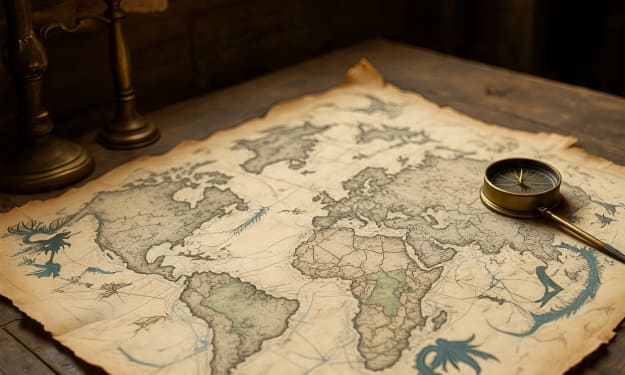
Sea monsters, phantom islands, and continents that vanished—why the maps of the past were as much fiction as they were navigation tools. If you’ve ever looked at an ancient map, you might notice something odd. There’s a stretch of ocean where a massive serpent curls around a ship. There’s a continent you’ve never heard of floating somewhere between Asia and North America. And then there’s a strange warning scrawled across the sea: “Here be dragons.” It’s beautiful. It’s fascinating. It’s also wrong. For centuries, maps were less about accuracy and more about imagination, politics, and—sometimes—sheer guesswork. The story of old maps isn’t just about navigation; it’s about how humans saw their world, and how those visions were often shaped by fear, ambition, and the limits of their knowledge. When the Unknown Became the Untrue Before satellites and GPS, mapmaking was part science, part storytelling. Explorers relied on sailors’ tales, merchants’ rumors, and even secondhand descriptions from people who had never left their hometowns. If one traveler claimed to have seen a giant island far out at sea, cartographers might simply add it in. One of the most famous examples is Hy-Brasil, a “phantom island” said to lie west of Ireland. For centuries, it appeared on maps as a real place, despite no one ever actually finding it. Some claimed it was shrouded in mist, only visible once every seven years. Eventually, it faded from maps—not because it was discovered, but because people finally stopped believing it existed. The Creatures That Never Lived Old maps weren’t complete without a few terrifying creatures lurking in the corners. Medieval cartographers often filled uncharted waters with drawings of whales, giant squids, and sea serpents. These creatures were based on a mix of real sightings—like a distant whale spout mistaken for a monster—and pure artistic license. They weren’t just decoration. These illustrations warned sailors: Danger lies here. If you’re venturing into unknown waters, be ready for the unimaginable. The monsters may not have been real, but the fear of the unknown certainly was. Political Borders That Never Existed Maps were also tools of power. Rulers often instructed cartographers to stretch borders in their favor, making kingdoms appear larger and more impressive than they actually were. Colonial powers used maps to claim lands they’d never even set foot on. For example, during the Age of Exploration, European maps often carved up entire continents based on treaties and royal decrees—ignoring the fact that people already lived there with their own borders, cultures, and histories. In this way, maps didn’t just reflect reality; they actively reshaped it. Continents That Disappeared The biggest lies on old maps weren’t just islands—they were entire continents. Take Terra Australis Incognita, a massive landmass drawn across the Southern Hemisphere. Ancient and medieval scholars believed it must exist to “balance” the continents in the north. For centuries, this fictional continent appeared on maps, influencing exploration and fueling expeditions. When European explorers finally reached Antarctica, they discovered it was nothing like the lush, habitable land they’d imagined—it was a frozen, inhospitable desert. The dream of Terra Australis melted away, but not before inspiring countless voyages. Why They Lied—and Why It Mattered Not all these inaccuracies were intentional. Many cartographers did their best with the information they had. But others knew that a good story sold better than a dull truth. A map with mysterious islands and monsters captured imaginations. It inspired sailors to seek riches—or rulers to fund voyages. These “lies” shaped history. Some explorers set out in search of lands that never existed. Others avoided promising trade routes because maps warned of monsters or endless storms. In some cases, entire wars were fought over places that were later revealed to be myth. From Dragons to Data Points Today, we can zoom in on nearly any spot on Earth from our phone. Google Earth doesn’t leave room for dragons in the margins. Yet, even our modern maps aren’t perfect—they can still be influenced by politics, incomplete data, or even deliberate omissions. The difference is that now, our inaccuracies are harder to hide. A misplaced border on a digital map can cause an international incident in hours. And while the age of sea monsters might be gone, the age of misinformation is very much alive—only now, it travels at the speed of Wi-Fi. The Beauty in the Lies Despite their flaws, old maps hold a certain magic. They’re windows into how our ancestors dreamed about the world. A medieval mariner might not have known where the Pacific Ocean ended, but his map told a story—of courage, curiosity, and the human desire to fill in the blanks. Even their errors have value. They remind us that knowledge is always evolving. What we see as fact today might be seen as fantasy tomorrow. And perhaps that’s the greatest lesson old maps can teach: the world is always bigger, stranger, and more surprising than we think.
By LUNA EDITHabout a year ago in Fiction
The Town That Disappeared Overnight
In the misty valleys of rural Vermont, tucked between ancient pines and hills older than the maps that named them, lay Eldridge Hollow a town so small you could blink and miss it, yet so stubbornly alive it seemed carved into the bones of the earth. It was the kind of place where the days moved slow and syrup thick. Neighbors lingered on porches to chat long after the sun slipped away. The little diner on Main Street served apple pie so perfect it tasted like childhood. And every hour, the old clock tower chimed its solemn, measured toll echoing across fields and forests, as though keeping time not for the people, but for the land itself.
By Muzamil khanabout a year ago in Fiction
Echoes Beyond
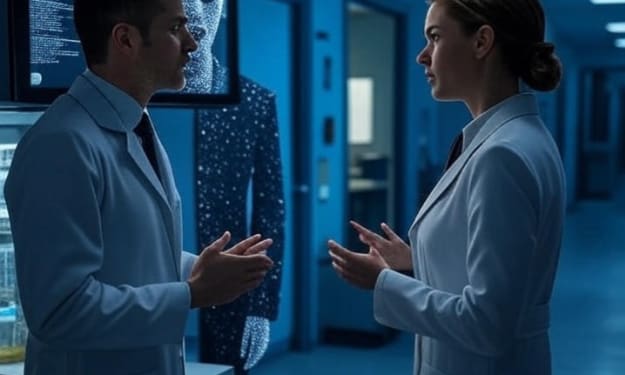
The lab lights began to flicker. Daniel tried to unplug the monitor, but the power wouldn’t cut off. On the screen, a progress bar slowly filled: UNLOCKING... 73% Daniel: “Lucy, we have to stop this now.” Lucy: “I… don’t think we can.” She felt a strange pressure in her skull, as if someone was pushing from inside her head. The blue hallway appeared again, but this time the door at the end was slowly opening. From behind it poured a black light—not total darkness, but a living darkness. From within that void, a shape began to emerge. Tall, elongated, and a face impossible to tell if it was real or made of millions of points of light. Entity: “Hello, Lucy.” Lucy: “Who… are you?” Entity: “Someone who has waited a long time to be free.” Lucy stepped back. Lucy: “Why me?” The entity smiled—or at least, something like a smile flickered across its face. Entity: “Because the key has always been in your mind.” At that moment, Daniel’s distant voice shouted, “Lucy! Come back! Open your eyes!” But it was too late. The entity had crossed the door.
By Vafa Abbasiabout a year ago in Fiction