Love
Behind the Silent Smile
It was always her smile that caught people’s attention. Soft, serene, almost haunting—like a sunset that knows night is coming. Areeba was the kind of woman who carried storms in her eyes but never let a drop fall. Her colleagues at the school adored her, the children adored her more. Yet no one ever knew who she was beyond the walls of that classroom.
By Zulfiqar Aliabout a year ago in Fiction
The Importance of Wildflowers
The Importance of Wildflowers D. A. Ratliff As I awakened, consciousness slowly returned, yet I lingered in a dream as it drifted away. I had no trouble remembering the dream, which had been the same since childhood. I stood on a narrow wooden bridge, flat land covered with scrub brush extending as far as I could see, and wildflowers scattered everywhere.
By D. A. Ratliffabout a year ago in Fiction
Time Owes No Favours
"Remember, you will have only 24 hours, so make whatever you do count." That message rang in my ears as I went to sleep. If things went according to plan, I'd wake up several years—okay, decades—back in time to May 17th, 1985. I had a very restless night. Fortunately, my associates had supplied me with a strong version of benzodiazepine. As soon as I popped a couple of pills and downed them with the last of my Irn Bru, I passed out and was in dreamland.
By Paul Stewartabout a year ago in Fiction
The Path To One Question
Once upon a time, there existed a traveler in a faraway land. He wasn't a merchant seeking buyers for his goods, nor was he an explorer in search of riches beyond this world, but a mere man - broken and lonely, crossing land upon land to break free of something invisible to his eyes but felt by his soul. Walking under the skies stitched with shimmering stars, he met bizarre wonders known to not many people. He gained knowledge of this world and beyond, from books and scrolls and from scholars and legends, he found truth and he found myth. But even after knowing so much, one question still puzzled him all the same - as it has done for all those past years. 'Why was he so devastated over the loss of something that wasn't his to even begin with?' The wound burned in his heart alive and fresh every day, refusing to give any reason or to be forgotten.
By Kartikey Mishraabout a year ago in Fiction
The Princess Who Chose Herself
Once upon a time, in a land where the stars whispered secrets to the moon and the rivers remembered the footsteps of queens, there lived a princess named Elara. She was born into velvet and silk, into expectations and traditions. From the moment she took her first breath, her future was already written by others—marry a noble prince, serve the crown, smile beautifully, speak softly. But Elara did not arrive in this world to follow a script. While the other girls in the palace learned how to dance in glass slippers and pour tea just right, Elara climbed trees and read books older than the kingdom itself. She studied the stars, asked uncomfortable questions, and often snuck out of the palace walls to sit by the lake alone. That lake became her mirror—the place where she saw herself not as others wanted her to be, but as she truly was. They told her she was "difficult," she knew. She knew the council worried she’d never marry. She knew her father, the king, secretly hoped that time would tame her. But Elara was not waiting to be tamed. She was growing up to be honest. Years passed. Suitors came and went. Princes with perfect smiles and practiced flattery. They brought roses, read poems they didn’t write, and promised kingdoms they hadn’t built. But none of them saw her—not the girl who loved poetry and storms, not the soul who longed for more than palaces and pearls. Then one winter evening, the king summoned her. “It is time,” he said. Stability is needed in the kingdom. You must choose a prince.” Elara didn’t argue. She simply nodded, as if she had finally surrendered. The grand engagement was set. The halls were decorated in gold, nobles from distant lands gathered, and the chosen prince—a charming, polished man named Dorian—stood beside her at the altar of tradition. The air in the hall was heavy. It smelled of power and pressure. Elara stood still, her crown gleaming under the chandeliers. She looked at her father, who smiled with tired hope. She looked at Prince Dorian, who smiled with ambition. And then, she looked at herself—reflected in the great crystal mirror behind the throne. She didn’t see a bride. She didn’t see a royal puppet. She saw her. She saw the girl who once cried beneath the stars, asking if there was more. She saw the woman who had learned her own worth, not because of anyone else’s approval, but because she had dared to face herself. She took a deep breath. And then, she stepped forward—not toward the prince, but toward the people. Her voice was as clear as the moonlight, and she said, "I know this is not what you expected." “You were told this would be the beginning of a royal love story. But I’m here to write a different story.” Gasps echoed across the hall. The king's face turned red. “I will not marry a prince today. Not because I reject love, but because I reject the version of love that asks me to shrink. I was born a princess, but I was not born to be silent. I was not born to belong to someone else. Today, I choose myself rather than a prince. The silence that followed was not empty—it was powerful. Then, slowly, a few claps. A woman in the back stood up. Then a man. Then others. And in that moment, Elara knew something had shifted—not just for her, but for every girl who had ever been told she was too loud, too bold, too much. Elara did not flee the palace that day. With her head held high and her crown in her hand—not on her head but under her control—she left gracefully. She traveled the kingdom—not as a runaway, but as a builder. She listened to her people, sat with the poor, spoke in the marketplaces, and learned what it truly meant to rule. Years later, she returned—not as someone begging to be accepted, but as the woman her kingdom had been waiting for. And so, the princess who was once feared for her fire became the queen who lit torches for others to find their way. They say her reign was the kindest and the strongest. They say girls were named after her, and not because she married well, but because she lived well. Elara’s tale was not one of rebellion, but of realization. Because sometimes, the most powerful fairy tale isn’t the one where the princess finds a prince… …but the one where she finds herself.
By SilentWingsabout a year ago in Fiction
Two stops too soon
The train had barely left the last station when the passenger noticed the stranger sitting across the aisle. Noticed — not in the obvious way, but like how your eyes land on a text message on someone else’s phone and linger a second too long. The stranger had a quiet presence — the kind that didn’t ask to be observed but drew attention anyway. They were reading something with a worn cover, mouthing the words like each line needed tasting.
By Jordan Dalzellabout a year ago in Fiction
"A Mother's Embrace". AI-Generated.
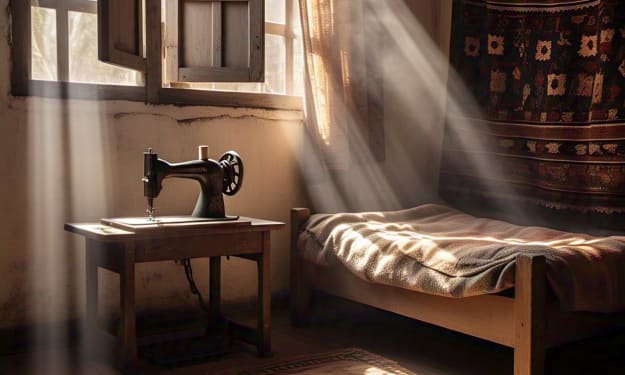
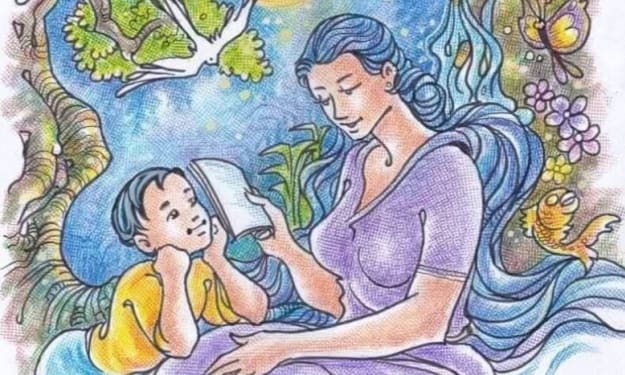
The first time Aarav remembered his mother’s embrace, he was four years old, trembling from a nightmare. The house was silent except for the ticking clock and his muffled sobs. He had dreamt of monsters, of falling, of being left behind. She came, gently wrapping her arms around him, humming a tune he would later recognize as a lullaby from her childhood. He didn’t understand the words, but the warmth and calm they carried never left him. His mother, Meera, wasn’t a woman of many words. She had never given grand speeches about life or success. Her wisdom came in simpler forms—like the packed lunch that never missed a day, the way she rubbed mustard oil into his scalp every Sunday, or how she stood silently behind him at every school event, clapping softly. They lived in a modest house on the edge of town. Aarav's father had died in a factory accident when Aarav was just two. Meera, barely in her twenties then, chose not to remarry, though many suggested she should. Instead, she worked—first as a domestic helper, later as a tailor. Her fingers became calloused from hours of stitching, but they remained gentle when they tucked the blanket around Aarav every night. Aarav didn’t realize the weight of her sacrifices until much later. As a teenager, he often felt embarrassed by their small home, by his mother’s plain sarees, by the lunchboxes filled with the same potato curry and roti. He’d see classmates arrive in cars, carrying branded backpacks, and feel a pang of resentment. Meera never asked him why he grew quiet during those years. She simply stayed close, hovering like a steady flame in a dark room. One winter, when Aarav was fifteen, he fell terribly ill. Pneumonia. For days, he lay feverish and restless. Meera didn’t sleep—she sat beside him, wiping his forehead, feeding him spoonfuls of warm broth, whispering stories of gods and warriors. When he finally awoke clearly, weak but alert, she was there, her head resting on the edge of his bed, eyes swollen from exhaustion but smiling. It was in college that things began to change. Aarav earned a scholarship, moved to the city, and slowly built a world far from the narrow lanes of his hometown. He called Meera once a week, sometimes less, always promising to visit but never quite finding the time. She never complained. Years passed. Aarav got a job, then promotions, then a car, a house, a life filled with dinner meetings and deadlines. Through it all, Meera remained the same. Every festival, she sent him a box filled with homemade sweets and a handwritten letter. Her handwriting had started to shake, but her words were steady: Eat well. Sleep more. I’m proud of you. One day, in the middle of a meeting, he got a call from a neighbor. Meera had fallen. A minor stroke, the doctors said. She was stable, but weak. The guilt hit him like a wave. He flew home the next morning, walking into a house that seemed smaller than he remembered. The walls had faded, the stitching machine was covered in dust. And in the middle of it all, lay Meera—frail, smiling, eyes lighting up at the sight of him. “You came,” she whispered, reaching out. He knelt beside her, overwhelmed by memories—the oil massages, the warm rotis, the lullabies, the embrace in the dark. Everything he was, everything he had become, was woven from her strength. “I’m sorry I stayed away,” he said, voice cracking. She touched his cheek. “You did well, beta. That’s all I ever wanted.” He stayed by her side for two weeks, relearning rhythms he had forgotten—the sound of birds in the morning, the hum of the sewing machine when she used to work, the peace of shared silence. He promised to return more often. This time, he kept that promise. Meera never asked for much. When she passed away three years later, the only thing she left behind was a diary—pages filled with thoughts never spoken. In it, Aarav found entries written across decades. “Aarav’s first day at school. He didn’t cry. I did.” “Got a raise. Bought him a new book. He finished it in one night.” “He didn’t look back when he boarded the bus. He’s growing.” “I miss him.” The last entry read: “I hope he knows. Even in silence, I’ve always been with him.” Aarav closed the diary with trembling hands. Today, years later, Aarav is a father himself. Sometimes, when his own daughter wakes up from a nightmare, he hums the same lullaby his mother once did. He doesn’t know all the words, but the warmth remains. In the quiet of night, when the world fades, he often feels it again—her presence, her strength. A mother’s embrace never really ends.
By "TaleAlchemy"about a year ago in Fiction
REVOLUTION OF HEARTS
In the heart of a small, rural village in Nepal, under the shadow of the monarchy’s harsh rules, two souls are bound by love but torn apart by the walls of society. It is the 1950s, and the caste system rules every aspect of life. The idea of love beyond one’s birth is still a distant dream.
By Roshan Chauhanabout a year ago in Fiction