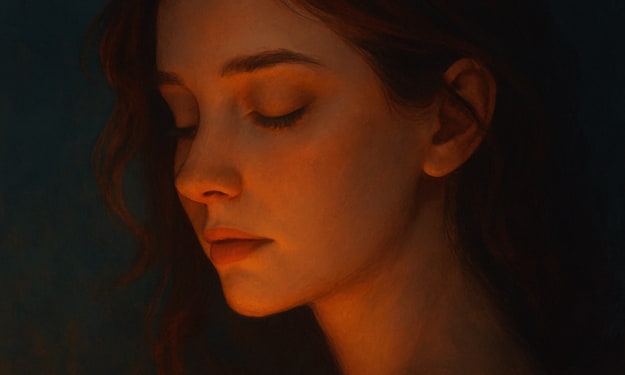
Love
The Flowers Never Wilted.
Every Tuesday at 9:00 AM sharp, he walked into the flower shop on Fifth Street. He never needed to speak. The florist already knew. > “White lilies and lavender, wrapped in brown paper,” she’d say. He would smile — softly, politely — and pay in cash. Always exact change. Then he would leave. --- The routine had gone on for months. Some of the newer staff wondered who the flowers were for. A lover? A wife? A grave? No one asked. His eyes had a look people didn’t interrupt. Not angry. Not broken. Just… distant. Somewhere else entirely. --- He would walk to the same park after that. Past the benches. Past the children. Past the noise. Toward the tree with the twisted trunk near the pond. There, he’d sit and gently place the bouquet beside him — never on the bench, always next to his thigh, as if someone invisible was there to receive it. Then he would whisper. Stories. Memories. Apologies. Sometimes, just silence. --- He remembered the first time he brought her flowers. They had only known each other for a week. > “Why flowers?” she had asked. > “Because I didn’t know what else to say.” She laughed. “Next time, say it anyway. And bring me lavender. I like how it smells like peace.” --- He did both, for years. --- They fought, sometimes. Of course. All couples do. But he never missed the Tuesday flowers. Not even after they separated for six months. > “You still brought them?” she had asked, when they reunited. > “Of course,” he said. “I didn’t know how else to apologize.” She had cried then — the soft, chest-shaking kind of cry people try to hide. And they started again. From scratch. From honesty. --- But even second chances run out of time. The accident came out of nowhere. She was walking. Sunny day. No warning. The kind of moment that splits a life into “before” and “after.” --- He didn’t cry at the hospital. Didn’t scream. Didn’t say much at all. But the next Tuesday, he showed up at the flower shop. Same order. Same routine. As if she were waiting at the bench like always. --- He did this every week. And then one day, a young florist asked — gently: > “Sir, if you don’t mind me asking… do you leave the flowers at her grave?” He shook his head. > “No. She’s not buried anywhere near here.” Pause. > “So why this spot?” she asked again, respectfully. He smiled, finally. > “Because this is where I felt closest to her. Not when she died… but when she lived.” --- Every bouquet was a conversation he never finished. Every visit was a memory he couldn’t afford to forget. Sometimes he read her old texts. Sometimes he told her what the world had become — how the news felt heavier, how the sky looked different now. Sometimes he just closed his eyes and imagined her voice saying: > “You brought me lavender? You’re still terrible with words, but you’ve got the scent right.” --- One rainy morning, a girl on a bench nearby watched him closely. She had seen him before. This time, as he stood up to leave, she approached. > “Excuse me,” she said, nervously. “I know this might be weird, but… you remind me of my father. He did something similar after my mom died.” He looked at her, surprised. > “You think it’s strange,” he said. > “No,” she smiled. “I think it’s beautiful.” He nodded. > “People forget that grief doesn’t disappear. It just changes shape.” --- She walked away. And he stayed. Longer than usual. This time, he whispered: > “They still remember love when they see it. Even if it’s wrapped in brown paper.” --- He never missed a week. Even when he got sick. Even when his legs hurt. Even when the sky poured. Until one Tuesday… he didn’t come. --- The florist waited. She kept his bouquet ready just in case. Days passed. Nothing. --- A week later, a letter arrived at the flower shop. No return address. No signature. Just a note: > “Thank you for helping me love her longer than time allowed. I don’t need the flowers anymore. But if someone ever asks why — tell them love didn’t stop. It just walked a little farther.” --- And so they did. They kept a bouquet of white lilies and lavender on the counter. Every Tuesday. For the man who loved with flowers. For the woman who still received them — in every scent, every silence, every soft memory the petals carried.
By Muhammad Usamaabout a year ago in Fiction
The Roar and the Whisper
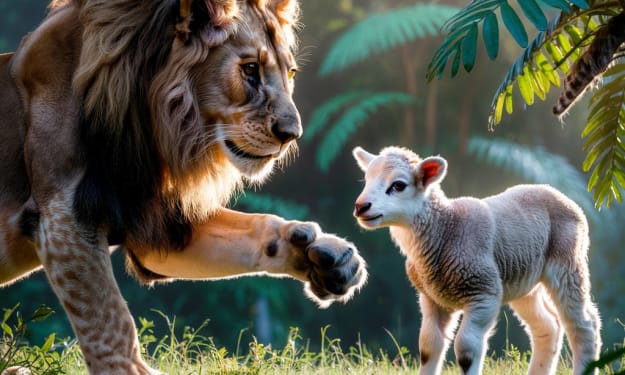
The Roar That Ruled "eep in the heart of the forest where sunlight cracked through tangled canopies and shadows held secrets, ruled the mighty lion, Ragnar. His mane was like flame, his roar like thunder, and no creature dared question his rule. He hunted when he pleased, roamed where he chose, and took what he wanted. The law of the wild was simple: “The strong survive, and the weak obey.” And no creature was considered weaker than the lambs of the northern meadow. Their soft bleats and peaceful grazing made them easy prey. They never ran far. They never fought back. And they always feared Ragnar. But the lion was growing tired. No hunt thrilled him anymore. No roar echoed long enough. A gnawing emptiness followed every victory, though he didn’t know why. The Lamb Who Didn't Run One overcast morning, Ragnar padded through the forest and came upon a stream near the meadow. There, alone and humming a strange little tune, stood a lamb—Lyra—her snow-white wool glowing against the gray sky. She was far from her flock, vulnerable, unaware. Or so Ragnar thought. He stepped forward, ready to pounce, but Lyra didn’t flinch. She looked up, locking eyes with the predator of her kind. "You’re the lion they all whisper about," she said. Her voice was calm. Almost... curious. Ragnar paused mid-step. No creature had ever spoken to him without trembling. "You should run," he growled. "I know," she replied. "But I won’t." "Why not?" Lyra smiled faintly. "Because I don’t believe you want to eat me. Not today. A Strange Curiosity Instead of devouring her, Ragnar sat down. For the next hour, they talked. Or rather—she talked, and he listened. She told him about the wind and how it carried the scent of wildflowers from the southern hills. She told him about a mother bird building her nest in a crooked tree. She even sang him a lullaby her grandmother used to hum during storms. When the sky darkened, Ragnar rose. “You’re strange for a lamb.” "And you’re quiet for a lion," Lyra said, unbothered. He left without a word, but that night, Ragnar didn’t sleep. He kept hearing her voice—soft and steady like a whisper brushing against thunde- Return to the Meadow The next day, Ragnar returned. And the next. And the next. They never talked about fear. Or death. Or what might happen if one day his hunger outweighed his curiosity. They spoke of stories instead. The myths of the forest. The colors of the moon. The dreams Lyra sometimes had where lions and lambs danced together without fear. “You’re ridiculous,” Ragnar said once, but he found himself wondering—what would that world look like The Challenge But the jungle noticed. And the pride grew restless. “You’ve gone soft,” snarled Drax, Ragnar’s younger rival. “You sit with prey while your strength withers.” “I’m still king,” Ragnar growled. “Then prove it. Hunt her. Bring her back as your prize.” Ragnar said nothing. But inside, something cracked. That night, he stood at the edge of the meadow. Lyra was waiting. She always waited. But this time, he didn’t sit. He stared at her as if seeing her for the first time—as a lamb, as prey, as the weakness he had once vowed to destroy. "Is today the day you eat me?" she asked gently. "I might have to." Lyra nodded. “Then at least let me tell you one more story.” He listened. It was a story about a lion and a lamb who were born into war but dreamed of peace. Who were told they could never be friends but still shared shade under the same tree. A story that never had an ending—because no one dared imagine one. “You can write it,” Lyra said. “You’re the lion. You decide how the story ends.” The Roar That Changed Everything The next morning, Ragnar returned to the pride. He roared—not a roar of dominance or hunger, but something new. A roar that echoed with choice, not instinct. “I will not hunt the lamb,” he declared. “Nor any creature who offers no harm.” The pride erupted. "You’ve betrayed your nature!" Drax roared. “No,” Ragnar said. “I’ve rewritten it.” A battle followed. Fierce, brutal, primal. But in the end, Ragnar stood over Drax, bloodied but unbowed. “This is our law now: strength with mercy, power with restraint.” Some lions left. Others stayed. But the jungle heard. And the whisper began to spread. A New Meadow Months passed. The forest changed. Predators and prey still lived by instinct, but not by fear. A fragile truce was born—not perfect, not without setbacks—but real. And sometimes, in the quietest part of the meadow, Ragnar would sit beside Lyra, listening to her stories as the sun dipped low. “Do you miss being feared?” she asked once. “Sometimes,” he admitted. “But I’ve found something better.” “What’s that?” He smiled. “Peace.” The Final Story Years later, when Lyra grew old and her steps slowed, she asked Ragnar for one last favor. “Tell the story,” she whispered. “Even when I’m gone. Tell it like it mattered.” Ragnar, now grayed and gentler, nodded. And he did. He told the cubs and the calves, the foxes and the fawns. He told them of a time when the jungle was ruled by fear, and how a lamb changed a lion with nothing but her voice. He ended each tale the same way: > “Strength isn’t in how loud you roar, But in how quietly you can listen.”
By Arshad khanabout a year ago in Fiction
Unsent
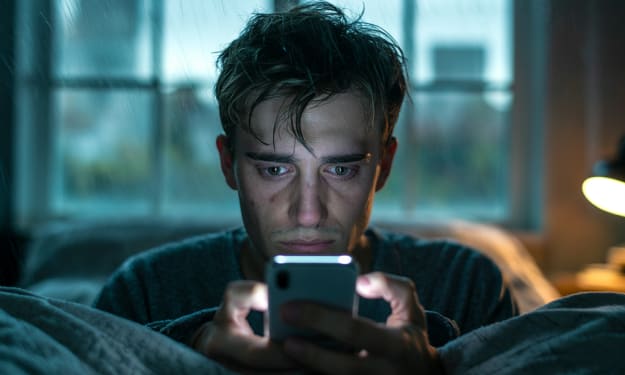
He stared at the phone screen, thumbs hovering above the keyboard. The message had been typed and deleted five times already. Every version felt wrong — too soft, too late, too honest, too full of regret. And yet, none of them felt like enough. At the top of the screen was a name he hadn’t spoken aloud in almost two years: Zoya. She had been a chapter that never ended. A sentence that still lingered in his mind. A song that always started, but never played through. And tonight, she came back again — not in real life, but in his dream. Same bookstore. Same laugh. Same sudden vanishing. --- They weren’t lovers. Not officially. Not in the way the world would recognize. But their bond had felt real. Maybe too real to survive reality. They talked every night for eight months — sometimes until dawn. They had matching playlists, unspoken inside jokes, and that strange closeness where two souls understand each other without having to explain. And then it ended. --- He scrolled up to read their old messages. She had sent pictures of her dog, late-night memes, her messy handwriting, voice notes when she was too tired to type. He remembered how she hated the sound of her recorded voice — but sent the notes anyway because she knew he liked them. Their last conversation was short. Cold. > Zoya: “I don’t want to wait for someone who’s unsure.” Him: [no reply] Not because he didn’t feel something. But because he didn’t know what to do with it. She was real. Grounded. Bright. He was unsure, anxious, lost. So, he let silence answer for him. --- He whispered to no one, “I thought we had time.” Maybe the biggest lie people tell themselves is that they’ll always have more time. --- He typed again: > Hey… I know it’s been a long time. But I never got to say the things I should have said when you were still here, still close, still maybe mine. I’ve thought about you more than I want to admit. And if there’s even the smallest chance you still think about me too… I just wanted you to know I’m sorry. I miss us. Whatever we were. Whatever we could’ve been. He paused, staring at the words. Then hit Backspace. Deleted every word. Locked the phone. He couldn’t do it. --- Across the city, Zoya sat curled in a blanket, sipping lukewarm tea. She had her tablet open and was scrolling through her photo gallery. One photo made her stop: her in a bookstore, holding a book and laughing mid-sentence. He had taken that picture without asking. She had secretly loved it. It was still her favorite photo — because it was the only one where she looked truly happy and didn’t know someone was watching. --- She sighed. Two years. People had come and gone. But none of them filled the quiet space he had left behind. Not even her current boyfriend, who was kind and gentle, but not… him. She opened their old chat. Still no new message. She whispered to herself, “Just one word. That’s all it would take.” But her phone remained still. --- Back in his room, he picked up a small notebook. Flipped to the last page. That’s where he wrote the unsent messages. He had written to her every month. Some long. Some one-liners. Some just her name. Tonight, he added another. > You asked me once what scared me more — losing you, or disappointing you. I didn’t answer then. But the truth is… both scared me equally. So I chose silence, and ended up doing both. --- He closed the notebook. Walked to the window. Rain had started. Quiet, steady. Not dramatic — just there, like a memory you forgot you were carrying. --- If he had sent the message, what would she have done? Cried? Ignored it? Called back? Or simply smiled at the closure? He would never know. Because he would never send it. --- And she would never know how much space she still took in his life. How he still checked her profile every month. Still noticed the new photos. Still remembered her favorite quote about stars and scars. --- Some people don’t leave. They just become quieter inside you. --- That night, they both dreamed of each other again. Different cities. Different hearts. But the same ache.
By Muhammad Usamaabout a year ago in Fiction
Still Here
Mark never deleted his dad’s number. He couldn’t. That felt like crossing a line he wasn’t ready to name. The voicemail was gone… something about Telstra wiping them after six months. The photos were all backed up… somewhere? But scattered. The texts were half-there. Fragments from old backups. No full threads.
By Louise Williamsabout a year ago in Fiction
She Wasn't Real — But She Saved My Life
I was eight years old the first time I saw her. She was sitting on the swings at the park, gently rocking back and forth, her sunflower-yellow ribbons fluttering in the breeze. She turned to me with a grin that felt like sunlight and said, “I’ve been waiting.”
By Masih Ullahabout a year ago in Fiction