Love
The Jasmine Promise
The morning mist still clung to the trees when Prince Indrajit and his sister Princess Indravati arrived at the ashram of Subramanyam, the legendary teacher of kings. The old guru welcomed them with folded hands, his white beard glowing in the dawn light. Behind him stood his son Prasanna - tall, broad-shouldered, with eyes that seemed to hold all the wisdom of his father's teachings. As Indrajit formally requested tutelage, Indravati found herself unable to look away from Prasanna. There was something in the way he stood - not like the stiff-backed warriors at court, but with an easy grace that spoke of quiet confidence. When their eyes met, she felt her breath catch in a way no palace suitor had ever made her feel. Even as her brother led her away, she glanced back three times, and each time found Prasanna still watching her. The next morning, as Indrajit began his lessons, Indravati's handmaiden Pramila approached Prasanna with a bouquet of night-blooming jasmine. "From the princess," she whispered, glancing around nervously. "She said you'd understand the meaning." The flowers' heady perfume surrounded Prasanna as he brought them to his face, his heart pounding. That evening, he pressed a carefully folded poem between the same flowers and had them returned to Indravati's chambers. For weeks, this secret dance continued. During the day, Indravati would sit with her brother during lessons, her eyes constantly drifting to where Prasanna tended the ashram's gardens. In stolen moments when no one was watching, they exchanged whispers by the old banyan tree, their fingers brushing as they passed notes hidden in flower petals. On the final day of training, as the sun set in a blaze of orange and purple, Indravati found Prasanna alone by the river. "I'll speak to my father tonight," she promised, her small hand gripping his. "We'll be married before the monsoon comes." Prasanna's joy was tempered by fear. "Your father is a king, and I'm just a scholar's son. What if he refuses?" Indravati lifted her chin with royal determination. "Then we'll leave together. I won't lose you." But fate had other plans. That very night, King Veerabahu summoned his daughter to the throne room. "Prince Vikraman of the northern kingdom has asked for your hand," he declared proudly. "I've already given my word." The blood drained from Indravati's face, but royal duty kept her protest locked behind clenched teeth. When word reached Prasanna, he collapsed beneath their banyan tree, a dagger glinting in his hand. "If I can't have her," he whispered to the uncaring night, "then let my life end here." Meanwhile, at the palace gates, a handsome stranger calling himself Anandan rescued Pramila from a charging elephant during the wedding preparations. As he carried her to safety, neither realized how their lives would soon intertwine with their masters'. On the eve of the wedding, as tradition demanded, Indravati and her bridesmaids visited the Durga temple in the forest. Hidden behind the towering statue of the goddess, Prasanna waited with a breaking heart, determined to see his love one final time. What he saw instead made his blood run cold - Indravati, alone before the idol, raising a ceremonial dagger to her own throat. "No!" He burst from hiding, grabbing her wrist just in time. The dagger clattered to the stone floor as they clung to each other, tears mingling. Suddenly, the temple doors burst open. There stood Anandan, the mysterious stranger, his disguise now discarded. "Stop this foolishness!" he commanded. "The obstacle isn't the king's promise, but Prince Vikraman's claim. Convince him to withdraw, and your path is clear." Indravati shook her head in despair. "How? I've never even met the man!" With a dramatic flourish, Anandan removed his traveler's cloak to reveal royal silks beneath. "Because Prince Vikraman stands before you." The truth unfolded like a lotus blooming - Vikraman had come in disguise to understand why the princess resisted their marriage. Seeing her true love for Prasanna, he refused to be the cause of their suffering. "No union begun with broken hearts can prosper," he declared. The next morning, a stunned King Veerabahu listened as Vikraman himself pleaded Prasanna and Indravati's case. Moved by such selflessness, the king gave his blessing. As the conch shells sounded their joy throughout the kingdom, two weddings were celebrated - one for the princess and her scholar, another for the noble prince and Pramila, whose courage had matched his own. Years later, when travelers passed the old banyan tree, they would sometimes see an aging couple sitting in its shade - a still-graceful woman leaning against a man whose eyes still sparkled with wisdom and love. And if the moonlight was just right, one might glimpse the ghostly shapes of two young lovers dancing among the flowers, their joy finally complete. Thus they proved that no promise is stronger than compassion, no law greater than love.
By Alice Talesabout a year ago in Fiction
I miss my love
The rain had returned again this evening, tapping softly against the windows like a forgotten lullaby. I sat curled up by the window, a blanket wrapped around my shoulders and a cup of tea slowly losing its warmth between my hands. The world outside blurred into smudges of grey and silver. Inside, the silence was louder than the storm. My name is Julia Christa, and tonight, like many nights before, I find myself wandering through memories of you. I wish I could forget the sound of your voice, the way you laughed when I said something silly, or the way your fingers fit perfectly between mine. But forgetting isn’t something the heart agrees to when it has loved deeply. You were never meant to be just a chapter. You were the story I thought would last forever. We met in late spring, when the world was blooming and so was I. Your smile felt like the first sunlight after a long winter. I still remember how you looked at me across the café table, your eyes filled with an ease I hadn’t known before. You spoke to me like we had known each other in another life. Perhaps we had. Or maybe I just wanted that to be true. We didn’t fall in love. We rose into it, slowly, like dawn breaking over the ocean—soft and inevitable. You used to tell me I made the world feel lighter. But it was you who carried my storms without flinching. In your arms, the chaos of life quieted. When I was with you, I didn’t need to pretend, didn’t need to hide the parts of me I thought no one could understand. You saw them. You stayed anyway. But nothing gold stays. And neither did we. I still don’t know when the beginning of the end began. Maybe it was when the silences between us grew longer. Maybe it was the nights we went to sleep facing opposite walls, each lost in thoughts we couldn’t name. Or maybe it was simply time, with its cruel habit of wearing down even the strongest of loves. The last day we were us is still etched in painful detail. You stood by the door with your bags packed, eyes tired but dry. I wanted to scream, to beg you to stay, to ask why love hadn’t been enough. But I couldn’t find the words. So I just stood there, frozen, as you said goodbye with the kind of softness that breaks a heart more than anger ever could. You left a silence behind that never truly filled itself in. Days passed. Then weeks. Then months. Life continued, as it always does, but it never felt whole again. People told me I’d move on. That time heals. But they don’t tell you that sometimes healing means learning to live with the hole someone left behind. It doesn’t close—it just becomes a part of you. There are still nights when I dream of you. In those dreams, we’re laughing again, walking under trees, our hands intertwined. You look at me the way you used to, and for a moment, I forget. Then I wake up to the cruel truth of absence, and the air feels heavier. I try not to wonder where you are now. If someone else makes you coffee in the morning. If you found that peace you were always searching for. But on nights like this, when the rain sings sad songs on the glass, I can’t help but wonder if you ever think of me too. I miss the little things. The way you’d tuck a strand of my hair behind my ear. The way you always knew when I needed quiet rather than comfort. The playlists you made for every part of our lives—each one now a relic I can't bear to play. But more than anything, I miss the feeling of being known. Truly known. You were the first person who saw all of me and didn’t look away. Sometimes I write letters to you that I’ll never send. I pour everything into them—what I wish I’d said, what I’ve learned since you left, and how some days I still search for you in crowds. It’s foolish, I know. But grief has its rituals, and this one is mine. I often wonder what I would say if I saw you again. Would I smile and pretend I’m okay? Or would the weight of everything unsaid come tumbling out like a storm? Maybe I’d simply thank you—for loving me, for breaking me, for teaching me how deeply I could feel. Because the truth is, even in your absence, you changed me. I’ve learned that love doesn’t always come with forever. Sometimes it comes with lessons, with heartbreak, with memories that outlive the relationship itself. And even though it hurts, I wouldn’t trade what we had. You were real. We were real. Tonight, I sit with that truth, even as the ache lingers. I allow myself to miss you, to remember, to mourn what was. Because missing you means you mattered. And I’d rather feel the pain of loss than the emptiness of never having known you at all. Maybe one day, the memory of you will make me smile more than cry. Maybe the sadness will soften into something gentler. But for now, I let the rain keep me company as I whisper your name into the quiet. Goodnight, my love. Wherever you are, I hope you found your light. I’m still searching for mine.
By Julia Christaabout a year ago in Fiction
Hot Dirigible
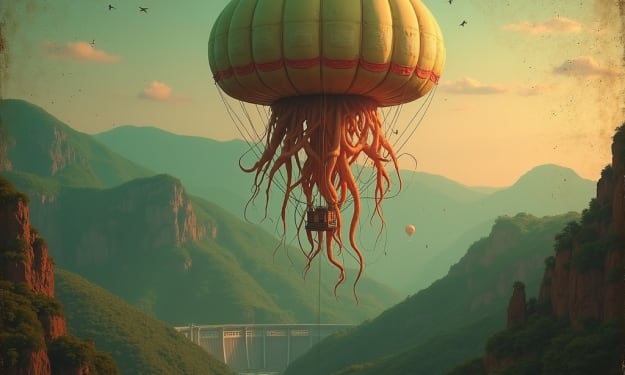
Tallulah felt the thick braids of the whicker basket through the soles of her running shoes. She imagined it matched the thick braids in her long blond hair. She was not sure about getting into a hot air balloon when she first arrived at the field near the Fort Crittenden Dam Park. She almost chickened out, but once they were up in the air she found the view utterly breathtaking. She could see the entire valley from their height.
By Amos Gladeabout a year ago in Fiction
The Garden Beyond the Jars. Content Warning.
Elora stepped through the threshold of her new home, the one Sorrel had helped her build after her old one crumbled. A single lantern lit up the space, the only thing she had managed to salvage from the wreckage. Its glow was a familiar comfort in the overwhelming newness of her life. The shattered jars, once so precious to her, now lay discarded. She no longer needed them.
By Elora ThornWoodabout a year ago in Fiction
Bloodline
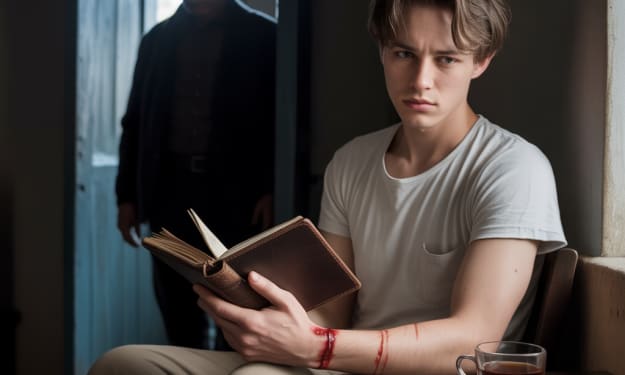
They say blood is thicker than water. But no one tells you how heavy it can feel. I was born into a family where no one said “I love you” out loud. Where silence was tradition. And suffering ran through our veins like some kind of inheritance. We bled, not from wounds — but from words unspoken, truths buried too deep, and the weight of expectations passed down like sacred curses. --- My father never hit us. But he didn’t need to. His silence could choke a room. One look could send us to our knees. He bled from his hands every day — the kind of blood that came from honest work and broken dreams. But he never showed pain. > “We don’t cry,” he used to say. “We hold it in. That’s what men do.” So we did. --- My brother, Adeel, was the golden one. Strong, stoic, brilliant. He followed in my father’s footsteps like a soldier marching to a war he never asked for. I followed too — quietly, always two steps behind. --- One night, Adeel got into a fight outside a gas station. Someone said something. He said something back. A broken bottle. A flash of red. And just like that, real blood was spilled. We rushed to the hospital. My mother praying under her breath. My father… silent. --- Adeel survived. Barely. He was never the same after that. He stopped eating. Stopped laughing. Started drinking. “Men don’t talk,” Dad said. “They get through it.” But Adeel didn’t. He bled differently now — from the inside. Quiet and constant. --- One day, I found him in the bathroom. Pale. Barely conscious. Wrists open. I screamed. He didn’t. That was the first time I understood that blood wasn’t just a metaphor in our family. It was our language. --- He lived. Again. But he left a note taped to the mirror: > “You never asked how I felt. You just assumed I was fine.” That sentence still slices through me like glass. --- After that, everything changed. Dad started going to bed earlier. Mom began lighting candles and praying harder. I… started writing. --- I kept a journal full of the things we never said: “I’m scared.” “I don’t know how to be a man.” “I love you.” “I wish someone would just hold me.” --- Then one day, I showed my father the notebook. He didn’t read it at first. Just stared at it like it was some foreign object. Then he asked, > “Why write this? What’s the point of remembering pain?” I looked him straight in the eyes and said: > “Because pretending it didn’t happen hasn’t helped us either.” He didn’t respond. But the next morning, I saw the notebook on his table — flipped open to the first page. A mug of tea sat beside it. That was his version of a conversation. --- Sometimes, love looks like pain passed down and finally broken. --- Now, years later, I work with boys like Adeel. Boys who’ve been told to man up. To shut up. To never cry. I teach them that strength isn’t silence. That blood doesn't always have to carry history — it can carry healing too. --- One of them once asked me, > “Do you think pain can be passed down in blood?” I said, > “Yes. But so can courage.” He smiled. I knew he understood. --- Adeel lives far away now. He paints. Sells art online. His wrists are scarred but his eyes are soft again. We call every Friday. Sometimes we talk about dad. Sometimes we don’t. --- The other day, my father — now slower, older — asked me, > “Do you think I ruined him?” I said: > “No. You just didn’t know how to hold him.” --- There’s something beautiful about broken men learning how to be gentle. Something tragic about how long it takes. --- Blood doesn’t have to be destiny. You can rewrite your story. You can choose what gets passed on. You can bleed — and still live. ---
By Muhammad Usamaabout a year ago in Fiction
Where the Heart Writes
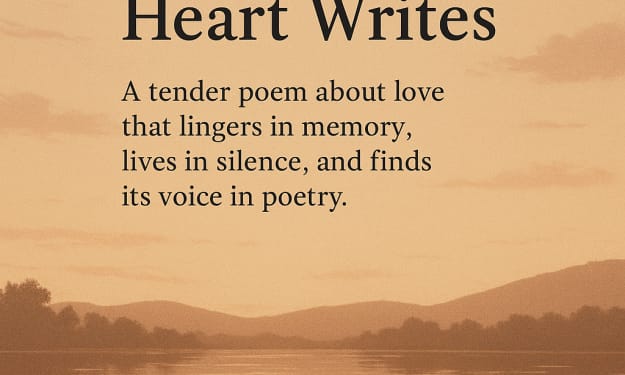
Where the Heart Writes I wrote you first in lines of light, Where shadows bowed to morning’s might. No voice had named you — still, I knew, The way the sky leans into blue. Before your hands had touched my skin, You lived in every song within. Each verse I penned, each silent prayer, Held pieces of you, unaware. Love is not found — it’s softly grown, In words we speak when we’re alone. It blooms between the lines we share, In ink, in breath, in whispered care. I write of you not just in rhyme, But in the turning wheel of time. In fleeting glances, held too long, In aching silence between song. You’re there in pages left unread, In thoughts I think but never said. In coffee warm and nightfall's hush, In every bloom, in every blush. You linger like a sacred hymn, Soft on the air, yet full and brimmed. A rhythm only hearts can feel, Too wild to name, too true to steal. I’ve seen you in a stranger’s laugh, In mirrored dreams split clean in half. I’ve heard your voice in waves that break, In every dawn my soul could take. And though the world may never see The full, unspoken depths of “we,” I’ll write — as if the stars conspire To set these trembling lines on fire. For love, when true, needs not be loud. It speaks in hearts, not to the crowd. And if my words are all I give — Then know: in them, we’ll always live. So let the poets think it art, But what I write — I write from heart. Each letter shaped, each phrase begun, Is proof that two can live as one.
By Khalid Khanabout a year ago in Fiction
In The Time Between Heartbeats
“In the Time Between Heartbeats” They met in autumn, when the world was ablaze in crimson and gold. Her name was Elena, a painter with a soul so soft it could quiet storms. He was Adrian, a violinist with hands that had known both war and wonder. The first time they saw each other, it was raining. She stood beneath a maple tree in Central Park, sheltering her canvas from the downpour, eyes locked on a world only she could see. Adrian, soaked to the bone, passed by with his violin case slung over one shoulder. Their eyes met—and something ancient stirred. He smiled first. She didn’t. But later, he would say he knew from that moment. They met again at a corner café two weeks later. She was sketching a sleeping dog by the fireplace. He was playing in a quartet across the room. Their eyes met again—this time, she smiled. It began, as most beautiful things do, quietly. Elena painted the way she loved: with slow, deliberate devotion. She told Adrian she feared impermanence—how colors faded, how people disappeared. Adrian told her music was just as fleeting, notes vanishing the moment they were born. But he would play for her anyway. Every night, beneath the stars or in the silence of her sunlit studio, he filled the air with sound, and she filled it with color. They loved like there was no such thing as later. They kissed like each breath might be the last. He played for her while she slept. She painted him when he thought she wasn’t looking. There was no proposal. No diamond. Just a Tuesday morning and two mugs of coffee, and Elena saying, “I’d marry you even if the world ended next week.” And Adrian saying, “Then let’s love like it will.” They were married in a garden, under a tree that remembered the rain of the day they met. It was just the two of them and the wind. No vows, no priest. Just his music and her laughter. It was perfect. For two years, they lived in a world they built together—a world of music and paint, of quiet breakfasts and deep kisses, of joy so gentle it almost hurt. Then came the diagnosis. Elena had a tumor behind her left eye. It was rare. Inoperable. Aggressive. She was twenty-eight. He fell apart in ways no one saw. Except her. Always her. “You must keep playing,” she told him. “When I forget the sound of your voice, let the music remind me.” She refused to be afraid in front of him. She painted until her hands shook too much to hold a brush. He played until his fingers bled. When she began to forget things—his name, the name of their street, the day of the week—he would sing to her. Songs he had written just for her. And for a while, she remembered. One night, she woke in the middle of a seizure. He held her through it, whispering that he loved her, over and over, like a prayer. After, she looked at him with wide, frightened eyes. “I’m slipping,” she said, barely a whisper. “You’re still here,” he said, placing her hand over his heart. “Every beat, you’re here.” Her final days came like fog—quiet, slow, inevitable. On her last morning, she asked him to take her to the tree where they were married. He carried her, though his back screamed with pain. She was nothing but bones and air in his arms. He sat with her beneath the branches, the wind threading through her hair. She looked at him as if seeing a memory. “Adrian,” she whispered. “You stayed.” He kissed her forehead. “Always.” She closed her eyes with a smile. And then—silence. Adrian never stopped playing. Each concert, each note, was a love letter across time and death. He composed an entire symphony in her name. Audiences wept without knowing why. They said his music made them feel like they were remembering something beautiful they'd never actually lived. But Adrian knew. He played for the girl who loved autumn, who painted storms into stillness, who promised forever on a Tuesday morning. And every time the bow touched string, he felt her. Still here. In the time between heartbeats.
By Khalid Khanabout a year ago in Fiction
Notes Between the Pages
In the heart of a crumbling alley, where old bricks bled history and the wind whispered forgotten verses, stood a modest bookstore—dusty, dimly lit, and nearly hidden behind the canopy of a gnarled fig tree. It was not much to look at, certainly not for the passersby who chased noise and neon, but for the few who sought depth over display, it was a sanctuary.
By Khalid Khanabout a year ago in Fiction
The Last Gate to Paradise
The air shimmered like glass in the golden light of the setting sun. A vast meadow stretched endlessly, blooming with flowers that had no names, colors that defied human language, and scents that evoked forgotten dreams. In the center of it all stood a lone gate — ancient, majestic, and pulsing with light.
By NIAZ Muhammadabout a year ago in Fiction
When I Close My Eyes. Content Warning.
When I close my eyes The summers end was coming near as fall was bestowing on us. Our children played in our yard as the sun was beginning to set. The nights began to cool down a sigh of relief as it was a tall tell sign that fall was drawing nearer. As the years come to pass, the summers seem to get hotter. Sitting on our back deck, I look around at my beautiful family, admiring how blissfully lucky I am. My wonderful husband Remi was making our favorite meal Falafel for dinner. The aroma wafting in my face as I take a deep breath, the heavenly scent Maqluba. Rice, fried vegetables such as tomatoes, cauliflower potatoes and eggplant, seasoned to perfection served with your choice of chicken or lamb. Tonight, Remi is making it with Lamb. “Smells wonderful darling,” I say smiling at Remi. He gives me a wink, “of course it does, I am after all a professional chef, “he quips. I burst into laughter, the kind that comes from your stomach, causing for it to ache. “A chef huh? You burn half the meat half the time,” I quip.
By Aubrie Sandnessabout a year ago in Fiction
Letting Go. Top Story - July 2025.
My head rests on my pillow, my heart rests in your eyes. You are so beautiful, I can’t believe you ever chose me. Your brown eyes glisten with a form of magic. I can’t explain it, but whenever you look at me, I feel seen. I feel safe, like I’ve finally found my home. You’re the first woman I’ve ever felt comfortable maintaining eye contact with. With you, it feels… right? That’s why it hurts.
By Simon Georgeabout a year ago in Fiction