Love
How a garden brought two hearts closer.
Arsalan never imagined he would fall in love among rows of roses. In fact, love was the last thing on his mind when he returned to his village after finishing school in the city. His uncle had grown old and needed help tending to his modest nursery on the outskirts of town. Every morning, Arsalan rose before dawn, tying a faded scarf around his neck and walking through the sleepy streets to reach the garden before the sun lit up the fields. The nursery was simple but beautiful. Rows upon rows of rose bushes stretched out under the soft early light, heavy with dew. The scent was intoxicating, a sweet promise of mornings yet to come. Arsalan found comfort in this routine, pruning branches, watering thirsty roots, and gently whispering to the plants as if they were old friends. Then came Hina. She was visiting her aunt who lived next door. A girl from the city, with delicate manners and bright eyes that seemed to notice every small wonder. The first time Arsalan saw her, she was standing shyly at the garden gate, her hands clasped in front of her. She looked out of place yet perfectly at home, as if the garden had been waiting just for her. Day by day, Hina began to wander into the nursery, always at the same quiet hour when the sun was soft and the world felt unhurried. Sometimes she would pick up fallen petals and cradle them in her palm, other times she would close her eyes and breathe in the rich fragrance as if trying to fill herself with it. Arsalan watched her from a distance, unsure what to say, how to act. His heart beat unsteadily whenever she was near. One morning, after weeks of silent glances and awkward nods, Hina approached him while he was carefully tying up a stubborn rose stem. She carried in her hands a small bouquet of half-open roses. “They’re beautiful,” she said softly, her voice like wind chimes. “But I think it’s you who makes this place truly come alive.” Arsalan nearly dropped his shears. No girl had ever spoken to him like that. His throat felt tight. He managed a nervous smile and wiped his hands on his kurta. Before he could reply, Hina stepped closer and tucked a stray leaf behind his ear, her fingers lingering for a heartbeat longer than necessary. The world seemed to slow, the air heavy with the scent of roses and something even sweeter — the first spark of love. From then on, the garden transformed. It was no longer just a place of flowers. It became a secret world where laughter bloomed along with the petals, where shy confessions floated on the breeze, and where two hearts slowly found each other in the hush of early mornings. They would walk between the rows hand in hand, sometimes silent, sometimes telling stories of their childhoods. Hina loved how Arsalan’s eyes shone when he spoke about the old mango tree he used to climb, how he once fell and broke his wrist but still laughed through the pain. Arsalan, in turn, was fascinated by Hina’s tales of bustling city streets, bright shop lights, and noisy weddings with hundreds of guests. One particular morning, when the sun was just beginning to warm the dew, Arsalan took a deep breath and reached into his pocket. His hand came out holding a tiny folded paper — a love letter he had scribbled under the dim glow of a lantern the night before. “My words aren’t fancy,” he said, his voice trembling, “but they’re true. I wanted you to have this.” Hina took the letter as if it were the most precious jewel. Her eyes filled with tears, a smile spreading across her face like the first bloom of spring. She leaned in and pressed a gentle kiss to his cheek, the touch so soft it left his skin tingling long after. The days that followed were painted with quiet joys — stolen glances, playful teasing, hands brushing over blooms heavy with perfume. The villagers began to notice, whispering among themselves, but neither Arsalan nor Hina cared. In their little world of roses, time stood still. One evening, under a sky awash with gold and lavender, Arsalan and Hina sat together on a low stone wall at the edge of the nursery. She rested her head against his shoulder, the scent of flowers all around them, as if the earth itself celebrated their love. Arsalan looked down at her, memorizing the way her eyelashes fanned across her cheeks, the way her lips curved even in stillness. “I think I’ve loved you from the first moment I saw you by the gate,” he whispered. “And I think,” Hina murmured back, eyes half-closed, “I came to this village just so I could find you here.” As twilight wrapped them in its tender embrace, the garden held their secret — a promise that in the heart of every flower bloomed the story of two souls who had finally found their way home to each other.
By Aman Ullahabout a year ago in Fiction
From Friendship to Love.
They had known each other for as long as their memories reached back. Areeba and Danish grew up in the same narrow village lanes, their homes just a stone’s throw apart. Childhood was a swirl of shared secrets, silly quarrels, and afternoons spent chasing each other through fields that stretched golden under the sun.
By Aman Ullahabout a year ago in Fiction
The Love Letter.
It was a cold, quiet winter afternoon in the small village where time seemed to move at its own gentle pace, unhurried and soft, like the drifting of clouds over the pale blue sky. Maheen had been meaning to clean her old wooden cupboard for months, but the task always felt too daunting. Today, however, she decided it was time. The cupboard had been standing in the corner of her room for years, silently holding the weight of memories, stories, and moments that had shaped her life. As Maheen opened the creaky cupboard doors, a familiar scent of sandalwood mixed with dust filled the air. Inside, there were faded clothes wrapped carefully in old cloth, glass bangles neatly placed in small boxes, and tiny perfume bottles whose fragrances had long since evaporated. She smiled softly, remembering the laughter and tears that these objects had witnessed. As she gently pushed aside layers of fabric, her fingers brushed against something unexpected—a small, fragile bundle of letters tied together with a delicate golden ribbon. The paper edges were yellowed and curled, clearly aged by time. Her heart fluttered with curiosity and nostalgia as she sat cross-legged on the floor and untied the ribbon. The very first letter was written in beautiful, flowing Urdu script, the handwriting neat and expressive, as if the words themselves carried the writer’s emotions. Maheen’s eyes began to scan the words, and instantly, memories flooded her mind. The letter was from Arif—her childhood friend, the boy she had grown up with. Arif had been the boy who ran races with her across endless mustard fields, climbed mango trees to pluck the sweetest fruits for her, and stood firmly by her side when village boys teased her. His presence had been a comforting constant during her childhood, and his letters now brought that old warmth rushing back. In the letter, Arif spoke of the vast city he had moved to, describing its dazzling lights and endless crowds. Yet, despite all the excitement, the city felt empty without Maheen. He wrote about how he missed her laughter echoing through the fields, the softness of her voice, and how every night, before falling asleep, he whispered her name as a prayer. He dreamed of the day when he could return and finally stand before her, confessing the love he had kept hidden for so long. Tears welled up in Maheen’s eyes as she read each heartfelt line. Fifteen years had passed since Arif left their village. Their letters had arrived frequently at first, then slowly less often, and eventually stopped altogether. The village folks had whispered that he had moved on, perhaps married someone else. Maheen had buried her hopes deep within her heart, but never let them die. As she finished reading, she clutched the letter tightly to her chest. It was as if time had folded in on itself, bridging the gap between past and present. The love that had once bloomed in the innocence of youth had never truly faded. Suddenly, Maheen’s phone buzzed loudly on the wooden table beside her. She wiped her tears hastily and glanced at the screen. It was a message from an unknown number. With trembling fingers, she opened it and read: “Maheen… is this still your number? I’m coming back to the village tomorrow. I’ve carried something in my heart for too long. I can’t let another year pass without seeing you and telling you face to face.” Her breath caught in her throat. It was Arif. Her Arif. The cold winter room seemed to fill with warmth. The thin rays of sunlight streaming through the window suddenly felt softer and brighter. Maheen stood up, holding the bundle of letters close. For the first time in many years, she felt hope rekindle within her. That night, sleep eluded her. Every creak in the house, every whisper of the wind outside made her heart race. She thought back to the carefree days of their childhood—the stolen mangoes, the quiet afternoons spent chasing butterflies, and the secret promises whispered beneath the old neem tree. Morning broke softly with a pale pink sky. Maheen stood outside her house, the letters once again tied with their golden ribbon, pressed close to her heart. Down the dusty village path, a tall figure appeared, moving slowly with a mixture of nervousness and excitement. Their eyes met, and in that moment, the years melted away. Arif smiled shyly, setting down his small bag. Neither of them spoke at first—their embrace said everything that words could not. The village around them seemed to pause, holding its breath as two hearts reunited after years of waiting. Maheen felt tears of joy streaming down her face as Arif whispered softly, “I never stopped loving you.” And there, under the golden winter sun, amidst the scent of marigolds and the gentle hum of village life, their timeless love story began again—stronger, deeper, and more beautiful than ever before.
By Aman Ullahabout a year ago in Fiction
"The Echo of the Forest: A Hidden Secret"
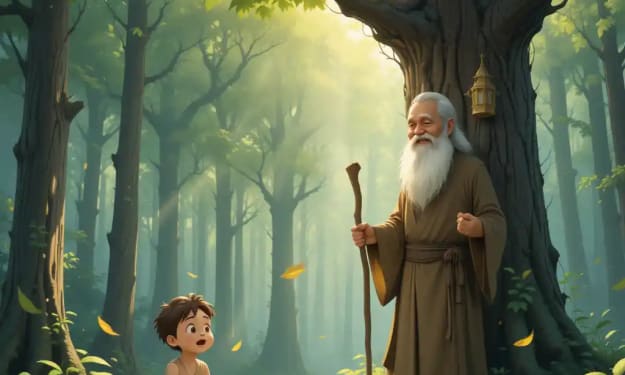
A young boy, burdened by life’s hardships, escapes into a forest seeking solace. There, he encounters a mysterious old man whose simple words unlock a powerful truth, giving the boy courage to embrace life anew. --- 🌲 Story. Ahmed lived in a quiet, dusty village that seemed untouched by time. The mud houses clustered together under the wide blue sky, and narrow lanes wove through fields of golden wheat. From the outside, it looked peaceful. But inside Ahmed’s heart, there was a storm. Every day felt like an uphill battle. His family struggled to make ends meet; their small harvest barely fed them. The burden of seeing his parents silently suffer, the whispered worries of debts, and the coldness of relatives who only visited when convenient — all of it weighed heavily on him. Ahmed was only seventeen, yet life’s heaviness pressed down on his shoulders like he was much older. Each morning he woke up hoping something would change, but every day looked the same. Nights were even worse. He lay awake staring at the cracked ceiling, haunted by thoughts of what future could possibly await him. One afternoon, after another argument at home over money, something inside him snapped. Without thinking, he left the house, his feet carrying him away from the village. He walked down the dusty path, past grazing goats and curious children, until he reached the edge of a thick forest that bordered his village. Many villagers rarely ventured deep into these woods, whispering tales of spirits and strange happenings. But Ahmed felt no fear — only an aching need to escape. As he stepped into the shade of towering trees, a cool breeze embraced him. The sunlight filtered through the canopy, creating shifting patterns on the forest floor. The air was filled with the scent of damp earth and leaves. Birds chirped from hidden branches, and somewhere a stream murmured softly. For the first time in months, Ahmed felt his heartbeat slow, as if the forest itself was whispering calm into his soul. He wandered aimlessly, letting the path disappear behind him. Eventually he came upon a massive old tree, its roots like giant arms wrapping around stones and soil. Exhausted, he sank to the ground, rested his back against the bark, and closed his eyes. There, surrounded by rustling leaves, he let his tears flow. He cried for his parents, for his lost childhood dreams, for the crushing weight of life that seemed too unfair for someone his age. Minutes passed. Or perhaps hours — time felt different here. Suddenly, Ahmed felt a subtle shift, as though someone was nearby. Startled, he wiped his eyes and looked up. Standing a few feet away was an old man with a long white beard, his back slightly bent, leaning on a sturdy wooden staff. His eyes, however, were bright and sharp, glinting with something between mischief and deep wisdom. He wore simple robes tied with a rope at the waist, and his feet were bare on the mossy ground. The old man smiled, a warm, knowing smile that made Ahmed’s guard drop immediately. “Why, my boy?” he asked in a gentle voice that seemed to echo softly through the clearing. “Why do you sit here looking so sad?” Ahmed hesitated. He was not used to sharing his heart. But there was something about this old man, something kind and timeless, that made honesty spill forth. In broken words, Ahmed told him everything — the poverty, the helplessness, the way each day felt darker than the last. He spoke of his fears that his life would never be anything more than silent suffering. The old man listened patiently, nodding slowly, never interrupting. When Ahmed finally fell silent, ashamed of having spoken so much, the old man rested his hand on Ahmed’s shoulder. His touch was light yet reassuring. “My son,” he began, his voice deep yet tender, “every single day in this forest, hundreds of leaves fall. The ground becomes covered in what once was green and full of life. And yet, do you see these trees? They do not die. They stand tall and strong, waiting for spring. Soon, new buds will appear, new leaves will unfurl, and once again the forest will dance in green.” Ahmed blinked, trying to take it in. The old man continued, “Just like these trees, you too must endure. Life will strip you bare sometimes. It will let parts of you fall away, and it will feel like loss. But inside, your roots are growing deeper, your trunk stronger. You must trust that new seasons will come, that fresh chances will grow. From today, see each dawn as a new beginning. Let yesterday’s sorrows fall away like dead leaves.” For a moment, Ahmed felt a warmth spread through his chest, like sunlight breaking through thick clouds. It was such a simple truth, yet so powerful. Tears sprang to his eyes again, but this time they weren’t from despair. They were from relief — from finally seeing a different way to look at his burdens. When Ahmed looked up again to thank the old man, he was gone. Startled, he stood and spun around. There was no sign of him. No footprints, no rustling through the undergrowth. It was as if the old man had melted back into the forest. Ahmed let out a shaky laugh. Maybe it was a forest spirit, or maybe his tired mind had conjured up the old man. Either way, the message was real. His heart felt astonishingly light. With a deep breath, he began walking back toward his village. The path no longer seemed as lonely, and even the burdens he carried felt somehow easier. As he emerged from the trees and saw his village’s small houses glowing under the setting sun, he smiled. Life might still be hard. There would still be days of struggle. But like the tree waiting for spring, Ahmed now carried hope — and that made all the difference.
By Aman Ullahabout a year ago in Fiction
Silent Island — Prisoner of Truth
The year is 1954. A violent storm brews over the Atlantic as U.S. Marshal Edward “Teddy” Daniels and his new partner Chuck Aule arrive at a remote island. Their destination? Ashecliffe Hospital, an ominous facility housing the criminally insane.
By Ameer Gullabout a year ago in Fiction
When Lily Met Elora. Content Warning.
A glimmer of light streams through my curtains as my alarm starts ringing. I grab my phone and quickly turn it off, exhaustion riddling my bones. That mirror kept me up all night. The knowledge that it shows the truth... the truth of who you were. I’m not ready to know, but it calls to me. That’s why I put a cloth over it years ago. The last time I gazed into it was when I was still carefree. Now I see no reason to remember a time of joy. I lazily pull myself out of bed and toward the bathroom—another mirror, but this one is covered in paint hastily put on. I haven’t had a usable mirror in years, but that doesn’t bother me as much as knowing the person who would be staring back at me is a failure. That’s all that reflected back for years. I shake my head, removing the thoughts from my mind.
By Elora ThornWoodabout a year ago in Fiction
She's Bananas
CLICK TO BEGIN RESTART Bob hovered his finger over the restart button. Once he hit that button he knew there would be no turning back. He would officially be… offline… all night long. He knew that the restart would take 8 hours and he was going to sleep through most of that anyway. His friends teased him about having a phone addiction, but he knew he could always put it away.
By Amos Gladeabout a year ago in Fiction
A Beautiful Mind. Content Warning.
A Beautfiul Mind I rose with the morning sun. Lately I have been unable to stay asleep, tossing and turning throughout the night, no position seems comfortable, eventually forcing myself to get up knowing I will never get the adequate sleep I long for. Today, will be another caffeine filled day to help push me through it. I throw on my robe, pull my bedridden hair into a messy bun and walk towards the kitchen. The natural sunlight peering through the window above the sink is more than enough light to allow my brain and body to adjust. The smell of dark Italian toast blend lingers through the air as I pour myself a nice cup of coffee. The newspaper on the table is from over a month ago. I pull it towards me, reading the funnies as if I hadn’t done that over a hundred times already. They never get old to me. Finishing my coffee, I place it in the sink and head over to our bedroom, the room is quiet, not wanting to wake my husband, I tiptoe to the bathroom and turn the shower on. The hot water feels good, refreshing as my brain activates and becomes alive once again. Standing there I allow the water to wash over my head, drowning out all the sounds around me. I close my eyes and let my body succumb to the sensational feeling of contempt and safety. Like a warm hug wrapping itself around me. After several minutes, I finish washing up and turn the shower off. I get dressed quietly in my closet and make my way down the hall to our daughter’s room. I pull open her drapes ever so slightly. I don’t want to startle her. Walking over to the edge of the bed I sit and rub her back, “good morning sunshine. Time to wake for the day,” I say to her. Her little eye lids peering slightly open, she lets out a big yawn and a stretch, “mommy, I just want to lay here all day. How come we can’t do that?” She asks. Tickling her little chin, “because sweetheart you have school today, and sometimes even though we want to stay in bed all day. We still need to do them, even disappointing things like go to school or mommy and daddy having to go to work trust me if I could, I would lay in bed all day too. Especially here cuddling and tickling you until your tummy aches from laughing so hard,” I said as I leaned in and tickled her whole body. Giggling she rolls out of bed, “okay, okay, I will get up,” she says, moving sloth like to her bathroom. “Brush your hair and brush your teeth! For two minutes little miss!” I sternly.
By Aubrie Sandnessabout a year ago in Fiction
When Love Still Lives
The world didn’t end when Michael walked away—but to Julia, it felt like it had. She sat on the bench where they had shared their first kiss, the wood still holding the memory of their laughter, the autumn leaves still falling like soft reminders of what once was. In her hands, she held a crumpled photograph of them at the lake, his arms around her, both of them glowing with the kind of happiness that no filter could ever replicate. She traced his smile with her fingers, remembering the way he used to say her name—Julia—as if it was the only word he ever wanted to learn how to pronounce. But that smile had faded, and so had their days. Three weeks had passed since the breakup. Michael had said it softly, carefully—like breaking a glass and trying to catch the shards midair. "I just don’t think we’re working anymore," he had whispered, not looking her in the eye. But Julia had felt it in her bones before he even said it. Love doesn’t disappear in a day. It unravels. It grows quiet. But her love hadn’t gone quiet. Hers had grown louder in the silence he left behind. Julia wasn’t foolish. She didn’t want to beg, nor did she want to convince someone to love her. Love, real love, can’t be coerced. But she knew something that Michael had forgotten—what they had was worth fighting for. It wasn't just the memories or the comfort of a familiar voice on the other end of the phone. It was the way he made her believe in herself when she was falling apart. The way he looked at her when she wore her hair in a messy bun and an oversized sweater, whispering, “You’re beautiful,” like he meant it more than any poem ever written. It was the life they dreamed of building together—sketches of a future drawn with late-night talks and inside jokes. She knew there had been arguments. Small ones, sometimes bigger. Days when pride had been stronger than patience. But even then, she had loved him—not because he was perfect, but because he was hers. She missed not just him, but the version of herself that bloomed beside him. One rainy evening, Julia sat at her desk, heart pounding, writing a letter. Not a text, not a message through mutual friends—a real letter. Her hands trembled, but her words came steady, like rain on a rooftop. Dear Michael, I’ve tried to let go. Really, I have. I walked past the bookstore where we used to spend lazy Sundays. I pretended not to notice your favorite mug still in my cabinet. I even smiled when people asked how I was doing. But the truth is, there’s an emptiness now—where your voice used to be, where your warmth used to wrap around me like a second skin. I’m not writing this to change your mind. I’m writing because love, real love, deserves to be spoken, even if it trembles. I know we lost our rhythm. I know we forgot to listen sometimes. But I also know we danced through storms, laughed until we cried, and held each other through fears no one else saw. That has to mean something. I love you—not just the version I met, but the man you are becoming. And I still believe in us, even if for now, you can’t. If your heart ever remembers what mine can’t seem to forget, I’ll be here. Yours always, Julia She folded it with care, sealed it, and left it at his doorstep, unsure if he would even read it. But her heart was lighter, like something important had finally been said. Days passed. Then, one night, as she sat curled on the couch with a blanket and a book she couldn’t focus on, her phone lit up. Michael: “Can we talk?” Her breath caught. She stared at the screen as if it might disappear. Julia: “Yes. Anytime.” They met at the lake—the same one in their photograph. He was already there when she arrived, hands in his pockets, the wind teasing his hair like it used to do when she reached out to fix it. He turned around, eyes searching. “Hi.” “Hi,” she replied, her voice almost breaking. “I read your letter,” he said quietly. “Twice. Maybe more.” Julia nodded, afraid that if she spoke too soon, she’d drown in everything she still felt. “I’ve been… confused,” he admitted. “I thought distance would make it easier. I thought maybe we had just run our course.” “But did it?” she asked softly. He looked down, then back up. “No. It made everything worse.” There was silence, thick and trembling. “I missed you,” he said, eyes glassy. “Every damn day. But I didn’t know if I had the right to come back.” “You always had the right,” she whispered. “We both just needed to remember what we were fighting for.” They didn’t kiss that night. They didn’t make promises or declare forever. But they sat together by the water, hand in hand, hearts beginning to remember the rhythm they’d once forgotten. Love is not always fireworks and dramatic reunions. Sometimes, it’s quiet forgiveness. It’s learning to speak gently where once you shouted. It’s understanding that even broken things can be mended if the hands that hold them are careful enough. Julia didn’t need to convince Michael with grand gestures. She had shown him the truth of her heart, and that was enough. A year later... There’s a new photo on her shelf. It’s them again, at the same lake. Older, wiser, still in love. This time, he’s holding her close, their smiles softer but more real. And underneath it, in small cursive writing, it says: “When love still lives, it finds its way home.
By Julia Christaabout a year ago in Fiction