Love
Whispers Beneath the Autumn Tree"
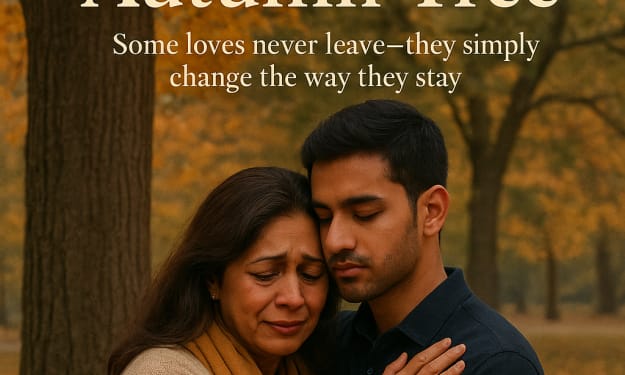
Whispers Beneath the Autumn Tree" Some loves never leave—they simply change the way they stay. Every autumn, the wind carried a memory—soft, familiar, and wrapped in the scent of something once deeply loved. Meera never feared silence; it was in silence that his memory spoke the loudest.
By Mushtaq Ahmadabout a year ago in Fiction
Beneath the Olive Tree
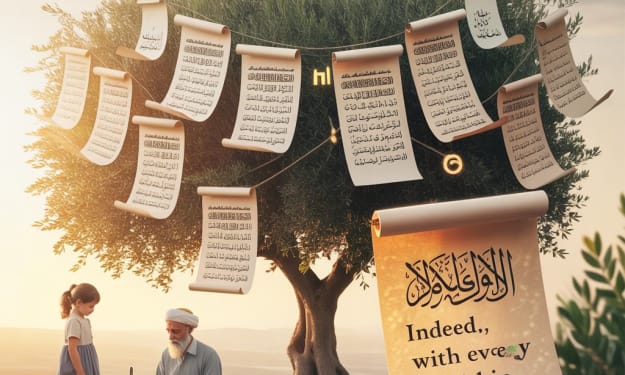
It was the spring of 2009 in the quiet town of Nablus, nestled among the hills of Palestine. The scent of jasmine lingered in the air as olive trees swayed gently under the wind’s hush. Amid this beauty lived Yousuf, a young calligrapher known not for his words, but for the way he painted them. People said he could write Allah's name in a way that made your heart tremble. He lived a quiet life, spending his mornings in his small shop, inscribing verses of the Qur'an onto handmade parchment. He had no interest in wealth or fame, only in devotion—until one day, the wind changed. Her name was Laila. She entered his shop not as a customer but as someone lost, searching for a memory. She held in her hands a torn piece of old parchment—Yousuf’s handwriting. “This... you wrote this for someone named Hanan years ago?” she asked. Yousuf took the piece gently, his fingers trembling. “Yes. That was for a teacher who lost her daughter. She said it gave her peace.” Laila smiled faintly. “Hanan was my aunt.” And that’s how it began. In the days that followed, Laila would visit often—not to buy, but to watch him work, to listen to his quiet wisdom about the art of patience and prayer. She was unlike anyone he had ever met. She asked deep questions. She listened like every word mattered. And she had a heart that spoke louder than her voice ever could. Yousuf knew he was falling in love. But he also knew love wasn’t always about possession—it was about presence. And faith. One day, as they sat under the olive tree behind his shop, Laila said, “You know, I’ve been proposed to.” Yousuf’s heart stilled. He didn’t ask by whom. He didn’t need to. “And what did you say?” he whispered. “I said I’d pray on it.” That night, Yousuf offered tahajjud, tears soaking his prayer mat. He didn’t pray to be chosen. He prayed for her happiness—whether or not it included him. Days passed. Then weeks. She didn’t return. One morning, a letter arrived. > “Yousuf, You taught me that silence can speak louder than words. I’ve accepted the proposal. He is kind, and he will care for my family. But I want you to know—had life been different, you were the kind of man I’d pray for. Please keep writing. The world needs your prayers more than I ever did. —Laila” Yousuf folded the letter and placed it in his Qur'an. He didn’t stop writing. In fact, he wrote more than ever. But his words were different now—deeper, softer, like a duaa whispered in sujood. He never married. Never told anyone. But every month, he would inscribe a verse of mercy and hang it on the olive tree, where they once sat. Years later, a young girl wandered into his shop. “My mother said you write prayers,” she said. “She used to sit here when she was sad. She said this place healed her.” Yousuf looked at the girl—Laila’s eyes stared back at him. He smiled, handed her a parchment, and said, “Then let’s write one together.” --- Some love stories don’t end. They simply continue in silence—in trees, in pages, in prayers. And in hearts that never asked for more than the joy of having loved.
By Mushtaq Ahmadabout a year ago in Fiction
The End We Chose
The sky cracked open like shattered glass. Purple lightning clawed across the horizon, and the earth trembled beneath crumbling cities. Towers that once touched the clouds fell like sandcastles under a child’s hand. It wasn’t sudden—not really. The end had been coming for years. We just chose to look away.
By abidnaseemabout a year ago in Fiction
When Silence Began to Shape Me
There was a time when my life was filled with noise — not only the noise of the world but the noise I created trying to keep up with it. Conversations, laughter, arguments, explanations — it all felt endless. I was surrounded by people, yet I often felt lonely. I was always talking, but rarely heard. I didn’t realize it at first, but my words had become a shield — something to hide behind, something to fill the emptiness I didn’t want to face. I feared silence, mistaking it for sadness, for abandonment, for weakness. But then, slowly, I began to withdraw. Not out of bitterness or anger, but from exhaustion. One day, I simply didn’t have the energy to explain myself anymore. The need to prove, to please, to entertain — it all began to fade. پھر کم کردی گفتگو لوگوں سے میں نے “I started speaking less to people…” And with that, the world grew quiet around me — but inside, something began to stir. At first, the silence was uncomfortable. I didn’t know what to do with it. I would pick up my phone just to scroll, open a chat just to feel less alone, turn on the TV just to hear voices. But eventually, I let the silence sit beside me. I allowed it in like a guest, and to my surprise, it wasn’t as empty as I thought. In the quiet, I started noticing things I had never truly seen. The sky changing its shades at dusk. The way my own breath felt in my chest. The sound of birds just before dawn. These were not grand discoveries — but they were real. And they belonged to a world I had ignored. Silence became my mirror. Without constant words, I could finally hear the voice within me — the one I had long silenced with busyness. That voice didn’t shout. It whispered truths I had long buried. I remembered old dreams, long-lost feelings, regrets I never addressed, and strengths I never acknowledged. And that’s when something beautiful began to happen. پھر خاموشی سے میری خوب بننے لگی “And then, slowly, silence began to shape my beauty…” Not beauty in the way the world defines it — not through appearances, filters, or attention. This was a different beauty. A quiet confidence. A steady grace. A strength in knowing who I am without needing others to validate it. I no longer craved constant company. I found joy in solitude — not loneliness, but solitude. I would sit by the window with a cup of tea and feel full. I started journaling, pouring my thoughts onto paper, not for anyone to read but to understand myself better. I started walking — just walking — no phone, no distractions, just me and the rhythm of my steps. I began to forgive myself. I stopped expecting perfection. I stopped measuring my worth by how many people I could impress or how many replies I received. My inner world started blooming in ways my outer world never could. People noticed the change. Some drifted away, confused by my calm. Others came closer, drawn to the peace I now carried. And I didn’t mind. I was no longer trying to keep everyone close. I was no longer afraid of being misunderstood. My silence had taught me that not everyone needs access to my soul — some things are sacred, and silence guards them well. Through silence, I began healing. I began writing poems again — ones I thought I had forgotten how to write. I picked up books that once gathered dust. I prayed not with words but with presence. I understood the value of a slow, quiet life in a world chasing noise and speed. There was still pain, still memories that visited me in the night. But now, I welcomed them like passing clouds. They didn’t scare me anymore. I had learned to sit with them in silence, and eventually, they left — softer each time. I didn’t isolate myself. I simply chose peace over pressure. I still smiled, still met people, still loved. But everything was quieter now, calmer. More real. If someone asked me what changed, I wouldn’t say much. How do you explain that silence rebuilt you in ways words never could? The beauty I found in myself was never loud. It didn’t demand to be seen. It just existed — in the way I walked, the way I breathed, the way I no longer rushed to speak. And I wouldn’t trade this stillness for anything. Now, I sit beneath the sky and listen to the wind. I speak only when my heart feels the need to speak. And when I’m silent, I am not lost — I am deeply found. Because in the end, I didn’t lose people when I stopped talking too much. I found myself.
By Fazal Wahidabout a year ago in Fiction
The Last Letter from Elderidge Lane
Elderidge Lane was the kind of road you’d miss if you blinked while driving past. Tucked between thick woods and forgotten by modern maps, it led to a crumbling village swallowed by time and silence. But for Nora Whitman, it wasn’t just a road—it was a lifeline to a mystery that had haunted her family for decades. Her grandmother, Elsie Whitman, had vanished from Elderidge in 1952, never to be seen again. The police blamed the wilderness. The town gossips spoke of elopement or madness. But Nora’s mother had always insisted something darker had taken her. Now, seventy-three years later, Nora held the key—quite literally. It arrived in a plain manila envelope postmarked from England with no return address. Inside was an old brass skeleton key wrapped in a letter written in delicate cursive: > If you are reading this, I am gone. But Elderidge is not done with us. Come to the house on Elderidge Lane. Bring no one. Find the truth that was buried. The door will open for blood. No signature. But Nora recognized the handwriting. She’d seen it in her grandmother’s old recipe books. Against every logical instinct, she drove to Elderidge. She didn't tell her husband, didn’t notify anyone. It felt like a summons. The air grew heavier the closer she got, as if time resisted her arrival. The house was still there—just as the letter described—a two-story wooden structure clinging to its foundations, shutters hanging like broken limbs, the porch cracked and moss-covered. But the lock on the front door looked strangely polished. With trembling fingers, she inserted the key. It turned smoothly. Inside, the house was... untouched. Dusty, yes, but not decayed. A faint scent of lavender hung in the air. An old grandfather clock ticked steadily in the corner, its hands frozen at 3:17. The fireplace crackled faintly, though no fire burned. On the table, another envelope. > You're early, Nora. Or maybe I’m late. Time doesn’t work right here. She dropped the letter. Her heart thudded. “This isn’t real,” she whispered. But her voice echoed unnaturally. The house groaned. A shadow moved across the hallway though no one was there. She wandered the house, each room whispering of the past—photographs of people who resembled her, furniture frozen in mid-use, teacups with dried leaves. In the attic, she found a girl’s bedroom—pink curtains, a music box, and a name carved into the wall: Elsie. That’s when the whispering started. Faint at first, like wind through trees. But it grew louder. > “Nora… Nora… open the mirror…” There was an ornate mirror on the wall. She stepped closer—and gasped. It didn't reflect her. It reflected her grandmother. Young. Alive. Terrified. The reflection mouthed words: "Behind. The. Books." Nora yanked the mirror from the wall. Behind it was a loose plank. Inside, a hollow cavity with a faded journal and a third letter. > I never left. They wouldn’t let me. The house, the woods—they feed on memories, on people. I tried to escape. I failed. But maybe you can finish what I couldn’t. Bury the locket. Burn the mirror. Break the cycle. The journal was filled with drawings of strange symbols, pages detailing rituals, cries for help, and a recurring name: The Timekeeper. Nora ran outside into the overgrown garden. The locket was easy to find—buried beneath a sundial that pointed not to north, but to 3:17. She dug with her hands until she pulled it out—cold, silver, pulsing like a heartbeat. When she returned inside, the house had changed. The clock now ticked. Slowly. The walls bled shadow. The air was thick with whispers and cries. Holding the mirror in one hand and the locket in the other, Nora set both in the fireplace. She hesitated—but then struck the match. The locket shrieked. Not mechanically—it screamed. The mirror cracked. Then shattered. The clock chimed once. Twice. At the third chime—everything stopped. Silence. Total. And then—light. The air cleared. The walls brightened. The whispers fell silent. The house—aged. Quickly. Decayed before her eyes, collapsing into the abandoned ruin it should have been all along. Nora crawled outside, coughing. Behind her, the house crumbled into ash and smoke. A figure stood among the wreckage. A young woman. Elsie. Not a ghost—but real. Tangible. Tears streamed down both of their faces. “You broke the loop,” Elsie whispered. “You freed us.” And then she was gone. Vanished into the morning light. --- The authorities found Nora by the road, confused and shaking, clutching an old brass key and a burned locket. The house, they said, hadn’t stood in that spot for over fifty years. She told them her story. No one believed her. But sometimes, late at night, when the wind is just right, she hears the chimes of a grandfather clock striking 3:17. And she smiles. Because Elderidge Lane is no longer haunted. And her grandmother is finally at peace.
By Kausar Hayat about a year ago in Fiction
We Never Said 'I Love You'
We Never Said ‘I Love You’ By Mahboob Khan We met in October, the kind of cold that makes your fingers hurt and your thoughts feel heavier. She was standing under a bus stop with a broken umbrella, fighting the wind like it was personal. I had a better one — barely — and I offered to share it. She rolled her eyes but stepped under anyway.
By Mahboob Khanabout a year ago in Fiction
The Morning After the Last Goodbye
The Morning After the Last Goodbye By Mahboob Khan I woke up to a silence that felt more final than any shout could ever be. The apartment was dark, save for the weak pre-dawn glow slicing through the curtains. I lay in bed, still tangled in the sheets we once shared, wondering if I had done something wrong or if it was just time. Last night’s conversation replayed in my head like a broken record—a conversation where words had been left unsaid, scattered in the space between our hearts.
By Mahboob Khanabout a year ago in Fiction