Love
Raining
It started with a single drop. Just one gentle tap on the windowpane, followed by another. I was seated by the old wooden table in my grandmother’s house, the very place where time seemed to move slower, or perhaps stopped altogether. The air was thick with the scent of earth and nostalgia. Outside, the sky was an ashen grey, rumbling softly with distant thunder. Inside, a silence lingered—one that had been waiting patiently to be broken by the arrival of rain.
By Motivate4universeabout a year ago in Fiction
When the Moon Forgot to Shine
The house was silent when I woke up. Not the comfortable kind of silence—the kind you’d expect when the world is asleep and dreaming—but a hollow one. The kind that echoes in your bones and makes the air feel heavier than it should.
By Kamran khanabout a year ago in Fiction
The Last Dance Again
The wooden floor creaked beneath Oliver’s feet as he stepped into the long-abandoned community hall. Dust hung in the air like a memory refusing to settle, and faded streamers still clung desperately to the ceiling beams, remnants of happier days. It had been twenty-five years since he last danced here, but tonight, he came back — alone, but not empty.
By NIAZ Muhammadabout a year ago in Fiction
Starting All Over Again
The screeching as I opened my eyes to look at my husband fast asleep. After a short wake-up to feed our baby, who was inevitably hungry after all. The tears started to run down his tiny face as I could not get the bottle fast enough. After all this time and control, I still was pregnant. My older child was an experience as a single mother without help. I had been through raising him, then he was old enough to take care of himself. Now, here I am with the new one. All the little things I had forgotten. It was almost like the first time when I was just a scared young woman. All the memories flooded my brain as the bottle was finally warmed up to the point of even testing. The little face was so innocent and helpless as I rocked her in my arms. No happiness without a bottle, even with a mother's loving touch. The tears were relieved as the nourishment entered her little mouth. Her eyes settled on me as the mother, trying her best, but she never felt good enough. Her small body never questioned if I could not take care of her needs. She investigates the distance as her tummy is filled with the warm, lackluster liquid. I was told I could never have another one after my son, but here she is, a precious new life waiting for her chance to shine.
By Sarah Danaherabout a year ago in Fiction
Midnight Books & Forgotten Kisses
“Moonlight Books – Open Only from Midnight to 4 AM. No one knew who owned the place. Some said the store had no register. No cameras. Just a single keyhole and a creaky floor that remembered every step. But the shelves? They whispered. Not in words, but in warmth. The kind of warmth that touches you when a book falls open to the exact page your soul needed.
By Shakespeare Jrabout a year ago in Fiction
Deal's a Deal. Honorable Mention in The Second First Time Challenge.
The wheels of her Mazda kissed the curve of the road like an old friend, the shoreline's rolling waves in the distance. Wow, has it been some time since she's been back here. Sandra glances into the rearview to see Jonah staring through the glass, slightly despondent. This wasn't the plan for him. This wasn't the plan for her. This wasn't supposed to be the trip they were taking in general. And yet they somehow were back in Herald's Cove, like she had never left it.
By Diana Frankhauserabout a year ago in Fiction
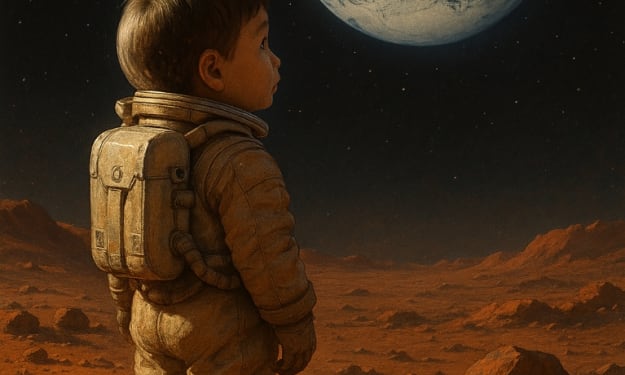
A Child’s Dream of Mars. AI-Generated.
1. The Boy Who Watched the Sky In a small, crowded city, nestled between concrete towers and tangled wires, lived a boy named Aasim. At just twelve years old, he had one peculiar habit—every evening after school, he would climb the stairs to the roof and just stare at the sky. While other kids played video games or chased after cricket balls, Aasim watched the stars appear one by one. He didn’t just see light. He saw possibilities. Routes. A calling. He didn’t come from wealth. His parents worked hard to provide food, schooling, and shoes that barely lasted a year. But Aasim had something rare: clarity of purpose. He didn’t want to be rich. He wanted to walk on Mars. 2. The Quiet Genius in the Classroom At school, Aasim was an average kid in most subjects. But in science—especially physics and astronomy—he came alive. He built paper models of rockets. He memorized every planetary orbit. He taught himself to calculate gravity on other planets, just for fun. When the school held a science fair, most students brought simple models. Aasim presented something different: “Mars Habitat for Child Survivors” — a protective space capsule designed to shelter children on Mars. The judges, visiting scientists from a global research alliance, were stunned. 3. A Future That Was Already Here The year was 2038. Humanity had already placed colonies on the Moon. Mars was the next frontier. Space travel had become faster. AI-managed spacecraft could now reach Mars in three months instead of seven. The world had changed, and space was no longer science fiction—it was a career. Aasim applied for a global space cadet program—a competitive internship designed for youth researchers to assist in Mars exploration. He didn’t expect much. He was just a kid from a crowded neighborhood. But a few months later, he received a message that changed his life. > “You’ve been selected for the Youth Mission to Mars.” 4. Leaving Home, Entering the Unknown At fourteen, Aasim left everything he knew. He boarded a sky elevator that took him into orbit. From there, he boarded a transfer shuttle bound for Mars. The three-month journey was both beautiful and brutal. Microgravity was fun—for a while. Loneliness was harder. Food was bland. Silence was constant. But Aasim carried a secret. A prayer from his mother. A handwritten note from his little sister. And a dream bigger than fear. He wasn’t just a boy. He was a seed, sent to grow on another planet. 5. First Steps on Red Dust When the lander touched the Martian surface, Aasim was among the first to step out. He didn’t jump in excitement. He simply fell to his knees and placed his forehead on the red soil. He whispered, > “Let my steps here benefit the world. Not just me.” He began working with senior scientists on a critical problem: Creating sustainable life systems—oxygen, food, and water on Mars. 6. The Discovery That Changed Everything While analyzing Martian soil, Aasim discovered microbial activity in a deep cave zone. The microbes produced trace amounts of oxygen—naturally. No one had seen this before. It was the missing piece for long-term survival on Mars. Suddenly, Aasim wasn’t just a cadet. He was a symbol. Not of genius. But of possibility. The media called him “The Quiet Star Walker.” 7. Homecoming and Humility After 18 months, Aasim returned to Earth. He had grown taller, quieter, stronger. Reporters wanted drama. He gave them depth. > “I didn’t go to Mars for fame,” he said. “I went so that kids with dreams, not resources, could believe again.” He didn’t care for interviews. He cared for education. He started a foundation to support space science in underprivileged schools. He wrote books for children, in simple language, explaining black holes, planets, and hope. Final Thoughts Aasim’s journey wasn’t just from childhood to space. It was from imagination to action. He didn’t carry flags. He carried prayers. And he proved one truth: > You don’t need to be born into greatness. You can rise to it. We may never all reach Mars. But through Aasim’s story, we’re reminded: Sometimes, all it takes is a rooftop, a restless mind, and a refusal to stop dreaming.
By Kaleem Ullahabout a year ago in Fiction
Rainy Night in Georgia
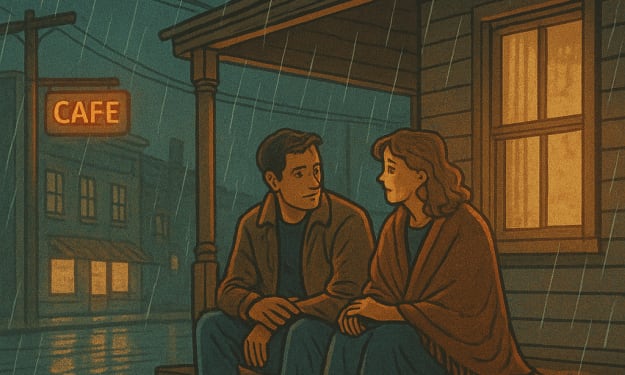
Title: Rainy Night in Georgia Subtitle: Sometimes, theThe rain came in slow, heavy sheets, the kind that didn’t ask for permission. It just was—thick and relentless, soaking the red Georgia clay until it bled into the streets. The kind of night where the air was warm and heavy and every drop sounded like a memory hitting the pavement. Clara hadn’t planned on being back in Savannah. She’d told herself she wouldn’t return—not after the way things ended. Not after Marcus. But grief has a way of pulling people home. Her mama passed two weeks ago, and the house had to be sorted, sold, and sealed up like it never held anyone’s whole world. She sat now on the old wooden porch, wrapped in her mama’s crocheted shawl, rocking in a chair that remembered her childhood better than she did. The sky was bruised purple, thunder humming like a lullaby meant to comfort ghosts. And it smelled like everything she’d forgotten—wet grass, magnolia, and the low hum of regret. Her phone buzzed, but she didn’t check it. She knew who it was. Marcus. He had texted three times since he found out she was in town. The first was cautious: “Didn’t think you’d come back.” The second, more vulnerable: “I’m sorry about your mama. She always liked me.” The third, the one she hadn’t responded to yet, simply said: “Can we talk?” Clara sighed and pulled her knees to her chest, watching as the rain carved trails down the steps like little rivers that knew how to run away better than she ever did. Their story had never been loud. It wasn’t fireworks and screaming matches. It was quiet disappointment. Missed calls. Words left unsaid. The kind of love that didn’t break—it faded, like paint on the side of a sunlit barn. And when she left for Atlanta, it wasn’t because she didn’t love him. It was because she didn’t love herself enough to stay. A pair of headlights cut through the wall of rain. Her breath caught. It was an old pickup, familiar and battered and loyal in a way no man ever managed to be. He parked but didn’t get out immediately. Just sat there, engine idling, maybe thinking through all the things he’d rehearsed in his head. Maybe wondering if she’d slam the door in his face. Maybe wondering if he deserved it. He stepped out finally, hood pulled up, hands in his pockets. He didn’t run from the rain. Of course he didn’t. Marcus was the kind of man who let the storm touch him, as if it earned him some sort of forgiveness. “Clara,” he said, voice softer than she remembered, but still stitched with gravel. She didn’t answer. Not right away. Instead, she asked, “Why now?” He looked down at the soaked floorboards. “I don’t know. Maybe because the rain reminds me of that night.” She didn’t need him to say which night. She knew. The one under this same porch roof, seven years ago. The night he told her he couldn’t go with her to Atlanta. That he didn’t know who he was without Georgia. Without these roads. Without this house. She left anyway. “I thought you hated the rain,” she said quietly. “I did,” he replied. “Until it was the only way I could still feel close to you.” Silence stretched between them, as fragile and sharp as a broken string on her mama’s old guitar. “I don’t know why I came back,” she said finally. “Maybe I thought the house would feel smaller without her in it. But it doesn’t. It feels like she’s in every wall.” “She loved you,” he said. “Even when you stopped writing. She kept your postcards.” “I didn’t know that.” “She read them out loud. Pretended you were still around.” A lump formed in her throat, heavy and aching. Marcus stepped closer, still keeping a respectful distance. “I never stopped waiting,” he said. “Even when you didn’t call. Even when I saw pictures of you with someone else on your birthday.” “That ended,” she whispered. “I figured,” he said. “You always smiled bigger in your letters from home.” Another pause. Then, gently: “You gonna let me sit with you?” She hesitated, then nodded toward the chair beside her. It creaked under his weight like it was waking up after a long nap. For a while, they just sat. Let the rain talk for them. Let the thunder remind them of old lullabies and open windows and the promise that even storms don’t last forever. “I’m not asking to start over,” Marcus said, voice low. “I’m just asking if we can start from here.” Clara looked over, eyes meeting his. The years hadn’t changed him much. A few more lines around the eyes. A scar on his hand she didn’t recognize. But the way he looked at her? That hadn’t changed at all. “I don’t know what ‘here’ is,” she admitted. “Maybe that’s the point,” he replied. “Maybe it’s not about knowing. Just… choosing.” She thought about it. Thought about the quiet mornings, the lost years, the rain that kept falling like it knew how to soften even the hardest ground. And then she reached over, her hand slipping into his. Not tightly. Not urgently. Just enough. Enough to mean maybe. Enough to mean this was a start. And on that rainy night in Georgia, they didn’t find the past. They found the possibility of a new chapter. Not rewritten. But reimagined.
By Muhammad Saleemabout a year ago in Fiction
I Answered a Stranger’s Phone and It Changed My Life
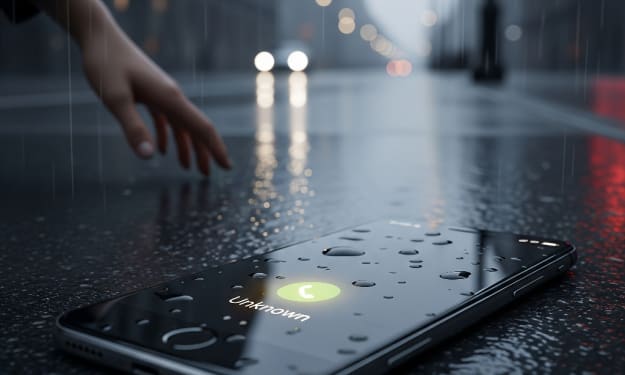
The phone rang on the wet sidewalk like it was meant for me. I wasn’t supposed to be walking that way. My usual route home was faster, drier, more predictable. But the cafe liked had closed early, and I’d decided to wander the long way through the park. That’s when I saw it — a sleek black phone, facedown, blinking with a single incoming call: “Unknown.” No one was around. Just me, the rain, and the silence between rings. I hesitated. The screen kept flashing. I answered. “Hello?” There was a pause. Then a voice I didn’t recognize, steady and calm: “Took you long enough.” My breath caught. “Who is this?” The voice didn’t answer that. Instead, it said something stranger. “I need you to listen very carefully. You have thirty minutes to get to the corner of Ash and Wren. Bring the phone. Don’t speak to anyone else.” “Wait—what?” But the line had gone dead. --- I should’ve left it right there. Put it on a bench. Taken it to lost and found. Let the rain finish it off. But I didn’t. There was something about the voice. Not threatening. Not desperate. Just... certain. Ash and Wren was ten blocks away. My shoes were soaked by the time I arrived, heart thudding louder than the thunder above. The intersection was empty. Except for a girl. Maybe seventeen. Standing perfectly still beneath a flickering streetlight, holding a red umbrella that didn’t match her black clothes. She looked up as I approached. Then — to my shock — smiled. “You brought it,” she said. Not surprised. Not relieved. Just... like she knew. “Is this yours?” “No. But it was meant for you.” “I—what is this? Some kind of prank?” “No prank,” she said gently, stepping closer. “Just a message.” She pulled out an envelope from her coat pocket and handed it to me. My name was written on it. In ink. In my handwriting. “I don’t understand.” “You will,” she said. “Just... open it when you get home. You won’t see me again after tonight.” And she walked away. --- I opened the envelope under my kitchen light, socks soggy and fingers trembling. Inside was a letter. It began: You don’t know me yet. But I know you. I’ve watched you forget the sound of your own voice when you stopped sharing your writing. I’ve seen the nights you stayed awake wondering if you matter. I know the pain you pretend you’ve outgrown. The guilt you carry from things that were never your fault. I read the whole thing, line after line, and by the end I was crying. Not because it was cruel — but because it was true. Every word. Every detail. And then, the last paragraph: Tomorrow morning, check your inbox. There’ll be a reply to the submission you sent two years ago and gave up on. Yes, that one. The one you never told anyone about. Don’t question it. Just know — it finally reached the right hands. You’re not forgotten. Not lost. Not invisible. This was just your reminder. No signature. No name. --- The next morning, I checked my email like someone emerging from a dream. And there it was. A reply from the literary journal I had submitted to years ago — long before I'd convinced myself I wasn’t good enough, long before I buried my creativity in day jobs and self-doubt. The message was simple: We loved your story. If it’s still available, we’d like to publish it. --- I still don’t know who left that phone. Who made the call. Who the girl was. Or how anyone could’ve known so much about me. But I do know this: Some stories don’t need logic. They just need to be believed. And I believe that sometimes — when you’re on the edge of giving up — the universe calls. You just have to be willing to answer.
By Firdos Jamalabout a year ago in Fiction