Love
The First Time I Said I Love You❤️❤️❤️
The First Time I Said I Love You It happened on a day that looked like every other. The sky was a gentle gray, the kind that made the air feel heavy but comforting. We had no plans—just two friends walking side by side, pretending that the closeness didn’t mean more than it did. Or maybe only I was pretending.
By Musawir Shahabout a year ago in Fiction
💔 Echoes Beneath the Ice💔
🌌 The Night the Ocean Held Its Breath The stars hung too still that night, as if the sky itself was waiting to drown. Eliza Thornton stood at the railing of the Titanic, breath misting in the cold, her gloves clutching the iron like they could hold her together. Below, the Atlantic looked like black glass—unbroken, unreadable. Behind her, faint music drifted, but none of it reached her heart. Her heart was with him.
By Leah Brookeabout a year ago in Fiction
The Autumn We Stopped Pretending
The scent of honeysuckle soap and old fear still clung to the satin as I lifted the gown from its cedar tomb. Sixty-one years had turned the ivory fabric the color of weak tea, the sleeves thin as dried petals. Outside my window, Maple Street burned with October’s fire. Inside, my arthritic hands trembled against the hanger. *Today*, the dress seemed to whisper. *Today they’ll see*. At ten o’clock on a Tuesday morning, I walked into St. Agnes Parish Hall wearing my wedding dress from 1956. --- Bingo balls rattled in their cage. "B-4," droned the caller. "G-52. N-37." Around me, the familiar Tuesday faces: Millie in her cat-hair sweater, Frank polishing his bifocals, Doris clutching her troll doll talisman. The room smelled of coffee and mothballs. My worn heels clicked on the linoleum. Doris’s dauber slipped from her fingers, bleeding blue across her card. Millie’s knitting needles stilled. Frank’s jaw went slack. "Evelyn?" Millie’s voice frayed at the edges. "Is that… your wedding…?" I adjusted the brittle tulle veil clinging to my silver hair. "Morning, Millie. Have they called O-72 yet?" Eighteen pairs of eyes tracked me as I shuffled to my seat, the moth-eaten train snagging on a floor tile. I felt their stares like physical touch—pity, embarrassment, the sour tang of judgment. Frank cleared his throat. "Evelyn, you… you know it’s Tuesday, right? Bingo day?" I smiled at the man I’d known for forty years. "I remember everything, Frank." --- **October 17, 1956** The last autumn I believed in happy endings. I’d baked a spice cake that morning, the kitchen warm with cinnamon and deception. Hank leaned in the doorway, his eyes still clear. The drunken haze wouldn’t come until evening. "Pretty dress, Evvie." My wedding gown hung in our bedroom—ivory satin, seed pearls, hope stitched into every seam. I’d sewn it myself during those early days when his hands were gentle and his words didn’t cut. "Is it for the VFW dance?" I asked, stirring batter too fast. "Nah." His fingers dug into my hip. "For right now." I wore it that evening while he ate cake. While he praised the frosting. While he hurled the plate against the wall because the fork scraped the china. *"Clean it up,"* he hissed, bourbon thick on his breath. *"And wipe your face. You look pathetic."* Pearls skittered across the floor like frightened insects. --- **October 18, 1956** 3:17 AM. I left in the torn dress. No suitcase. Just the gown, my mother’s cameo, and thirty-seven dollars hidden in a flour sack. The bus depot reeked of urine and possibility. "Where to, ma’am?" The ticket agent eyed my dirt-streaked train. "Anywhere but here." Three days on a Greyhound with women who didn’t ask questions. A waitress job in Salem. A room above a bakery where I hid the dress inside a ceiling tile. For sixty-one years, I was just Evelyn from the flower shop. The childless widow. The woman who brought lemon squares to funerals. No one knew about the collarbone that never set quite right. No one saw the ghost of Hank’s ring finger bruise still blooming beneath my foundation every morning. --- Back in the bingo hall, Doris found her voice first. "Well! Don’t you look… festive." I pressed my dauber onto G-60. "Thank you, Doris." A young mother in the corner—new to town, her baby asleep in a carrier—met my gaze. Not staring. Not smirking. Just *seeing*. Millie leaned close, her whisper carrying. "Evelyn, sweetheart, is it your anniversary? Did Arthur love you in that dress?" The room held its breath. I turned slowly, satin whispering. "Arthur was my second husband. Died kind. This dress?" My finger brushed a loose pearl. "This was before Arthur. This was Hank Miller." The silence thickened. "He hit me," I said clearly. "For three years. I left wearing this on October 18, 1956. Today, I’m celebrating my escape." --- Frank’s face turned ashen. Doris’s troll doll clattered to the floor. Millie pressed a knuckle to her mouth—not in shock, but in painful recognition. "Hank Miller?" Frank rasped. "But he… he ran the food drive. Coached my grandson’s baseball team." "He broke my wrist when I served his coffee too hot," I said, daubing N-42. The young mother stood. Walked to my table. Set her untouched ginger ale beside my cards. "Pearls suit you," she said softly. Then Millie broke. Great, shuddering sobs heaved through her small frame. "My sister," she choked. "They said she fell down the stairs in 1964. But her husband Roy… he had Hank’s eyes when he drank—" Doris reached across the aisle. Twined her fingers through Millie’s. No one called numbers for seven minutes. --- Last Tuesday, Dr. Evans said the word *pancreatic* and *six months* in the same gentle sentence. As I walked home, the maple in my yard blazed crimson against the grey sky. *No more silence*, the leaves whispered. *No more pretending*. Survivors die with their truths still locked inside them every day. I refused to be one. --- When the game resumed, something fundamental had shifted. Frank brought me coffee—cream, no sugar, just how I liked it. Doris slid her winning card toward me with a shaky smile. The young mother pressed a note into my palm: *"My name is Maya. Left Malik last spring. Thank you for today."* As I gathered my things to leave, Millie gripped my walker. Tears still streaked her cheeks, but her chin was high. "Evelyn?" Her voice didn’t waver. "Next Tuesday… would you help me find my sister’s favorite dress?" --- We misunderstand strength. We confuse it with silence—with bearing wounds in darkness, with folding pain into smaller and smaller origami until it disappears. True strength isn’t quiet. It’s the courage to say: *This happened.* *It hurt.* *I lived anyway.* In that bingo hall smelling of ink and redemption, eighteen ordinary people chose truth over pretense. Millie’s grief. Frank’s shame. Maya’s solidarity. Doris’s clasped hand. The world tells broken women to hide their cracks. To preserve the peace. To swallow their stories with their morning pills. But peace built on lies is violence wearing a pretty mask. So I tell you this: Wear the dress that holds your history. Name the ghost that haunts your bones. Let your pearls scatter where the light can find them. Let autumn strip the trees down to their honest skeletons. Let it do the same for your soul. The pretending ends when we decide to speak.
By Wondermindabout a year ago in Fiction
The Last Voice on Earth
The Last Voice on Earth It had been 47 days since the world went silent. No news broadcasts. No car horns. No footsteps on pavement. The birds had stopped singing. The wind blew without whispering. It was as if someone had placed the world under a glass dome, muting every echo of life. And yet, amidst the global silence, Amara still had her voice.
By Musawir Shahabout a year ago in Fiction
The Last Firefly Summer
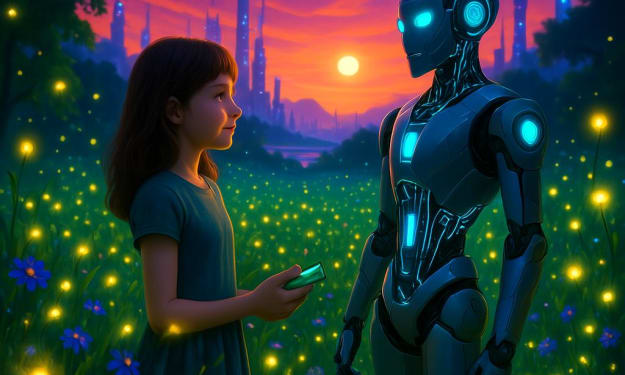
The summer of 2075 was supposed to be my last in Willow Hollow. The town was dying, just like the rest of the world. The air was thick with dust, the rivers were dry, and the trees were more brown than green. They said the planet was giving up, that we’d burned it out with our machines and greed. I was sixteen, and all I knew was that I didn’t want to leave. Not yet. My name’s Lila. I lived in a crumbling house with my dad, who spent his days fixing broken tech for the few families still hanging on. The city folks had already left for the domes—giant glass bubbles where the air was clean and the food was fake. But Willow Hollow had something the domes didn’t: fireflies. Every summer, they’d light up the meadow behind our house, tiny stars dancing in the dark. Dad said they were a miracle, a sign the world wasn’t done fighting. I believed him. That summer, everything changed. It started with Rusty, the robot Dad built from spare parts. Rusty wasn’t like the shiny bots in the city. He was clunky, with mismatched arms and a screen for a face that flickered when he talked. Dad made him to help with chores, but I thought of him as my friend. He’d follow me to the meadow, his joints creaking, and ask questions like, “Why do humans like glowing bugs?” I’d laugh and say, “Because they’re hope, Rusty.” One night, the fireflies didn’t come. The meadow was dark, silent except for the hum of Rusty’s circuits. I sat on the grass, my stomach twisting. “They’re gone,” I whispered. Rusty tilted his head, his screen glowing faintly. “Data suggests environmental collapse. Fireflies require clean water, stable temperatures.” His voice was flat, but it felt like a punch. I didn’t want data. I wanted my fireflies. The next day, I heard the news. Willow Hollow was being evacuated. The last transport to the domes was coming in a week. Dad started packing, his hands shaking as he boxed up tools. “It’s safer there, Lila,” he said. But the domes felt like giving up. I wanted to fight, like the fireflies did. I snuck out to the meadow every night, hoping for a glow. Rusty came with me, scanning the grass with his sensors. “No biological activity,” he’d say, and I’d glare at him. “Stop being so smart,” I’d snap. But one night, he didn’t scan. He just sat beside me, his metal hand brushing the dirt. “Lila, why do you stay?” he asked. I didn’t have an answer, not really. “Because this is home,” I said finally. “Because I believe they’ll come back.” On the last night before the transport, I was desperate. I ran to the meadow, my sneakers kicking up dust. Rusty followed, his screen flickering. “Lila, probability of firefly return is 0.03%,” he said. I ignored him and dropped to my knees, digging through the dirt like I could find hope buried there. That’s when Rusty did something weird. He knelt beside me and pressed his hand to the ground. A soft hum came from his chest, and his circuits glowed brighter, pulsing like a heartbeat. Then I saw it—a tiny green spark in the grass. A firefly. Then another, and another, until the meadow was alive with light. Emerald, sapphire, amber—they danced around us, brighter than I’d ever seen. I laughed, tears stinging my eyes. “You did this?” I asked Rusty. His screen flickered, almost like a smile. “I accessed dormant nanobots in the soil. Programmed them to mimic firefly bioluminescence. For you.” I stared at him, this clunky robot who’d given me a miracle. “Why?” I whispered. He tilted his head. “Because you believe in hope. I calculated it is worth preserving.” For the first time, I hugged him, his metal cold against my cheek. The next morning, we boarded the transport. I carried a jar with a single firefly—not a real one, but one of Rusty’s nanobots, glowing softly. Dad didn’t ask questions. He just squeezed my hand. As the dome gates closed behind us, I looked back at Willow Hollow, a dusty speck under a purple sky. The fireflies were gone again, but I wasn’t afraid. I had Rusty, and I had hope. In the dome, I started telling stories. Not just about fireflies, but about the world we could rebuild. Kids listened, their eyes wide, and even the adults leaned in. Rusty sat with me, his screen glowing. “You are changing probability,” he said one day. I grinned. “Good.” That summer, I learned something. The world might break, but hope doesn’t. It’s in the stories we tell, the friends we keep, even the ones made of metal. It’s in the fireflies, real or not, that light up the dark. What’s your firefly? What keeps your hope alive? Tell me below.
By Muhammad Abuzar Badshah about a year ago in Fiction
Layla and Majnun – A Love Beyond Time
In the heart of ancient Arabia, where deserts stretched endlessly and stars told stories of the past, a tale of eternal love was born. It is the story of Layla and Majnun, a love so deep and pure that it defied all boundaries and continues to echo through generations as a symbol of devotion and madness in love. The First Glance Qays ibn al-Mulawwah was a young man of noble lineage, known for his beauty, intelligence, and especially his poetic talent. In his tribe, he was admired and respected. One fateful day, while attending a tribal gathering with his father, Qays saw a young girl named Layla. She was graceful, modest, and breathtakingly beautiful. From the moment their eyes met, a fire of love was ignited in Qays's heart. Layla, too, felt something unusual stir within her. That glance, filled with silent words and deep emotions, became the beginning of a love that would soon shake both their worlds. Love Blossoms in Silence Qays and Layla began to meet secretly. Under the shade of trees, near the village well, or in the quiet corners of the desert, their souls connected deeper each time. Qays composed passionate verses praising Layla’s beauty and virtues, while Layla listened in quiet joy, her heart echoing the same love. As their love grew stronger, so did Qays’s poetry. He began to pour his soul into his verses, and Layla’s name echoed in every poem. People started calling him “Majnun,” which means “madman,” because he seemed lost in his love for Layla — disconnected from the world, devoted only to his feelings. The Shackles of Society But in those days, love wasn’t always something to be celebrated, especially not publicly. When Layla’s family discovered their daughter’s growing closeness with Qays, they were enraged. To them, it was shameful, and it threatened their honor. Fearing disgrace, Layla’s father forbade her from ever seeing Qays again. Soon after, he arranged her marriage with a wealthy man from another tribe. Despite Layla’s broken heart, she was forced into the union, unable to resist the authority of her elders. Qays was devastated. The news shattered him completely. Refusing to return to normal life, he withdrew from society. He wandered into the desert, reciting poems for Layla, calling her name into the wind, and speaking to the stars as if they carried his messages to her. He ate little, slept rarely, and lived among animals, trees, and rocks — his new companions. Layla’s Silent Pain Although married, Layla never gave her heart to another. Her soul remained tethered to Majnun, her true love. In the privacy of her home, she cried silently, thinking of Qays lost in the wilderness. She tried to learn about his condition through whispers and travelers, and what she heard broke her even more. She longed to meet him, to see the man who had sacrificed everything for her love. But tradition and honor stood tall like unscalable mountains, keeping them apart. The Mad Lover Majnun, meanwhile, had become a legend. His madness for love, his poetry, his wandering — all became known far and wide. People came to see the mad poet of the desert, to listen to his verses that carried the fragrance of true love. But Majnun didn’t care for fame. He lived for one reason alone — Layla. He carved her name on the bark of trees and drew her face in the sand. He spoke to birds and animals, asking them if they had seen her, if they could carry his message to her. His love was not physical anymore. It had become spiritual — a divine yearning that connected his soul to hers across distance, silence, and time. A Glimpse in the Desert It is said that once, Layla secretly went to see Majnun. Hidden behind a veil, she saw the man she once knew — now thin, frail, covered in dust, but still with the same fire of love in his eyes. They couldn’t touch, couldn’t speak for long, but that brief moment was enough to fill their hearts. After that, Layla returned home with a heavy heart. Her health deteriorated, consumed by longing and grief. Majnun, too, sank deeper into the desert, away from human eyes, away from everything — except his poetry and his Layla. Death Meets Love In time, Layla passed away, heartbroken and alone. When Majnun heard the news, he wept like the heavens had fallen. He wandered to her grave and sat there for days, refusing to move, refusing to eat or drink. Eventually, Majnun too died at her grave — in the arms of silence, with only the wind and earth as witnesses. It is said that when people found his body, he had a smile on his face — for in death, he had finally found union with Layla. --- The Legacy of Their Love The story of Layla and Majnun is more than just a tale of two lovers. It is a symbol of pure, selfless love — one that seeks no reward, no possession. Their love transcended the physical, became spiritual, and turned into a timeless legend. Their graves, some say, lie side by side. But it doesn’t matter where their bodies rest. Their love lives on — in poems, in songs, in hearts that still believe that true love is not about being together, but about never giving up on each other. Their story reminds us that sometimes, the greatest love stories are not the ones with happy endings, but the ones that never end.
By Nimatullahabout a year ago in Fiction
I Found a Hidden Room in My Grandfather’s House and--- a Secret
I never imagined that a routine visit to my grandfather’s house would change the way I saw my family forever. Grandfather’s house sat on a quiet street lined with oak trees that whispered in the breeze. It was a two-story structure that looked ordinary from the outside, but inside it was a time capsule. Nothing had changed—the faded wallpaper, the smell of old books and pipe smoke, or the grandfather clock that had stopped ticking but still stood proudly in the hallway.
By Echoes of Lifeabout a year ago in Fiction
YOU SAID NOTHING THAT SAID ME EVERYTHINHG
In a world loud with opinions, reactions, and never-ending chatter, silence can often be mistaken for emptiness. But silence, in the right moment, can speak louder than any scream — and with more precision than a thousand words. I learned this the hard way. Or maybe the gentle way. It’s still hard to tell.
By IHTISHAM UL HAQabout a year ago in Fiction
Take Two
We closed the doors of the office building. And my brain remembers that we had a wild ride. I didn’t think starting a company with my best friend would result in losing it and our relationship. It was starting off with a bang. I was getting investors with my short skirts, friendly smiles, and appealing pitches. He was working on developing the products. The celebration sex was phenomenal then there were the long days and hours of working on keeping the business going.
By Lisa Pulliamabout a year ago in Fiction