Humor
The Last Prayer of Rahim
There’s a small village at the edge of nowhere — the kind of place where time moves slowly, and people remember everything. That’s where Rahim lived. He wasn’t always sick. Once, he was the strongest man in the village — the kind who carried bricks all day and still helped his neighbors fix their roofs before sunset. People used to call him “Bhai Rahim — the man with a heart bigger than his hands.” But life has a strange way of testing the kindest souls. A few years ago, an illness crept into Rahim’s body. At first, it was just pain — something he could hide behind his smile. Then came the swelling, the weakness, the nights of burning fever. Doctors called it incurable. Rahim just called it “Allah’s test.” His house was small — two rooms and a wooden door that always creaked. Every morning, before the sun climbed over the rooftops, he would spread his prayer mat and whisper the same words: >Ya Allah… give me patience, not comfort. Give me strength, not ease.” The neighbors would hear his voice through the thin walls. Some pitied him. Others just shook their heads and said, “He won’t live long.” But Rahim always smiled when he heard that. “I’ve already lived longer than despair,” he’d say softly. -- One cloudy afternoon, a traveler named Saeed arrived in the village. He wasn’t looking for Rahim — he was just passing through, tired and lonely, searching for something he couldn’t name. Someone at the tea stall told him about “the sick man who prays for others.” Curious, Saeed went to find him. When he reached Rahim’s home, the sight stopped him cold. Rahim was sitting on a thin mattress by the door. His body looked fragile, but his eyes — those eyes had light. He wasn’t praying for healing; he was praying for gratitude. Saeed sat quietly beside him. Neither spoke for a while. The sound of their breathing filled the silence between prayers. Finally, Rahim opened his eyes and smiled. “Brother, you look troubled,” he said softly. Saeed’s eyes were wet. “I came to see you, but now I don’t know what to say. I feel helpless.” Rahim chuckled faintly — a dry, gentle sound. “Don’t be. Pain is not always a punishment. Sometimes it’s a reminder… that we still belong to Him.” -Saeed took out a bundle of money, hands trembling. “Please, take this,” he said. “Use it for medicine, for care… for anything.” Rahim looked at it for a moment, then closed Saeed’s hand around it again. “Brother, money can fix a body, but not a heart. And my heart is fine.” Saeed couldn’t hold back his tears anymore. “What can I do then?” he asked. “Pray with me,” Rahim whispered. “That’s all I ever need.” So they sat together — two strangers who suddenly felt like brothers. Their hands lifted, voices low but full of meaning. “Ya Allah, forgive us when we forget to be grateful. Forgive us when we fear pain more than we fear losing faith. And when we suffer, let us remember — You never test without purpose.” The air grew still. Even the birds seemed to listen. Saeed could feel the weight of those words settle deep inside his chest. Rahim’s hands slowly dropped to his lap. His eyes stayed open, but something changed — a softness came over him. He whispered one last time, barely audible: “Tell the world… I wasn’t waiting for death. I was waiting to meet the One who gave me life.” And then, silence. Complete, peaceful silence. The azaan began to echo from the nearby mosque. Saeed sat there, motionless, tears falling one by one. He wasn’t crying out of pity anymore — he was crying because he’d just seen what faith truly looked like. Before leaving, he looked around the little courtyard. There was no wealth, no comfort, no sign of healing. Yet somehow, Rahim had everything Saeed had been searching for — peace. When Saeed walked back to the main road, the evening light touched the village roofs. He whispered to himself: "He healed me, even as he was dying.” And from that day on, wherever Saeed went, he carried Rahim’s prayer in his heart — a prayer that wasn’t just about pain or faith, but about finding light in the darkest corners of life. Moral / Reflection: Some people leave this world without fame or fortune, but they leave behind something far greater — a lesson that faith can turn suffering into strength, and sorrow into peace.
By Vocal Member about a year ago in Fiction
Roadkill
No one else in the room seemed to notice of this I am sure but the pounding at the front door continued. It was sporadic. There would be pelts against the windowpane which was high above one’s visual field on the old wooden door. Then there would be silence.
By C. H. Richardabout a year ago in Fiction
Boop. Content Warning.
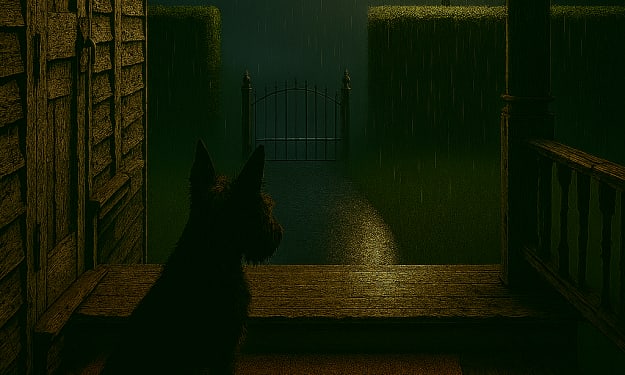
Part I The knock at the door wasn't unusual - just four knocks - knock-knock-knock-knock. Usual. The thunderous barking of Ryan Seacrest, my Scottish Terrier wasn't unusual. Pound-for-pound, Scottish Terriers have the loudest bark in the canine kingdom.
By John R. Godwinabout a year ago in Fiction
Israel Declares Victory and Ends All Hostilities in the Gaza Strip
The almost century old conflict between the Jews and Hitler which began when Germany invaded Poland on September 1, 1939, has finally ended after 86 years. During the first part of the conflict, which has come to be known as World War II, approximately two thirds of all European Jews, some six million people were killed in Nazi concentration camps through a program of mass executions by poisonous gas and starvation. The surviving Jews went on to found the state of Israel and in more recent years struck back at Hitler by retaliating with a campaign of mass executions in the Gaza strip using artillery bombardment and starvation resulting in the deaths of at least 65,000 Palestinians or approximately one tenth of the population of Palestine.
By Everyday Junglistabout a year ago in Fiction
The Silence That Answers Back
The Silence That Answers Back By: Abdul Muhammad The knocking began the night after they scattered her grandfather’s ashes. It was a soft, rhythmic sound from within his old oak wardrobe, a patient tap-tap-tap like a heartbeat muffled by wood and time. It wasn’t a sound that frightened Elara; it was a sound that ached. It was the echo of his pocket watch being wound, the tap of his pipe against the ashtray, the sound of him puttering in his sanctuary. For a week, she lay in the spare room of the now-too-quiet house, listening. Grief was a heavy blanket, and the knocking was a thread she could cling to in the dark. Finally, on the eighth night, she rose. Her heart hammered against her ribs, a frantic counter-rhythm to the patient knocking from within. She stood before the carved oak doors, took a shaky breath, and knocked back. Three timid raps of her own. The sound stopped. For a terrifying second, there was only silence. Then, with a soft, sighing creak, the wardrobe doors swung inward. There were no coats. No scent of cedar. Instead, she was looking into the sun-drenched living room of her childhood. There she was, seven years old, wearing a paper crown, her face alight with a joy so pure it was a physical blow. Her grandfather, young and vibrant, was laughing, his hands held out to present a towering, lopsided birthday cake. The scene was frozen, silent, and perfect, like a diorama in a museum of her happiest memories. A sob caught in her throat. She reached a hand across the threshold, her fingers passing from the dim bedroom into that golden afternoon light. As she did, a small, porcelain figurine of a bird on her grandfather’s nightstand flickered, its colors leaching away for a single, disorienting second before snapping back. She didn’t understand the cost, not then. She only understood the miracle. Over the following days, she became an archaeologist of her own soul. She knocked on the bathroom door and opened it onto the steam-filled room where she’d celebrated her high school graduation, her mother’s proud face beaming through the mist. She knocked on the kitchen door and found the silent, tense morning her father left, the memory so sharp she could smell the burnt coffee. Each door was a portal, each knock a key. But the present began to protest. The house, her anchor in the now, was growing thin. The pattern on the wallpaper would blur, mimicking the floral print of her childhood home. The hum of the refrigerator would distort into the distant sound of a lawnmower from a long-ago summer. The more she visited the past, the more the present fought to become it. The real terror began when she saw the first patch of transparency. She had opened her own bedroom door onto the memory of learning to ride a bike, her grandfather’s steadying hands on her shoulders. When she closed the door, her reflection in the mirror was faint, like a ghost looking back. The scent of her perfume, a modern, adult fragrance, was gone, replaced by the faint, persistent smell of grass and birthday cake. She was being erased, replaced by the echo of what once was. She knew she had to stop. She packed a bag, determined to leave the house and its siren song of memory. But as she walked down the hallway, she heard it again. The knocking. This time, it wasn't from the wardrobe. It was coming from the front door—the real, solid front door of her present. Her blood ran cold. Who could that be? The past didn't knock from the outside. Tap. Tap. Tap. It was the same rhythm. Patient. Heartbeat-like. Trembling, she approached. She couldn’t knock back; she was too afraid of what might open. But she had to know. She pressed her eye to the peephole. Standing on her welcome mat was her grandfather. Not the frail man from the end, not the young hero from her memories, but the man from her teenage years. He looked solid, real. And he was smiling softly, his hand raised to knock again. “Elara,” his voice came through the wood, warm and clear. “It’s so loud in here. All these memories… they’re so bright. Don’t you want to come where it’s quiet? Don’t you want to come home?” It wasn’t an invitation. It was a retrieval. She looked back into the house. The hallway was wavering, the walls softening into the remembered pattern of her grandparents’ cottage. The past wasn’t just in the doors anymore; it was consuming the very structure of her life. The knocking on the front door continued, a patient, relentless rhythm. Tap. Tap. Tap. Her choice was no longer about revisiting the past. It was about where she would choose to live: in a fading present, or in a perfect, unchanging echo. Her hand hovered over the doorknob, the cold brass a final anchor to the woman she was, the woman she was about to erase forever. The silence behind the knocking was no longer empty. It was waiting. And it had finally found its answer.
By Abdul Muhammad about a year ago in Fiction
The Halloween Table 3
The doorbell began bonging again. I went to the door and checked. It was my friend Wolfy. You are a tad early there Wolfy but remember no changing tonight. I do have your favorite meal preparing for you can stay normal. The bonging began once more. I went to the door and looked out and there she was Vivian. Welcome, Miss Viv. How did the dentist visit and those two teeth you were worried about? Your favorite drink in in the cooler over there in the corner. Wolfy stop that and let her past. What did I do just smelling.
By Mark Grahamabout a year ago in Fiction
The Thorn in My Heart
Since her university days, Sippa had a mark on her skin that bothered her. It wasn't exactly on her side, but a bit more toward her back—a place she couldn't see with her own eyes. Every nurse would say, "Don't worry, it's just a normal mole."
By Abid Malikabout a year ago in Fiction
The Library at the Edge of Dreams
M Mehran No one knew when the library appeared. One morning, the townspeople of Merrinfield woke to find a tall glass building standing at the edge of the river — a place that hadn’t been there the day before. It shimmered faintly, like sunlight caught on water. There was no sign, no doorbell, only a single line etched into the glass: > “Borrow wisely. Every story costs a memory.” People laughed at first, calling it a prank. But by evening, curiosity won. The first visitor entered — and never spoke of what she found inside. --- Eleanor Gray was not easily frightened. She was a schoolteacher, practical and careful, the sort who believed in schedules and not much else. But she had dreams that haunted her — dreams of a boy’s laughter echoing through a field of sunflowers, though she had never had a child. When she heard about the library, something in her heart tugged. That night, she followed the river until the building came into view. The doors opened on their own. Inside, rows of shelves spiraled upward into darkness. The air smelled faintly of rain and old paper. Each book glowed with a soft golden light, and on their spines, instead of titles, were phrases: “A Day You Forgot,” “Your First Smile,” “The Moment Before Goodbye.” Behind a circular desk sat a woman dressed in gray, her eyes like candlelight. “Welcome,” she said. “I am the Librarian.” Eleanor tried to speak, but the words tangled in her throat. “What kind of library is this?” “One that trades stories for memories,” the woman said. “You may read anything you wish. But remember — the story you take will cost you something you once lived.” Eleanor laughed nervously. “That’s absurd.” “Is it?” The Librarian smiled. “You already carry stories you cannot remember. Wouldn’t you like to know where they went?” --- Eleanor hesitated only a moment before walking deeper into the shelves. Her hand brushed the glowing spines until she found one that pulsed warmly beneath her fingers. > “The Son You Never Knew.” Her breath caught. “What…?” The Librarian appeared beside her, silent as shadow. “Are you sure you wish to open it?” Eleanor nodded. The moment the book opened, the room vanished. She was standing in a kitchen flooded with morning light. A man stood at the stove, humming softly, while a small boy with curly hair drew pictures at the table. “Mommy!” the boy said, turning to her. She froze. “What… did you call me?” He giggled. “You’re silly. You said we’d go to the park today!” The man smiled over his shoulder. “He’s been waiting all morning, Ellie.” Tears blurred her eyes. The warmth, the laughter, the smell of pancakes — it felt real, more real than anything she’d known. Then the pages began to turn. The light dimmed. The man faded first, then the boy. “No!” Eleanor screamed, clutching at the air. “Please, don’t take them!” The Librarian’s voice echoed softly around her. “Every story ends, Miss Gray.” When Eleanor blinked again, she was back in the library, her cheeks wet with tears. “Was it true?” she whispered. The Librarian tilted her head. “Truth and memory often trade places. But you paid for it, didn’t you feel it?” Eleanor’s mind ached — like something precious had been stolen and replaced with emptiness. --- Days passed, but she couldn’t stay away. She returned again and again, each time drawn to another glowing spine: “The Road You Never Took.” “The Letter You Forgot to Send.” “The Life You Almost Lived.” Each story showed her a world that might have been — a husband she had loved, a friend she had lost, a version of herself who laughed more often. But with every visit, her memories of the real world dimmed. She forgot her students’ names. She forgot her address. Eventually, she forgot why she had ever come. --- One stormy night, she stood before the Librarian for the last time. “I don’t remember who I am anymore,” Eleanor said. “Have I borrowed too much?” The Librarian regarded her gently. “You have borrowed your whole life, dear one. But there is one book left — the first story you ever gave away.” She led Eleanor to a mirror at the far end of the hall. Its frame was carved from ink-dark wood, and at its center lay a single book — plain, unmarked, bound in blue leather. Eleanor opened it. The pages were blank, except for a single line written in her own handwriting: > “The day I lost my son.” And suddenly, it all came back — the hospital room, the stillness, the silence after his first and only breath. The pain had been too great, so she had wished to forget. And someone — something — had answered. Eleanor fell to her knees. “I remember now.” The Librarian placed a hand on her shoulder. “And now you may rest.” As the rain beat against the glass walls, the light of the library dimmed. The shelves faded, one by one, until only the mirror remained. When the townsfolk came at dawn, the building was gone. All that remained was a single blue book lying on the riverbank, its cover damp but unspoiled. Inside were no words — only the faint scent of rain, and one pressed sunflower.
By Muhammad Mehranabout a year ago in Fiction