Holiday
Animal Farm (George Orwell) - Chapter- 8 (Novel)
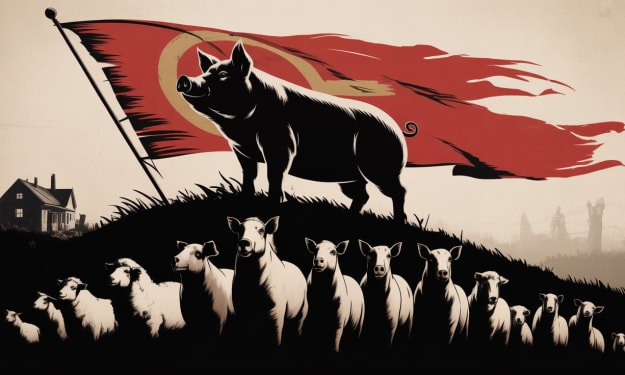
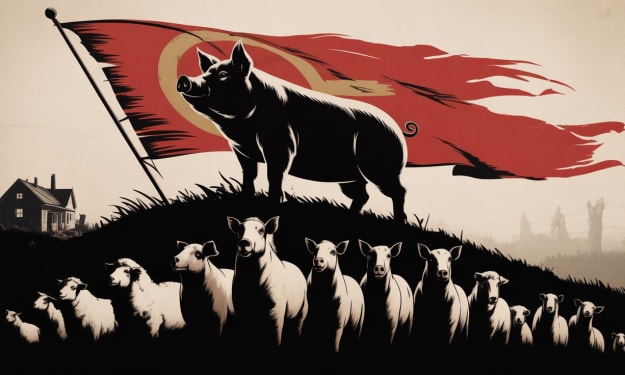
As Animal Farm enters its fourth year of independence, the gap between the pigs and the other animals is growing rapidly. Napoleon, with the help of his ferocious dogs and the persuasive Squealer, has consolidated his control. The animals are struggling to survive, but their memories of the past are dim, and they cling desperately to hope.
By Echoes of Lifeabout a year ago in Fiction
Animal Farm- Chapter- 4 (George Orwell)
As summer turns to autumn, word of the animals’ successful rebellion spreads far beyond Animal Farm. Snowball and Napoleon send pigeons to neighboring farms to tell the other animals about their revolution and to teach them the song of the Beast of England. The pigeons carry the message far and wide, inspiring animals on other farms to rise up just as they have. Meanwhile, the human owners of neighboring farms—Mr. Pilkington of Foxwood and Mr. Frederick of Pinchfield—become deeply concerned that ideas of animalism might spread. They try to downplay the animal revolution, mocking Animal Farm and calling it a failure, but secretly, they fear a similar rebellion among their own animals.
By Echoes of Lifeabout a year ago in Fiction
Animal Farm — Chapter 3 (George Orwell)
With Manor Farm now transformed into Animal Farm, the animals waste no time in putting their new society into practice. They begin working enthusiastically in the fields, more motivated than ever under Mr. Jones. The pigs, thanks to their superior intelligence, take on leadership and planning roles, while the other animals throw themselves into physical labor. Boxer, a huge cart horse, becomes the farm's workhorse in both name and spirit. His personal motto - "I will work harder" - inspires everyone around him. Even the ducks and chickens do their best, picking up stray kernels of corn to ensure that nothing goes to waste. Although harvesting is difficult without human tools and skills, they manage better than expected, with greater success than ever before. There is a sense of pride and ownership in every mouthful of food they produce, which drives them to work harder and cooperate more willingly. The animals, for the first time, feel that their labor is truly for their own benefit, not for some master who steals the fruits of their labor.
By Echoes of Lifeabout a year ago in Fiction
lucid. Content Warning.
There once was a family that had been struggling to reconnect. Arguments, silence, resentment—they had drifted apart, each locked in their own little world of pain. Hoping to mend their fractured bond, they decided to go away on a short holiday. A chance to reset. To be a family again.
By Sabrina Verweyabout a year ago in Fiction
Whispers of the Forgotten Clock
In the sleepy town of Elderglow, nestled between rolling hills and a river that sang secrets to the stars, time had a peculiar habit of standing still. Not metaphorically, but literally. The townsfolk swore the old clock tower, perched on the edge of the square, hadn’t ticked in a century. Its hands, frozen at 3:17, cast long shadows that never shifted, as if the sun itself respected the clock’s stubborn refusal to move. The townspeople called it the Forgotten Clock, and they whispered that it held the soul of Elderglow, trapped in a moment no one could remember. Lila Wren, a young woman with a penchant for unraveling mysteries, arrived in Elderglow on a rainy afternoon, her boots splashing through puddles that reflected the gray sky. She’d heard of the clock from an old book she’d found in her grandmother’s attic, its pages yellowed and brittle, detailing a town where time refused to flow. The book hinted at a curse, a pact, and a key—none of which made sense, but all of which ignited Lila’s curiosity like a match to dry tinder. She’d come to Elderglow to write a story for Vocal Media, hoping to uncover something extraordinary. The townsfolk were kind but cagey. At the local diner, where the air smelled of coffee and burnt toast, Lila asked about the clock. Old Mr. Harrow, who claimed to be ninety but looked no older than sixty, squinted at her over his glasses. “Some things are better left alone, girl,” he said, his voice like gravel. “That clock don’t like being questioned.” Others echoed his sentiment, their eyes darting to the tower as if it could hear them. But Lila wasn’t one to heed warnings. She thanked them, paid for her coffee, and headed to the clock tower. The tower loomed over the square, its stones weathered but unyielding, ivy crawling up its sides like veins. The door at its base was locked, but Lila, ever resourceful, found a loose windowpane and slipped inside. The air was thick with dust, and the faint scent of rust clung to everything. A spiral staircase wound upward, its steps groaning under her weight. At the top, she found the clock’s heart—a massive mechanism of gears and springs, frozen mid-motion. In the center, dangling from a chain, was a small, ornate key, glinting faintly in the dim light. Lila reached for it, her fingers brushing the cold metal, when a voice echoed through the chamber. “You seek what you cannot understand.” She spun around, heart pounding, but no one was there. The voice was soft, almost sorrowful, like a sigh carried on the wind. “Who’s there?” she called, her voice trembling. No answer came, but the air grew heavier, pressing against her skin. She grabbed the key and stuffed it into her pocket, determined to uncover its purpose. Back at the inn where she was staying, Lila examined the key under the flickering light of a lamp. It was intricately carved with symbols she couldn’t decipher, but it felt alive, warm to the touch. That night, she dreamed of the clock tower, its hands spinning backward, the town unraveling around it. Faces she didn’t recognize pleaded with her to return the key, while others begged her to use it. She woke in a cold sweat, the key still clutched in her hand. The next day, Lila returned to the tower, determined to find answers. She explored the town first, piecing together fragments of its history. The librarian, a woman with eyes like storm clouds, told her of a watchmaker who’d built the clock in 1873. He’d loved a woman named Elara, but she vanished on the night the clock was completed. The town believed the watchmaker had bound his grief to the clock, stopping time to preserve her memory. “Some say the key unlocks the clock,” the librarian whispered, “but others say it unlocks something far worse.” Lila’s heart raced as she climbed the tower again. The voice returned, louder this time. “You hold my prison,” it said, and now Lila was certain it was Elara’s voice, trapped within the key. She hesitated, her fingers trembling as she approached the clock’s mechanism. The key fit perfectly into a small slot she hadn’t noticed before. She turned it, and the gears groaned to life, a deep, resonant hum filling the tower. The world outside shifted. The sky darkened, the air shimmered, and the townsfolk froze in place, their faces contorted in fear. Lila ran to the square, where the clock’s hands were spinning wildly, forward and backward, as if time itself was unraveling. Shadows moved in the corners of her vision—figures that weren’t quite human, their eyes glowing like embers. “You’ve freed me,” Elara’s voice whispered, now clear and sharp. “But you’ve also freed them.” Lila realized too late what the librarian meant by “something far worse.” The clock hadn’t just preserved Elara’s memory—it had trapped the watchmaker’s despair, his rage, and something darker, something that fed on time itself. The shadows grew, coalescing into forms that reached for her. She sprinted back to the tower, the key burning in her pocket. With no other choice, she yanked it from the slot, and the clock fell silent once more. The shadows vanished, and the town returned to its eerie stillness. Lila stood panting, the key heavy in her hand. She could leave now, write her story, and let Elderglow keep its secrets. But the voice lingered in her mind, pleading. “I’m still here,” Elara whispered. Lila looked at the key, then at the clock. She could try again, find a way to free Elara without unleashing the darkness. Or she could walk away, leaving the town to its frozen fate. She chose to stay. The story wasn’t over yet.
By Nauman Hassan Khanabout a year ago in Fiction
May All Your Irises Be White. Content Warning.
I pissed off Amanda again. What’s new? I could never satisfy her. To be honest, I don’t even think I ever tried to. As the first child, she had to look up to me. I never had to request validation from her. But this argument was different. She wanted to partner up and move forward with the I Hate Rachel Herrmann Company. I simply could not. While the company promotes trauma recovery through the use of dark humor, I’d rather leave the more serious tasks to the professionals. Amanda believes the standard mental health treatments are corrupt and that this company will start a reform movement. She acts like Rachel Herrmann is the next Dorothea Dix. I could never have so much faith in just one person alone.
By Rachie Iris about a year ago in Fiction
Seal rock
Finally the time had come, summer holiday time. A whole 14 days without work. I had been counting the days for many months, work wasn't going well so the break was needed. A long drive to the coast but always worth the effort. The worst part was the going home.
By ASHLEY SMITHabout a year ago in Fiction
Seeing Is Believing
Joanie pulled her threadbare wool coat tighter around her as she walked, rubbing her numb, red nose with a sniff. Her feet were killing her after being on them all day, but sadly she couldn't go home yet. She still had one more shift to go. One more long, exhausting shift, to cap off the longest, most exhausting day of her life so far.
By Natalie Grayabout a year ago in Fiction
Hoof Prints In The Snow!
Christmas always brings memories of my early childhood. The memories are filled with the expectations that if I am a “good little girl,” I will get that red bicycle on training wheels as well as the doll that I always wanted. I use to believed that when I awaken and dashed out of my bed they would be sitting under our cedar tree that was decorated with homemade ornaments. However, Christmas after Christmas left me disappointed again.
By Frankie Berry Wiseabout a year ago in Fiction