Historical
The Holy American Empire
Relief came first. For the first time in weeks, trucks rolled across Mexico’s highways carrying sacks of grain, barrels of fuel, crates of medicine stamped with the seal of the Empire. Markets opened cautiously, lights flickered back to life in the cities, and families wept as refrigerators hummed again. The blockade was over.
By Logan M. Snyderabout a year ago in Fiction
Echoes of a Forgotten City
Echoes of a Forgotten City The city once glowed with culture, art, and the laughter of children. Its streets carried the footprints of generations, and its walls echoed with stories older than memory. But when the war came, the city that once sang was reduced to whispers of smoke and broken stone.
By Wings of Time about a year ago in Fiction
The Holy American Empire
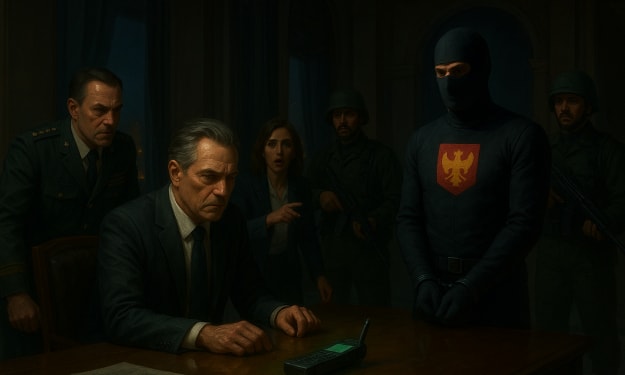
“Good evening, Mr. President. I’ll be quick. I want the blockade over just as much as you do,” Emperor Kane said, an unexpected note of empathy softening his voice. “I know your people are hungry, your hospitals are running out of fuel for their generators, and your citizens are beginning to turn on you. I don’t want them to suffer anymore. I want them to be my people. Agree to a full, unconditional surrender of Mexico. The blockade will be lifted, my engineers will restore power, and we will deliver food and medicine. You will be allowed to live out the rest of your days in Mexico as well.”
By Logan M. Snyderabout a year ago in Fiction
Tales from the Loom. Content Warning.
When technology finally caught up to the desire to live beyond a single lifetime, The Loom was born. It offered a person a chance to step into their own reality. Any life they imagined, complete and convincing in every detail. Inside, a year of experience was merely a minute in the real world. Their new reality around them was filled with people who could love, struggle, and die, yet the one who entered was spared from chance or tragedy. A wound, a fall, or a bullet became a miracle of survival, and only old age could bring their story to an end.
By Michael Noonabout a year ago in Fiction
Switching to Stout
Initially, at St. James's Gate, Arthur Guinness produced ale (a lighter-colored beer, popular in Ireland at the time). However, Arthur was a visionary who observed trends. In England, especially in London, Porter beers (a type of black beer, fermented with roasted malt) had become extremely popular. Porter was more stable and better withstood long-distance transport, making it perfect for export.
By alin butucabout a year ago in Fiction
Voices Behind the Walls
Voices Behind the Walls When Elina first moved into the old brick apartment building on Willow Street, she thought the constant creaks and groans were just the building settling. The rent had been low, and the location was perfect—quiet, near her work, and close enough to the park where she liked to run in the mornings. But by the end of her first week, Elina realized the walls were speaking to her in ways she couldn’t ignore. At first, it was subtle—a whisper here, a muffled laugh there. She told herself it was imagination, maybe even the neighbors’ late-night conversations. But the whispers didn’t sound human. They were fragmented, hushed words that seemed to seep directly into her mind, echoing from the walls themselves. It was a rainy Wednesday when the voices became impossible to ignore. Elina had just returned from work, her umbrella dripping across the hallway, when she heard a soft, trembling voice. “Don’t… tell… anyone…” She froze. Her heart raced. She pressed her ear against the cold plaster wall of the living room, trying to locate the source. The voice was faint, almost desperate, and it was speaking in broken sentences. “…they’ll… find… me… room 4… don’t…” Room 4? That was the apartment across the hall. Curious and slightly apprehensive, Elina waited until the voice faded. The rest of the evening was quiet, and she tried to ignore the chill crawling down her spine. But sleep was elusive. That night, the whispers returned, louder, more urgent. “Help… please… locked… hidden… truths…” Elina sat upright in bed, gripping her blanket. This was no ordinary old-building noise. Something had happened here, something someone wanted hidden. The next morning, she tried to find information about the building’s history. The landlord, a frazzled man in his sixties, shrugged when she asked. “Old building. Been here forever. Nothing strange, I promise.” But Elina didn’t believe him. She started to observe her neighbors discreetly. Apartment 4 had been vacant for months, though she occasionally saw a flicker of movement behind the curtains. And every night, the whispers persisted, telling fragmented stories—a woman crying, the sound of footsteps running, hushed arguments, and then silence. Weeks passed, and Elina grew obsessed. She began writing down every phrase she heard, trying to piece together a coherent story. Words like “stolen,” “promise,” “child,” “fire,” and “never forgiven” formed a puzzle she was determined to solve. One evening, she found a crack behind the baseboard in her living room wall. Peering inside, she glimpsed old letters, yellowed and brittle with age. Carefully, she pried them out and began reading. The letters were between a woman named Margaret and her brother, Thomas. They spoke of a scandal, a disappearance, and a betrayal that had shaken the small town decades ago. Margaret had written about a child hidden from the world, a fire that destroyed evidence, and a secret she feared would kill her if discovered. Elina’s fingers trembled as she read the final letter, dated 1978: “They will never know. I’ve kept her safe all these years, but the walls remember, and I cannot escape their whispers.” The whispers intensified that night. They were no longer just voices—they were memories, replaying like a film in her mind. She saw a young girl running through smoke, a woman clutching her head in despair, and shadowy figures arguing in the hallways. Elina felt the weight of decades pressing down on her, the pain and fear of lives trapped within these walls. Determined to uncover the truth, she knocked on the door of the long-vacant Apartment 4. No one answered, but the door was unlocked. Inside, the air was thick with dust and the faint scent of smoke. A small trunk in the corner caught her attention. Inside, she found more letters, photographs of a smiling woman and a child, and a diary that chronicled years of secrecy, fear, and longing. As she read, the whispers softened, almost grateful. Elina learned that Margaret had hidden her niece after a tragic accident, protecting her from a family feud that had threatened to tear them apart. The girl had grown up in secret, moving between relatives who never knew her true identity. The tragedy had left a scar on the building, a residue of sorrow that had imprinted itself onto the walls. Elina felt tears stream down her face. She understood now that the voices were not haunting her—they were reaching out for acknowledgment, for someone to finally hear their story. The next day, she visited the local archives and matched the letters to public records. She discovered that the hidden niece, now elderly, was alive and had been searching for her roots. With Elina’s help, the two were reunited, bridging a gap that had remained unhealed for over forty years. That night, when Elina returned to her apartment, the walls were silent. For the first time, she felt peace. The voices had been heard, the secrets revealed, and the pain transformed into closure. The building, once a place of whispers and shadows, seemed lighter, almost alive with relief. Elina smiled, realizing that some mysteries are not meant to scare us—they are meant to be uncovered, understood, and, finally, set free.
By Abdul Muhammad about a year ago in Fiction
Holy American Empire
Two weeks. It had been two weeks since Emperor Kane deployed his fleet to blockade Mexico. Two weeks of darkness, of no power. Two weeks of the citizens growing hungry. Two weeks of nothing but silence from Mexico’s neighbor turned enemy.
By Logan M. Snyderabout a year ago in Fiction