Historical
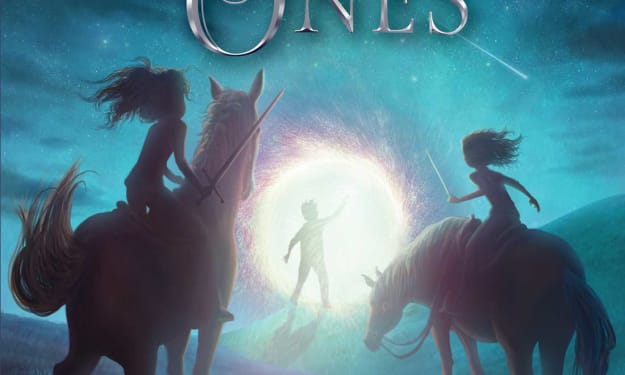
Choosen one’s magical Adventure
Once upon a time, in a quaint little village nestled between lush green hills and shimmering blue lakes, there lived a young girl named Lily. She was known for her infectious laughter and unwavering curiosity. The village was a place of magic and wonder, where legends of mythical creatures and enchanted forests were passed down through generations.
By NISAN KHAREL3 years ago in Fiction
10 Spine-Chilling Encounters in Morgues and Hospitals
Numerous eerie events occur in our world, but witnessing them unfold in hospitals and morgues adds a whole new level of terror. These inexplicable occurrences leave witnesses bewildered and afraid. Luckily, some of these incidents were captured on camera, providing chilling evidence of the unexplained. Here, we've gathered some of the most terrifying facts for you to witness. Join us as we explore the ten scariest things ever captured in morgues and hospitals.
By TAJUDEEN Abubakar3 years ago in Fiction
20 Enigmatic Discoveries Trapped in Ice
Every day, our understanding of the world evolves as new discoveries come to light. In the frozen tundras of our planet, scientists have found a plethora of well-preserved relics and artifacts, ranging from ancient creatures to strange and puzzling objects. With global warming revealing more of these icy wonders, let's explore the ten most mysterious, bizarre, and eerie things found trapped in ice.
By TAJUDEEN Abubakar3 years ago in Fiction
A brief history of cannibalism
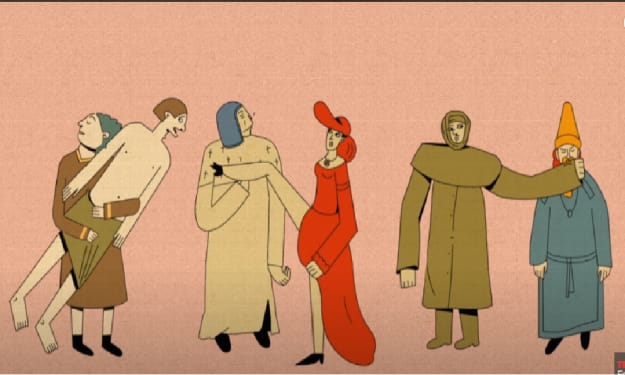
15th century Europeans believed they had hit upon a miracle cure: a remedy for epilepsy, hemorrhage, bruising, nausea, and virtually any other medical ailment. This brown powder could be mixed into drinks, made into salves or eaten straight up. It was known as mumia and made by grinding up mummified human flesh.
By Terema Remx3 years ago in Fiction
The dark history of zombies
Animated corpses appear in stories all over the world throughout recorded history. But zombies have a distinct lineage one that traces back to Equatorial and Central Africa. The first clue is in the word “zombie” itself. Its exact etymological origins are unknown, but there are several candidates. The Mitsogho people of Gabon, for example, use the word “ndzumbi” for corpse. The Kikongo word “nzambi” refers variously to the supreme being, an ancestor with superhuman abilities, or another deity. And, in certain languages spoken in Angola and the Congo, “zumbi” refers to an object inhabited by a spirit, or someone returned from the dead. There are also similarities in certain cultural beliefs. For example, in Kongo tradition, it’s thought that once someone dies, their spirit can be housed in a physical object which might bring protection and good luck. Similar beliefs about what might happen to someone’s soul after death are held in various parts of Africa. Between 1517 and 1804, France and Spain enslaved hundreds of thousands of African people, taking them to the Caribbean island that now contains Haiti and the Dominican Republic. There, the religious beliefs of enslaved African people mixed with the Catholic traditions of colonial authorities and a religion known as “vodou” developed. According to some vodou beliefs, a person’s soul can be captured and stored, becoming a body-less “zombi.” Alternatively, if a body isn’t properly attended to soon after death, a sorcerer called a “bokor” can capture a corpse and turn it into a soulless zombi that will perform their bidding. Historically, these zombis were said to be put to work as laborers who needed neither food nor rest and would enrich their captor’s fortune. In other words, zombification seemed to represent the horrors of enslavement that many Haitian people experienced. It was the worst possible fate: a form of enslavement that not even death could free you from. The zombi was deprived of an afterlife and trapped in eternal subjugation. Because of this, in Haitian culture, zombis are commonly seen as victims deserving of sympathy and care. The zombie underwent a transformation after the US occupation of Haiti began in 1915 this time, through the lens of Western pop culture. During the occupation, US citizens propagated many racist beliefs about Black Haitian people. Among false accounts of devil worship and human sacrifice, zombie stories captured the American imagination. And in 1932, zombies debuted on the big screen in a film called “White Zombie.” Set in Haiti, the film’s protagonist must rescue his fiancée from an evil vodou master who runs a sugar mill using zombi labor. Notably, the film's main object of sympathy isn't the enslaved workforce, but the victimized white woman. Over the following decades, zombies appeared in many American films, usually with loose references to Haitian culture, though some veered off to involve aliens and Nazis. Then came the wildly influential 1968 film “Night of the Living Dead,” in which a group of strangers tries to survive an onslaught of slow-moving, flesh-eating monsters. The film’s director remarked that he never envisioned his living dead as zombies. Instead, it was the audience who recognized them as such. But from then on, zombies became linked to an insatiable craving for flesh with a particular taste for brains added in 1985′s “The Return of the Living Dead.” In these and many subsequent films, no sorcerer controls the zombies; they’re the monsters. And in many iterations, later fueled by 2002′s “28 Days Later,” zombification became a contagious phenomenon. For decades now, artists around the world have used zombies to shine a light on the social ills and anxieties of their moment from consumer culture to the global lack of disaster preparedness. But, in effect, American pop culture also initially erased the zombies origins cannibalizing its original significance and transforming the victim into the monster.
By Terema Remx3 years ago in Fiction
Breathing Life
In the annals of space exploration, intriguing discoveries have sparked a question that has captured the imagination of scientists and enthusiasts alike: could there be life beyond Earth within our very own solar system? This curiosity was kindled when, on September 28, 1969, a brilliant fireball streaked across Australia's skies, and a peculiar 100-kilogram meteorite was discovered near Murchison, Australia. Witnesses noticed an unusual tar-like odor emanating from the meteorite, and laboratory tests later revealed that it contained organic matter and dozens of amino acids, the building blocks of life on Earth. Microscopic examination of the meteorite revealed structures resembling the remains of ancient bacteria. Even more astonishing was the radiocarbon analysis, which dated the living meteorite to be between five to seven billion years old, predating the formation of our solar system. This remarkable discovery led American planetary scientist Lindy Elkins-Tanton to propose a revolutionary theory: what if life originated not on Earth, but on planetary embryos in the protoplanetary disk? If this theory holds true, then the possibility of extraterrestrial life existing within our solar system becomes a tantalizing prospect.
By TAJUDEEN Abubakar3 years ago in Fiction
Legacy of Love
In the quiet little town of Willowbrook, a young woman named Emily lived a simple life. She was known for her genuine kindness and a heart that was always ready to lend a helping hand. However, behind her warm smile, Emily carried a burden—a past filled with unspoken pain and lost dreams.
By Onah Patrick3 years ago in Fiction
The Symphony of Forgotten Stars
In the distant future, humanity had long colonized distant galaxies, and among the stars, they discovered an enigmatic planet known as Melodoria. This celestial body was unlike any other, for it emitted a harmonious melody that seemed to resonate throughout the universe. Legend spoke of a magical artifact hidden deep within Melodoria's heart that could harness the power of this ethereal symphony to grant unimaginable wishes.
By Shelby Felices3 years ago in Fiction