Historical
Boy's after 21
The Progress After 21: Figuring out the Progressions for Young Men The change from youthfulness to adulthood is perhaps the most groundbreaking time frame in an individual's life, and for young men, arriving at the age of 21 denotes a huge achievement. It is when natural, close-to-home, mental, and social changes escalate, impacting their way to self-revelation and autonomy. After turning 21, the shift from the lighthearted, exploratory period of late adolescence to the more organized and mindful period of youthful adulthood achieves various changes. These progressions are frequently connected with actual development as well as advancing connections, character arrangement, vocation choices, and new obligations.
By nadia khanom2 years ago in Fiction
311: The Day After, Just Without Zombies (or, Is It?)
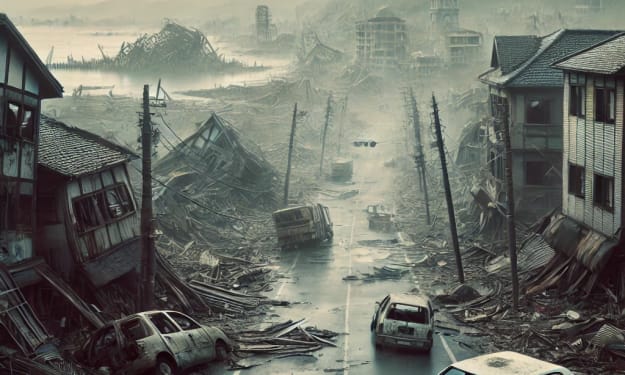
Disasters leave scars, both physical and psychological, on a nation and its people. Some are so powerful that they forever alter the way society perceives safety, risk, and resilience. One such event occurred on March 11, 2011, in Japan, a day that has become known simply as "3/11." This day brought not just a natural disaster, but a cascading series of crises that had Japan and the world on edge. While there were no zombies involved, the catastrophe felt apocalyptic to those who experienced it. This was a real-world horror, testing humanity's endurance, adaptability, and collective strength. What Happened on 3/11? At 2:46 p.m. JST on March 11, 2011, a 9.0-magnitude earthquake—the strongest in Japan's recorded history—struck off the northeastern coast of Honshu, Japan's main island. The seismic activity unleashed a massive tsunami with waves over 130 feet (40 meters) high that devastated coastal towns and cities. Buildings, cars, and boats were tossed about like toys in a tub. Entire neighborhoods were wiped off the map, leaving only debris and rubble in the wake. If the earthquake and tsunami weren't enough, the situation escalated further. The Fukushima Daiichi Nuclear Power Plant, located near the epicenter, sustained significant damage, leading to a partial meltdown in three of its reactors. This nuclear disaster released dangerous levels of radiation, forcing thousands to evacuate, some never to return to their homes. This triple disaster—earthquake, tsunami, and nuclear meltdown—created a profound sense of dread that was likened to the zombie apocalypse of popular fiction. For Japan, and indeed for much of the world, this felt like a waking nightmare. The Human Impact The 3/11 disaster claimed nearly 20,000 lives, left thousands missing, and displaced over 470,000 people. The nuclear disaster also rendered large areas uninhabitable due to radiation, adding a haunting quality to the devastated towns. Survivors faced not only the loss of loved ones but also the destruction of their communities, homes, and ways of life. Rescue teams and volunteers came from around the world to assist, but the task was daunting. For many, the situation felt surreal; the ruins of once-bustling cities looked like scenes from post-apocalyptic movies or games, with debris-strewn streets, destroyed buildings, and a haunting silence in formerly lively neighborhoods. People who lived through the events of 3/11 often describe the psychological toll as almost unbearable. They had to endure aftershocks for weeks, the constant fear of radiation exposure, and the struggle to find food, water, and shelter. For some, the experience left lifelong emotional scars. Schools, hospitals, and public infrastructure were damaged beyond repair, leading to a long, painful road to recovery. Zombie Apocalypse Comparisons: Why They Made Sense It might sound sensationalist to compare 3/11 to a zombie apocalypse, but there are eerie parallels that capture the existential dread it brought. Just like in zombie movies, there was a sense of isolation and vulnerability as survivors navigated deserted streets filled with debris. The threat of radiation was invisible yet omnipresent, creating an anxiety similar to the unknown dangers associated with zombies. Evacuees from the Fukushima area were treated with caution, sometimes even stigmatized, because others feared radiation "contamination," almost as if they were "infected." The images of abandoned towns, empty schools, and deserted homes lent an eerie, post-apocalyptic aesthetic. These ghost towns were left untouched due to high radiation levels, and residents could only briefly return to gather essential belongings. Additionally, the government issued restrictions and safety guidelines that further contributed to a feeling of containment, much like quarantine zones in fictional zombie outbreaks. The Aftermath and Ongoing Recovery Years have passed since 3/11, but its impact lingers. Recovery has been slow, and full restoration is still a work in progress. Japanese society has demonstrated remarkable resilience, facing the challenges of rebuilding cities, decontaminating radioactive areas, and addressing the psychological impact on survivors. The nuclear incident at Fukushima has also led to significant changes in Japan's energy policy, with a push toward renewable energy sources and stricter nuclear safety regulations. Communities affected by the disaster continue to work toward reconstruction, but not everything can be rebuilt. Some areas are still uninhabitable, and many families have permanently relocated, leaving behind memories and a part of their lives. There’s also the challenge of radioactive waste management, which remains a complex and contentious issue. The Fukushima Daiichi plant has been in a decommissioning process that experts say could take decades, if not longer. Lessons Learned 3/11 serves as a powerful reminder of nature's unpredictability and the vulnerability of human societies. The disaster highlighted the need for better preparedness and robust infrastructure capable of withstanding extreme natural events. Japan, known for its earthquake-resistant buildings and stringent safety codes, has since strengthened its emergency response mechanisms, including early warning systems, evacuation protocols, and nuclear safety measures. Furthermore, the disaster underscored the importance of mental health care for disaster survivors. Support services for trauma and mental health are now integral to Japan’s disaster response framework, ensuring that survivors receive the care they need to process their experiences and begin to heal. Is It Really Over? Even without zombies, 3/11 was a kind of apocalypse for those affected. Lives were permanently altered, and many families still struggle with the trauma. In some ways, Japan has emerged stronger, its people showing a remarkable capacity for resilience. But as nuclear cleanup continues and families try to rebuild lives disrupted by this “zombie-free apocalypse,” 3/11 remains a reminder of human fragility. Much like fictional depictions of the end of the world, 3/11 brought about an awareness that safety and security are not guaranteed. It showed that humanity must be prepared to face nature’s wrath and must work toward a future that considers the lessons of past catastrophes. And while there were no undead roaming the streets, for many who lived through it, 3/11 will always be remembered as a real-life horror, a day after that changed everything.
By Hridoy Hasan2 years ago in Fiction
The Vanishing of the Vanishing Point
In the heart of Paris, within the hallowed halls of the Louvre Museum, a perplexing enigma has emerged from the shadows of time. A painting, once celebrated and then forgotten, has vanished without a trace. This isn't just any painting; it's the work of an enigmatic artist, Étienne Moreau-Nélaton, a visionary whose unique exploration of perspective and vanishing points pushed the boundaries of artistic illusion.
By Oghenetega Jude Ebiai2 years ago in Fiction
The Meaning Behind Pirate Colors and Symbols
Pirates have long captured the human imagination with their swashbuckling adventures, buried treasure, and rebellious spirit. But beneath the surface of the pirates' fierce reputation lies a world rich with symbolism. Pirate flags, colors, and symbols were not just meant to strike fear into the hearts of their enemies—they also carried deep meanings and were an essential part of pirate culture.
By Aditya Agarwal2 years ago in Fiction