Historical
Mars Kept a Secret for 3.5 Billion Years – NASA’s Curiosity Rover Finally Dug It Up
Introduction For decades, scientists have been unraveling the mysteries of Mars, searching for clues about its ancient past and potential for life. A groundbreaking discovery has now been made by NASA's Curiosity rover, one that Mars had kept hidden for 3.5 billion years. Buried beneath the planet’s rusty surface, the rover uncovered organic compounds and evidence of past water, offering tantalizing hints about the Red Planet’s lost habitable era.
By Saibi Rahman2 years ago in Fiction
10 Billion Suns, 10 Billion Earths?
The search for life beyond Earth has always intrigued scientists, philosophers, and dreamers alike. Recent astronomical studies have brought us closer than ever to understanding the potential for life elsewhere in the cosmos. One particularly exciting revelation is the estimate that at least 10 billion stars in our Milky Way galaxy could host habitable planets. This staggering figure doesn't just open the door to the possibility of alien life—it flings it wide open.
By MD. Nasim Hossaain2 years ago in Fiction
The Lighthouse Keeper s Daughter
The storm arrived with a vengeance, its howling winds tearing at the cliffs of Blackthorn Isle. Marin gripped the rusted railing of the lighthouse, her mother’s final words ringing in her ears: “Never let the beacon die. Not even for a second.” However, her mother had now vanished into the same sea that she had vowed to control. Marin hadn’t returned to the island in ten years. Not since her father’s fishing boat sank in these waters. But the lawyer’s letter forced her hand: “Inherit the lighthouse or lose it to the wreckers.” She’d expected dust and ghosts. The carved phrase, "For Marin, when the tides turn," on the lid of the locked trunk in the attic surprised her. Inside, she found her mother’s journals, nautical maps, and a child’s doll with one eye missing. The first journal entry chilled her:
By Md Johirul Islam2 years ago in Fiction
Quantum Gravity Eye In Space: NASA’s Trailblazing Sensor To Unlock New Dimensions Of Earth’s Pull
“A journey of a thousand miles begins with a single step.” – Lao Tzu NASA’s latest venture into quantum technology proves that humanity’s quest to understand the universe is taking a giant leap forward. The Quantum Gravity Eye, a first-of-its-kind space-based quantum sensor, promises to revolutionize how we measure Earth’s gravitational field. But why is this mission so groundbreaking, and how will it reshape science? Let’s dive in.
By Jacky Kapadia2 years ago in Fiction
The Price of Freedom
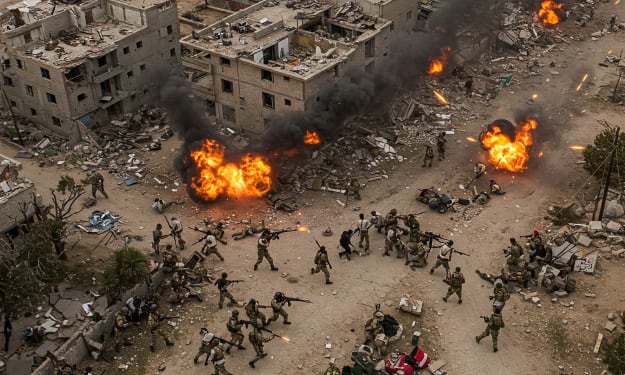
The protracted conflict between a nation's established military apparatus and a determined liberation movement underscores a fundamental human aspiration: self-determination. For generations, the populace in question endured governance characterized by systemic marginalization, economic exploitation through resource extraction, and the suppression of their distinct cultural identity. This environment cultivated a burgeoning resistance, initially manifested in clandestine networks but progressively evolving into a cohesive and assertive movement for national sovereignty. The emergence of freedom fighters, individuals drawn from diverse societal strata, marked a pivotal juncture in this struggle, as they confronted a professional army, transforming their inherent love for their community and ancestral land into a formidable impetus for armed resistance. Their arduous journey, punctuated by profound sacrifice, ultimately defined the substantial cost of their nation's hard-won independence. The genesis of this protracted conflict lies in decades of inequitable governance. Legislative frameworks that systematically disadvantaged the local populace, the appropriation of regional resources to benefit a distant metropole, and concerted efforts to erode indigenous cultural norms served as potent catalysts for dissent. Initially subdued, expressions of resistance gradually coalesced into a unified demand for autonomy. Individuals from agrarian backgrounds possessing intimate knowledge of the terrain, educators dedicated to preserving cultural heritage, and laborers subjected to exploitative conditions collectively formed the nucleus of an increasingly organized underground movement. Though lacking formal military training, their profound commitment to their community and territorial integrity imbued them with a resolute determination to challenge the status quo. The initial engagements were characterized by acts of profound courage executed with rudimentary resources. Improvised weaponry, strategic utilization of the local topography, and an unwavering ideological commitment served as their primary assets in confronting a conventionally armed and hierarchically structured military force. Each successful tactical maneuver and act of defiance resonated throughout the subjugated population, instilling hope and simultaneously eroding the morale and perceived invincibility of the occupying forces. Operating clandestinely, these freedom fighters became potent symbols of resistance, their bravery illuminating a path through the prevailing darkness of oppression. However, the pursuit of liberation exacted a significant toll. Reprisals from the national army were executed with demonstrable severity. Villages suspected of providing sanctuary to resistance elements faced systematic destruction, non-combatant civilians were indiscriminately affected by military operations, and extrajudicial executions became a pervasive instrument of control. The physical landscape, once a source of sustenance and cultural identity, was transformed into a zone of conflict, scarred by defensive emplacements and indelibly marked by violence. Societal structures were fractured, compelling individuals and families to make agonizing choices regarding allegiances or displacement, resulting in a burgeoning population of internally displaced persons. Despite the escalating violence and human cost, the spirit of resistance remained unbroken. The sacrifices of those who perished served not to extinguish the movement but to galvanize the resolve of the remaining fighters. Each fallen comrade became a potent symbol of the cause, their memory fueling an unwavering determination to achieve their ultimate objective. Despite facing numerical and material disadvantages, the freedom fighters possessed a critical advantage: the unwavering support of the populace for whom they fought. Local communities provided essential shelter, logistical support, and crucial intelligence, effectively undermining the army's efforts to exert control. The nature of the struggle transcended purely military engagements. A sophisticated and resilient network of communication and logistical support emerged. Unofficial publications disseminated information, effectively countering state-sponsored propaganda. Medical professionals risked their safety to provide care for the wounded. Covert supply lines were established to procure essential resources. In essence, the entire civilian population became an active participant in the broader struggle for liberation, albeit through diverse means. The international community, initially circumspect, gradually acknowledged the protracted nature of the conflict and the documented violations of fundamental human rights perpetrated by the national army. Diplomatic pressure intensified, and humanitarian assistance began to reach the affected population. The prevailing narrative shifted, increasingly portraying the freedom fighters not as mere insurgents but as a legitimate movement striving for the fundamental right to self-governance. The concluding phase of the conflict was characterized by intensified and increasingly direct military confrontations. The freedom fighters, having refined their tactical capabilities and augmented their operational strength, began to directly challenge the army's dominance. Their unwavering ideological conviction, coupled with strategic acumen and an intimate understanding of the terrain, facilitated significant tactical victories. The national army, facing the cumulative pressures of a protracted and resource-intensive conflict, coupled with mounting international condemnation, began to experience a decline in morale and operational effectiveness. Ultimately, after years of sustained struggle and profound national sacrifice, the objective of independence was realized. The occupying forces withdrew, leaving behind a nation bearing the deep scars of conflict but politically sovereign. The price of freedom had been immense, marked by the tragic loss of life, the fragmentation of families, and enduring societal wounds. However, from the crucible of resistance emerged a new nation, its identity forged in the shared experience of struggle and unified by the collective sacrifice of its people. The legacy of the freedom fighters became a foundational element of the nascent nation's identity. They were memorialized not solely as combatants, but as embodiments of profound courage, unwavering resilience, and an unyielding commitment to the principles of liberty. Their struggle served as a potent and enduring reminder that fundamental freedoms are rarely conceded voluntarily; rather, they are often the hard-won outcome of the dedication, perseverance, and ultimate sacrifice of those who dare to envision a future defined by self-governance and are willing to pay the ultimate price for its attainment. The sacrifices made during the war for independence formed the bedrock upon which the new society would be constructed, indelibly imprinted in the collective consciousness of a nation finally free to chart its own destiny. The enduring echoes of their struggle would stand as a timeless testament to the indomitable spirit of humanity in the face of oppression and the profound significance of a nation's collective sacrifice in the pursuit of self-determination.
By Iftikhar Ahmed 2 years ago in Fiction
Peter Krause
Peter Krause was a quiet boy who lived in a small town near the mountains. He was fifteen years old, tall for his age, and always wore the same old blue jacket. He didn’t have many friends, not because he was mean or rude, but because he was shy. He liked to sit alone under the big oak tree near the school and read books about animals, the stars, and places he had never seen.
By Tahir khan2 years ago in Fiction
"Beneath the Waning Moon: A Witch's Oath to Shatter the Dark". Content Warning.
The air still hummed with spent power as Cormac stumbled into the mist-shrouded night, his shadow stretching long and brittle down the laneway like crackling parchment. Finola watched from the threshold, her silver hair catching the moonlight in a way that made Julie’s breath hitch—not merely strands of age, but threads of starlight pulled taut from the heavens.
By Gibson Official2 years ago in Fiction
The Plane That Returned After 35 Years-A Real Life Mystery
It was the 28th Admirable, 1984. Time: 3 PM in the evening. A ordinary traveler plane took off from Kolkata Airplane terminal. The flight was from Indian Airlines, and it was getting to Mumbai. There were 70 travelers and 5 crew members on board.
By Joyprokash Roy2 years ago in Fiction