Fantasy
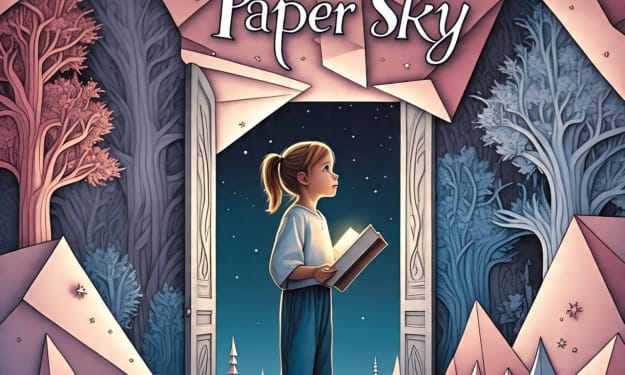
Beneath the Paper Sky
When the world ended, it didn’t crumble into fire or freeze into silence—it folded. It began on a Tuesday, with the sky. One moment it was bright with morning sun, clouds drifting lazily across the blue. The next, a sharp crease appeared overhead, as if some invisible hand had bent the heavens along a straight edge. Birds scattered. Planes veered. And within hours, more folds appeared—crisp, geometric lines slicing through the sky like origami instructions. By sunset, the sky was no longer a dome, but a canvas—creased, bent, and finally folded into sharp planes. The stars never came out. The moon blinked off like a forgotten lamp. People panicked. Scientists fumbled for explanations. Some said it was an atmospheric illusion. Others blamed satellites or solar flares. But sixteen-year-old Lena Holloway knew better. She had seen it before. In her sketchbook. Weeks before the sky changed, Lena had started drawing a series of dreamscapes. One showed a forest where trees bent like accordion paper. Another, a city where buildings folded flat and stood back up again. And one, drawn in the margins of her math homework, showed a sky with a perfect crease running across the sun. She hadn’t known why she drew them. They just came. Now, she stared up at the fractured sky, flipping through her sketchbook in disbelief. Every image was coming true. Her parents were too busy hoarding supplies and boarding windows to listen. Her teachers stopped holding online classes. The news looped the same footage: people staring up, screaming, praying, or simply sitting on rooftops waiting for answers. Lena wasn’t interested in answers. She wanted to know why. So she packed her sketchbook, a flashlight, and three granola bars, and followed the lines in the sky. Literally. The folds above cast long shadows on the ground, as if the heavens were reflecting themselves. The creases led her out of the city, into the overgrown fields behind the old train tracks—places she used to explore with her older brother before he disappeared a year ago. Before he’d left behind only a note with a single sentence: “Beneath the paper sky, you’ll find the door.” She hadn’t understood it then. But now, as she stood beneath a part of the sky that shimmered unnaturally, almost pulsing like a heartbeat, she pulled out the sketchbook and flipped to the last page. There, in charcoal and smudged ink, was the drawing of a doorway—tall, narrow, floating just above the ground. And as the wind picked up and the folds in the sky shifted again, there it was. The door, hovering before her, exactly as she’d drawn it. Lena stepped forward. The door opened inward, revealing paper. Not darkness. Not light. Just paper. Miles and miles of blank, moving parchment that rippled like ocean waves. She stepped through. Inside, the world was… constructed. Trees made of paper tubes and curled leaves. Rivers drawn in ink that flowed across textured parchment. Birds flew overhead, their wings flapping with the sound of flipping pages. And in the center, on a hill of stacked books and folded maps, stood her brother—Jamie. He turned as if he’d been expecting her. “I knew you’d follow the folds,” he said, smiling. “They started coming to me first. The drawings. The visions. I thought I was losing my mind. Then I realized…” “What?” Lena asked. Jamie looked around. “This place—it’s not just a world. It’s ours. Built by the ones who see beyond the folds. The artists. The dreamers. People like us.” Lena glanced at her sketchbook. The pages now glowed faintly, pulsing with warmth. “But why is the real sky folding?” she asked. Jamie knelt beside a pool of shimmering ink. “Because that world is collapsing. Too much noise. Too little imagination. The folds are the undoing—and the beginning. This world… this is where we rebuild. From stories. From memory. From imagination.” Lena looked up. The paper sky above this world was soft, glowing with handwritten constellations and drifting ink clouds. “It’s beautiful,” she whispered. Jamie nodded. “But it needs more creators. More dreamers. The others are coming. We need to be ready to guide them.” Lena took a deep breath, then tore a blank page from her sketchbook. She placed it on the ground, pulled out her pencil, and began to draw. A lighthouse. A real sun. A mountain with singing trees. The paper absorbed it instantly, and the drawings came alive. --- Back in the real world, the sky folded one last time. People stood still, breath held, as the last patch of blue disappeared into the crease. And then, above them, a new sky unfurled—of paper, yes, but glowing with stars and swirls of color that had never existed before. The old world was gone. But beneath the Paper Sky, a new one was being written. One story at a time.
By Azmat Roman ✨about a year ago in Fiction
The Day the Moon Didn't Rise
e I was the kind of evening where the sky melted into soft pastels, and the stars waited behind a veil of dusk, ready to twinkle awake. But that night, something was wrong. The moon did not rise. It wasn’t just late. It wasn’t hidden by clouds. It was… gone. At first, no one noticed. The streetlights flickered on as usual. Parents called children in for dinner. Dogs barked at nothing in particular. But when people looked up, expecting that familiar silver coin in the sky, they found only emptiness. Astronomers scrambled. Satellites were checked. Telescopes turned skyward. The moon had vanished—not behind Earth’s shadow, not out of orbit. It was simply not there. In the small town of Thistle Hollow, twelve-year-old Ella Caldwell noticed first. She was a stargazer, a dreamer, the kind of girl who kept a telescope on her windowsill and a notebook full of sky charts under her pillow. That night, she had been waiting to see the Harvest Moon, the biggest and brightest of the year. She had even made cocoa and pulled her beanbag chair right up to the window. When she saw nothing, not even a sliver, her stomach twisted. “Dad,” she called downstairs. “The moon’s gone.” Her father laughed. “Probably behind some clouds, kiddo.” But Ella knew better. The next morning, the world was buzzing. Newscasters used phrases like “unprecedented astronomical anomaly” and “possible spatial displacement.” Scientists gave long explanations that didn’t explain anything. But Ella had a different theory. She remembered something her grandmother once told her, late one night as they stargazed together. “The moon is more than a rock in the sky,” Grandma had said. “It’s a guardian. A watcher. If ever it disappears, it means something has gone very wrong.” Ella had thought it was just a story. But now, as she stared at the empty sky night after night, she wasn’t so sure. Animals were acting strange. Tides grew erratic. People became restless. Dreams turned darker. Without the moon’s gentle pull, something in the world—perhaps even in people—was unraveling. One night, a week after the moon vanished, Ella awoke with a start. A soft, humming sound filled her room. She sat up, heart pounding. Her telescope began to glow faintly blue. The hum came from the sky. She looked through the telescope. And gasped. There, hidden behind a shimmer like heatwaves, floated a silver shape—blurred, out of reach. The moon wasn’t gone. It was trapped. Ella scribbled furiously in her notebook. She plotted the shimmer’s location and realized something startling: the moon wasn’t missing—it was hiding behind a tear in the sky, like a curtain pulled between dimensions. But why? That night, under the ghostly stars, Ella crept into the woods behind her house. There, in the clearing where she used to play, a strange circle of mushrooms had grown—massive, glowing faintly. A faerie circle, Grandma would’ve called it. She stepped into it. The world twisted. Colors bled into one another, and the sky above shimmered like oil on water. And then—there it was. The moon, suspended, pulsing softly, like it was breathing. Beside it stood a figure cloaked in shadow, tall and ancient. “You’re not supposed to be here,” it said, voice like falling leaves. “Why did you take the moon?” Ella asked, clutching her notebook to her chest. “The world no longer listens,” the figure replied. “They poison the seas, burn the forests, drown the stars in city light. The moon grew tired. So I let her rest.” “She doesn’t want to rest,” Ella said, heart rising. “She wants to shine. She has to.” The figure was silent. The moon throbbed faintly, like it heard her. “I still look,” Ella whispered. “Every night. And I’m not the only one.” The figure studied her, eyes like old stone. Then it reached into the sky and peeled something back. The shimmer split, and light burst through like sunrise. “She will rise again,” it said. “But remember—she watches. And she tires.” In a blink, Ella stood in her backyard, her telescope humming once more. That night, for the first time in eight days, the moon rose—full, bright, and heavier somehow, like a queen returning from battle. The world exhaled. But Ella remembered. She watched the sky every night, not just for beauty, but for balance. She wrote to newspapers, joined science clubs, started skywatching meetups. She reminded people of what they'd almost lost. Because she knew the truth: The moon doesn’t just rise. She chooses to.
By Azmat Roman ✨about a year ago in Fiction
Berry Blue Beasts
Blueberries, a healthy way to keep one in shape and a delicious treat, but in this case it tells of a beast in blue. In Alaska where blueberries can be found, they have been known to cover the ground in huge mats that many creatures find absolutely irresistible. On this day, there is a creature has decided to pay a visit to their blueberries fields and enjoy the fruits before him. He is an Alaskan caribou and a large one at that. With giant antlers over his head covered in velvet that are as tall as a twelve year old and robust enough to rip apart any tree that stands in his way, he is a beast to behold. In his prime, he can shake off just about any challenger, but not all odds are desirable when food is the prize.
By Toby Hewardabout a year ago in Fiction
The Mystery Of The Floating Containers
The Old Amber Forest Grove, nestled deep within the tall Canadian Rockies, was a place of whispering pines, beautiful babbling brooks, and a peculiar brand of chaos. It was home to a community of animals as diverse as the wildflowers dotting its lush green meadows, and where the unexpected was, well, to be expected. But even for the Old Amber Forest Grove, the sight of several large, brightly colored containers of different sizes bobbing down the usually serene stream was decidedly out of the ordinary.
By Toby Hewardabout a year ago in Fiction
The Girl Who Drew Doors.
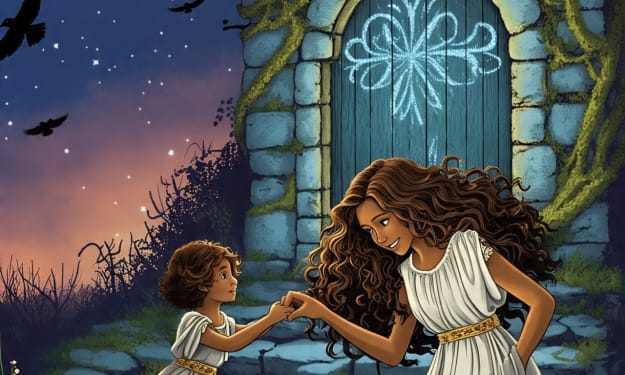
In the quiet town of Elmbrook, where the fog rolled in thick every morning and the rain tapped gentle lullabies against windowpanes, lived a girl named Mira. She was an oddity by the town’s standards—not because she wore mismatched socks or talked to the crows, but because she carried a piece of chalk wherever she went. Bright blue, always sharpened to a perfect point. Mira wasn’t like other children. While they played hide-and-seek or kicked footballs across the muddy park, Mira crouched by the walls of old buildings, sketching doors. Not ordinary doors, either—hers had twisted handles, vines growing out of the frames, and symbols no one could read. Sometimes they glowed faintly under moonlight. People whispered. “That Mira’s not right,” they’d say, peeking through lace curtains. “Drawing doors on things like she’s trying to leave.” But Mira wasn’t trying to leave. She was trying to return. It all began when Mira was five. Her parents took her on a walk through Elmbrook’s outer woods. They told her stories about faerie circles and owl spirits, trying to make her giggle. At one point, they sat by an old stone well to rest. Mira wandered, drawn to a moss-covered boulder. Upon its face, someone had drawn a door—curved at the top, etched with stars. Curious, Mira reached out and touched it. And it opened. The world behind that door was unlike anything she knew—sky split into ribbons of lavender and gold, trees that whispered secrets, and flowers that blinked like sleepy animals. She met a woman there, tall and pale-skinned, with silver eyes and hair like fireflies. The woman called herself Liora and spoke in riddles. “You have the Sight,” Liora had said. “You can draw paths where none exist. You can open what’s closed.” Mira spent hours there, or maybe days—it was hard to tell. When she finally returned, staggering back to the mossy boulder, her parents were gone. The well was gone. The trees were different. And the town… had changed. She was still in Elmbrook. But everything felt slightly… off. Her home looked the same, but a different family lived there. The bakery was on the wrong side of the street. Her name was no longer on the school’s registry. It was like she had slipped into a different version of the world. No one remembered her. Except the crows. That’s when she began drawing. She stole a stick of blue chalk from a schoolyard box and began sketching doors—trying to find her way back to the door that had first opened. Trying to find Liora, or at least someone who remembered the world behind the veil. For years, Mira searched. Sometimes the doors she drew would open. Sometimes they would hiss and vanish into smoke. Once, a door led her to a desert with two moons and a city made of glass. Another took her into a library suspended over a void, where books fluttered like birds and spoke aloud in a dozen voices. Each time, she asked, “Do you know how I can get back?” Each time, the answer was either silence or more riddles. One day, at sixteen, Mira found herself sketching a door on the stone wall behind the old bakery—an ornate arch with spirals like flames. She hadn’t meant to draw it; her hand had moved of its own accord. When she stepped back, the air shimmered, and the door opened soundlessly. Liora stood on the other side, older now, sadness etched around her eyes. “You’ve been searching long,” Liora said softly. “The threads between worlds are thinning.” “Why can’t I go back?” Mira asked, heart aching. “Because your world has already moved forward. And so have you.” Mira lowered her gaze. “Then what am I?” Liora smiled, brushing a curl from Mira’s face. “You are a Walker now. A Doorweaver. The girl who drew doors because she could never stop seeking… and who helped others find their way.” Mira turned. Behind her stood a child, lost, frightened, clutching a stuffed bear. The girl’s eyes wide with wonder. “She’s like you once were,” said Liora. “She needs a path.” Mira took the child’s hand. Then she knelt, and with her blue chalk, she began to draw. A door bloomed on the stone wall, warm and golden. It pulsed like a heartbeat. And together, they stepped through. Mira had finally found her purpose—not to return to where she came from, but to help others find their way home. She would always be the girl who drew doors. But now, she was also the one who held them open
By Azmat Roman ✨about a year ago in Fiction
Jan the Waster
Jan was a shadow of herself, a prisoner to the ceaseless thrall of implant addiction. Her life had become a series of fleeting, neurodigitally induced euphorias—echoes of real joy—fed by the relentless VR and AR wired directly into her senses. Much like someone enslaved by heroin, crack, meth, or alcohol, Jan was ensnared by a new demon—an insatiable hunger for digital pleasure. Roaming the streets, she was a shell—mentally fractured, willfully sapped, and living in squalor. Her existence had been reduced to a perpetual quest for the next data-driven high, and her agony was palpable within the onslaught of this digital narcotic on her mind.
By Benjamin Riceabout a year ago in Fiction
The Rose of Gbaye. AI-Generated.
In the quiet hills of Gbaye, a remote Liberian town untouched by the pace of modern life, time moved differently. There were no phones ringing, no electric hum from screens, no cars honking impatiently. The people lived by the sun and the stories, the ones whispered over fires at night and carved into memory like scripture. One story, however, stood apart. A story too strange to be true, too real to be fantasy, the story of Jomah and Satta.
By Altrick_ Nellabout a year ago in Fiction
My Grandmother’s Mirror Only Reflects the Dead
The Mirror’s First Secret I almost sold the mirror the day after Grandma Lillian’s funeral. It was an ugly thing—a heavy oak frame carved with twisting vines, the glass smoky with age. But Mom insisted: "She wanted you to have it. Said it was special."
By MUHAMMAD Abbasabout a year ago in Fiction
What The Ocean Took
The ocean had always been a part of Clara’s life. She was born in a cottage on the windswept cliffs of the Maine coast, raised by a fisherman father who smelled of salt and seaweed and a mother who hummed old sea shanties as lullabies. Every morning, the tide whispered stories through the stones and sea-glass outside their home. Clara used to listen, believing the waves carried messages from another world. But on the morning of October 12th, when she was seventeen, the ocean stopped telling stories. That was the day her brother, Eli, didn’t come back. It had started like any other autumn morning. A pale mist hovered above the waves, and the sea was restless, but not angry. Clara had brought Eli a thermos of hot tea as he packed the lobster traps into their father’s old skiff. His smile was lopsided, still half-asleep. He ruffled her hair, promised to be back by noon, and pushed off into the gray. He never returned. The Coast Guard searched for three days. They found the skiff capsized near Blackwater Cove, one trap caught in a reef, its wire bent like it had struggled against something far stronger than a crustacean. But there was no sign of Eli. No body. No clue. Just the silence that followed. Their mother stopped singing. Their father sold the boat. Clara stopped going near the water. Years passed, but the grief did not dull—it calcified, like barnacles clinging to her ribs. Clara moved inland to Boston for college, studied marine biology to try to make sense of the very thing that had taken her brother. She spent years trying to understand the language of tides, the patterns of currents, even the behavior of storms. None of it answered the question that kept her awake at night: What did the ocean take him for? --- Ten years later, Clara returned to the coast. Their mother had died the previous winter, and the cottage sat vacant, the sea breeze peeling paint from the shutters. Her father had long since moved south, leaving the place in Clara’s name. She hadn’t planned to stay more than a few days—just long enough to settle the estate and say goodbye properly. But the ocean called to her again. It was subtle at first. The crash of waves no longer made her flinch. The salt air began to feel like home. One evening, as she stood barefoot on the rocks where Eli used to fish, she saw something glinting between the stones. A silver pendant. She recognized it instantly—Eli’s Saint Christopher medallion, the one their mother had given him when he first learned to swim. The chain was tangled with seaweed, and the metal was tarnished by years underwater. Clara stared at it in disbelief. The tide had gone out, revealing the medallion just feet from where she stood. How could it have surfaced now, after a decade? How had it not washed away? That night, she dreamed of Eli. He stood on the shore, soaked and pale, speaking in a language she didn’t recognize—his mouth moved like the tide, rhythmic, deep. When she reached for him, a wave pulled her under. She woke gasping. Something had changed. --- The days grew stranger. Clara began hearing whispers in the wind—faint, unintelligible sounds that disappeared the moment she turned her head. At night, the waves seemed to echo her name. The beach behind the cottage yielded more objects: a boot she remembered Eli wearing, a bit of red cloth from his old flannel shirt. She wasn’t losing her mind—at least, not in the way others feared. She was being summoned. The morning she decided to answer, the sky was cloudless, the sea unusually still. She put the medallion around her neck and walked into the surf. She expected cold, but the water was warm—welcoming. It rose past her knees, her waist, her chest. When it covered her head, she opened her eyes. The world beneath was not the dark, silt-churned abyss she feared. It was luminous. Schools of silver fish darted through glowing kelp forests. Bioluminescent tendrils lit a path downward, and she followed, breathing as if she were still on land. At the bottom, she saw him. Eli. He hadn’t aged. His eyes were the same sea-glass green. He stood barefoot on a ridge of coral, arms open, as though waiting all this time. “This is what the ocean took,” a voice echoed—not Eli’s, but the ocean’s itself. Clara understood then. The sea hadn’t stolen him. It had chosen him. Just as it now chose her. The world above the waves faded. The next day, the townspeople found Clara’s footprints leading into the surf. No one ever saw her again. But if you stand on the cliffs on certain misty mornings, some swear they hear two voices singing—a brother and sister, their harmony carried on the tide.
By Azmat Roman ✨about a year ago in Fiction
From A Distance
They had been travelling for what seemed like forever, following the instructions of the ones who claimed to know what they needed, and now, in the distance, they could see the City of Gold at the end of the road that they had been walking for so long.
By Mike Singleton 💜 Mikeydred about a year ago in Fiction