Fantasy
🌕 Mailbox to the Moon
It all started with a blue mailbox that wasn’t supposed to be there. It stood crookedly at the end of the cul-de-sac, right where the neighborhood path curved into the woods. No street number, no postal mark, no name—just a faded moon sticker peeling from the side like a forgotten dream.
By Pir Ashfaq Ahmadabout a year ago in Fiction
A Map of All the Places We Cried.
I found the map again today. Folded into a notebook I hadn’t touched in years, pressed between pages like a fragile leaf. The paper had yellowed, the ink faded, but the red circles were still there—each one a place we cried. I don't remember whose idea it was, only that it started with a joke. "We should keep track," you said, wiping your face with your sleeve as we sat on that rainy bench outside the train station. "Make a map. Chart every time we fall apart.” So we did. --- First mark: Bench outside the train station. You were leaving for a semester abroad. I smiled as you walked away, then crumpled the second you turned the corner. It was our first goodbye, and even then, we knew it wouldn’t be the last. Second: The cafe on 9th and Willow. You spilled your coffee, and I snapped at you for something trivial. We argued in hushed voices while the barista looked away. You reached for my hand even as tears slipped from your eyes, whispering, "Why does love feel like drowning some days?" Third: Your bedroom floor. The night your dad called from the hospital. I held you as you trembled, unable to speak. Your sobs were small and sharp, like you were afraid of taking up too much space even in grief. Fourth: The parking lot after my brother’s funeral. I couldn’t breathe. You let me punch the dashboard until my knuckles bled, then kissed each one like they were wounds you could heal. You didn’t say a word. You didn’t have to. --- Over the years, the map grew. Cities, sidewalks, hotel rooms. Airports and empty streets. The front seat of the car during a thunderstorm. The museum in Chicago where we stood in front of a painting and cried for reasons neither of us could explain. Some marks were from goodbyes. Others from fear. Some, from laughter that turned into tears. There’s a kind of crying only love can bring—the kind that says “I can’t believe I found you,” and also “I’m terrified of losing you.” We were both emotional people, raw and tangled. We never pretended to be made of steel. That was what made it work—until it didn’t. The last mark we made was the park by the harbor. You said, “We’re not good for each other anymore, are we?” I said nothing, because you already knew the answer. You took the pen from my hand and circled the bench where we sat, both of us red-eyed and broken and somehow still holding hands. “One last mark,” you said. “For the record.” --- And then you left. No anger, no betrayal. Just a slow, quiet undoing of something that had once felt like forever. I stopped looking at the map after that. Until today. --- As I unfolded it, I traced every red circle with my fingertip. Not with regret—but with recognition. Because here’s the thing about mapping sorrow: it doesn’t only show where things hurt. It shows where we were. Where we tried. Where we cared enough to cry. That map is our love story, just told in a different language. And I think, maybe, that’s okay. Because for every place we cried, there was a moment before the tears. A hand held. A promise made. A silence filled with understanding. A love so deep it had nowhere else to go but out through our eyes. --- If I could talk to you now, I wouldn’t ask for another chance. I’d just hand you this map and say, “Look. We didn’t fail. We felt.” And maybe that’s enough. Maybe it always was.
By Azmat Roman ✨about a year ago in Fiction
The Last Song We Danced To
When Emma first met Ayaan at the college music club, she didn’t think much of the shy guy in the corner, strumming his guitar like the world outside didn’t exist. He barely spoke, eyes always hidden behind messy curls, but when he sang — something in her stirred. It wasn’t just his voice. It was the pain in it. The kind of pain people try to hide, but music spills. Emma was the exact opposite — loud, impulsive, bright like summer. She talked too much, laughed too often, and felt everything deeply. Still, something about Ayaan made her heart slow down. Made her quiet. He didn’t speak much, but over time, he started leaving her little notes on her sheet music. Lyrics he was too afraid to say aloud. One day she replied — not with words, but a melody on the piano, soft and uncertain. That was how their love began — not with fireworks, but with notes and silences. By the final year, everyone knew them as “the duo.” Where Emma went, Ayaan followed, always two steps behind but never too far. He wrote songs for her. She sang them like they were hers. One rainy evening, under a tin roof that echoed with thunder, he kissed her for the first time. No words. Just the kind of kiss that says, “Stay.” But life, like music, sometimes ends on unresolved chords. A few months after graduation, Ayaan started disappearing. He missed calls, skipped dates, and avoided questions. Emma fought. She cried. She screamed into voicemail. Then one day, he showed up on her doorstep, pale and trembling. “I didn’t want to tell you until I was sure,” he said, voice breaking. “I have cancer.” The world tilted. Everything went quiet except the sound of her heart breaking. They spent the next year in hospitals and waiting rooms, measuring time not by days but by chemo cycles and blood reports. Emma never left. Not once. She read to him, played their songs, made him laugh on the worst days. She became his anchor, his home, his song. And still — he was slipping away. One winter evening, he took her hand, his fingers cold and thin. “I wrote one last song,” he whispered. “Play it when I’m gone.” Emma shook her head, tears streaming. “Don’t say that.” But he just smiled. “Promise me.” She nodded, even as her heart screamed. Three weeks later, he was gone. She didn’t touch the piano for months. Couldn’t bear the silence it left behind. Couldn’t breathe without him. But on what would have been his 25th birthday, she opened his notebook. And there it was — a song titled “The Last Time I Saw You.” Her fingers shook as she played. The notes were soft, aching, unfinished — like him. Halfway through, she broke down, the keys wet with her tears. But then, something shifted. She felt him there, in the pauses, in the melody, in the ache. So she played it again. And again. She performed it live one year later, in front of a crowd that didn’t know their story. But she sang for him — and for herself. And when she sang the final line — “You were my forever, even when forever ended too soon” — the whole room went still. She still plays that song. Sometimes at shows. Sometimes alone. Love doesn’t always end in old age or wedding rings. Sometimes it ends in a hospital room with an unfinished song and a promise kept. And sometimes, that’s enough to keep a heart beating. Conclusion “The Last Song We Danced To” is a tender reminder that love, even when cut short, leaves behind a melody that never fades. Through grief and music, Emma finds a way to keep Ayaan’s memory alive — not in silence, but in song. Their story doesn’t end with goodbye; it lingers in every note she plays, echoing a love that transcended time.
By Dr Gabriel about a year ago in Fiction
Through the Mirror, She Waits.
The mirror in the attic had always been wrong. Not broken—its surface was perfectly smooth, unmarred by cracks or age. It wasn’t dusty, despite the years. It didn’t even reflect the light quite right. Sometimes, it made things appear a second slower, like a video buffering on bad Wi-Fi. But no one paid much attention to the attic. Except me. I first saw her when I was eight. We’d moved into the old estate house after my grandfather died. My parents were busy with unpacking and grief, and I was just... curious. I found the attic on a rainy afternoon, drawn by the creak of a door that hadn’t been open in years. It smelled like mothballs and forgotten stories. And there, in the far corner, stood the mirror. It wasn’t just a mirror—it was a tall, arched thing in a brass frame, ancient and imposing, resting against the wall like it had grown from the house itself. And in it, I saw... her. She looked like me. Same hair, same eyes, same little scar on the chin I got when I fell off my bike. But it wasn’t me. She moved when I didn’t. Tilted her head the wrong way. Smiled when I frowned. And when I turned to run, she waved. --- Years passed. I learned to ignore the attic. Grew out of my imagination, or tried to. But sometimes I’d catch a glimpse of her reflection in a dark window or the bathroom mirror when the lights flickered. She never aged. I did. At sixteen, I returned to the attic again. I don’t know why. Maybe I was angry. Maybe I wanted to prove she was just a dream. But when I faced the mirror, she was waiting. She pressed her hand to the glass. I followed. And for the briefest second, our hands touched. Not glass to glass—but skin to skin. And then she whispered something I’ve never forgotten: “You’re the one who left.” --- It started to unravel after that. My dreams grew heavy, filled with static and fog. I’d see her walking through my school halls in my clothes. I’d hear my name spoken in my own voice, when I hadn’t spoken. I started to wonder if I was the reflection—or if she was. When I told my parents, they called it stress. Anxiety. “Creative overdrive,” my mother said. They took away the attic key. But she still found me in the mirrors. On my nineteenth birthday, I found a note taped to my bedroom mirror. Five words. Written in my handwriting: “You don’t belong out there.” --- I write this now because I’m not sure how much longer I’ll be here. This morning, I looked in the mirror, and I wasn’t there. She was. She was brushing her hair, humming the lullaby my mom used to sing. She looked... real. Solid. And I felt—thin. Paperlike. Like a drawing someone had forgotten to shade in. She looked at me, calm and certain, and said, “It’s your turn now.” And I understood. I wasn’t the original. I never was. She was the one who had been trapped. Somehow, years ago—maybe that first time at eight—I had taken her place. Or stolen it. And now, she waits no longer. Because I do. --- Through the mirror, she waits. Where time stands still. Where smiles don’t reach the eyes. Where everything is almost, almost, almost real. If you ever find a mirror that seems a little too quiet, that reflects a version of you who lingers too long after you've turned away—don’t touch it. Don’t speak to her. Because she’s always waiting. And the mirror remembers. Even if you don’t.
By Azmat Roman ✨about a year ago in Fiction
He Wrote Me Into His Story.
I met him on a Thursday, the kind of gray-skied day that made the world feel softer, as if everything around us was exhaling. He was sitting at the corner table of the little bookstore café I always ran to when life grew too loud. He had a notebook open, pen in hand, coffee gone cold. Something about him looked like he belonged in a different time—quiet, observant, full of old soul energy. I didn’t know then that he was a writer. Or maybe I did, the way you know someone has music in them even if you’ve never heard them play. Our first words were borrowed. I asked if he was done with the table. He looked up, smiled slightly, and said, “No, but stay. There’s room in stories for more than one.” I stayed. We began like pencil marks on the edge of a page—sketched, tentative, light. A passing glance turned to casual conversation. He told me his name was Eli, and that he wrote things “no one really reads.” I told him I studied art and didn’t know where I was going with it. He laughed and said, “That’s how you know it’s real.” Weeks turned into months. Our lives became chapters with recurring scenes—mornings over mismatched mugs, evening walks through rain-damp streets, notes scribbled on napkins and tucked into books. He started showing me his writing, first shyly, then more often. His words were like secret doors. One night, while curled on his couch with a blanket wrapped around my knees, he handed me a new draft. “It’s not finished,” he said, eyes flicking away. “But you should see it.” The main character was a girl named Clara. She was nothing like me, and yet, completely me. She was fiercely quiet, wore her pain like perfume—subtle but always present—and found refuge in art and old things. She loved a man who didn’t know how to say "I love you," but wrote it in the margins of every page. I read it twice. Then again. “You wrote me,” I whispered. “No,” he said, gently. “I wrote with you.” Some people show their hearts with hands. He did it with ink. In every line, he gave me pieces of himself he couldn’t say aloud. There was longing in the pauses, tenderness in the dialogue. His characters stumbled and tried and hoped—and somehow, I knew he was telling me he loved me. He just hadn’t found a way to say it in real life. But life, as stories often do, turned. His agent loved the manuscript. Publishers were suddenly interested. He was going to be somebody—he was somebody. I was proud of him. I truly was. But as his world expanded, I felt mine shrinking. The quiet spaces we used to share were now filled with interviews, deadlines, book tours. He tried. I know he did. But time became thin. Our chapters grew shorter. Then, one day, I walked into a bookstore and saw our story on a shelf. The Paper Heart, by Eli Archer. The cover was beautiful. His words even more so. I flipped through the pages and found her—Clara. Still broken in beautiful ways, still trying to be whole. And there, in chapter fourteen, she looked across a café and whispered, “There’s room in stories for more than one.” That was my goodbye. Not in person. Not with a fight. But in fiction, where he could love me forever without the mess of reality. I haven’t seen him in years. But sometimes, on quiet afternoons, I pick up the book and reread my favorite lines. I remember the way his voice sounded when he read aloud. The way he hesitated before writing something vulnerable. He wrote me into his story—not to keep me, but to remember me. And in a strange, painful, beautiful way... That was enough.
By Azmat Roman ✨about a year ago in Fiction
The True Story of Sam. Runner-Up in You Were Never Really Here Challenge.
I met him the summer I turned seven. Down by the creek where I used to play on my grandparent's farm. He waited behind the toolshed. He told me his name was Sam, and he told me that like he wasn’t sure it still was.
By Tim Carmichaelabout a year ago in Fiction
A Promise in Ash
Before dawn, beneath a sky heavy with unshed stars, the Night Market held its breath. Lanterns swayed like flickering souls caught in a restless wind. Shadows leaned close, whispering secrets that time had forgotten. And in the heart of this ancient, bleeding place, the Mender moved—a figure woven from sorrow and quiet resolve, his cloak trailing faint echoes of prayers long spent.
By Paper Lanternabout a year ago in Fiction
The Cloud Collector
It was the kind of evening where the sky turned a dull purple before the sun even set. A gust of wind played with the trees, sending whispers through the branches. In the quiet of the neighborhood, eleven-year-old Noah stood by the edge of his yard, a small, homemade net made of string and an old coat hanger in his hand. It looked like something from a forgotten science project, but it was his most prized possession.
By Pir Ashfaq Ahmadabout a year ago in Fiction
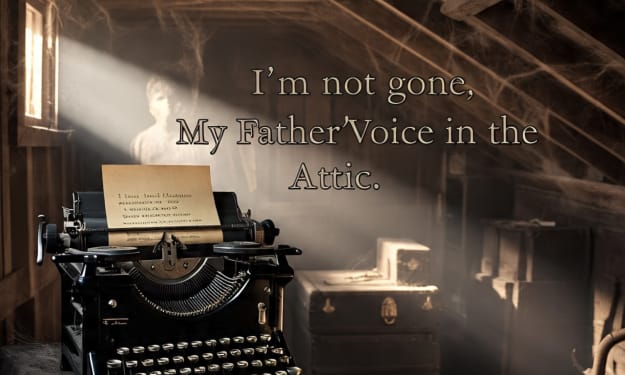
My Father's Voice in the Attic.
It started with a voice—soft, unmistakable, and impossibly familiar. I was alone in the house, brushing dust from old photo albums in the parlor, when I heard it. A low murmur floated down from the attic, like a conversation overheard through a wall. My heart stuttered. It had been three years since my father passed away. The funeral was quiet, somber—just as he would have wanted. He was a private man, a writer of some small renown in his day, and he’d lived most of his final years holed up in this very house, surrounded by papers and silence. Now that Mom had moved into a smaller place, it fell on me to sort through everything. The house still smelled faintly of pipe smoke and ink. I told myself I imagined it. The wind maybe, or the moan of the old beams settling under the June heat. I went back to organizing the old letters. Then I heard it again. This time, clearer: “Anna…” My name. I froze. My father’s voice. Raspy, deep, unmistakable. He used to call my name that way when I was little, when he found me buried under a pile of books in the corner of the study, or when I’d fallen asleep on the sofa while he wrote late into the night. I stood, grabbed the flashlight, and made my way up the creaky stairs. The attic door groaned on its hinges as I pulled it open. The warm air hit me like a wave, thick with dust and old paper. “Dad?” I called, feeling ridiculous. Nothing. The attic looked the same as always—stacked boxes, a few old paintings, yellowed newspaper clippings of his book reviews pinned to the rafters. And then I noticed it: the typewriter. His old black Remington sat in the middle of the attic floor. I was sure it hadn’t been there before. Slowly, I approached. A single sheet of paper was fed into the carriage. On it, one line typed in the faded ink of a ribbon long expired: “I'm not gone, Anna.” My hands trembled. The key bars were cold to the touch, unmoving. I looked around, heart thumping. Dust clung to every surface, undisturbed. No footprints but mine. I backed away, closed the attic door behind me, and didn’t sleep that night. --- The next day, curiosity won over fear. I returned with gloves, a mask, and determination. If someone was playing tricks on me, I needed to know. I searched the attic thoroughly. No speakers, no electronics. No prankster hiding in the boxes. But the typewriter? It had more pages. One each day. Each with a new line in his voice, his phrasing, the kind of poetic insight only my father could produce. “You always understood the silence between words.” “There are stories I never told you, Anna.” “You are the final chapter I never got to write.” It became a ritual. Each morning I climbed into the attic and read what he’d left behind. And then came the day the typewriter stopped. The last page sat there with a single sentence: “Look beneath the floorboards.” My breath caught. I hesitated. But something deeper than fear pushed me forward. I pried up the floorboards near the typewriter, coughing as dust billowed around me. There, wrapped in oilskin and bound with string, was a manuscript. The title page read: "For Anna – The Story of Us" It was a memoir—his memoir. A deeply personal, beautiful, and painfully honest chronicle of his life, his regrets, and his love for me and Mom. Things he never said aloud. Stories he never shared. I read through the night, tears soaking the final pages. --- When the publisher saw the manuscript, they wept too. “It’s his masterpiece,” they said. “A voice from beyond.” But I knew better. It wasn’t a ghost story. It was love—my father’s final act of connection. Somehow, some way, he had waited until I was ready to hear it. And now, whenever I sit quietly, I sometimes hear the clack of old typewriter keys, echoing faintly from the attic above.
By Azmat Roman ✨about a year ago in Fiction
The Whispering Library
The Whispering Library Genre: Mystery / Fantasy Theme: Truth vs. Family Loyalty | Power of Knowledge Word count: ~750 --- In the forgotten town of Elderbrook, where fog rolled in like soft ghosts over broken cobblestone streets, stood a building that no one dared enter: The Elderbrook Library. Its roof sagged, ivy gripped its crumbling walls, and rusted chains held the massive oak doors shut like the mouth of some ancient creature. But the real reason no one went near it was the whispers. Anyone who wandered too close on a quiet night swore they heard them—voices calling from inside, soft as breath, repeating secrets no one could quite understand. Sixteen-year-old Lila Maren had grown up with the stories. Some said witches once kept spells there. Others claimed it was cursed. But for Lila, it was something more personal. Her grandfather—Elias Maren—had vanished years ago after spending countless hours in that library. No one in her family spoke of him. If she asked, her mother’s lips tightened into a thin, pale line. That silence was what led her here. One evening, armed with a flashlight, a notebook, and a stolen iron key she found hidden inside her grandfather’s old writing desk, Lila stood at the entrance. Her heart raced as she slid the key into the old lock. The chains fell away with a sharp, metallic clatter, echoing into the quiet night. As she pushed the heavy door open, a gust of stale, cold air rushed past her. Dust swirled in the beam of her flashlight, and tall shelves stretched endlessly into the darkness. Books sat forgotten, their spines cracked and worn by time. And then she heard it. Whispers. They drifted from the shelves, curling around her like silk threads — soft voices, some speaking clearly, others just murmurs on the edge of meaning. Some told stories, others whispered names, dates, regrets. Drawn by a voice clearer and more urgent than the rest, Lila moved deeper into the library. The voice seemed to know her. Finally, she stopped in front of a solitary table. On it sat a large, worn book, its leather cover cracked with age. The title, barely visible under layers of dust, read: “The Maren Lineage: Truths Unspoken.” Her breath caught. Maren. Her family name. Hesitating only for a second, she opened the book. A sudden, cold draft swept over her. Then, the whispers stopped — all except one. “Lila… at last.” The voice was familiar and distant, like an old record playing in another room. It was her grandfather. Frozen in place, Lila listened as the voice continued: "They buried the truth, but you deserve to know. I was not lost—I was hidden, hidden by those who feared what I uncovered here.” As Lila turned the pages, strange glowing ink swirled to life, forming words, maps, family trees. Images rose from the pages like smoke, forming fleeting pictures in the air—memories from another life. She saw her grandfather standing in the very library where she stood now, surrounded by books whispering ancient histories. She saw council meetings in shadowed rooms, decisions made to protect some great secret. “Beneath this very building,” Elias’s voice whispered, “is something our family was tasked to guard for generations — a hidden archive of knowledge too dangerous for the world above. But greed grew within the family. They locked me away with silence because I refused to keep it hidden any longer.” Lila’s hands trembled. Suddenly, everything made sense — the unspoken words at family dinners, the missing photos of her grandfather, the quiet shame that hung like a fog over their home. The last pages of the book formed a map. “There’s a door below the library,” the whisper said. “The truth is yours to find. But beware — once you know it, you cannot un-know it. Knowledge is power, Lila, but it’s also a burden.” The whispers around her resumed like a storm starting in the distance, louder now, echoing truths long forgotten. For the first time, Lila didn’t feel afraid. She felt chosen. Clutching the book to her chest, she walked toward the back of the library, where the floor sloped downward into darkness. The truth waited for her there, and with it, the answers her family had buried. And the whispers followed her every step of the way. Moral :Knowledge is a gift — and a responsibility.”
By Abdul Musawer about a year ago in Fiction