Fantasy
The Third Taste. AI-Generated.
The Third Taste I met her for the first time at a quiet coffee shop in a posh area—my usual spot. I used to come there every day, sip my coffee, and read a few pages of whatever book I had in hand. It was a routine I started back when I was a university student, and it became my world—books and coffee, nothing more, nothing less.
By A Waseem khattakabout a year ago in Fiction
The Librarian’s Clock
Elias Whitlock had never planned to return to the old library. It had always felt more like a museum than a place to read—a grand, forgotten structure filled with dust, silence, and secrets. But when his grandfather, Arthur Whitlock, passed away, the town's only library and everything inside it was left to Elias. Along with it came a letter:
By Musawir Shahabout a year ago in Fiction
The Man Who Collected Goodbyes
The Man Who Collected Goodbyes He sat in the farthest corner of the café, where the sunlight met the shadows, sipping lukewarm coffee like it was sacred. Every day, at exactly 4 p.m., he arrived—never early, never late. Always alone.
By Wings of Time about a year ago in Fiction
Death is a mystery (Episode 2)
DEATH IS A MYSTERY😔... But IT OFTEN SEND SIGNS BEFORE IT COMES 😔 (Episode 2) The village of UJUALA was cloaked in an uneasy silence following Elder Nneka's ominous declaration: “Tomorrow, at this same hour, one of you… will not be here.”
By Haya princessabout a year ago in Fiction
When the Rain Fell Softly. AI-Generated.
The first time I saw her, it was raining—not the wild, stormy kind, but the soft, gentle drizzle that makes everything feel like a dream. I was sitting outside a quiet bookstore in Lahore, under a small awning, sipping hot chai from a paper cup. The smell of wet earth, old books, and street samosas lingered in the air. That’s when she appeared—running, laughing, drenched but not bothered at all. Her dupatta clung to her, her hair wet and tangled, and her smile… it was the kind that didn’t ask for attention but captured it anyway. She looked at me, a stranger, and said, “Do you mind if I stand here for a while? My umbrella broke halfway down the street.” I moved slightly, making space under the already crowded shade. “Of course not.” She stood beside me, brushing water from her sleeves. There was a kind of quiet comfort in the moment—two strangers sharing shelter from the rain. I offered her some chai. She took it with a soft laugh and thanked me. That’s how it began. Her name was Areeba. She was a literature student, studying Urdu classics, and had a soft spot for rainy days and old poetry. That first conversation went from Faiz to Ghalib, from chai stalls to childhood stories. She told me how marigolds reminded her of her grandmother’s garden—how they were simple but lasted longer than roses. I remember thinking, This girl sees beauty in things most people forget to notice. We parted ways that day without exchanging numbers, just a smile and a soft “maybe I’ll see you again.” I didn’t expect to. But the city, in its strange way, kept bringing us back together. We met again a week later at the same bookstore. Then again in a chai shop nearby. After that, it became a pattern. We never made plans—we just kept running into each other like the universe was writing us into the same chapter. We talked about everything. She told me how her dream was to pursue her Master’s in Karachi. I told her how I loved photography but never had the courage to chase it seriously. She encouraged me, saying, “If something brings you peace, it’s worth following.” One day, I brought her a bunch of marigolds, tied in a simple white thread. She looked at them, then at me. “You remembered.” “I remember everything about you,” I replied. We sat on that bookstore bench for hours, not caring about time or the noise around us. She read me poems from her notebook. I took pictures of her holding those marigolds, the sunlight catching her smile. But not every love story ends with forever. Some just leave you with moments that never fade. One evening, as we sat under our favorite tree, Areeba told me she’d gotten her admission in Karachi. She was leaving in two weeks. “I’m happy for you,” I said, though my chest ached. “I don’t want to go,” she whispered. “But you have to,” I replied. “For yourself. And I’ll still be here. Always.” We didn’t make promises we couldn’t keep. We exchanged letters instead of big words. And when she left, I stood at the station with another bunch of marigolds, watching her train disappear into the horizon. We kept in touch for a while—calls, texts, voice notes filled with poetry and silly jokes. But life has its way of testing distances. Slowly, the messages grew shorter. The calls became less frequent. And yet… not a day goes by when I don’t think of her. Every time it rains, I look out the window and remember that day—her laugh, the broken umbrella, and the warmth of her hand brushing mine as she took the chai. I still visit that bookstore. I still sit on that same bench. And yes, I still buy marigolds. Because sometimes, a moment is enough. One walk in the rain. One poem. One girl who saw beauty in forgotten things. And honestly, even if love doesn’t last a lifetime, it can still change one. Forever.
By Sherooz khanabout a year ago in Fiction
One Hundred Years of Solitude
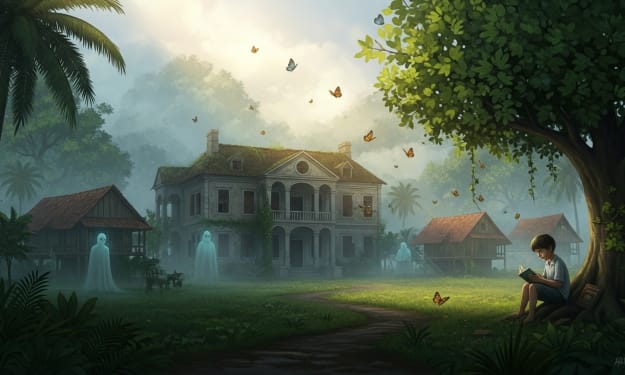
The Buendía house stood at the edge of the village of Santa Nieve, where the jungle whispered and time curled in on itself like old parchment. It had been there for a hundred years, though no one remembered building it, and no one dared to tear it down. The walls wept in the rainy season, the windows blinked with the wind, and strange lights flickered from the attic even when the house was empty. Except it was never really empty. The villagers swore they saw the same faces looking out from the upper window—faces of the dead. But it was not the dead that haunted the Buendía house. It was memory. --- Every generation of Buendías was born with two things: a peculiar birthmark shaped like an almond and an incurable yearning to escape the fate of their forebears. Yet they always came back—drawn by dreams, omens, or guilt—to the house that never aged, even as they did. Mateo Buendía was the last. At twelve, he wandered into the library on the second floor and found a dusty journal with a cracked leather cover. His fingers tingled when he touched it, as if the book had been waiting for him. Inside were entries dating back a century, written by hands that trembled with love, sorrow, and madness. The first entry: “Time is not a line. It is a circle made of forgetting.” Mateo read late into the night, the past whispering secrets through ink. --- He learned of Esperanza Buendía, who could see spirits but married a man who believed only in science. She danced with ghosts in the hallway and wept when her husband burned all her journals in a fire fueled by logic. Of Rafael, who tried to sail upriver to find the city of mirrors but returned years later with white hair, empty eyes, and a bottle that contained only silence. Of Alma, who once fell in love with a man in her dreams and searched the waking world in vain, never realizing he had been born decades after her death. And of Aureliano, the original—the first to write the journal, the first to speak of solitude not as loneliness, but as inheritance. --- “Why do they all return?” Mateo asked the old gardener one morning. The gardener, who had worked there longer than anyone alive could remember, said, “Because the house remembers what they forget.” That night, Mateo dreamed of Esperanza standing by the fig tree, beckoning him. Her voice echoed: "The curse is not solitude. It is silence. You must finish the story." --- Mateo wrote every night after that, filling page after page in a second journal. Not just with the tales of the Buendías, but with his own. Of feeling invisible at school. Of the boy who smiled at him once and never again. Of the silence that grew between him and his mother, who spoke to birds more than she did to him. The more he wrote, the more the house changed. The cracks in the walls healed. The air grew lighter. The attic door, sealed for generations, creaked open. Inside, Mateo found a mirror. But when he looked into it, he saw not himself—but every Buendía before him. They blinked, breathed, wept. And then, they smiled. --- Years passed. Mateo never left the house. People said he had gone mad like the others, obsessed with the past. But sometimes children saw him in the garden, speaking to butterflies or writing in the dust with his fingers. And at night, light still flickered in the attic. One stormy evening, lightning struck the fig tree. When the villagers came to check the ruins, the house was gone. All that remained were two journals under the roots—one old, one new—and a single almond-shaped birthmark burned into the earth. --- In time, the Buendía name became legend. A whisper. A tale told to children about the house that remembered and the boy who listened. No one dared rebuild on the land. For even in absence, solitude lived there still—eternal, magical, and waiting to be written again.
By Shah Nawazabout a year ago in Fiction