Fantasy
Purpose Beach Part 1:
It is a well known fact that despite the vastness of the cosmos, finding a planet able to support life is not an easy task. Because of this, planets such as Earth are often viewed as places one could go if one wished to start a new life.
By Noah Motechinabout a year ago in Fiction
He Carved Her Name Into the Tree Every Year
He Carved Her Name Into the Tree Every Year Written by Mirza Each autumn, when the leaves began toHe Carved Her Name Into the Tree Every fall like fireflakes from the sky, an old man with a slow gait and gentle eyes would walk the narrow path beside Silverlake. He always carried the same worn satchel, a blanket tucked inside, and a rusted pocketknife older than many of the trees lining the path. He walked past the crooked wooden sign reading Lakeview Trail, past the bench where young lovers often sat and whispered dreams, and toward a tall sycamore tree by the water’s edge. Its bark bore many stories — initials, hearts, dates — but his was always the deepest, the most carefully etched. He reached the tree and paused. His hand, trembling from age, brushed across the bark where one name stood out from all the others: “ELENA.” Every year, he came back to this tree. And every year, he carved her name a little deeper. The First Carving It was 1975. He was 19, and she was 17 — a firecracker in a denim skirt with paint on her cheeks and wild dreams in her eyes. They met at a community picnic, and she’d laughed at his serious face as he tried to explain the difference between oaks and sycamores. That same evening, as the sun dipped below the hills, she’d dragged him by the hand to the lake and said: “Let’s carve our names into that tree. That way, even if we forget, it won’t.” He’d hesitated — trees were living things, and cutting into them felt like vandalizing something pure. But she looked at him with those eyes, and he caved. J + E — a simple carving, surrounded by a heart. She smiled and kissed him, her lips tasting like lemonade and certainty. The Middle Years Life, as it does, grew complicated. They got married two years later, moved into a cramped apartment, and eventually found their way into a modest house with peeling paint and a yard full of weeds they never had time to pull. He became a school teacher. She became an artist, though most of her work never left the garage. But they always had Silverlake. Each anniversary, they’d walk the trail, find the tree, and carve the date below their initials. The bark grew thick over the years, but somehow their markings endured. When she had their daughter, Lily, they brought her to the tree and told her, “This is where we started.” The Last Year Together She started forgetting little things — the names of her paints, the route home, even their anniversary. At first, they joked about it. “My brain’s just full of color,” she’d laugh. But then it got worse. Diagnosis: early-onset Alzheimer’s. The years that followed were cruel. Some days she didn’t recognize their daughter. Some days she mistook him for her father. Some days she stood at the sink crying, unsure of why. But one thing remained: the tree. Even when words failed her, she’d look at the carving and whisper, “That’s me.” Their last visit to Silverlake was in the fall of 2010. She clutched his hand tightly and asked, “Will you keep coming here? Even when I’m gone?” He nodded, tears streaming down his cheeks. “Every year. I promise.” She died two months later. The Promise He Kept Since then, he returned every autumn. Alone. He brought a chair now, since standing long became difficult. He’d sit for hours, just staring across the lake, watching the wind stir the water like she used to stir her tea — slowly, with intention. Each year, he’d carve her name again. Not adding anything. Just tracing over the old letters, as if keeping them fresh would somehow keep her memory alive. E-L-E-N-A. Birds nested above. Children played nearby. Young couples passed, not noticing the quiet man who sat with a blade and a heart full of grief. Sometimes, he’d bring their daughter. Sometimes, she brought his grandchildren. They never carved anything. They said the tree belonged to him and her. One Autumn Morning He didn’t come. For the first time in 15 years, the trail remained untouched by his footsteps. The tree stood alone, the bark slowly reclaiming its scars. A week passed. Then two. Locals noticed. Someone left flowers beneath the tree. A note: “We miss you.” Eventually, his daughter returned with her two children. She carried a photo — of her parents sitting beside the sycamore, arms wrapped around each other, the lake behind them glowing like liquid gold. She didn’t cry. She smiled and whispered, “Thank you, Papa. You kept your promise.” That year, she brought a small chisel instead of a knife. And just below the name ELENA, she carved one more word: JAMES. Side by side. Forever. Now the Tree Knows Their Story Years pass. The tree grows. Tourists walk the trail, pointing at the carvings. Some smile. Some wonder. Some take photos. But if you ask the locals, they’ll tell you: “That’s the Love Tree.” “A man came here every year, just for her.” “He never stopped loving her, even after the goodbye.” And if you sit long enough by the lake, on a crisp autumn day, you might just hear the wind whisper her name. Elena. And his. James. Still together. Still growing.
By Moonlit Lettersabout a year ago in Fiction
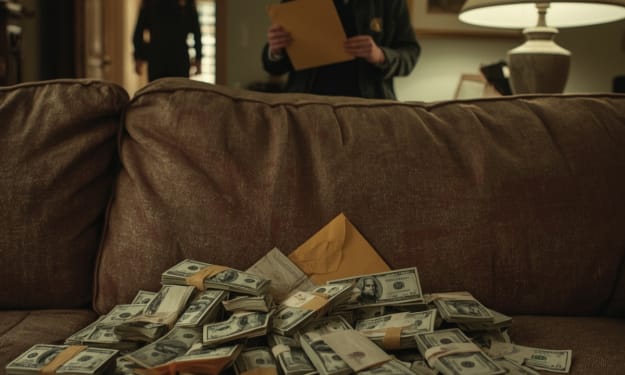
"He Bought a $70 Couch—Then Found $300,000 Hidden Inside"
When 28-year old Max Fletcher walked into a dusty secondhand furniture store in northern Michigan, he was just looking for something cheap and decent enough to replace the battered futon in his studio apartment. What he walked out with—well, he had no idea his $70 purchase would become the most bizarre and life-altering decision of his life. “I just thought, hey, this old couch is ugly, but it's sturdy,” Max says. “The springs were still good, and I could throw a blanket over it. I was broke and needed something fast.” He tossed it into the back of his pickup, hauled it up three flights of stairs, and collapsed onto it that same night with a pizza and a documentary. Everything seemed perfectly normal—until four days later, when he dropped his TV remote behind one of the cushions and went fishing for it. What he pulled out wasn’t the remote. It was a thick yellow envelope. “I thought it was junk mail or old receipts,” Max recalls. “But when I opened it, it was full of cash. Like… a lot of cash. Neatly bundled in $100 bills.” Max quickly found more envelopes stuffed deep within the couch's lining and beneath the cushions. His heart racing, he pulled out envelope after envelope. By the end of the night, he was sitting on a living room floor surrounded by $300,000 in cash. The First Question: Is This Even Real? Max did what most people would—he panicked. “I thought it had to be drug money or something illegal,” he says. “I didn’t even sleep that night. I kept checking my window expecting someone to show up and knock on the door.” The next morning, Max called a lawyer and then the local police. Within hours, officers were at his door, carefully counting and documenting the cash. At first, the situation looked like it might be the start of a criminal investigation. But things took a dramatic turn when the thrift store traced the couch’s origin: an estate sale from a woman who had recently passed away at age 91. A Hidden Fortune, Forgotten by Time According to her family, the woman—Mildred Harrison—was known for being intensely private, almost to the point of paranoia. She didn’t trust banks, and after her husband died in the 1980s, she began hoarding cash in unusual places. Her family had no idea. “We cleaned the house thoroughly,” said her granddaughter, Susan Harrison. “But we never thought to rip apart the furniture.” When contacted by authorities, Susan and the rest of the family were stunned—but also gracious. After confirming the money had belonged to her grandmother, the Harrisons declined to take it all back. The Unexpected Twist: A Generous Offer Instead of demanding every dollar, the family asked that Max be allowed to keep a portion of the money as a “thank-you” for doing the right thing. “We were grateful he came forward. A lot of people wouldn’t have,” said Susan. “He could’ve kept it, and no one would’ve ever known.” In the end, Max was allowed to keep $45,000—a life-changing amount for someone who’d been living paycheck to paycheck. “I almost cried,” Max says. “That money paid off my student loans, fixed my truck, and gave me a cushion I’ve never had before.” What would you Do? The story quickly went viral after a local news segment aired. Online commenters were divided—many praised Max for his honesty, while others admitted they would’ve kept quiet. Max doesn’t regret his decision. “Yeah, I could’ve kept it,” he says. “But if it was my grandma’s money, I’d want someone to do the same. Karma’s real. Besides, I still got a free couch… and 45 grand.” Moral of the Story? Always Check the Couch. Whether it’s luck, fate, or just a wild coincidence, Max Fletcher’s story is a reminder that life-changing moments can hide in the most ordinary places. So next time you’re digging between the cushions for spare change—who knows? You might just find a fortune.
By Shoaib Afridiabout a year ago in Fiction
The Clockmaker’s Last Secret
In the quiet, mist-laden town of Eldermere, where cobblestone streets wound like the gears of an ancient timepiece, there lived a clockmaker named Elias Veyne. His shop, tucked between a butcher’s stall and a forgotten bookstore, was a place of whispers—both literal and imagined. The townsfolk said Elias didn’t just repair clocks; he "listened "to them. And then, one autumn evening, he vanished. The only clue was a single pocket watch left on his workbench, its hands frozen at 3:17. But this was no ordinary timepiece. When wound, it didn’t tick forward—it ticked *backward*. The Mystery Unfolds Lira Arden, a young journalist from the city, arrived in Eldermere after hearing rumors of the clockmaker’s disappearance. She had grown up on stories of Elias—how his clocks never lost a second, how some claimed they could even *predict* events before they happened. But superstition was one thing; a missing man was another. The townspeople were reluctant to speak. The butcher muttered about "bad luck," the bookstore owner simply shook her head, and the mayor insisted Elias had "gone on a trip." But Lira noticed how their eyes flicked toward the old clock tower at the center of town, its face perpetually stuck at the same time: 3:17. That night, Lira wound the pocket watch. The world shuddered. Suddenly, she stood not in the dimly lit shop, but in the same room bathed in golden afternoon light. Elias Veyne stood before her, his fingers stained with oil, his expression one of grim recognition. "You shouldn’t have done that," he said.
By Azmat Roman ✨about a year ago in Fiction
Echoes of a Hollow Crown
The crown was too large for her head. It rested there like a curse, gleaming with centuries of bloodshed and betrayal. Queen Seris of Virelle had been crowned at midnight—no fanfare, no cheers, only the droning chants of masked priests and the rattling breath of her dying father. The throne room had smelled of dust, candle wax, and old lies.
By Masih Ullahabout a year ago in Fiction
A story of Brujeria, shovels and a baby chick
It was a Thursday. A normal Thursday for me. I went to work and came home like always. It wasn’t too hot yet in our Central Texas town, so comfy pajamas and a soft blanket were calling me. My husband was going to be at work for a few more hours and my 3 teenagers were out with friends. A rare evening where no one was there to bug me about nonsense or ask about dinner. In other words, a perfect evening for an overworked mom. I looked at my watch and it said 6:15pm. The perfect time to start my perfect evening. With my pajamas on I walked to the kitchen and had mentally decided on a pint of buttered pecan ice cream and a show to binge watch until I passed out. I was about to silence my phone when my older sister’s name popped up on the screen. I was going to let it roll to voicemail, but she rarely calls me, and I felt happy to hear from her, so I answered. The second she said my name and not my nickname, the hair on my arms stood up and I felt nervous. She asked if I had anything super important planned for the evening. I looked at my ice cream and was about to say yes when guilt set in and I said no. She thanked the heavens with relief and then proceeded to tell me I needed to pick her up in my SUV. Then she tells me that I can’t ask any questions until I pick her up and that I need to wear darks jeans, boots and a hoodie. Oh, and bring some bottled water, plastic bags and a couple of shovels and gloves. Time stood still for me because I always told her I was her ride or die. She was calling to collect, and I don’t know why, but I said OK. I never thought I would have to make good on it. As my mind came back from my mental pause, the truth finally registered at the forefront of my mind: Oh. Crap. She finally snapped and it is going down!
By "Ann Garza"about a year ago in Fiction
He Never Missed a Day—Until One Morning, He Did
He Never Missed a Day—Until One Morning, He Did Written by Raza Iqbal The townspeople called him “Captain.” It wasn’t his real name—no one ever knew what that was—but it suited him well. Every morning, just as the sky broke into shades of rose and gold, he would arrive at the beach with a soft leather journal in hand and a thermos of something warm. He’d sit on the same weathered bench facing the sea, the one closest to the old fisherman’s dock, and stare out into the waves like they held a secret only he understood. Children whispered tales about him. Some said he’d once sailed around the world. Others claimed he was waiting for a lost love who vanished at sea. The truth, perhaps, was quieter. He never missed a day. Not for rain or wind or fog. Until one morning, he did. I. The Absence “Have you seen the Captain?” The question echoed through the small coastal town. The waitress at the diner noticed first. “His coffee’s still hot,” she muttered, holding the thermos he’d left behind a week ago to be filled daily. Then the postman. The lifeguard. The librarian. Even the children noticed—the old man with eyes like tidepools hadn’t shown up in four days. His absence grew louder than his presence ever had. Someone finally checked the bench. On the seat, tucked beneath a smooth stone, was a sealed envelope. To the Next One Who Needs This, it read. II. The Letter A teenage girl named Ava was the one who found it. Her brother had just left for university. Her mother hadn’t stopped crying since. Ava didn’t understand the silence that had settled in their home. She just knew it felt heavy. And the beach was the only place she could breathe. She sat on the bench without thinking. Her eyes found the letter. Her hands trembled as she opened it. Dear Stranger, If you’re reading this, I’m gone. I don’t know who you are, but I know what brought you here. Sadness. Loneliness. A question you can’t ask out loud. The sea calls to people like us. Let me tell you something: I came here for fifty years. Every morning. Not because I was waiting for someone to return… but because I needed to remember. You see, once I had a wife. Eleanor. Bright eyes. Loud laugh. She hated sand in her shoes but loved the smell of salt in the air. She died before her time. A car accident. Just like that, she was gone. No goodbye. No time to prepare. One moment I had a life. The next, I had a silence too deep for words. That bench saved me. I’d sit and let the wind scream for me. The waves would speak when I could not. And slowly, very slowly, I began to live again—not all at once, but piece by piece. If you're hurting, let the sea hold your grief. It has room. More than you know. You don’t need to be okay right now. You just need to sit. Breathe. Let time do its quiet work. This bench is yours now. Be kind to the next soul who needs it. III. The Town Responds Ava left the letter where she found it. She didn’t tell anyone, not right away. She just came back the next day. And the day after. She started bringing her sketchbook. Then, her mother joined her. A week later, someone added a tiny wooden plaque to the bench: “To the Captain—Thank You for Listening.” Stories began to spill. A man whose daughter left home after a fight sat there with tears he hadn’t shed in years. A woman from the café who lost her baby found peace enough to smile again. A widower brought flowers and left them beside the letter each Sunday. The Captain had become part of the town’s rhythm—alive in memory, even in death. IV. One Year Later Ava sat on the bench on the Captain’s anniversary. The sun warmed her face. Her mother had a new job now. Her brother called every week. The house was still quiet, but the silence no longer hurt. She looked down at the journal on her lap. The same kind the Captain had carried. She opened it and began to write: “Dear Stranger, If you're reading this, then you’ve found the bench. And I’m glad. I was once lost too. This spot helped me find myself again. The man who came before me—he left behind more than a letter. He left a place for healing. So sit. Watch the waves. Let your heart soften. You’re not alone.” V. The Legacy Years passed. People came and went, but the bench remained. Weathered. Silent. Steady. Like the sea. A place for beginnings disguised as endings. A place where strangers became stories. And grief, once too heavy to carry, floated gently out to sea.
By Moonlit Lettersabout a year ago in Fiction
The House Where Time Sleeps. AI-Generated.
At the edge of Thorn hollow village, where the trees grew thick with silver moss and the wind never howled, stood an ancient manor, half-swallowed by ivy and shadow. The villagers called it cursed. They said the clocks inside had never moved—not for over a hundred years. They whispered that if you listened too closely near its doorstep, you'd hear the ticking of memories instead of time.
By Adil Nawazabout a year ago in Fiction
The Summer that wasnt
Scene One: The Archives The Archives were colder than the streets above. Elias pulled his coat tighter as he descended into the vault, the air thick with dust and silence. The lights flickered overhead—old fluorescents that hummed like insects trapped in glass. Down here, the world didn’t ask questions. It just waited to be forgotten.
By Liz Burtonabout a year ago in Fiction