Fan Fiction
The Last Cup of Tea
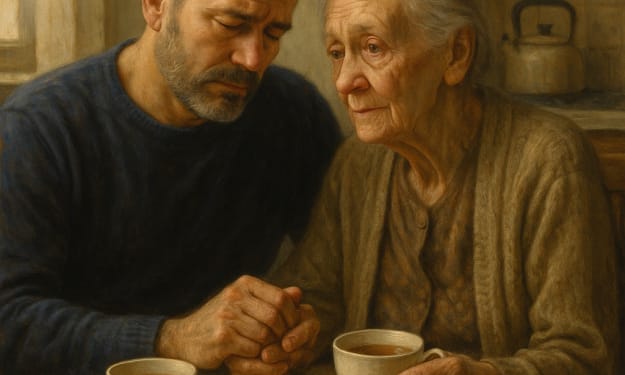
The kettle whistled gently, its familiar song filling the tiny kitchen. It was 6:45 a.m., just as it had been every morning for the last thirty-two years. Samuel stood by the counter, waiting. He was no longer the boy who used to sit cross-legged at the kitchen table, legs too short to touch the floor, watching his mother move through her morning routine like a silent symphony. He was a man now—tall, broad-shouldered, with grey already whispering into his beard. But in this kitchen, in this moment, he felt like a boy again. His mother, Evelyn, sat at the table wrapped in her favorite cardigan, hands resting on the floral-printed tablecloth she’d sewn herself when Samuel was ten. Time had not been kind to her body, but her eyes—those deep hazel pools—still held the same warmth, the same unspoken strength. “Is it ready?” she asked, voice soft and brittle like dried leaves. Samuel nodded and poured two cups. The scent of chamomile filled the air, comforting and nostalgic. He placed one cup in front of her, and one in front of himself. They sat in silence, the kind that only years of shared life could build. “You remember when we used to drink tea and read poems on Sundays?” she asked, a wistful smile tugging at her lips. He nodded, throat tight. “You always chose the sad ones.” “Sad poems are the most honest,” she said. “They don’t try to pretend.” He watched her cradle the cup in both hands, as if it were something sacred. His chest ached. Not from sadness alone, but from the weight of what he hadn’t said yet. She knew, of course. Mothers always do. “You’re leaving tomorrow,” she said, not as a question. He nodded again. “The job in New York… it’s everything I worked for.” She looked at him with so much pride it nearly crushed him. “You deserve it, Sam. You’ve always deserved more than this little town could offer.” He reached for her hand. It was thinner now, skin paper-like, veins like blue rivers. But it was the same hand that had wiped his tears, held him through fevers, and taught him how to hold a pencil. “I just hate the thought of you being alone,” he whispered. “I’m not afraid of being alone,” she replied. “I’m afraid you’ll forget the sound of my voice.” “I never could.” She smiled again, though her eyes welled with tears. “Promise me something, Sam.” “Anything.” “No matter how busy life gets, no matter how far you go—make a cup of tea once in a while. Sit down. And remember me.” He swallowed hard, nodding. “I promise.” They sat there for a long time, sipping slowly, letting memory wrap itself around them like a warm blanket. Outside, the world stirred. But inside, time stood still. That evening, he packed the last of his boxes. She helped where she could, folding a sweater, labeling a book. They didn’t talk much. They didn’t need to. The next morning, he hugged her tighter than he ever had. Her small frame pressed into his chest, her breath warm against his neck. “I love you, Mom.” “I love you more, my boy.” He left, heart heavy but full. Years passed. New York was everything he’d hoped—and nothing like he’d imagined. Success came, accolades followed, and the pace of life drowned out the quiet rituals of the past. But every Sunday morning, without fail, he boiled water. He poured a single cup of chamomile tea. And he sat by the window, eyes closed, listening. For her voice in the quiet. For her love in the steam. And in those moments, she was never far.
By Dr Gabriel about a year ago in Fiction
The Question That Changed My Life
The morning sun spilled through the café window, painting the wooden table in soft gold. Nora sat alone, her journal open, a black coffee cooling beside her. At 31, she was a freelance copywriter in Austin, cobbling together a living from blog posts and ad campaigns. Her life was a patchwork of deadlines and solitude, a far cry from the dreams she’d scribbled in that journal years ago. Today, though, something was about to shift—a single question, asked by a stranger, would crack her world open and change everything.
By Shohel Ranaabout a year ago in Fiction
The Pink Heart in the Cage: Escaping Society’s Expectations
The morning sun spilled over Melbourne’s skyline, painting the Yarra River in hues of rose and gold. Zara stood on her balcony, a chipped mug of coffee in hand, her eyes tracing the city’s pulse. At 26, she was a graphic designer at a sleek advertising firm, her days filled with client briefs and tight deadlines. Her apartment was a Pinterest board come to life—minimalist furniture, pastel cushions, a vision board pinned with quotes about “hustle” and “success.” But inside her chest, a pink heart beat wildly, trapped in a cage of expectations she hadn’t built but felt bound to. Today, that heart was stirring, demanding to be let out.
By Shohel Ranaabout a year ago in Fiction
The Man Who Left the Moon Behind
I was the last man to set foot on the Moon. Not because we stopped going, but because no one ever came back after me. It was called the Prometheus Project. A private venture boasting billion-dollar tech, cutting-edge suits, and more AI than any one person should trust. And I'm a washed-up astronaut with nothing left to lose. My wife had passed from cancer, my son no longer spoke to me, and my name had faded from every headline. Prometheus offered what I thought was redemption. -Or at least an escape.
By peter thoithiabout a year ago in Fiction
The Chicken Who Dreamed of Clouds
Once upon a time, in a dusty little barnyard nestled between two sleepy hills, there lived a chicken named Perry. Perry wasn’t your ordinary chicken. While most hens were content to peck around for seeds and gossip about roosters, Perry had bigger dreams; sky-sized dreams.
By Basote Lakhpinabout a year ago in Fiction
wrestling story- a reunited family
the camera pans backstage to a the entrance of the building where its basically a army out there and they are everywhere. the ceo is seen walking backstage and theres people at every door basically and every corner of the building. something major is going down but no one knows why and the crowd belives that it has to be a storyline right becaue why else would the show still be going on.
By josh napperabout a year ago in Fiction
Tomura Shigaraki Character breakdown.
This is about the boy who was never meant to become a man — and the man who was never meant to be free. Tomura Shigaraki. Once, he was Tenko Shimura— the grandson of a hero, the child of a shattered legacy. But names are fragile things. They crack beneath the weight of grief, and his did too.
By Aira Shinazugawaabout a year ago in Fiction
Fear, Alone: The Quiet Words That Haunt Us
The morning was soft, the kind of dawn that draped the world in a hush, as if the sun itself was hesitant to rise. Clara sat on the edge of her bed, her bare feet grazing the cold hardwood floor. Her apartment was small, a one-bedroom in a quiet corner of Portland, where the walls were thin enough to hear her neighbor’s coffee maker hiss each morning. At 29, Clara was a poet, or at least she had been, before the words stopped coming. Now, she was a barista, a listener, a keeper of secrets—her own and others’. The quiet words, fear and alone, lived in her chest, heavy as stones, whispering truths she wasn’t ready to face.
By Shohel Ranaabout a year ago in Fiction
The Unspoken Pact
The Unspoken Promise The first thing Leo remembered was the cold. A damp cardboard box, the sharp scent of wet pavement, and the overwhelming *bigness* of the world. Then, warm hands. Gentle, despite their calluses. They lifted him, and a face swam into view – round, young, with eyes the colour of the sky just before twilight. Ben. Ben smelled of old books, engine grease, and a faint, comforting sweetness like warm bread. Leo pressed his tiny, shivering body against Ben’s jacket, and the cold began to recede. That was the pact, unspoken but absolute, forged in that rain-slicked alley: Leo would chase away Ben’s cold, and Ben would be Leo’s sun. For twelve years, Leo lived by that pact. He learned the rhythms of Ben’s life: the frantic scramble of early mornings punctuated by toast crumbs Leo would hoover up; the deep sighs as Ben slumped onto the sofa after work, Leo immediately claiming the space beside him, a warm, heavy weight against Ben’s thigh; the quiet concentration as Ben tinkered with old radios in the garage, Leo content to watch, nose twitching at the scent of solder and dust. Leo learned Ben’s silences. There was the tired silence, which Leo answered by resting his chin on Ben’s knee. There was the worried silence, brows knitted, which Leo countered by nudging Ben’s hand insistently until fingers absently scratched behind his ears, the tension slowly easing. And there was the deep, aching silence that sometimes came after Ben looked at the framed picture of the smiling woman – Ben’s sister, Leo somehow understood, gone too soon. That silence Leo met by simply leaning his full weight against Ben, a solid, breathing bulwark against the invisible tide of grief. Life wasn’t always warm radiators and shared sandwiches. There was the terrifying thunderstorm when Leo, normally stoic, trembled violently under Ben’s desk until Ben crawled under too, murmuring nonsense words into his fur until the storm passed. There was the time Leo ate an entire chocolate cake and spent a night at the vet’s, Ben’s face pale with fear until the all-clear. There were walks where Leo’s nose led him into muddy disasters, resulting in shared baths that were more splash-fight than hygiene. Ben changed too. The round face sharpened. Lines appeared around his sky-blue eyes, etched by laughter and worry in equal measure. His hair receded, silver threads appearing. Leo watched it all, his own muzzle greying, his joints sometimes protesting the morning run to the door. He understood time, not in hours, but in the deepening grooves on Ben’s face and the slower pace of their walks. His pact remained: warmth for Ben, Ben for Leo. Then came the winter of Ben’s discontent. Leo sensed it before Ben spoke – the longer silences, the restless pacing, the absence of the engine-grease smell replaced by the stale scent of the apartment. Ben stopped tinkering. He sat for hours, staring out the window at the falling snow. The worried silence became constant, thick and suffocating. Food lost its appeal for Ben, and Leo, ever attuned, found his own appetite waning. One afternoon, the silence broke. Ben dropped onto the sofa, head in his hands. A low sound escaped him, raw and broken, unlike anything Leo had ever heard. It wasn’t just worry; it was despair. Leo felt it vibrate through the floorboards, through his own paws. The cold was back, colder than that damp cardboard box. Leo didn’t nudge. He didn’t whine. He hauled his stiffening body onto the sofa beside Ben. He pushed his head forcefully under Ben’s arm, ignoring the resistance, until his muzzle rested on Ben’s chest, right over the thudding heart. He licked, once, a rough swipe across Ben’s stubbled cheek that tasted of salt. Ben flinched, then froze. Slowly, his arms came down. Trembling fingers buried themselves deep in Leo’s thick ruff, gripping hard. Leo stayed perfectly still, a steady anchor in the storm. He felt the shuddering breaths against his fur, the dampness spreading. He held the silence now, not with worry, but with an unwavering presence. *I am here,* his steady heartbeat thrummed against Ben’s chest. *Your sun is still here. The cold doesn’t win while I’m here.* Minutes stretched. The light faded outside. Finally, Ben took a deep, ragged breath. He didn’t speak, but his hand moved from gripping to stroking, slow and deliberate, tracing the familiar path from Leo’s head down his back. The terrible, frozen silence thawed, replaced by a fragile calm. Ben didn’t magically recover overnight. Job applications were filled out, rejections came. But the crushing despair lifted, inch by inch. Leo was his shadow, his silent co-pilot. On bad days, Leo would bring Ben his worn tennis ball, dropping it insistently on his lap until Ben, despite himself, gave a weak smile and threw it down the hall. On better days, they walked, slower now, Leo’s tail a metronome of cautious hope. Years layered upon years. Leo’s walks became short strolls, then just brief trips to the backyard. His hearing faded, his sight grew cloudy. But his sense of Ben remained sharp. He still knew the exact moment Ben entered a room, still felt the shift in the air when Ben was sad. One crisp autumn afternoon, much like the day Ben found him, Leo lay on his favourite patch of sun-warmed rug. Ben sat beside him on the floor, leaning against the sofa. Leo felt Ben’s hand, older now, more bony, resting gently on his side, rising and falling with each laboured breath. He felt the familiar warmth radiating from Ben, the scent of old books and warm bread stronger than ever. Leo was tired. So tired. The pact… he’d kept it. He’d chased away the cold. Ben’s face, etched with time and love, filled his dimming vision. Ben leaned closer, his forehead touching Leo’s. No words were needed. The warmth, the loyalty, the twelve years of shared sunrises and storms – it was all there, in the touch, in the shared breath. Leo took one last, deep breath, filled with the scent of his sun. The warmth was complete. The pact was fulfilled. He closed his eyes, not to the cold, but to the enduring light of Ben. And beside him, Ben wept silent tears onto the grey fur, whispering a promise of his own into the quiet room, knowing the truest friend he’d ever have was leaving, but the warmth they’d built would never truly fade. Leo slept, dreaming of warm hands and a sky-blue gaze, forever his home.
By Hazrat Umarabout a year ago in Fiction
When the Future Turns Against Us
A haunting reflection on our world disguised as entertainment What if your phone judged you? What if your memories could be replayed, paused, or erased? These aren’t just questions—they’re nightmares brought to life in Black Mirror, a show that doesn’t ask for your attention but demands your soul. With its eerily plausible technologies and morally gut-wrenching twists, Black Mirror drags us into futures so familiar they could be now. And that’s what makes it terrifying. If you think this is just another sci-fi series, think again. Black Mirror is a mirror, cracked and cruel, held up to the darkest parts of our humanity.
By Bubble Chill Media about a year ago in Fiction