Fan Fiction
The Choise Of Love
In a small, sun-kissed town by the sea, lived a beautiful and kind-hearted girl named Lila. With her sparkling hazel eyes and a smile that could melt hearts, she was adored by everyone—especially by two best friends, Ryan and Ethan. Ryan was the town’s brave firefighter—strong, protective, and always putting others before himself. Ethan, on the other hand, was a charming musician, whose soulful melodies could make anyone fall in love. Both loved Lila deeply, and she cherished them both, torn between two hearts that adored her. One evening, as the three sat by the beach, watching the sunset, Lila sighed. "I don’t know how to choose… you both mean so much to me." Ryan looked at the waves, his jaw tight. "I’d do anything for you, Lila. Even if it means stepping aside." Ethan strummed his guitar softly. "Or maybe… love isn’t about choosing. Maybe it’s about who chooses you back." Lila’s heart ached. She needed to decide. One stormy night, disaster struck. A fire broke out in Lila’s apartment building. Trapped inside, she coughed from the smoke, fear gripping her. Outside, Ryan and Ethan arrived at the same time. "Lila’s inside!" Ethan yelled, panic in his voice. Without hesitation, Ryan tied a wet cloth around his face and charged into the flames. Ethan tried to follow, but the heat forced him back. Inside, Ryan found Lila unconscious. He carried her through the burning hallway, shielding her with his body as debris fell. When they burst out of the building, Lila gasped for air, her eyes fluttering open to see Ryan’s soot-covered face, his arms trembling as he held her. "You… saved me," she whispered. Ethan rushed to her side, tears in his eyes. "I couldn’t… I couldn’t go in." Lila looked between them—her heart finally knew. Weeks later, under the same sunset where they had sat many times, Lila took Ryan’s hands. "You risked everything for me," she said softly. "That’s the kind of love I want forever." Ryan’s eyes glistened as he pulled her close. "I’ll spend my life protecting you… loving you." Their lips met in a slow, passionate kiss—a promise of forever. Ethan watched from a distance, heartbroken but smiling. "Take care of her," he whispered before walking away. Years later, Ryan and Lila stood on their porch, their little daughter, Sophie, giggling as she chased fireflies. Ryan wrapped his arms around Lila from behind, kissing her neck. "Remember when you chose me?" he murmured. Lila turned, cupping his face. "Best decision I ever made." As the sun set, painting the sky in gold and pink, their love story continued—one built on bravery, passion, and the sweetest happily ever after.
By Alice Talesabout a year ago in Fiction
The Man Who Sat at Table Seven
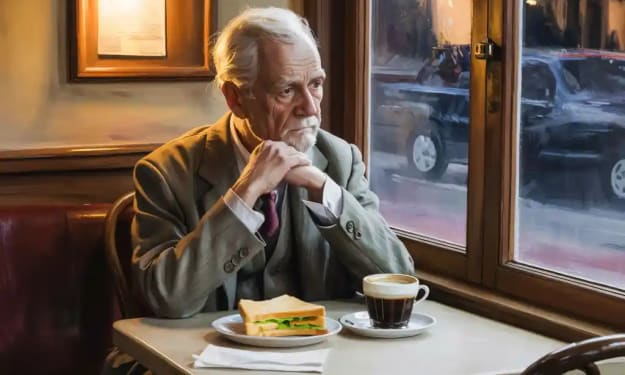
There’s a quiet little café on East 41st Street, nestled unceremoniously between a secondhand bookstore and a flower shop that always smells of jasmine and damp stems. Blink, and you might miss it. No neon signs. No whimsical chalkboard menus boasting fancy lattes or turmeric infusions. The awning just reads “Mira’s Café” in fading gold letters. Inside, it smells like toasted bread, warm milk, and stories too old to tell.
By Arshad khanabout a year ago in Fiction
The Echoes of the Yellow Scarf
When Mira stepped off the subway at 14th Street, the crowd swept around her like waves. It was the same platform, same train, same morning routine—but today, something was different. Clutched in her hand was a yellow scarf. Not hers. She had found it on the park bench she always sat on before heading to work. It was soft, handmade, and slightly frayed at the edges, with initials stitched in the corner: S.H. She hesitated before picking it up earlier that morning. Normally, she'd ignore lost items, let someone else deal with them. But something about this scarf felt… personal. Like it was meant for her to find. By the time she reached her office on the 22nd floor of a glass-paneled building, she couldn’t stop thinking about the initials. Who was S.H.? Why did it feel like more than just a lost scarf? She Googled the initials with “yellow scarf” and “New York”—of course, nothing. A thousand meaningless results. But then came the dreams. That night, Mira dreamt of a girl in a yellow scarf standing under a streetlamp, eyes full of sorrow. She said nothing. Just stood. Watching. Silent. The next night, she returned. This time, Mira spoke. “Who are you?” The girl looked up. “Help me find home.” Mira jolted awake. The scarf was on the chair beside her bed—right where she’d left it. But it looked newer. Less worn. As if time had reversed. In the days that followed, the dreams grew more vivid. The girl—always in that yellow scarf—stood by a bench, her back to Mira, facing a lake Mira had never seen before. And every time, she'd whisper, “Almost there.” Mira started drawing the scenes. She was no artist, but the urge was uncontrollable. She filled pages with images of the girl, the lake, the scarf fluttering like a whisper caught in wind. Her friends thought she was spiraling. “You need sleep,” they said. “You’re obsessing over nothing.” But she couldn't stop. One rainy Sunday, Mira walked aimlessly through Central Park, the scarf wrapped around her neck, the dreams echoing in her thoughts. And then—she saw it. The bench. Not just any bench. The bench. The one from her dreams. It faced a small, quiet lake. Willow trees bowed along the edges. A streetlamp flickered nearby. It was all real. She sat. A soft breeze passed. Leaves rustled. The scarf lifted slightly. And then, across the lake, stood the girl. Real. Flesh and bone. Same yellow scarf. Same solemn eyes. Mira stood. “Who are you?” The girl smiled faintly. “You found me.” Mira stepped forward, breath caught in her throat. But before she could speak again, the girl turned and walked toward the trees—fading like mist in morning light. Gone. Mira looked down. The scarf had vanished. In its place, on the bench, was a note. “Thank you. I’m home now. – S.H.” That was three years ago. Since then, Mira walks the park every Sunday. She never saw the girl again, but sometimes, when the breeze picks up just right, she feels a soft warmth on her neck—as if a scarf, unseen, still lingers. She doesn’t tell many people the story. Who would believe her? But if you ever find a yellow scarf where it shouldn't be… Hold on to it. Someone might be waiting.
By Arshad khanabout a year ago in Fiction
Long Nose the Liar. Top Story - July 2025.
There was an old liar who lived in our village. I’m sure of it. No one else seems to remember him, but then again no one else seemed to like him either. Back then the other children called him “Long Nose the Liar” because he looked like Pinocchio, and all his stories sounded like lies.
By Judah LoVatoabout a year ago in Fiction
Between Our Cups of Tea
She placed the teacup in front of me, just like she always did — handle turned exactly to the right, the way I liked it. No sugar. No milk. Just like our mornings now. Bland. Quiet. Ritualistic. “Thanks,” I said, my voice low but audible. She didn’t answer. She never really did these days. She took her seat across from me, the chair creaking slightly under her, and lifted her own cup without a glance. The steam rose between us like a ghost — thin, silent, vanishing quickly. We sipped. Two strangers in a house we once called home. --- There was a time when mornings meant laughter. When she’d lean over the table, teasing me about my uncombed hair. When I’d kiss her forehead while the kettle boiled. When we’d talk — really talk — about dreams, books, movies, and silly ideas that only mattered to us. Now, we sip in silence. --- “What time are you heading out?” she finally asked, eyes still on her tea. “Around ten,” I replied. “You?” “Maybe earlier. I have to stop by the pharmacy.” I nodded. Another ordinary exchange. Another moment with nothing in it. --- It wasn't always like this. We used to touch each other without thinking — fingers brushing while reaching for the same spoon. We used to giggle like teenagers, even after five years of marriage. We used to sit on the floor instead of the couch, just because it felt cozier. We used to say “I love you” before falling asleep — even when tired, even when angry. I can't remember the last time we said that. I can't remember the last time I looked at her and saw her — the girl I fell in love with. Now, I just see a quiet woman in a bathrobe, pouring tea. And maybe she sees just a man behind a newspaper — not the boy who once chased her in the rain. --- “I’ve been thinking,” she said, suddenly. I looked up. “About?” She hesitated, then shook her head. “It’s nothing.” Say it, I wanted to tell her. Scream it if you have to. Tell me you’re unhappy. Tell me you miss me. Tell me you want to leave. Anything. Just don’t sip tea and pretend this is normal. --- I remember the night I first met her. She was at a bookstore, reading the back cover of a poetry collection. She had no makeup on. Just jeans, a plain blue shirt, and hair tied in a messy bun. She looked up, caught me staring, and smiled like I was already forgiven. We spoke for two hours that night. We didn’t even buy the book. Now, the same woman won’t speak to me for more than two minutes unless it’s about bills or groceries. --- I reached across the table and touched her hand. She didn’t pull away. But she didn’t hold it either. Just let it sit there — like my touch was something to tolerate, not treasure. “I miss us,” I said. She blinked. Once. Twice. And then quietly replied, “I know.” --- Silence again. Not heavy. Not angry. Just... empty. --- She stood, collected her cup, rinsed it in the sink. I watched her movements. Precise. Mechanical. Distant. I wanted to say so many things. Like how I still remember the way she laughed with her eyes. Like how I still sleep on the edge of the bed because that’s how she likes it. Like how I don’t want to lose her but don’t know how to keep her. But I said nothing. Because we both had gotten used to saying nothing. --- As she dried her hands on a towel, I asked: “Do you think we’ll ever be okay again?” She didn’t turn around. After a pause, she said: > “I think... we’ve been trying not to break. But maybe we already did. Quietly. Without noticing.” --- I stood up. Walked to the door. Picked up my coat. “I’m going for a walk,” I said. She only nodded. No “be careful.” No “come back soon.” Just a nod — like I was a neighbor borrowing sugar, not her husband. --- Outside, the air was colder than I expected. I shoved my hands into my pockets, thinking about how two people can share a house, a bed, a life — and still feel miles apart. --- When I returned an hour later, she was gone. But on the table, next to my empty teacup, was a note. > I made you a fresh cup. I don’t know if it changes anything, but… it still matters to me that you drink it warm. —M ---
By Muhammad Usamaabout a year ago in Fiction
The Generous King
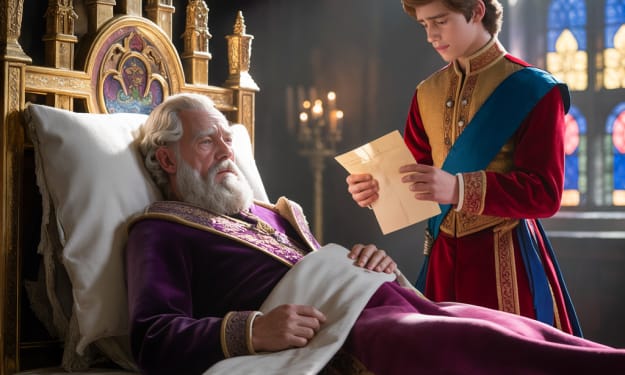
In the kingdom of Nahazar, there lived a king unlike any other. He was called King Rayan the Generous — not because of titles, but because of the way people whispered his name with gratitude. He had no hunger for gold, no thirst for war. He believed true power came from kindness. And so, he gave. He gave to the poor until the streets no longer knew hunger. He gave to the farmers when the rains were late and the crops failed. He gave to the widows, the orphans, the broken — and none left his court empty-handed. His palace gates were never closed. His treasury, always open. The people called him a king touched by heaven. But not everyone in the kingdom felt so blessed. --- The Forgotten Face in the Palace In a room just behind the throne, a young boy used to wait. His name was Zayan — the king’s only son. While his father ruled a kingdom, Zayan ruled nothing but silence. His mother had died when he was five. His father, always surrounded by ministers and the needs of the nation, had forgotten the boy who used to wait outside his chamber door — just to walk beside him. Every evening, Zayan would peek through the carved doors of the court, hoping his father would look up. He rarely did. --- “The People Need Me” When Zayan turned ten, he built a wooden horse by himself. He ran into the court to show his father. But the king was kneeling before a crying widow, handing her his own gold ring. “Not now, my son,” he said, without looking. Zayan nodded, stepped back, and never showed him anything again. The king gave everything… except time. --- A Kingdom Celebrates The years passed, and the king’s legend grew. He built hospitals, opened schools, forgave debts. On his 50th birthday, the entire city threw a festival. Thousands came to bless him. The streets lit up in his honor. But Zayan, now 21, did not attend. He sat in the palace garden, watching the fireworks alone, whispering to himself: > “You gave them all your gold, father. But you never gave me a moment.” --- Illness Comes Quietly One winter, the king fell ill. The royal doctors called it exhaustion. His body had served the people endlessly — now it was fading. The king summoned Zayan to his bedside. “You must be king now,” he said, weakly. “I taught you all I knew.” Zayan looked at him — this man loved by millions, unknown by one. “You taught the kingdom how to love,” he said, “but not your own son.” The king looked away, and for the first time, tears fell from his eyes. --- The Last Gift The king died two nights later. Thousands marched with his casket. The skies rained. The people wept. But Zayan remained in the palace. Only after the funeral did he enter his father’s private chamber. On the desk, untouched for years, was a sealed letter. It was addressed to him. --- The Letter > My son, If you are reading this, I am gone. I was a king to many — but I fear I was a stranger to you. Forgive me. They came to me with empty bowls, torn clothes, broken hearts. I gave them everything because I saw your mother in every crying face. When she died, a part of me froze. Giving to others was my way of keeping her alive. But in doing so… I left you alone. You are the only treasure I never learned to hold. Rule better than me. Love louder than I did. And know this — I was proud of you, even from afar. Always. Your Father. --- Now Years have passed. Zayan rules Nahazar now — a king like his father in generosity, but greater in presence. He still feeds the poor. Still opens the palace gates. But each evening, he walks through the garden where his father never came, holding his daughter’s hand. When she tugs at his robe and says, “Look, Baba,” he stops — every time — and looks. Because he learned the greatest truth too late: > A kingdom can be rebuilt. A treasury can be filled again. But a child who feels unseen… may never forget.
By Muhammad Usamaabout a year ago in Fiction