Fan Fiction
Behind the Locked Door — A Story of Secrets and Second Chances
The house had been empty for nearly three years when Ayaan returned. It stood at the edge of the small town like a shadow of its former self—paint peeling, shutters hanging loose, garden overgrown. To most people, it was just another abandoned property. But to Ayaan, it was home. Or at least, it had been once.
By Nadeem Shah about a year ago in Fiction
The Most Popular Creatures of Slavic Folklore
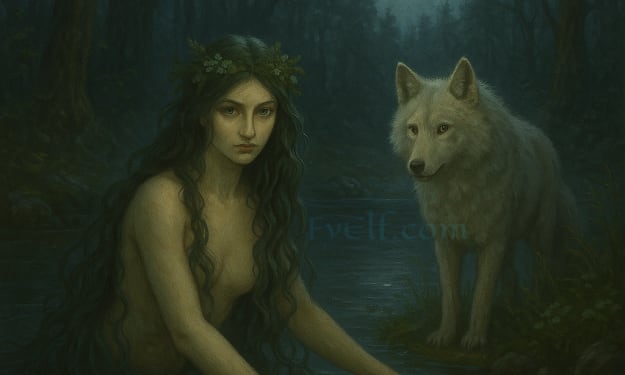
Slavic folklore is one of the richest traditions of Europe, filled with witches, spirits, dragons, and magical beings. These creatures were more than stories told around the fire—they explained the mysteries of nature, taught moral lessons, and reflected the struggles of daily life in villages surrounded by forests, rivers, and endless fields.
By Ancient Spiritabout a year ago in Fiction
The House on Harbor Street
M Mehran No one on Harbor Street liked to talk about the gray house at the corner. Its windows were always shuttered, the garden overrun with ivy, and the gate leaned as if it might collapse under its own rust. Children dared each other to touch the front steps, but few stayed long. The house had been empty for years—or so everyone thought. Then one rainy October evening, a moving truck appeared. The neighbors peered through curtains as boxes were carried inside. By morning, the house that had long been silent now had life: lights in the windows, smoke curling from the chimney, and the faint sound of a piano drifting into the street. The new owner was a man named Adrian Cole, a quiet figure in his late forties. He wore long coats, spoke softly, and seemed uninterested in small talk. When Mrs. Douglas from next door brought him a plate of cookies, he thanked her politely but shut the door before she could ask questions. Soon, Harbor Street buzzed with speculation. “He’s a writer,” said one. “A recluse,” whispered another. “Or hiding from something,” muttered old Mr. Gaines at the corner store. But it was eleven-year-old Emma, curious and fearless, who discovered the truth. One evening, as she walked home from school, she heard the piano again. The melody was unlike anything she had heard—soft, haunting, full of longing. Drawn by curiosity, she crept closer until she was peeking through the iron gate. To her surprise, the garden no longer looked wild. The ivy had been trimmed, roses bloomed where weeds once strangled, and lanterns glowed along the path. The music stopped. “Are you going to stand there all night, or will you come in?” a voice called. Emma froze. Adrian Cole was at the door, watching her with tired but kind eyes. Embarrassed, she shuffled forward. “I… I just liked the music.” He studied her for a moment, then smiled faintly. “Then come listen properly.” Inside, the house was nothing like she had imagined. Instead of dust and cobwebs, the rooms glowed with warmth. Bookshelves lined the walls, filled with journals and thick novels. Paintings of strange landscapes—moons with two suns, forests made of glass—hung above the fireplace. On the piano rested sheets of music, handwritten and delicate. Emma pointed at one. “Did you write this?” “Yes,” Adrian said. “It’s part of a story I’m working on.” “You write stories and music?” “They’re the same thing,” he said softly. “Stories are music for the mind. Music is a story without words.” From that day, Emma visited often. She sat by the piano while Adrian played, and in return she told him about school, her friends, and her dreams of becoming an artist. But as weeks passed, she noticed something strange. The stories Adrian read to her weren’t ordinary tales. When he described a forest, she swore she could smell pine. When he spoke of rain, her hair dampened with mist. And once, when he read about a storm at sea, the entire room shook with thunder. “Is it magic?” Emma asked breathlessly. Adrian paused, then nodded. “Words have power. Too much, sometimes. That’s why I came here—to hide them, to keep them safe.” “Safe from who?” He closed the book carefully. “From people who would use them to change the world without caring for its consequences.” Emma wasn’t sure she understood, but she knew one thing: Adrian was no ordinary writer. One cold evening, as wind howled outside, Adrian handed her a leather-bound journal. “I want you to have this,” he said. Emma opened it. The first page read simply: “For the next storyteller.” “Me?” she asked. “You see the magic,” he said. “That means you can carry it when I no longer can.” Before she could protest, the room shook violently. The lanterns flickered, books fell from shelves. Outside, shadows moved in the street—tall figures cloaked in black, their eyes glowing faintly. “They’ve found me,” Adrian whispered. The shadows pounded at the door. Emma clutched the journal. “What do I do?” “Run,” he said firmly. “And don’t stop until you’re safe.” “But what about you?” He smiled sadly. “Stories never die, Emma. They only find new voices.” The door burst open. Adrian raised his hands, and suddenly the house itself seemed to awaken. Walls trembled, the piano roared a furious chord, and light blazed from every book as though the words themselves were fighting. “Go!” Adrian shouted. Emma fled into the rain, clutching the journal to her chest. Behind her, the house glowed brighter and brighter until it vanished in a flash of light, leaving nothing but the rusty gate and the sound of fading music. The next morning, Harbor Street was quiet. The gray house stood empty once again, as though Adrian Cole had never been there. Neighbors shook their heads and muttered about tricks of the storm. But Emma knew better. Late at night, when the street was silent, she opened the journal. The blank pages whispered softly, waiting for her pen. And as she wrote her first line, she felt the same hum she had heard in Adrian’s music—alive, powerful, endless.
By Muhammad Mehranabout a year ago in Fiction
The Lantern in the River
M Mehran In the quiet town of Bellmere, where the river curled like a silver ribbon through the valley, people whispered about the Lantern. No one quite remembered how the tale began. Some said it was a fisherman’s trick of light, others swore it was the ghost of a woman waiting for someone who never came home. Whatever its origin, the story lived on: every August, when the moon was high and the nights grew cooler, a single lantern appeared, drifting down the river against the current. Mira, a young journalist for the Bellmere Chronicle, had always dismissed it as one of those stories people told to keep small towns feeling magical. But this year, when her editor demanded something “bigger than bake sales and council meetings,” she decided to chase the Lantern. On the first night of August, she stood by the riverbank, recorder in hand. The town was still, except for the hum of crickets and the gentle rush of water. She had almost given up when she saw it: a glow far downstream, bobbing gently, moving up the river as if the current were nothing but air. Her breath caught. It wasn’t a campfire, nor the reflection of a streetlamp. It was a lantern—wooden frame, glass sides, and a steady golden flame burning inside. Mira followed it. She walked along the bank, stumbling over roots, brushing through tall grass. The lantern moved slowly, waiting for her, until it reached a bend where the trees leaned close like old listeners. And then, without a sound, it vanished. The next morning, Mira’s article caused a stir. Neighbors dropped by the Chronicle’s office, eager to share their own encounters: a farmer who saw the Lantern from his porch in 1978, a teacher who claimed her grandmother followed it once and never came back. Mira listened, scribbling notes, half convinced and half skeptical. But what unsettled her most was the letter she found slipped under her apartment door that night. It was written on faded paper in a shaky hand: “The Lantern chooses. If it waits for you, follow it. It will show you what you most need to know.” No name, no return address. By the third night, curiosity gnawed at her more than fear. She returned to the river. Again, the Lantern appeared, glowing softly like a star within reach. Mira followed it further this time, across the wooden bridge and into the darker stretch of forest. The sound of water faded; all she could hear was her own heartbeat and the crackle of flame. At last, the Lantern stopped in a clearing where the river pooled like glass. It hovered for a moment, then sank slowly beneath the surface. The flame did not go out. Instead, the water lit up, shimmering with threads of light that formed an image: her mother’s face. Mira staggered back. Her mother had disappeared when she was six years old. The police said she’d drowned in the river during a storm, but no body was ever found. Now here she was, smiling gently, as though waiting. “Mira,” the image whispered—not with sound, but directly into her chest, like memory made real. “You are ready.” The light rippled, showing Mira a small wooden box, its lid carved with the same pattern as the lantern’s frame. She remembered it vaguely, tucked high on a shelf in her childhood home, always locked. The vision faded, and the clearing was once again only shadow and water. The Lantern was gone. Mira stood trembling, recorder useless at her side. For the first time, she believed. The next day she searched her late father’s attic, and there, under dusty blankets, she found the box. The lock snapped open easily, as if it had been waiting. Inside lay letters—dozens of them, written by her mother. They told a story Mira had never known: her mother came from a long line of “Lantern Keepers,” people bound to the river’s strange gift. Each year, one person was chosen to guide lost souls back to those who remembered them. The flame was not of fire, but of memory. Her mother’s final letter was dated the night she disappeared: “If the Lantern comes for me, I must follow. But one day, Mira, it will come for you. Do not fear it. The river remembers.” Mira wept quietly in the attic, clutching the pages that smelled faintly of cedar and river mist. She realized the Lantern had not shown her the past to haunt her, but to pass on the duty. That August, Bellmere buzzed with rumors of Mira’s investigation. Some thought she was fabricating stories for fame. Others, older and wiser, simply nodded and said, “The Lantern found her.” Mira never published the letters. Some truths, she decided, belonged to the town’s hush and mystery. But at night, when the river glowed faintly beneath the moon, she walked its banks with a lantern of her own, flame steady, waiting to guide those who still searched for home.
By Muhammad Mehranabout a year ago in Fiction
The Fisherman’s Net
The Fisherman’s Net The net was my grandfather’s true legacy. Not the small cottage, not the rickety boat, but this twenty-foot span of hand-knotted cork and twine. It smelled of salt, seaweed, and a lifetime of hard work. After the funeral, it was the only thing I wanted.
By Habibullahabout a year ago in Fiction
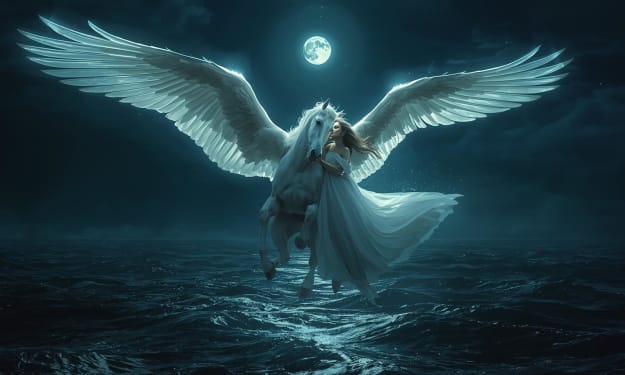
Wings of Fate: Elena’s Forbidden Encounter
Wings Over the Tower I was staring out of my bedroom window when I saw it. A horse. Not just any horse, but a radiant white stallion standing still on top of the old stone tower at the edge of the village. My breath caught in my throat. My heart slammed down into my stomach as if the ground beneath me had collapsed. Horses don’t climb towers. Horses don’t perch like statues on weathered stone. And yet, there it was—its mane shimmering like silver fire, its eyes glowing with a light that chilled me to the bone. Then I noticed the wings. Vast, powerful, angelic wings, stretched out against the night sky. My hands trembled as I fumbled for my phone. Without thinking, I snapped a picture and sent it to my mother, Margaret. “Look! I’m not imagining this. It’s real.” Her reply came within seconds, cold and dismissive: “Elena, you’re tired. You must be seeing things. Horses don’t stand on towers.” I wanted to believe her. God, I wanted to believe her. But the horse didn’t vanish. It stood there, watching me. Not moving, not blinking—watching me. I texted again, fingers shaking. “Check the picture. Just look.” The three dots appeared. Disappeared. Appeared again. Then her answer dropped like a stone into my chest: “Dear God… how is that horse on the tower?” The moment I read her words, I knew I wasn’t hallucinating. Fear coiled around my lungs, tightening with every breath. The air in my room grew heavy, suffocating. I could barely breathe. Then another message appeared: “I’m coming home right now. Lock the door. Don’t let anyone in.” That was the moment I knew I was in real danger. The stallion’s eyes blazed brighter, as though it sensed my fear. My knees weakened, and yet I couldn’t tear my gaze away. Every second, I felt its presence press closer, even though it hadn’t moved. The wings shimmered as if ready to take flight, but instead, the beast stood perfectly still—focused only on me. I jumped when I heard the rattle of keys outside. My mother had arrived. I ran to the door, heart pounding so hard it echoed in my ears. Margaret stumbled inside, her face pale, her chest heaving. “Close the door, quickly!” she gasped. We slammed it shut, bolting the lock. For a moment, I thought we were safe. Until the window shattered. A weight crashed into the room. Shards of glass sprayed across the floor, glittering like ice. And through the wreckage stepped the stallion. Its enormous wings filled the space, brushing the ceiling and walls. The air smelled of rain and roses, sweet and terrifying. I screamed, clinging to my mother. And then—before my eyes—the horse began to change. The feathers burned away like smoke. Its legs stretched and shifted. Its face elongated, reshaped, transformed. Within moments, the stallion was gone, replaced by a man. Tall. Broad-shouldered. His hair black as midnight, falling messily across his brow. His eyes—those same burning eyes—pierced through me, their dark glow pulling me in like a tide. He smiled, slow and cold. His voice was low and steady, vibrating through my bones. “There is no need to fear, Elena. I came for you.” I froze, torn between terror and a strange pull deep in my chest. My mind screamed at me to run, but my body leaned toward him, as though I had always known this man. My mother stepped in front of me, her voice sharp with fury. “Stay away from her!” But he raised his hand, calm as death itself. “No one can keep me from her. She has belonged to me… long before she was even born.” The words crashed over me like thunder. Belonged to him? Before I was born? My heart thrashed wildly. My legs refused to move. His gaze locked mine, and it felt as if he was drawing the very breath from my lungs. Margaret clutched my hand and began reciting prayers, her voice trembling. But instead of retreating, he only smiled wider. “I have been with you in every nightmare,” he whispered. “I have guarded you in your sleep. I waited as you grew. And now I’ve come to claim what was always mine.” Tears burned my eyes. As horrifying as his words were, part of me… believed him. Part of me recognized him, as if from some forgotten dream. Mother screamed again, calling him cursed. But he only chuckled, the sound echoing like distant thunder. “Cursed to you, perhaps,” he said. “But to her… I am salvation.” He reached out his hand to me. And though my body shook, I nearly lifted my own to meet it. Then—light. A blinding beam of light shot through the window, slashing across the room. For an instant, wings unfolded from his back again, glowing brilliantly—then dissolved into black smoke. His face twisted with fury and sorrow all at once. He looked at me, his voice breaking like a vow. “No matter where you run, Elena. You are mine. You will return to me.” And with that—he vanished. Only the scent of roses remained. That night, I didn’t sleep. Every time I closed my eyes, I saw his face. His wings. His burning gaze. His voice whispered in the dark, promising, calling. When sleep finally took me, I found myself in a world of endless fog. Cold seeped into my bones. My bare feet sank into frost. And from the mist, he came. Lucian. Wings wide, eyes black but glowing with a strange light—half terror, half comfort. His smile was softer this time, tinged with sorrow. “I missed you,” he said. My lips trembled. “Why do you keep appearing? Who are you?” He stepped closer, his touch brushing my cheek. My skin tingled, my heart stuttered. “I am no stranger. I was your knight. Your lover. Betrayed, murdered before your eyes. My soul bound to yours ever since. I waited for you to return, Elena. And now, the moment has come.” Images slammed into my mind—memories not my own. A white dress. His blood. My screams. His name on my lips as he fell. I gasped, clutching my chest. “It was real? I was there?” He nodded. “You were there. You were mine. And tonight, we are together again.” Behind me, faint and desperate, I heard my mother’s voice, as though carried from another universe. “Elena! Don’t leave me! Come back!” Tears streamed down my face. His hand reached out, his eyes pleading. My mother’s voice called, raw with fear. And still, I lifted my hand to his. The moment our fingers touched, light exploded around us. Wings burst from his back, wrapping me in a circle of brilliance. The ground fell away. We soared. Over oceans, over starlit skies. The wind roared in my ears. My fear melted into strange, blissful calm. For the first time in my life, I felt… home. He pulled me close, his own tears falling freely. “No force can part us now,” he whispered. I laid my head against his chest. And I smiled through my tears. From that night on… Elena was never seen again. But on nights of the full moon, villagers swore they saw a winged horse gliding above the sea, carrying a young woman in its embrace. Her laughter echoed over the waves. And beside her, the voice of a man answered with endless devotion. Together at last. Forever bound.
By محمد السبكيabout a year ago in Fiction
The Mirror's Reflection
Lena sat in the dusty attic, her fingers lightly tracing the edges of an old sketchpad. The room around her was still, the only sound being the occasional creak of the house settling. It had been months since she’d come here, since she’d hidden away from the world outside. In the silence, her thoughts roared louder than ever—recollections of failure, dreams that had slipped through her grasp, of who she was and who she no longer believed she could be.
By Mansoor Khanabout a year ago in Fiction